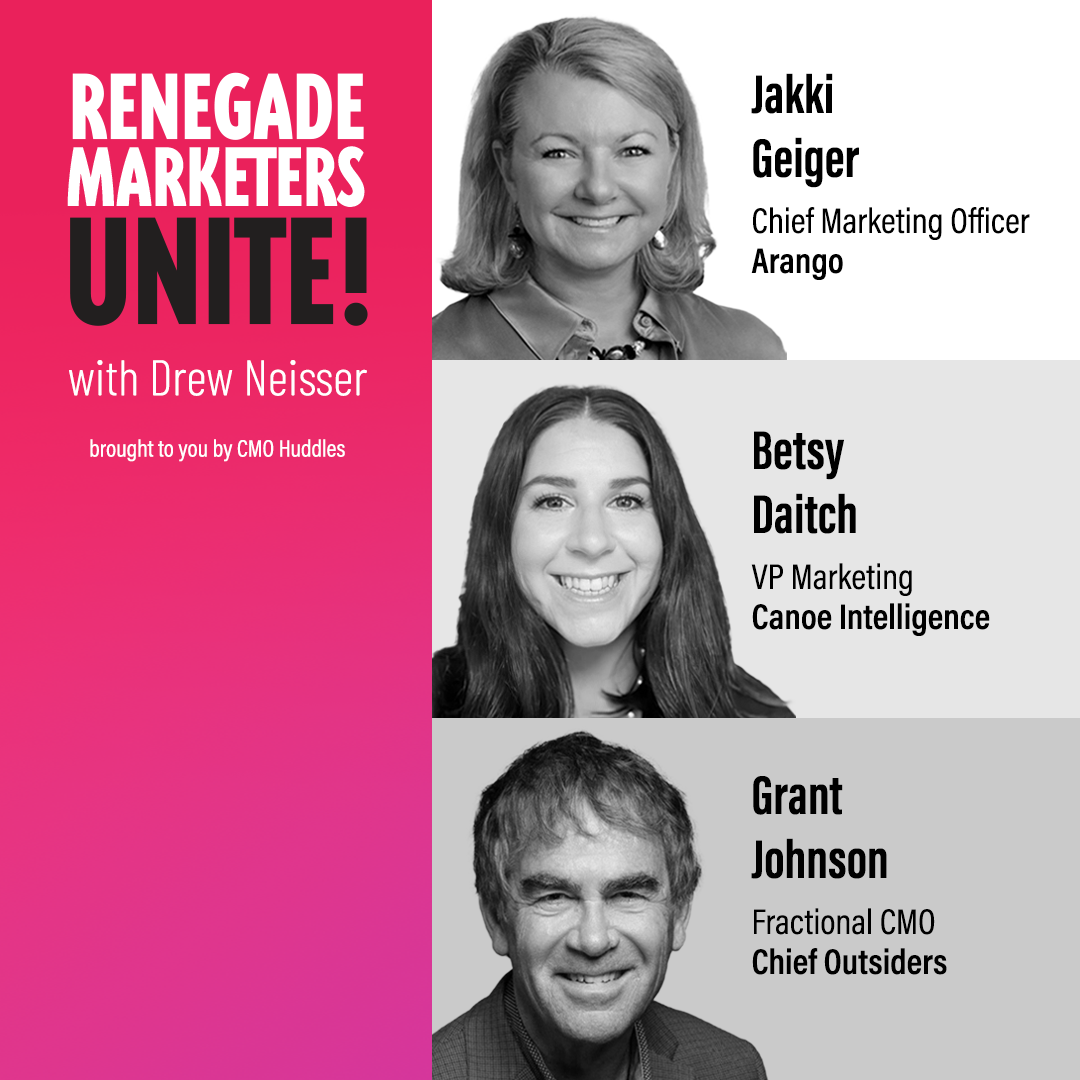
Leading Teams Through the AI Learning Curve
AI is now part of the job, whether your team feels ready or not. Some folks jump in with prompts and pilots; others stay on the sidelines while the pace keeps picking up. How do you turn that mix into a team that understands AI, uses it well, and gets stronger with every experiment?
Drew talks with Jakki Geiger (Arango), Betsy Daitch (Canoe Intelligence), and Grant Johnson (Chief Outsiders) about what it takes to uplevel AI skills across marketing. They get into hiring for AI-forward talent, picking use cases that matter, and tracking progress so experiments turn into repeatable, results-focused habits.
In this episode:
- Jakki hires AI-forward talent, builds digital twins for leaders, and kicks off AI projects from SDR pilots to sales enablement knowledge bases.
- Betsy uses Gemini, an “Upleveling Marketing Efficiency” tracker, and QBR AI projects to lift adoption across product, growth, and corporate marketing.
- Grant sets AI proficiency goals, runs workshops, and assigns ownership so each marketing function keeps building capability over time.
Plus:
- How to create a safe space for AI experimentation anchored to clear business goals
- Ways to narrow use cases so pilots stay manageable and show impact
- Why documentation, ownership, and simple workflows keep AI programs alive
- How CMOs can model AI use and report progress in language the C-suite cares about
Tune in if you are serious about raising your team’s AI game and want practical ways to build confidence, capability, and momentum.
Renegade Marketers Unite, Episode 498 on YouTube
Resources Mentioned
- Tools mentioned
- Past episodes mentioned
-
- Jakki Geiger
-
- Grant Johnson
Highlights
- [2:00] Jakki Geiger: 60 days to launch with AI
- [5:22] Peer-tested tools
- [6:35] Notebook LM powers sales enablement
- [8:28] Betsy Daitch: Transcripts to tasks with owners
- [11:06] QBR: Each team pitches AI
- [13:36] Replit calculator proves automation ROI
- [16:00] Grant Johnson: Make AI readiness a mandate
- [20:23] Define one use case to start
- [22:52] Make AI workflows marketing-owned
- [25:23] CMO Huddles: Peers, speed, and support
- [28:51] Turn upskilling into show and tell
- [32:55] Make AI just part of work
- [34:28] Scale thought leadership with digital twins
- [37:44] Iterate with AI for quality
- [41:09] Outcomes over AI experiments
- [45:52] Tips to build your team's AI acumen
Highlighted Quotes
"I've built digital twins for myself, my CEO, my CPO, and for the company. I'm trying to lead by example, model the way, so my team feels more comfortable using this type of technology."— Jakki Geiger, Arango
"Always keep your business goals front and center and also be intentional about the AI pilots and experiments that you run."— Betsy Daitch, Canoe Intelligence
Having that efficient person that could discern good strategy from a bad strategy, a good direction from a poor one, that takes the human element. It's the human plus AI."— Grant Johnson, Chief Outsiders
Full Transcript: Drew Neisser in conversation with Jakki Geiger, Betsy Daitch, & Grant Johnson
You are about to listen to a recording from CMO Huddle Studio, our live show featuring the flocking awesome B2B marketing leaders of CMO huddles. In this episode, Jackie Geiger, Betsy Dai. And Grant Johnson share how they're building AI fluency across their marketing teams. They talk about leading by example, adding AI into everyday workflows, and making room for experimentation while staying grounded in outcomes.
If you like what you hear, please subscribe to the podcast and leave a review. You'll be supporting our quest to be the number one B2B marketing podcast. Alright. Let's dive in.
Welcome to CMO Huddle Studio, the live streaming show dedicated to inspiring B2B greatness. I'm your host, drew [00:01:00] Nier live from my home studio in New York City where the coffee is strong and the dad puns are stirring. Today we're diving into a topic that's hotter than a CFO in budgeting season. How marketing leaders are building AI acumen across their teams.
From prompt skeptics to prompt engineers, the goal is the same. Smarter marketing powered by human judgment and machine efficiency. With that, let's bring on Jackie Geiger, CMO of Arango db and a returning guest who previously appeared on the show to discuss category creation, moving up market and customer-centric marketing.
Hello, Jackie. How are you? And where are you? This fine day.
Hi, drew. It's good to see you again. I'm actually in San Francisco Bay area right now at my home office, but I've been traveling the world. I was just in Germany, the uk, and also Washington dc.
Wow. All right. Well, I'm, I'm imagining that's gonna inform our conversation today, a whirlwind [00:02:00] trip, and you're relatively new at, uh, a Rango, but I'm, really curious how.
Because we, when you just started like two months, we're full into this AI thing. I'm, I'm curious what you found and, and how you're approaching AI literacy with your new team.
Absolutely. So I'll give you a little background context. So I have just jumped right in. I'm committed to, in 60 days, launching a new product, a new website, new positioning, messaging, and a new brand identity.
So, oh yeah, it's a lot, right? So without my trusted agency that I've used in the past and the use of ai, there's absolutely no way. We would be on track today to launch, by the way, next week. so when I joined, you know, we're a small but mighty team. We have about two people. I have three open head counts.
Um, so building the team feverishly, but I'm looking for people who are AI forward. I wanna make sure people feel comfortable with AI when they come into the organization. I like to hear what are some of the things they've done already. Drew, I met, uh, Lisa Adams at the super huddle last year, which she's just been a fantastic resource.
I've built digital [00:03:00] twins for myself, uh, for my CEO, my chief product officer and for the company. And so what I'm trying to do is lead by example model the way, um, so my team feels more comfortable using this type of technology, and that we're looking at our existing tech stack and saying what AI capabilities are offered that we're not using today, and then what are some of the gaps that we need to fill to get the business outcomes we need to achieve?
You know, it's so interesting and I, and I'm curious on your perspective, it's 'cause we've had a lot of conversations in the last two months in our huddles about, how do you build an AI team and so forth. And I, I feel like the ones that have a hundred people are really. Have in a much more difficult situation than you would too, because your team could probably do what, 50 people, I don't know what the number is, but if they are all AI empowered, if you will, is kind of remarkable what a small team can do.
And I So part one of this is a question. Do you imagine that your org is gonna be a little bit different than you might have had at a previous job or in the pre AI period [00:04:00] because of the, the what these tools can help you do.
Absolutely. And I'm not really even just limiting ourselves to marketing, although like, let's face it, I'm telling my team I wanna win an award for like the most AI forward marketing organization.
If we could win that award, that would make me really happy. Because I see, like for me, it's a strategic partner, right? Like what is our go-to-market strategy? Understanding our personas better. Um, bouncing positioning and messaging off of a digital twin that is a amalgamation of our customer advisory board, right?
So there's strategic work. There's also like the content marketing type of work. Like how do we produce the right blogs to show up in SEO and now GEO, uh, results, um, how do we make sure we've got the right keywords? We're going to be building AI SDRs managed by a human, but like an SDR r that's focused on our different industry verticals.
Company-wide, I wanna build an FAQ knowledge base. We're gonna start with the sales team, all the sales enablement material for the new product launch. We're building an FAQ. Ideally, we're gonna use our own technology Arango to have that data [00:05:00] foundation we need so that the questions just come in with natural language, like a rep can say, how do we describe our AI data platform?
And boom, the answer comes up and it's accurate with the right business context. So we're gonna start with sales. But I'd like to see us expand beyond that. And good news is the leadership team is very AI forward as well, and they align with that vision,
which is again, all amazing. And you've listed a lot of different things.
are there any of those of the, whether it's the ai, SDRs, or the. I'll call it a GA sales enablement, GPT, that are, you know, you've already been able to ramp up, or we're still talking. I mean, again, you're two months in, so how much can you done, I guess it, it sounds like a lot, but is one that you're feeling really good about?
Yeah, so I think the digital twins we've built out for the CEO and chief product officer for myself and now like. We're actually thinking about purchasing some technology that a couple of the CMOs on Cmmo huddles have used and recommended. They kind of gave me the here's what's good, here's what could be better, and here's the roadmap that we're kind of [00:06:00] banking on.
Um, so that's another valuable thing from CMO huddles is meeting these CMOs who've had experiences and can give you feedback on technology. but yes, so, um, some are in process. Some are live and working every day. Some are starting on Friday, like the AI SDRs. That project starts Friday and. We just we're building this knowledge base from the first day I started.
so we're, you know, gonna be coordinating with our development team to find out when can we launch a prototype for this. I liked how you said it. Sales enablement, GPT.
It occurs to me. So we've had this first 90 days, quick wins checklist and we have to completely update it with this sort of F framework.
So thank you for this, uh, information. I, I wanna get specific, was there any, are there any tool or tools that have, that you're using that you're, that are really helping? and it could be specific, whether it's building the website or, cause you talked about that or any tools that you wanna reference.
So I'm, I'm gonna broaden it a little bit. To, you know, I just learned when I was in Washington DC we had our sales enablement training and our sales team is using Notebook LM in a really strategic way. [00:07:00] So they're recording all the calls from sales conversations and they're saying, you know, what were some of the highlight quotes from this customer?
How did they describe their pain so that they can do a better job of mapping our solution to their needs? And then they do that to create readout decks and to ensure that there's continuity across that whole sales conversation. And again, for marketing, that's gold, right? Like all that feedback, all the questions, understanding the pains better feeds into our positioning and our messaging, the content we create and the effectiveness of the programs we're gonna be running.
Wow. There's so much good meat in there. I, I just, I'm gonna highlight one, so if you're not recording sales calls that this is a problem. Yeah. 'cause there's such an opportunity and a gold mine in there to get better and learn, to the extent that you're doing that. And then you have this database and then you can create this real time, answer engine for yourself.
thank you for sharing that. Alright. Amazing. Uh, let's now bring on, uh, Betsy, uh, dach, uh, VP of marketing at Canoe Intelligence, and an industry expert who's joining the show [00:08:00] for the very first time.
Hello, Betsy and welcome.
Hello, drew. Great to see you. Great to be on the show for the first time. Excited to here. Yeah.
how, how are you and where are you? This, um, amazing day.
Sure thing. Yeah, I'm doing great. I'm on the North Shore in Massachusetts, Manchester by the Sea, and it's a, a beautiful fall day here, so enjoy.
I love it. Well, we're, well, we're, we're coast to coast here now. Yeah. From San Francisco to Massachusetts. I love it. Okay, so. You are in the financial data space. Um, and I'm curious, 'cause that probably has its own sort of things, but how are you helping your team adopt AI and are there any implementations you're feeling really good about?
Sure thing. Sure thing. Yeah. So I think, you know, similar to what Jackie was mentioning about leading by example, I think that's really where it starts in helping the, the rest of the team adopt AI. And, you know, and there are very simple ways [00:09:00] that we do that, that I do that, you know, every team meeting that we have, we are, uh, recording it with Gemini, we're using the transcript.
Pulling out the next steps automatically to keep projects going with even more efficiency, simple things like that, that I'm modeling as the, as the team leader to move to, you know, better adopt ai. and I do think that adoption of course, happens on a spectrum. Um, there are lots of ways that we can add more projects into our, into our roadmap.
Uh, whether it's discovering new tools. Or recognizing a problem and then looking for the tools that we have or new ones in order to solve it. Uh, so one of the things that we've done on our team is, uh, created this sheet. It's a running sheet that's called Upleveling Marketing Efficiency. and with that, we're mapping out problems that we have, tools that we find, and, and ways that we can adopt it on the team and, and various pilots that we'll [00:10:00] undergo.
That's a lot. Yeah. So thank you for that. Uh, yes. Uh, leading by example. Yeah, these, uh, the recordings of the transcripts are making it easier. Uh, it's interesting right now they sort of, the transcript happens and you get an email, and in fact, we're working on a workflow that's trying to deal with that.
I'm just curious, have you created a, a more sophisticated workflow than transcript gets sent to the attendees?
Yes, yes. not incredibly sophisticated, but I have a prompt that I use that I run on Gemini once we receive the transcript to pull out action items, next steps, decisions made with owners and due date.
To make it really simple to follow up right after the meeting with, what's coming next.
Yeah. I mean, what I'm seeing and, and I'm imagining there are some companies who've already gotten, and I, I've talked to a couple AI folks where it'll auto do what you just talked about, right? Right. It'll just take those prompts and, and this is what we're, we're talking about workflow, but even.
Ideally start to follow up on [00:11:00] things and say, oh, by the way, you were supposed to have meat on this on this day. Did you do that? So, uh, exactly. These are some exciting workflow things. I'm curious, did you have any, do you have any laggards, and again, I don't, uh, or folks that were slow to adopt and, you know, have you had to do some training, to build the fluency?
Yeah, I think you know, everyone on the team, whether, you know, whether you're in corporate marketing, product marketing, growth ops, uh, wherever you are, there are ways that, that each team is adopting AI in, in different ways. So I wouldn't necessarily say that there are any laggards on the team, just kind of meeting people where they are in their specific workflows.
Yeah. I mean, I, I didn't mean to call them out, but I guess let's, let's, what about training though, because I think this is a big issue. What, what are you doing there to help folks sort of bring them along? Because. I mean, while this is the first technology that you could actually ask it, how do I use [00:12:00] you and how do I use you to the best of my ability?
And you know, what could I else, I could I do better here? So it may, it's unusual that way, but still not everybody figures that out. And, and I'm curious if you've done formal training.
Yeah, I feel like I'm, I'm being led to say that we need formal training, but we actually haven't, we haven't done any, we haven't done any formal training.
It really is, it's on the job. It's experiential. Right. It's learning from each other. and one of the things that we're doing on that front is we have our, our QBR for Q3 on Tuesday next week among the marketing team. Part of that QBR is, every marketing vertical is going to pitch an AI project that they're going to execute on in Q4.
and by that, you know, we're learning from each other, we're sharing ideas and always, always continuing to innovate in that way.
Yeah, I love that. And this kind, it came up, in a huddle recently, this notion of sort of, now you can enable people to. Pitch really interesting [00:13:00] things, uh, that they could never actually consider before.
What's interesting and when we started with this, it was about the tools and a new tool would come out and people would get excited. And then, you know, for a moment in my, in my mind, and we were swinging to focus on the problems that you wanna solve, and then you can figure out the tools later.
But I think there's some balance potentially, because sometimes the tools do things you never thought you could actually do.
Yeah, exactly. And you know, and every day there's more. Connectivity between like your existing tech stack and new AI tools. So it's just, it's a constant learning process.
Yeah. And do you have anybody on your team that's sort of stepped up that you would say is like a vibe coder that that is just like so enamored with this, that they're, kind.
Leading the way.
Yeah. I would say, um, on our product marketing team, our, our product marketing lead has really become, the leader in adopting new technologies and, and just really testing out everything from creating [00:14:00] a kind of a, a calculator with Repla to, Like writing songs through an app just for fun, but, um, but really leaning into all new tools available and, and seeing how it fits within our, within our plan.
I love it. Can you explain the calculator a little bit more?
Uh, sure thing. So, um, so at canoe what we do is we automate document and data workflows for alternative investors. and we were, interested in building a calculator to map out what could the efficiencies gained be, in using canoe to automate this work versus doing it manually.
So we went to Repli as, as kind of a test, a fun test in order to build out this calculator, and continue to expand it and, and use it as a, as a lead gen tool in the future.
I love it. Yeah. and there's so many things that, you know, I mean, these days everybody should have the equivalent of an ROI calculator or because, you know, it, it is a question in every buyer's mind is what's the speed [00:15:00] to value?
How quickly can I get value out of whatever your product or services? So, If you can't figure out how to answer that, maybe generative AI can, so that's super cool. Okay. alright, well with that I'm gonna bring on Grant Johnson, who is fractional CMO at Chief Outsiders, who has previously joined the show to discuss many topics including C-E-O-C-M-O, alignment, B2B marketing metrics, and implementing a BM.
Hello Grant, welcome back.
Hey, it is great to be here. Drew, how are you today?
I am, I'm fantastic. although I had a tough match last night, uh, which you can appreciate. Won the first set. Lost the second two. Anyway, grant and I had a chance to meet in, in, uh, in Southern California, uh, just recently and actually got out and hit some tennis balls, which is a lot of fun.
Anyway, where are you this fine day?
I'm in San Clemente in South Orange County, where the sun's generally out by midday.
There it is. All right. Well, we've got, full representation [00:16:00] on the West Coast. So look, you're advising a lot of companies, and you're, um, what are you seeing as the biggest gaps in AI readiness across sort of B2B marketing teams?
Yeah, I think, um, we got a sense of it from, you know, talking earlier, and what you can see is that, There's no real mandate, to upscale each staff member, to their level of proficiency needed to move that sub-function in marketing, whether it's, you know, product marketing, or demand gen or operations or communications.
I think that's one of the biggest things or. There's not time allotted. we all have faced in our lives and our careers. The tyranny of the urgent. And if you don't block time, you don't have to become a by coder. Oh, that could be fun too, improve your skills on a daily basis. it's gonna be difficult to get keep up.
And then the other thing I've seen, and I'd loved hearing the, you know, tracking list of how [00:17:00] we're going to, you know, improve marketing competency over time. This is, tracking. I started two years ago at a company where we probably tried 400 experiments, and I think in retrospect that was a good exercise.
But what it lacked was, let's find the one best tool. Right, that'll help the function. And so, like for me, gamma for presentation is a game changer. A lot of people might, you know, use midjourney for, uh, images. Clay's been great at a couple of my clients for, lead enrichment prospecting and even workflow automation.
Uh, yeah. And it, and it's funny, I, uh, we talked about this before. I mean, descrip is another one. It's for us at least, uh, we use it for both video and for the podcast. And it's literally probably saved us 80% per episode in terms of time. and those are dramatic, improvements I wanna go back to. So if there's no clear mandate.
For competency level, the solution would be to try to [00:18:00] set some levels and then, but you'd have to have training or something available for the team in order to get there, right?
Yeah, I, I really think so. Betsy mentioned, and I've talked to dozens of CMOs, there's hundreds in cmmo huddles.
Uh, many of which we all know, and there's some in chief outsiders, uh, we're all grappling with, the age of, of AI and agent AI coming even faster. I, uh, think that, you really have to have a framework for how you're gonna adopt it. Now, I've done workshops. A lot of us in chief, if you do workshops, two hour, four hour, one day workshops.
And of course, like any workshop, you have to plan, you have to understand the current state, you have to have the end state where you're trying to get to. And what tools use, and I, I think one of the best things about workshop is when you've got multiple groups. Let's say it's you're launching a new go to market, or you know, a BM segment campaign, and you're gonna need.
Product marketing, you're gonna need, creative, you're gonna need content, you're gonna need the, you know, the target list. Uh, maybe some [00:19:00] segmentation. Have everybody work together on that using one or more tools. And it's amazing how fast the learning can go and you can, you know, you bring the skill up, uh, faster.
And then as you said earlier, you know, you've gotta have one person on your team. Not everybody has to be a five on a scale of one to five. But it's great to have, I designated our content marketing person 'cause he was leaning in at my last company. Hey, why don't you take the lead on this? And then he sent me a website.
New tools every day for ai. Nobody can try 'em all, but you can crowdsource. You can ask chat. Hey, what are the best tools for product marketing, for demand gen, for comms, for ops, whatever.
Again, I wanna get to dig into this thing 'cause I, I think there was a tendency early on to sort of be tool centric, oh, this one is really cool, let's go after that.
And we weren't necessarily solving meaningful business problems. and so we started to move into, say, workflow. Like, yes, you can create content faster. We still don't know if you can create content better, [00:20:00] but we know we can create content faster. Okay. Great. Then there's workflows and workflows are kind of complicated and, but I like your notion of here's a specific challenge that we have.
We've gotta solve that problem. Now let's all work together with some of these tools to help us solve that problem faster and then map out a solution. And I, I'm curious, what do those workshops look like?
Well, you've got, uh, the prep work. so you, you uploaded whether you've got Gemini or chat, GPT or.
what, you know, you pick your tool claw, right? Uh, so you, you have to have your own instance and your own license. 'cause you wanna keep it within your company, that container, if you will. So you upload your content and a lot of clients that, you know, work with, they've got, you know, their, the brand guidelines for, you know, visual.
the verbal guidelines for messaging. And so at least you know that what's gonna be created by, uh, the tools will be either on brand or close enough for minor editing [00:21:00] required. and then you have to have a specific use case that you define. You don't wanna try to boil the ocean so you can see, hey, where did it help?
and I always talk to people who are on our gen AI journey. It's like any new skill, whether it's, you know, in the tennis court or learning the language. There's sort of that, uh, crossing point where, you know, the time invested is less than the time gained, but initially you might have to invest more time to get your competency level to, uh, where it's, it's taking work off your plate.
It's automating the manual, mundane, repetitive tasks and it's passing the to-do. Without you having to think about it to the next person in the production line, if you will.
You know, it's funny when you describe that it's not that different if you, have an assistant or you have direct reports and so forth, and there's an issue that all everybody has, which is what do you delegate?
And there's time that it takes initially to train someone to do something so that you don't have to do it. And it sounds very [00:22:00] similar here. You have to train these tools, To really get you, uh, where you wanna go. And so yeah, it, it does take some time and it's not as simple as going in and just searching in one step.
And that's part of the kind of interesting thing that's happened with projects, and again, with workflows and. What we found, and maybe you've seen this too, is this is where you need this AIOps person because a lot of times it's not just the prompt. There's connecting other sources of information and that could you need to understand at least, okay, we're integrating an API here, we're gonna grab that transcript from Zoom.
Well, nobody on my team needed knows how to do that. and so you need to have somebody, uh, who can figure out some of this. and that's, again, this is what's tricky here is we're sort of in the world of coding and we're in the world of prompting and we're trying to get all of that. so again, I think I go back to how do you as a CMO and an advisor kind of stay on top of [00:23:00] what's even possible right now?
Well, I think through CMO huddles, quite frankly, there's a lot of discussions. There's bonus huddles, there's other industry ways and you know, peers and the chief outsiders. You know, we're always posting, check this out. Our operating system we use with clients has, 12 built in AI prompts and we're adding or amending those over time.
But you'd also mentioned the AI prompt engineer. I just saw a posting and I've mentored 20, heads of marketing CMOs earlier in their career. They've launched very successfully. And, uh, she's hiring an AI prompt. You're just dedicated. There's so much that they're doing at her mid-size company, let's call it 50 million merging growth, mid-size.
It's like we can't just parse this out. We've gotta have somebody to do it. And I found this at a client where they created amazing workflow, would go out, scrape websites, and based on certain criteria they put into. Would say, Hey, this is a, a, a prospect, upload it, send it to the respective SDRs or AEs, you know, here's a lead.
Uh, but when the person who built that left the company, there was no institutional [00:24:00] knowledge how to move it forward. And so that's why you've gotta have that expertise. And, you know, ideally. You know, it's, it's either in marketing or semi dedicated to go to market and marketing so you can iterate and improve and, you know, experiment to find out what's gonna work for you and, and give you incremental gains.
Yeah, it's interesting. I hadn't really. Thought about the, the person leaving. And so you really need to have these things documented just like you would've in the old days when you were creating an application. Uh, you need to have some documentation behind this just in case the person who wrote it leaves.
All right. Well, lots more to digest, uh, and jump into, but now it is time for me to talk about CMO huddles. Launched in 2020. CMO Huddles is the only community of flocking awesome B2B marketing leaders, and that has a logo featuring penguins. Wait, what? Yes. Well, a group of this, these curious, adaptable, and problem solving birds is called a huddle.
Get it. And the leaders in CMO huddles [00:25:00] are all that and more huddling together to conquer the toughest job in the C-suite. So, Jackie, Betsy. Grant, you're all incredibly busy leaders. grant and Jackie, you guys have been with us almost from, from the beginning. I'm wondering if you could share a specific example of how CMO huddles has helped you.
Jackie, do you have any thoughts?
Yes, absolutely. So, yes, I was one of the founding members of CMO huddles and for me it was about, I was a first time CMO and I wanted to network with other CMOs and get to know other CMOs who I could bounce ideas off of. Talk about challenges. Get feedback and input, and it's really evolved where now I have this incredible network of people that I meet with regularly, right, as part of the CMO huddles, online sessions, live sessions, but also one-on-ones where we really help each other out, where I now mentor others This.
Space is changing so dramatically all the time. So for me, you mentioned like how do you do it? Is it business or is it the tool? And like, honestly I think it's both. And I think the best network you have, you know, [00:26:00] leverage that to figure out like what's working for other people, how can you apply it to your own business?
What's working for you? How can you share the news with others so they can benefit as well.
I love it. Well, we appreciate you and your longtime, uh, membership. grant, anything to share?
Well look, I'm a founding member as well. I've believed in the value of CMO huddles. Like anything else, you, you get as much out as you as you put in.
I will say it was at the Super hall last year. I'll be there again this year in Palo Alto in person, and when I met a dozen. Other CMOs that I'd worked with through CMO huddles where we helped each other with a particular business challenge. We were a sounding board. We were somebody you could turn to for resources, ideas, dealing with difficult boards, speaking of board, and we saw each other irl In real life.
It just cemented the depth of relationship and value that the the CMO huddles brings you. You may not always have the opportunity to meet in real life, just like your. Customers or other people's, uh, other [00:27:00] folks in your network. But when you do, you, you sort of reinforces that it's such a valuable investment.
You have to have somebody on your side and somebody to help, you know, propel your career when needed, or help you overcome an obstacle. And what better than a group of penguins, uh, members of CMO huddles.
I love it. All right. Well, Betsy, no pressure here. I mean, you're relatively new to Cmmo huddles, but curious your perspective.
Sure thing. Yeah. And of course, you know, not a founding member. I've been part of, uh, CMO huddles for about a year. Um, but I joined for a lot of the, a lot of the same reasons for the comradery. you know, being in a, a marketing leadership. Seat at a fast growing business, it can get lonely. and finding, finding a really great group at CMO huddles has been fantastic.
One, um, I guess real example of that is earlier this year we were really overhauling a lot of our go-to-market efforts, and one of the big challenges that we were looking to solve was marketing [00:28:00] attribution. And so I took to the CMO Huddle Slack channel, asked for advice. And I think really within minutes, I had a number of responses, um, who gave me advice on best approach.
There's so many options. First touch, last touch, multi-touch, look back periods, all of this. and through those conversations I was really able to formulate our approach at canoe, with so much more speed than I would've been able to otherwise. So. Really grateful for that. And um, you know, and that's just one example.
I love it. Having been able to leverage the community.
Well, thank you all, all for that and it really, we appreciate you so much. If you're a B2B marketing leader who wants to build a stronger peer network, gain recognition as a thought leader and get your very own stress penguin, please join us@cmohuddles.com.
Alright, let's bring everybody back. We've talked about some of this, but I'm curious. So, every team seems to have, uh, an AI resistant person, and we wanna have everybody be [00:29:00] AI curious. and there's a big difference between those two. And so let's talk about upskilling in general. We've covered a little bit, but how do we sort of.
Crack this nut. And are we at the point, I know that with new hires it's easy, right? You can just say, Hey, have your vibe code, are you doing this? And what, how are you using it? But are we at the point where if someone doesn't adopt these tools, they probably are in the wrong place
I think so. You know, like there are people who are just, I'd say there's two types of people. You give them an i a project and they're like, let's go. And then you have some people who are like, oh no. Right? There's always those people on your team who are like, oh no, I've gotta learn something new.
So I loved Betsy's idea about, you know, just have that quarterly meeting where everyone on the team has to present how they're leveraging, and I think there's no better way to get over fear and uncertainty. Then taking on a project yourself and seeing how it works, figuring it out, and then presenting to other people and how it went.
Yeah, I'm, I mean, I, I have to tell you, just, this is not [00:30:00] self-congratulatory as it sounds, but having committed myself to having to, to create an AI video, which I had never done, I learned so much. I also knew that, learned that you need professionals at some point in time if you wanna create a great video, but you have to sort of commit to it.
Betsy, you've talked about, uh, other things. Anything on, on the upskilling part that has worked particularly well for you?
Yeah. I think, you know, when there is kind of a, a spectrum of, ability and knowledge within the team, I think that it's one way to always make incremental progress is to focus on the most narrow problem to solve, to make.
AI adoption, less daunting. so that's just one way that we've done it on the team. Like starting, starting small with content creation, leveraging gems, applying what other members of the team are using in order to elevate other work. I think that that's. That's one thing that's worked well for us and we're continuing to build on it.
Yeah. I love [00:31:00] that point about narrow the problem to solve and as you're thinking about it, just it, it occurred to me that one of the things that we know in a EO recency matters. So one person just Can go back through your top 20 posts and update them with some interesting new information. That takes a few seconds now, uh, where it would've been longer.
And that's an easy one to do. We need to update our top 20 posts. Boom. Give it to the person who's the most resistant and have them figure it out. grant, you wanna weigh in on, uh, this whole process of upskilling.
Yeah, and I think it is essential, you know, whether you're public, private, PE, vc, everybody is telling the hardest job in the C-suite, we can do, you know, faster, better, cheaper, more ai.
So you need to, instead of being on the defensive, on the offensive and just do reporting like you, you know, marketing monthly update, you know, AI progress, update, and talk about, you know, how you're streamlining workflow, how you're speeding insights, how you're. progressing [00:32:00] pipeline.
and I think, that helps. And, you know, whether it's individuals that are making the progress, our teams, that's the just, the campaign that I described that was cross-functional. you know, the, the AI skilling is essential because the questions gonna become well, you know, 'cause everybody's gonna be running their own chat and say, well look, we could have done it this way, that way.
So you sort of have to be a ahead of that curve and, uh, I think lead the charge uniquely suited and as a marketing leader to lean into to AI with your team. And as you said, drew, if you're interviewing new people and they say, no, I don't, AI's for the techies, it's probably not gonna be a good fit for your team.
Right? Everybody has.
Yeah. Uh, it, it's true. And what's interesting, you know, a year ago, at least when you had this conversation, the person who was most resistant, once you sort of forced them to like, make 'em lead the team, they became the great champions. It's a, it's a classic scenario of that, but I, I'm, this brings up an interesting point, which is what do CEOs care about revenue?
Today, revenue Tomorrow profit. [00:33:00] Right. And the tricky part with this right now is we don't know which pilots are actually going to lead to either better. Outcomes and which ones are gonna lead to faster outcomes and which ones are gonna lead to faster, better outcomes. Right. And it's, so it's hard to, I imagine, but it, you know, I'm curious, so Jackie, you just got there, but are you reporting AI initiatives up the chain, or is that, is it too early or does that feel like you're talking about side traffic again?
Yeah, I don't really. Do it a lot. Right? Like I, I think for me, I just think it's part of our work. Like it's me and my digital twin and my CEO's digital twin and Chief Pro, so Right. I'll talk about and say, yeah, so I, I, you know, used my digital twin to create this or whatever, but I'm not like, here's an AI project we're running and let's see what the results are.
Right. To me, it's just part of our daily work, and I think it's important to mention Drew. Chachi PT is a toddler. Like this is the hardest AI's ever gonna be like, right? I, I had to go to Germany, England, all [00:34:00] these places. I used Chachi PT to figure out I'm flying premium economy. What's the best airlines to use?
What's the best route? But you know what it didn't do. Book my flight right? open AI just announced now they're gonna have agents that will go that last mile and execute it for you. So today we have to worry about prompts and everything. Very near future, we're gonna be using natural language to just make our lives so much easier, get the information we need, make better decisions.
So I think. It's only gonna get easier.
I think one point that you made, and I'm gonna ask the other two about this, is you built a digital twin for your CEO. I think that's genius. Yeah. Because that way they're not left behind too. And I'm just, it occurred to me that you probably should have A-C-E-O-G-P-T, uh, which slightly different than a digital twin in that if you ever wanna write with.
For that, in that voice or need that for social. Uh, and maybe they're the same, but I'm, I'm just curious, uh, Betsy or Grant, are you seeing CEOs adopt these tools or it is part of marketing's entree into the strategic level? Uh, [00:35:00] there is to help them do this. Betsy, you're nodding your head.
Yeah, certainly.
Yeah. So we are, we're doing this on behalf of our, of our leadership team today. Uh, leveraging tools, bringing together past recordings, past media placements, and in order to go down this path. We haven't quite created the digital twins yet for, for our team or for myself, but that's certainly on, on our roadmap.
Something that we'd love to do.
Interesting grant. it just, it hadn't occurred to me that, boy, if the CMO is the one, not, you know, I know there are some CMOs who are driving organizational adoption, but if we just specifically think about CEO and CFO and their either potential resistance or the, all the time, the things that the CMO could do to help them become more AI forward, have you seen any of that?
Yeah. Well, I, I think on the, let's take this, I with a company, I've been help helping out, uh, they just hired a VP of marketing. So we come in as a fractional, you know, help them write the [00:36:00] rubric and screen. And so like a lot of companies are challenged with, you know, trying to keep up with, companies that have bigger budgets and, you know, have multiple people that've got one guy, one man, one woman, one person doing.
Content, and that's a lot. And so we, you know, they created the, uh, the digital twin for the CEO. And so they understand that their tone of voice, the language. How they speak, how they approach these areas of expertise for thought leadership content. And so it takes a CEO just, you know, a minute to scan the next post or thought leadership article and all of it's fed through, you know, a customized prompt that, enables, super Joe, his name's Joe.
We call him now Super Joe, to crank out like 10 pieces a week. You know, it was 10 pieces a month and then, you know, twice that, and then now four times that. I dunno if it gets to 10 times that. 'cause still these engines, you know, quality over quantity as you've been talking about for a couple years and your Saturday blogs, drew.
But yes, use it for the CEO, [00:37:00] the, the CFO's. Another brilliant idea. If you can help the CFO save money, uh, you might get more of it for marketing. Let's try that one out.
You know, it's funny, I, I just wanna make this I the Saturday rants, I've probably done 70 of them now. Two of them were primarily, GPT driven out of the 70.
Those were the worst performing of all, it, and by the way, I have a digital twin that has all of my content, like two books worth and like a thousand articles in there, so it knows my voice. It's really good for that yet. They don't hit that, they don't spark conversation. And so either I'm prompting poorly, which is quite possible, or there's just nothing like human writing.
I dunno, you tell me, but this is my concern overall. Like I love workflow because I know if we can get something that took 10 hours to two hours because of workflow, brilliant. I still worry about content. Not if you have an original piece and then you parse it out and create a bunch of other iterations, but written word content.
Are we certain at [00:38:00] this point that GPT generated content will perform anywhere near as well as human written content?
Drew, I'd love to jump in on that. Like I use it as a partner. I would never just say, okay, here's a prompt. Take it, review it for accuracy and you know, style and send it out. I iterate, I don't like this sentence, you forgot this key message.
Like I'm constantly iterating with it to get it to a point where I'm happy with it because it sounds like me or it sounds like our CMO or CCEO or CPO. Right. So for me it's not a one and done, it's a basically like having an editor. And you're working closely with this editor, it still takes a couple hours to create a really good piece of content.
but I find it, it's a great collaborative process for me. I enjoy it.
Interesting. Betsy, any thoughts there? I mean, again, empirical proof, you can test this.
exactly. I mean, very much in line with, with Drew, what you're talking about. And Jackie, there's never a time where we're able to put content into Gemini, with a prompt and it spits [00:39:00] out exactly a hundred percent what we were intending.
There's always that review process, that advisory, um, angle. Back and forth, and, and it does usually take a couple of hours or, or longer in order to get the, get the piece completed. Um, but having, having the tools in that advisory capacity, um, does of course streamline anything that we, they were, we were doing before.
And by the way, I am, I'm sorry for this, ran in, in getting on my high horse on this. But I do think it matters because measurement of these things is interesting. We can't just look at efficiency, right? We know we need to be driving revenue. In order to drive revenue and keep customers, we need to have content plays a role in that.
So this is the part where, AI could, if we just focus on efficiency, we may be in trouble. As marketers and I, I'm both. And so I guess the challenge becomes, and this is why, you know, grant Super Joe is cranking out step, I hope Super Joe is [00:40:00] also a great editor. I mean like a really good content discerner, right?
Absolutely. Yeah. You know, you have to have that. And I, I agree with you on, I've done all kinds of things seeing clients and when I was full-time, CMO. Uh, where, you know, it's the first output, it's not even usable, and creativity is still gonna rule supreme and judgment. know, at some point it, it may do those better that the various ais, but, you know, having that efficient, person that.
Could discern, you know, good strategy from a bad strategy, a good direction from a poor one, and so forth, that, that takes the human element. It's the human plus AI is where you can really move it forward.
Yeah. And, and again, I think that human matters in the scheme of things, right? It's.
Someone who has experience, who has judgment, uh, judgment being the key word. So we spent a lot of time, a lot of this conversation is about generating curiosity and getting folks to use the tools to their fullest [00:41:00] capabilities. then of course we're, now we've moved into the judgment area, but I guess I want to go back to where the show is supposed to be about, which is getting more adoption.
So How are you creating and, and you know, this safe space for experimentation ' cause we wanna get everybody to do things, but, and, but still you want 'em also to have, be accountable for results. So what's, what's the approach? And it, we've heard some already, but, and if you need to repeat yourself, that's okay Jackie.
Yeah, so for me, we have technology already. We've invested quite a bit into tech stack. So number one is like, let's find out what AI capabilities those vendors provide and do they impact our business results, right? Do they help us to get to business outcomes faster? Do they improve conversion rates?
Whatever it happens to be, right? Let's identify what they're meant to do. Let's test them out and see if they actually give us those results. And then I, you know, the best for me has been meeting with these new vendors. you know, what you said really resonated with me is. Sometimes, like people are inventing technology that you never even imagined, before.
And so I'm learning [00:42:00] a ton from that. I want my team to learn a ton from that and say, Hmm, how can we apply this to our business? And does it make sense right now for this phase that we're in? Or should we put this on the list as something to explore later? So for me it's, it's an AI forward approach in everything we do.
Right? So start a project, Hey, how can we use AI for this? I think. That's the big message for me. The other thing is, as marketing leaders, I think we need to shift the conversation from just, can we use this for content marketing? We need to be documenting our processes. The teams that have the best documented processes will be able to build these workflows and agents to really boost the efficiency, which is what you're talking about.
That's where I think the efficiency is gonna come from. Um, rather than, you know, helping you create content faster.
Yeah, I can't emphasize that enough. We've talked a lot about that in huddles in the last six months. You, there are a number of processes that you have in your company that are, that you do over and over and over again.
Mm-hmm. And it may not seem a lot, but like where there could be 35 to 50 human touches on some simple process. And if you [00:43:00] can figure out that workflow, you can automate it. You just have to sort of have that, that mindset. Betsy, I think you talked about the quarterly qbr where you guys are sharing things and, and you, you also have a list, I'm imagining, so talk a little bit about there's gotta be some of these that don't work and how you're dealing with that.
you know, there are always things that, that don't work and. Canoe. We're an 8-year-old business. we pivot really quickly. You know, we're, you know, we pivot really quickly and optimize, in all areas from paid search to events to, to everything else.
So this is another area that we're. That we're testing. you know, one way to, to kind of ensure that we are making the, the best investments with AI is really also investing the time to test everything, give everything the best shot, give our ideas the best shot.
So another, another um, I guess, program that we're putting in place for the rest of this quarter is spending one day a week. Focused on these initiatives that we're pitching at the QBR next week. [00:44:00] So, um, so we'll have the time to invest to really measure the results and the impact.
I love it.
All right, so now we're on a weekly basis. Yeah. Uh, grant, anything else in this, boosting confidence space and, uh, in, in thoughts?
Yeah, if you've got a complex campaign or initiative, I've been doing this, uh, with Chief Outsiders and clients. I'm trying to implement a few clients of, of more, interlocked, a BM programs so that, you know, sales SDRs or BDRs marketing are working in lock lockstep, let's say over a quarterly project, and you can just feed into your favorite, you know, prompt engineering.
And say like, give me the work streams, the, the timeframes, the deliverables, the hours needed, and it seems like double the hours you actually need. Now you can have individuals, how do we do this piece faster together? So it sort of becomes like a challenge, that's very concrete. 'cause all the steps are defined in, in, in the program, uh, [00:45:00] organizational structure.
And timeline. And so that's been a way like, oh, I guess if I can't go faster with the current tool, maybe there's a better tool, you know, I can swap this out for that out. And so it's just, it's rather than the one-offs that we were talking about earlier in the show. This is a, a unified approach to leveraging a variety of AI tools.
Could just be one or, or more to help deliver program, as you said, not just efficiency, but effectiveness. You know, the number of leads that convert to opportunities that close the one revenue. That's what CFOs, CEOs care about,
right? Yeah. And, and that's, that's such an important part of this, is that, that we ultimately are translating any of these initiatives to, to business value.
Okay. we've got a lot, uh, we've covered a lot of ground in a short period of time, but we need some final words of wisdoms for other CMOs when it comes to building their team's AI acumen. And, uh, Jackie, we'll let you start.
Sure. So I think back, you know, this is just another technology revolution in marketing, right?
Like, remember when we didn't have a hotspot, right? [00:46:00] Remember when we didn't have YouTube? Remember when we didn't have social media channels when there was nothing like PPC, right? So imagine people without digital marketing skills. You can't, in order to be in this profession, you need to keep up with the changes and they're becoming faster and more furious.
And so I would say, you know, help your team get up to speed as quickly as possible. Hear their concerns. try to give them small projects to make them feel more comfortable, but most importantly, lead by example. And it, the future is not about like AI or people, right? It's AI with people and it's only gonna get easier to use moving forward.
I love it. Okay. Um, Betsy, final words of wisdom.
Sure thing. I would say, you know, kind of with everything, in marketing, but in particular with ai, always to keep your business goals front and center. and also be intentional about the AI pilots and experiments that you run. if you do these two, things, focus on your goals and be intentional about the pilots that you run.
you're first, you know, [00:47:00] guaranteed to, to learn. In everything that you do, and you will be consistently making an impact. And of course, you know, developing your team's AI acumen.
I love it. Okay, grant, bring us home.
Well, certainly you wanna lean in as we've heard from the other guests today. And don't be afraid you'll make mistakes, but you'll learn faster through the mistakes.
bringing advisors and tap your community that MO huddles has so many people trying to do a lot of things, and somebody may have succeeded or fail in an area you're about ready to venture into. So call a friend,
phone a friend. I love it. All right. There's a, a, a lot here that I've, I just wanna highlight, uh, really quickly to to end this up.
So, big picture, there is no future in the short term, probably in the long term, where humans are not using these tools. now we know that the tools will adopt and change so. clearly your team can help you, with that process. 'cause one person simply can't do it all. [00:48:00] Although we have agreed that we do need an internal AI ops person who can like code and so forth, and you either have to hire that person or you.
gotta have someone raise their hand to do it. I love this other idea that came up, which is, you know, what can you do to empower your CEO to use these tools and make them feel comfortable with it so that you become the person that helped them, uh, be, uh, super powerful? Because if you think about it for a second, you say, I'm wrapping a machine around me, suddenly I can lift 500 pounds.
That's what this is about. It's about turning you all in into, Superman. okay. Enough on that. Thank you, Jackie. Betsy. Grant, you're all amazing sports and thank you audience for staying with us.
To hear more conversations like this one and submit your questions while we're live. Join us on the next CMO Huddle Studio. We stream to my LinkedIn profile. That's Drew Nier every other week. Renegade Marketers Unite is written and directed by Drew Nier. Hey, [00:49:00] that's me. This show is produced by Melissa Caffrey, Laura Parkin and Eschar Cuevas.
The music is by the Amazing Burns Twins, and the intro voiceover is Linda Cornelius. To find the transcripts of all episodes, suggest future guests and learn more about CMO Huddles or my CMO coaching service. Please visit renegade marketing.com. I'm your host, drew Eiser. Until next time, keep those Renegade marketing caps on and strong.
Show Credits
Renegade Marketers Unite is written and directed by Drew Neisser. Hey, that's me! This show is produced by Melissa Caffrey, Laura Parkyn, and Ishar Cuevas. The music is by the amazing Burns Twins and the intro Voice Over is Linda Cornelius. To find the transcripts of all episodes, suggest future guests, or learn more about B2B branding, CMO Huddles, or my CMO coaching service, check out renegade.com. I'm your host, Drew Neisser. And until next time, keep those Renegade thinking caps on and strong!