B2B Marketing Moves from the 2025 Super Huddle
Nine years in. 500 episodes later. Hundreds of CMOs on the mic. A deep well of marketing wisdom for anyone brave enough to draw from it.
This milestone episode is a celebration of the bold B2B ideas, experiments, and hard-earned lessons that have filled the show from day one. Thank you to every marketer who has listened, shared, and dared to try something new because of what they heard here.
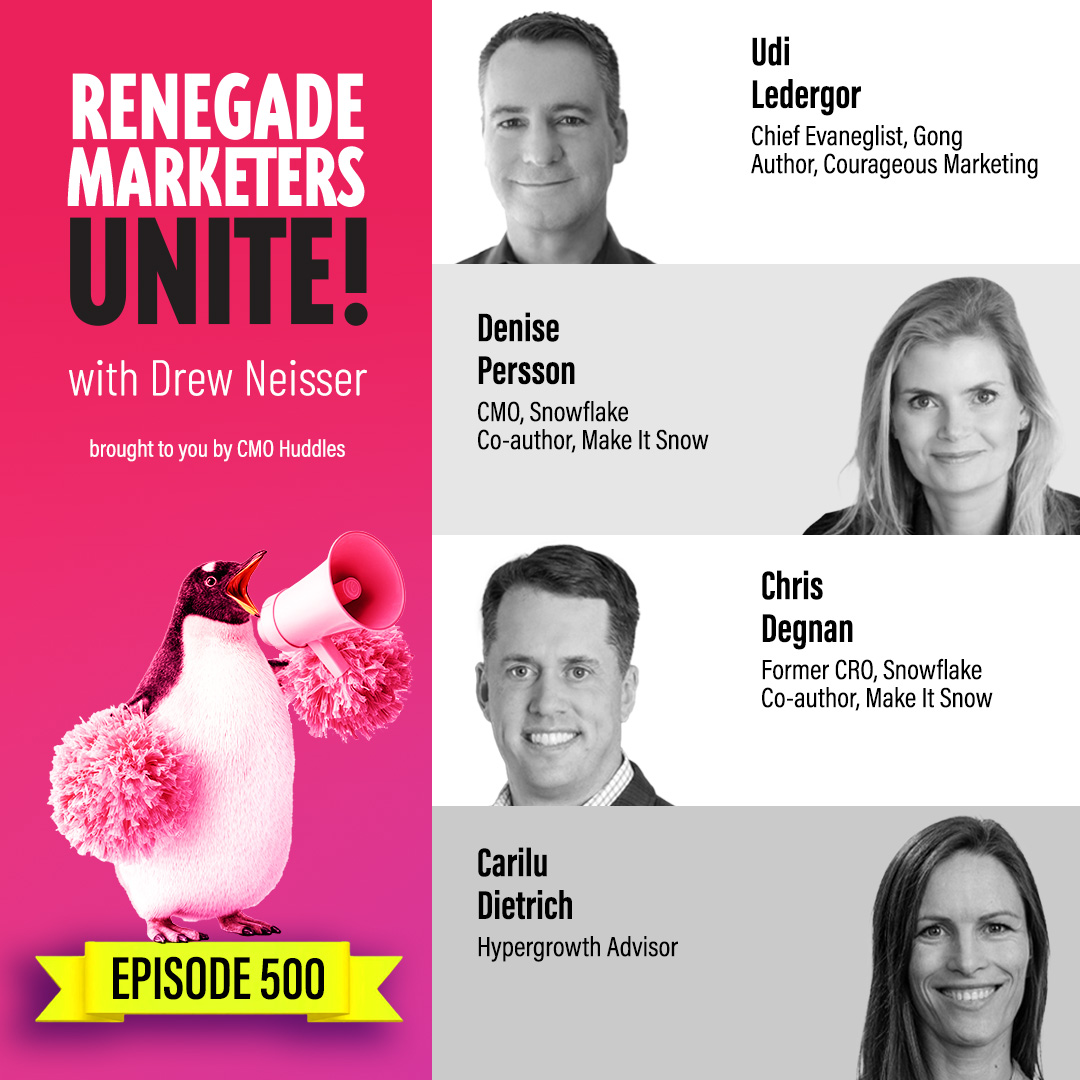
Recorded live at the 2025 Super Huddle, Drew’s conversations with Udi Ledergor, Denise Persson and Chris Degnan, and Carilu Dietrich anchor this milestone episode.
In this episode:
- Udi shares how Gong pulled off a Super Bowl spot on a regional budget, aimed it at VPs of Sales, and tracked impact in traffic, conversations, and pipeline.
- Denise and Chris explain how a CMO and CRO stayed aligned through four CEOs at Snowflake and evolved the story from “cloud data warehouse” to “data cloud,” all in lockstep.
- Carilu shows how Lovable is building a movement with real users as influencers, a CEO who lives on social, and a speed-first mindset tuned to the pace of AI and customer buzz.
Plus:
- Why a “crazy ideas” budget creates room for standout plays that still satisfy the CFO
- How empathy for sales and shared ownership of the number strengthen CRO-CMO alignment
- How CEO-led social, customer stories, and edutainment power modern B2B brands
- What it takes to move at AI speed while keeping product value and customer love at the center
If you want a concentrated hit of CMO-level courage, alignment, and playmaking, this milestone episode is your highlight reel.
Renegade Marketers Unite, Episode 500 on YouTube
Resources Mentioned
- Books mentioned
-
- Courageous Marketing by Udi Ledergor
-
- Make It Snow by Denise Persson & Chris Degnan
Highlights
- [1:48] Super Bowl reach on a scrappy budget
- [7:13] Do AI, ignore competitors, test channels
- [8:40] Surviving four CEOs in lockstep
- [12:29] Don’t let competitors box your brand
- [14:21] Lead with sales empathy
- [16:40] Go all in on social
- [19:57] Speed is the strategy
- [21:41] Turn customers into your megaphone
Highlighted Quotes
"Try a new medium or channel you've never done. Do a small enough pilot that nobody's going to fire you if it doesn't work out, but it's big enough to be indicative of whether you should invest more."— Udi Ledergor, Chief Evaneglist, Gong & Author of Courageous Marketing
"You need to have empathy for sales and make sure that your entire marketing organization has that empathy. Sales is hard. Carrying that bag every day, a number on your head, you get fired if you don't meet your numbers."— Denise Persson, CMO, Snowflake & Co-author, Make It Snow
"The thing that would drive me crazy is marketers that get up there and say, here's how many MQLs we've gotten and the sales team sucks. If you throw your sales peer under the bus to your CEO, you're done."— Chris Degnan, Former CRO, Snowflake & Co-author, Make It Snow
"No one wants to hear from our brand. They want to hear from people and really building up evangelists in the company is something we can all do."— Carilu Dietrich, Hypergrowth Advisor
Full Transcript: Drew Neisser in conversation with Udi Ledergor, Denise Persson, Chris Degnan, & Carilu Dietrich
Drew: Hello, Renegade Marketers! Welcome to a very special episode of Renegade Marketers Unite, number 500. Yep, 500—that's nine years, hundreds of CMOs, and more marketing wisdom than a penguin has feathers. And trust me, I would know. When I launched this show in 2017, I had already interviewed, I don't know, 125 CMOs, just not with high-quality audio. And when I finally started recording with good equipment, well, it took 30 tries to get five episodes I felt were CMO-worthy, but it was worth it. I mean, because the goal from day one was simple: to draw out actionable insights from CMOs for CMOs. Since then, we've doubled down on bold B2B marketing stories that drive real business impact. The questions have gotten sharper, I hope so. The conversations deeper and the insights richer. Thanks in no small part to CMO Huddles, our vibrant community of over 600 flocking awesome B2B marketing leaders. So whether you're with us for the first time or you've been with us since episode one, bless you, welcome—you're in really good company. For this milestone episode, we're bringing you three highlights from our 2025 Super Huddle, a gathering of brilliant, okay, dare I say it again, flocking awesome B2B minds and the kind of marketing wisdom you just don't see on slides. Let's get into it.
Narrator: Welcome to Renegade Marketers Unite, possibly the best weekly podcast for CMOs and everyone else looking for innovative ways to transform their brand, drive demand, and just plain cut through, proving that B2B does not mean boring to business. Here's your host and Chief Marketing Renegade, Drew Neisser.
Drew: We kick things off with a Super Bowl-worthy tale from our friend Udi Ledergor, Chief Evangelist of Gong. His story is a masterclass in marketing courage and how thinking scrappy can still get you seen by millions.
A lot of the book is about punching above your weight, and part of the reason you need to be courageous is so you can stand out, so you can differentiate your brand. I would love just one example, and it's in the book, but of how at Gong you punched above your weight that would be instructive for this amazing audience.
Udi: So as much as I might get sick of talking about it—I don't, but people keep asking about it—is how we pulled off our first Super Bowl commercial back in 2021. So it was years since any noteworthy B2B company did a Super Bowl commercial, and we kept it under wraps until Super Bowl day of 2021, and we went live. We were a much smaller company back then. This was four years ago, right? We went live with our first Super Bowl commercial, and folks were just flabbergasted, and they started sharing it widely because it was the first time, as far as I know ever, that a commercial was created for VPs of sales, and we made that very clear in the commercial. And people assumed that we spent a ton of money. Anybody know what an in-game 30-second spot cost last year? It was between $6.5 and $7.2 million. To cut a long story short, people assumed that we spent $7 million on a 30-second spot. I wish I had that budget. I did not have that budget to do that. And the very short version of the story goes like this: I got an email. It was on the heels of a recent fundraise that we did that year, and I got an email from Monica at CBS. And Monica said, "Udi, congrats on the fundraising. You've all seen these emails that they're trying to sell me private jets and yachts and everything else," and just said, "I think you'd make an amazing advertiser for the next Super Bowl." So I would have laughed it off, but I tried to be polite, and I responded, "Monica, thank you for considering me. I hope one day to be in that ballpark, but I don't have anything like the budgets that we need for this. Thank you for your email." And she responded within minutes, saying, "Udi, if you give me 15 minutes, I think I can show you how affordable this can be, and we can find a creative solution for you." I said, "Okay, Monica, you've piqued my interest. I love a crazy idea." I jumped on a call with Monica, and what she explained to me is, like in most mediums, that unless you've worked and advertised on them, you will know this, there's the famous national spot or national edition, like Wall Street Journal has a national edition but also has local editions, and TV and radio and all these things have national and local inventory. And so what she explained to me, she said, "Look, you don't care about getting in front of people in Idaho, right? They grow great potatoes, but they're not going to buy Gong anytime soon. You care probably about people in the Silicon Valley area, maybe New York, maybe a couple of other cities." I said, "Yes, that's correct." She said, "Well, you can buy the regional media, and when people sit at home watching the Super Bowl, they have no idea which ads are served to them from the national inventory, which costs $7 million—it was $5.5 million that year, remember the good old days—and the ads served from their local inventory, which could be the local pizza store, but it could also be your ad." I said, "Okay, tell me more." And then it turned out that for a low five- or six-figure amount, I can buy local inventory. So Bay Area, fun fact, there's only 800,000 people living in San Francisco. It's actually one of the cheaper regions to buy for local television. Think about that. Now, that's true for a consumer brand, but for a B2B brand, where at the time 60% of my audience was—now it's a little bit less than that because we've gone broader and broader and international—but for 60% of my audience, I can reach that for maybe $200,000 of an in-game Super Bowl ad. I'm like, "This is now interesting." So I asked for the à la carte menu, and I started looking at the regions, and I ran the numbers on my CRM to see where my accounts were concentrated. And I found that if I bought two or three regions, I can cover 80% of my audience for less than, like, $300,000 in media on the Super Bowl. And this is wild. So the next week, I meet my CEO, Amit, at a rooftop bar in San Francisco, and I wait till we're on our second drink, and I said, "Amit, I've got a crazy idea for you." "I love crazy ideas." And I told him, "Super Bowl," and he was like, skeptical, like, "This is even too crazy for us. Like, this is millions of dollars." And then I recapped the Monica story, and at that point, we just toasted our drinks. He said, "Let's go twist Tim's arm. Tim is our CFO. Let's go twist Tim's arm. I'll tell him we got a great deal on Super Bowl, and we'll do this." And that was how I got buy-in for Super Bowl. We did Super Bowl. I'll end the story here. I measured it in three interesting ways. One, I couldn't tell you to this day who the teams were playing because I was on my Google Analytics dashboard frantically refreshing it like any good marketer should be, and I saw the huge traffic spike when our ad went live in each of the regions, and it created a new baseline for traffic that we've never gone below since then. The second thing that happened is I listened in on Gong. I set up a tracker to tell me when a customer is on a call talking about our Super Bowl ad. And I saw hundreds of calls, and I listened to several of them, and they said things like, "Well, I'd heard of Gong. I was kind of on the fence, but then I saw you guys in the Super Bowl. I realized you were a big deal, and I need to check this out. So I took this demo call." So I have dozens of these calls, hundreds in total. And then at the end of the week, Tim, our cranky and skeptical CFO, came to me—I loved him; in case this is recorded, I loved him—he came to me at the end of the week and said, "Udi, do you realize that we just broke our all-time record for pipeline creation in a single week?" So that was Super Bowl week of 2021. So armed with those three reports from Google, Gong, and the pipeline report, I came with that to the board, which they loved, and that helped me secure a 3x bigger budget for the following year's Super Bowl. That was amazing. All right, courageous example. Thank you.
Drew: So we're out of time, but I talk a lot. We're going to have a rapid-fire close with one do, one don't, and one dare for CMOs who want to market more courageously in 2026.
Udi: Try out a new AI tool this week. Try playing with a new AI tool. Even if you're this big-shot CMO and you don't have to do it yourself, play with it. It's very humbling, and you learn a lot about the capabilities and mostly about the limitations of what the tools can and cannot do. So do that. I try and do it. I should do it more. That's a do. What was the second one? Don't stop looking at your competitors. It's a total waste of your time. Just stop looking at what your competitors are doing. They're just as clueless as you are, if not more. So they're looking at you, and you're looking at them like, "Oh, they probably know better." They don't. Just do your own thing. Obsess about your customers. You will always win by doing that. And one dare: try a new channel or medium that you've never, ever tried. Put that in next quarter's program. If you need to, set aside 5 to 10% of your program's budget as marketing experiments, otherwise known internally on my team as "Udi's crazy ideas." Put that out there. In the book, I explain how to rationalize that to your CFO if you need to, but try a new medium or channel you've never done. Do a small enough pilot that nobody's going to fire you if it doesn't work out, but it's big enough to be indicative of whether you should invest more in that channel. Could be out-of-home, could be print, it could be TV, could be radio, could be food delivery robots. That's a real thing. I tried. It didn't work out for me.
Drew: Awesome. Udi Ledergor, thank you very much.
From Super Bowls to superhuman resilience, next up it's CMO Denise Persson and former CRO Chris Degnan of Snowflake. Together, they weathered four CEO transitions, I think, over a course of seven years and helped turn Snowflake into a multi-billion-dollar juggernaut. Here's how:
I think you had three different CEOs during your course. Is that—am I doing that count?
Denise: Yeah, four.
Chris: Technically four.
Four. See, okay. So again, how many of you have stayed in seat with a rotation of two CEOs, like usually three CEOs? Raise your hand if you survived three CEOs. Okay, raise your hand if you survived four. Okay, well, these two did, and I'm wondering if part of it was that you were in such lockstep that it was like, "Okay, they're a team. We can't, you know, we may want a new CMO or CRO, but we are going to have to..." You know, was that a ballpark because you were so connected at the hip that each CEO said, "Oh, I guess they're…”
Denise: I think, in a way, they felt that this is working well. They didn't want to sort of touch it, sort of immediately. And I think you also have to thank, you know, Chris for especially surviving Frank Slootman. I think we never thought—we never thought—I mean, it was six months where we thought we would get fired every single day. Everyone else got fired around us, right? We're the only ones who actually had a product survive too. Everyone else got fired. I read in the news, like, "Oh, Frank Slootman is bringing in his former CMO at Snowflake..."
Chris: ...and CRO.
Denise: This is my job they're talking about here. So we—and I think it was until that Christmas, seven months later, then we got stock options.
Chris: Yeah. Merry Christmas. Here's life-changing amounts of stock.
Denise: We had never heard any kind of nice words ever, right, for seven months.
Drew: It sounds like you were pretty happy when that move switched and you got somewhere.
Chris: I have a good story about that. It's like, so when Slootman came in, it was like, it was shock. It was like, you know, I remember, you know, getting a text from one of our board members at 3 in the morning, said, "Call me when you get up." And of course, I saw it at 3 in the morning, and I couldn't sleep. Love that. Not great. Okay, so I called them, and they said, "You have a new boss, and you have a one-on-one with him in two days." Okay, great. And I knew of Frank. I had been at EMC when EMC bought Data Domain, but I never met him, and I'd heard some things about him, that he was pretty tough. And I go into my one-on-one with Frank, and in the one-on-one, I just said, "Look, I've got two things for you, Frank. Number one, I have this huge—we had a $100 million deal, and Bob was in the middle of it, and I need your help. And number two, we have the best marketing department on the planet. Don't mess with it." And he's like, "Wow, you're the first person to come in, first peer of mine, like, the first person on the executive team that hasn't come in here and talked shit about, you know, your other peers." And like, I got nothing bad to say. And now there were people I didn't like, but I wasn't going to do that. I thought I was getting fired, so I had nothing to lose, right?
Drew: Take me, don't take Denise, which is nice. But just the gesture of that and the fact that you two were so combined in driving success. And I guess one little thing that it's not such a little thing, but your positioning changed kind of with each CEO a little bit. It wasn't just that you needed to change. And there was a moment I feel like your CEO came in and said, "Yeah, it's not Cloud Data Warehouse. You wanted to be a platform for a minute." And then he just said, "Data Cloud," or something like that. Oh, that was Frank, yeah. So talk a little bit about the evolution of positioning, just the managing of that as you had this exponential growth.
Denise: Yeah, and also, Frank is a really good marketer and salesperson and understands positioning really, really well, and he was always talking about the algorithm book as well. With the positioning, it was very much kind of the market that pulled us in that direction. And of course, expansion of the platform—Snowflake was essentially built to be a Data Cloud from the beginning. But when you're coming out as a zero-revenue startup named Snowflake and you're trying, "Hey, we're a Data Cloud," it's like, I mean, no credibility at all. That would have been too big a positioning in the early days. But we were essentially a Data Cloud, and the product evolved and truly, really became sort of a cross-cloud Data Cloud. So it was very authentic positioning. It became so obvious, actually, and customers were actually even referring to us as a Data Cloud.
Chris: I think it was hard, though. I think because, like, when Denise started, I mean, we were $3 million in revenue. And like, our North Star was to be the Cloud Data Warehouse. And turns out, we were hyper-successful in becoming the Cloud Data Warehouse. In fact, we were so successful at it that our competitors started to then try to pigeonhole us into being the Cloud Data Warehouse. And so Frank recognized that and worked with Denise, and then we had to, you know, kind of say we're more than that. And that was a hard pivot, I think, because people still wanted it, and our competitors are like, "Yeah, just leave them over there." Like, you know, like Databricks did a really good job of saying, like, "Hey, leave these guys over here." Microsoft's the same thing. So we had to overcome some of those challenges.
Drew: It's a fascinating thing, but I will marvel that it could have been much more complicated. So you went from zero to billions, from startup to public company, right? Correct. And we've got a group of CMOs here, and I'm wondering, because to wrap up, one thing every CMO in this room could do next week to get one step closer to the alignment that you built. And Denise, why don't you start?
Denise: I think you need to have, really, also empathy for sales and make sure that your entire marketing decision has that empathy. And I also hired from the sales team. Chris always says, like, "Oh, you took my best sales rep." She runs North America field marketing today, started as an SDR with the company. So I always infused sales experience, and people understood the craft of sales into the team, because sales is hard—carrying that bag every day, a number on your back. You get fired if you don't meet your numbers. Nobody else in the company gets fired in one quarter if they don't deliver on a number. So having that empathy, I think, is important. I think when I started marketing in '96, right, there was no way to measure anything in marketing. The only measurement I had was the feedback I got from the salespeople, right? I literally handed over leads on a floppy disk, right, and handed it, walked over to—I did an Excel floppy disk over to the sales team, and then I don't know what happened. So I relied on that tight relationship to get the feedback, right? What's going on? So yeah, that was one.
Drew: Okay. Some simple, clear advice for the CMOs here to build a nine-year relationship that can withstand four CEOs. You have 30 seconds. Go.
Chris: Stop pointing at the scoreboard. And Denise did that well. Like, the thing that would drive me crazy is marketers that get up there and say, "Here's how many MQLs we've gotten, and the sales team sucks." Like, that's, that's, like, the worst. And then it creates this awful relationship. Denise would then, privately, she would say, like, "Here's the funnel. Here's what we're getting," but she would help me diagnose where we were breaking. And so there was never a public feud between her and I and our CEO. It was always resolved behind closed doors between her and I, and there was never a bragging if we were missing the number. There was no, like, "Well, we did our job." That didn't happen. And so I think it's really important to have alignment with sales. If you throw your sales peer under the bus to your CEO, you're done. It's over.
Drew: You guys are amazing. I love the book.
And now for a glimpse into the possible future of B2B marketing. Carilu Dietrich, hypergrowth advisor, shares how Lovable is building a movement with influencers, edutainment, and a speed-first mindset that leaves the competition gasping for air.
Influencers is something that B2B brands could learn from. Is there something—should we talk about how they actually engaged and worked with influencers and what it took for them to be able to do it? Because they kind of let them go, while it feels like…
Carilu: I definitely think influencers and social media is the new marketing stack. I think, you know, for so many of my jobs and clients, social media was like, it's hard to prove. You know, I advise Sprout Social, which makes it fantastically. You should check out their ROI tools. And, you know, has all these ways to really, like, integrate social into your business in a really, like, substantial way. But I think a lot of CMOs still see it as a side project because it's just so hard to track directly to revenue. But for Lovable, it's like the majority of the business was built on social, and then these influencers like entertaining people across YouTube, across Instagram, across TikTok, who are builders, who really like use the product. The influencers are using the product and making creative things that's really engaging. And I think that there's this massive transition from in B2B marketing to edutainment, like these YouTube people who are just like, funny and young and interesting. And, you know, we even see it on LinkedIn, right, with Corporate Natalie. I don't know if any of you guys know Corporate Natalie, or who's the sales guy. I forget what his—his name is, Corporate Bro, right? That there's these, like, you're like, how can they get so many followers? So, yeah, so, I mean, there's like two people at Lovable on a team of 15 or 20 that are dedicated fully to working with different influencers, and we've worked on different ways of kind of vetting them better over time, but really engaging with a bunch of them and experimenting to see where you get traction.
Drew: And when you and I talked, this was one of the things that struck me, is that they're all in on this. It's not like we have an intern doing social. There's two people on the team dedicated to influencers. You also said they had one person dedicated to Reddit, right?
Carilu: I would say, like, half the team, almost, is kind of on the social and edutainment. There's a guy who's, like, fully committed to, like, writing everything for the CEO. I mean, the CEO, I had a couple slides that William didn't actually get up in the end. I apologize, but, you know, I mean, he's tweeted like 6,000 times over the course of the year, and he's got—had a couple that went super viral that were like, you know, when they were small, when they were like 20 million, he, like, teased about acquiring Figma, and it got 4 million—4 million likes on X. And then Figma gave us a cease and desist around using dev mode, and he published the letter as a tweet, and that got like 6 million followers. And then he's got this guy, this like 22-year-old in Sweden who, you know, like, these people are very young, like, no kids, no family to take care of, like, in the office, so focused. He's like a past professional hockey player, and his, like, full goal is to go viral almost like three or four times a week. And he writes the CEO's tweets. So you've got this, like, social guy dedicated to the CEO. You've got two community people. You've got two YouTube people. It's really like a modern marketing stack investment.
Drew: There is something magical about what happened at Lovable. I mean, one of the things—it feels like something is they move. Their whole mantra is speed. Talk—just help us wrap our mind around that. And again, you describe this 22-year-old who doesn't have a life and will do that, and a whole culture around that. But speed beats everything.
Carilu: Astronomically—it's so—Lovable is like integrated with all of the different LLMs. So we, like, get a heads up before GPT-5 came out. They let us beta test it 34 hours ahead of time, and then we did a launch in 24 hours and had a video and a launch of launching GPT-5 on Lovable. And I was talking to someone at OpenAI and being like, "Oh my gosh, it's like 24 hours to, like, create our launch, everything so hard." And then she's like, "They give us two days at OpenAI." And I talked to another friend at a hot AI company whose, like, product is shipping so fast they can't even tell me what it is. So I've hired a dev rel to, like, backward architect what they're releasing so that we can talk about it. Like the pace is just like, you know, and part of it's existential, like, if we don't win the market right now, maybe the market's gone. And these people feel like this is the opportunity of a lifetime, and B, they're going to build this generational company. But it has to, like, it has to win right this second. And so the speed is like out of this world. It's just shipping, tweeting, delivering, thinking, immediacy that's like just faster than what I've experienced.
Drew: I love the story. I mean, one thing that it feels is that it's almost everything that Udi said. There isn't a single best practice in here. It's just do everything really fast and get committed to it. But at the core, there is a product that people really enjoy using. And so you could say this is a customer-led growth company because that's what's happened, right?
Carilu: Well, and here's what I'd take with me: great product that's really wanted by the market. I think that's true for all of us, if we can, like, pivot. You know, I think Intercom has done the best job of pivoting into an AI-first company with Fin. And so, like, pivoting to a product that people really love, always important. Two, customer stories and, like, customer love and experience, and whether that comes through influencers who are sharing case studies or real—you know, a lot of our social media is republishing someone who won a hackathon in February, just got a seed fundraise for, like, more than, I don't know, a lot of money. So, like, sharing customer stories, I think, is the second thing. I think the new modern stack, the CEO as the, like, face of the company. All business is social. You know, I—no one wants to hear from our brand. They want to hear from people, from people. And really, like, building up evangelists in the company is something we can all do. And I think edutainment, like making things interesting and provocative. I've worked for so many brands that that was a risk. And as a small company in a new market with a big personality, trying to stand out and really be warm for everyone, instead of, like, kind of cold and just for developers, which is some of the competitors, is something all of us can do, right? Brand, social, customer stories, product—these are the things we've always done.
Drew: I love it. Carilu Dietrich, thank you so much for joining us.
And there you have it, a 500th episode packed with bold ideas, big swings, and brave marketers who refuse to play it safe. If there's one thing all these conversations prove, it's this: B2B marketing isn't for the faint of heart. It takes courage, creativity, and a commitment to putting your customers first, and that's what we celebrate every week here and every day inside CMO Huddles, where the most generous, curious, and fearless marketing leaders come to share, care, and dare each other to flocking awesomeness. And of course, none of this would have happened without you, the listener. Whether this is your 500th episode or your first, I'm grateful for every download, every share, every note. I love the notes. They keep me going along with my ever-growing collection of penguin swag, which you can see behind me. I'm Drew Neisser, and this is Renegade Marketers Unite, the podcast for B2B marketing leaders who refuse to play it safe. Until next time, keep those renegade thinking caps on and strong.
Show Credits
Renegade Marketers Unite is written and directed by Drew Neisser. Hey, that's me! This show is produced by Melissa Caffrey, Laura Parkyn, and Ishar Cuevas. The music is by the amazing Burns Twins and the intro Voice Over is Linda Cornelius. To find the transcripts of all episodes, suggest future guests, or learn more about B2B branding, CMO Huddles, or my CMO coaching service, check out renegade.com. I'm your host, Drew Neisser. And until next time, keep those Renegade thinking caps on and strong!