The Real Work of Customer Obsession
Most companies say they put customers at the center of their business. Few actually operate that way.
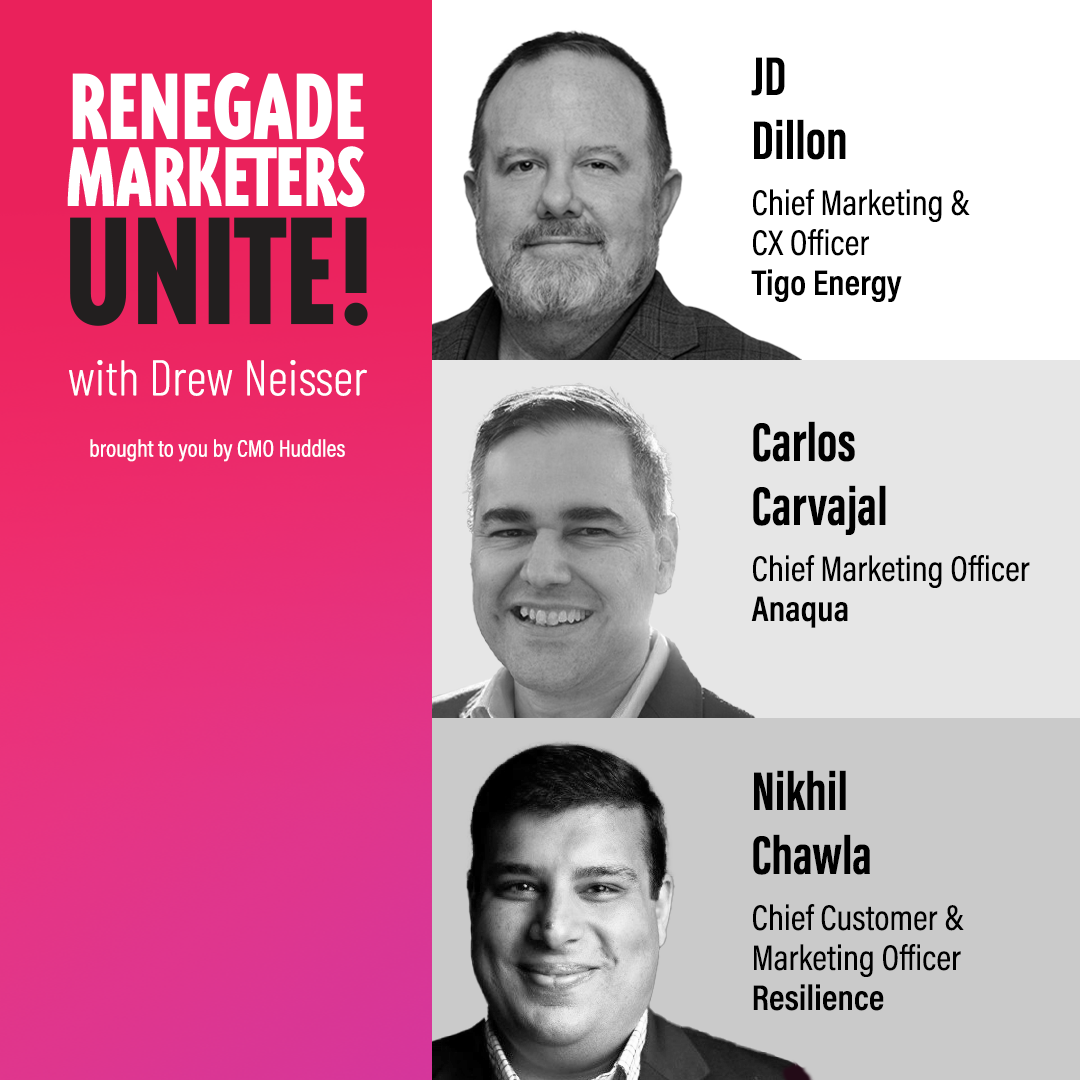
In this episode of Renegade Marketers Unite, Drew Neisser talks with JD Dillon (Tigo Energy), Carlos Carvajal (Anaqua), and Nikhil Chawla (Resilience) about what it takes to turn customer voice into real organizational change.
Together, they unpack what customer-centric leadership looks like in practice—from retention programs and executive briefings to listening to real sales calls and turning customer signals into action across the business.
The result is a more operational view of customer obsession, one where the voice of the customer shows up not just in dashboards, but in meetings, decisions, and everyday habits.
The big idea: Customer centricity becomes powerful only when it shows up in everyday habits—meetings, messaging, and decisions. If you want to move from customer-aware to customer-obsessed, this episode delivers practical strategies you can apply immediately.
What You’ll Learn:
- Why customer obsession must show up in company habits, not just strategy decks
- How marketing leaders are using customer voice to shape planning and priorities
- Why stories and quotes from customers often move teams faster than dashboards
- How narrowing customer centricity to a clear job-to-be-done makes it actionable
- Why customers should appear in all-hands meetings, planning sessions, and executive briefings
- How marketing teams can turn customer conversations into a repeatable growth engine
Three perspectives on Customer-Led Growth:
JD Dillon: Make Customer Commitment Visible
JD shares how combining marketing and customer experience leadership helped Tigo Energy tackle its biggest challenge—retention. One result: the Green Glove Service, a hands-on installer support program that improves outcomes while reinforcing a customer-first culture across the company.
Carlos Carvajal: Build the Customer Habit
Carlos focuses on turning customer listening into a marketing habit. From direct conversations with customers to executive briefing programs that bring prospects into deeper dialogue, he shows how consistent exposure to customer stories strengthens messaging, improves win rates, and builds alignment across teams.
Nikhil Chawla: Focus Customer Centricity on Real Problems
Nikhil argues that “customer centricity” becomes powerful only when teams narrow it to specific problems they can solve. At Resilience, that means combining tools like Gong and AI analysis with integrated data pipelines to shorten feedback loops and surface the customer signals that matter most.
This Episode Is For
B2B CMOs and marketing leaders who want to move beyond talking about customer centricity and start embedding customer insight into how their organizations actually operate.
Renegade Marketers Unite, Episode 509 on YouTube
Resources Mentioned
- Winning on Purpose by Fred Reicheld
- Past episodes mentioned
-
- JD Dillon
-
- Carlos Carvajal
-
- Nikhil Chawla
Highlights
- [2:27] JD Dillon: Retention is marketing plus CX
- [3:15] Learn, fix, and communicate
- [4:43] Green glove makes customer success measurable
- [10:06] Carlos Carvajal: When in doubt, ask the customer
- [11:30] Scale listening with Gong
- [14:17] Turn touchpoints into renewals and wins
- [18:48] Nikhil Chawla: Marketing and customer are one
- [20:06] AI synthesis, human listening
- [21:03] Pick two customer problems to solve
- [27:54] CMO Huddles: Where you can borrow brilliance
- [30:31] NPS score vs net promoter system
- [34:21] Customer access + smarter prioritization
- [40:50] Embed marketing with sales and customers
- [45:21] Tips for making your org truly customer obsessed
Highlighted Quotes
“If retention is our number one challenge, ensuring that they are taken care of and then reminding them that they are taken care of — it blends perfectly, to be honest."— JD Dillon, Tigo Energy
“When in doubt, talk to a customer. I just cannot stress that enough. A lot of marketing teams just do not have enough dialogue, relationships."— Carlos Carvajal, Anaqua
"Integrating our marketing team members into the customer and sales teams conversations on a weekly basis. Getting them the permission to actively listen and participate, and turn that into a process versus a collaboration."— Nikhil Chawla, Resilience
Full Transcript: Drew Neisser in conversation with JD Dillon, Carlos Carvajal, & Nikhil Chawla
Drew: Hello, Renegade Marketers! If this is your first time, welcome, and if you're a regular listener, welcome back.
You're about to listen to a recording from CMO Huddles Studio, our live show featuring the flocking awesome B2B marketing leaders of CMO Huddles. In this episode, JD Dillon, Carlos Carvajal, and Nikhil Chawla explore what happens when the voice of the customer starts carrying more weight across the business. They discuss retention, executive briefings, smarter use of key touch points, and how marketing can help align sales, product, and customer-facing teams around shared insights. If you like what you hear, please subscribe to the podcast and leave a review. You'll be supporting our quest to be the number one B2B marketing podcast. All right, let's dive in.
Narrator: Welcome to Renegade Marketers Unite, possibly the best weekly podcast for CMOs and everyone else looking for innovative ways to transform their brand, drive demand, and just plain cut through, proving that B2B does not mean boring to business. Here's your host and Chief Marketing Renegade, Drew Neisser.
Drew: Welcome to CMO Huddles Studio, the live streaming show dedicated to inspiring B2B awesomeness. I'm your host, Drew Neisser, live from my home studio in New York City. Today we're tackling a topic that sounds really simple but challenges even the savviest B2B brands, which is the notion of putting customers at the center of the company. It's more than a mantra. It's a mindset shift that touches everything from product to pipeline. And the CMOs who get it right are turning customers into raving fans and powerful growth engines. So how do you do all that? Well, fortunately for you, we have three amazing CMOs with us today. And with that, let's bring on JD Dillon, Chief Marketing and Customer Experience Officer at Tigo Energy, and a returning guest who has previously appeared on this show to discuss many topics, including customer-led growth, strategic focus, and B2B branding on a budget. Hello, JD, how are you?
JD: I'm great, Drew.
Drew: And where are you?
So I'm in the Bay Area, California. And by the way, I'm great because my favorite two teams are the Patriots and the 49ers, so I've got two of the games this weekend captured.
Drew: Wow, good for you! And we look forward to seeing you at the Silicon Valley Strategy Lab in April on the eighth. Yeah, I don't think you have this on your calendar yet, but we will get it on your calendar.
JD: I'll be there.
Drew: All right, I knew I could count on you. So let's talk about your dual role — marketing and CX — and how that shapes your approach and enables your ability to put customers at the center of everything.
JD: You bet. So our number one challenge — that data has shown us and anecdotes have shown us — is retention. So I was Chief Marketing Officer when I started, and there became an opportunity to actually cover the group that does technical support, so level one, level two, and then all the way into root cause corrective actions for customers, things like that. And as a result, if retention is our number one challenge, ensuring that they are taken care of, and then reminding them that they are taken care of, it blends perfectly, to be honest.
Drew: And so talk about that a little, because the subtle reminding-them part — I think that's the subtle part of this. But that's obviously where marketing comes in. We're supposed to be really good at communicating. What does that feel like, look like?
JD: It is a challenge for two reasons. Number one, we sell solar equipment. So if anybody has seen it on a house or a business, the equipment's on the roof, and then it's on the wall, and then there's an app, and you can see — now the contractor who installed the equipment is our customer, but the end user is his or her customer. So sometimes in that chain there are mistakes made. So the problem might not be our equipment, but how do you tell a customer it was their fault? That's not very easy, right? And you've got to embrace the fact that if they make a mistake, it's your fault that they made the mistake. And intellectually, that's hard to do, right? So perhaps you can make it easier, or mistake-proof, or if it fails, it fails better — meaning it doesn't cause damage — and make the instructions better, and make the app better, and have YouTube videos, etc., etc., etc. So learning from their mistakes to fix our offering, and then communicating the fixes we made as a result — that's the dual track.
Drew: And a bit — since it's funny — earlier this week, we had David C. Baker, and he talked about criticism and feedback as just a data point. Don't take it personally. It's data. It's an opportunity to do something with it. So I love that attitude. Is there a specific initiative where we're really talking about alignment that's had a measurable impact?
JD: By the way, he needs to talk to my three kids.
Drew: Yeah, I think I’d like David talking to everyone I know.
JD: These are our green gloves. So I have a copy — oh, they're like work gloves too. Work gloves. So we have a program called the Green Glove Service, and we started it two years ago, and we've had 1,500 installations go through the Green Glove program. Basically, you enroll for free in the program — you being the installer. If the installer enrolls, we look at their design. We're photo-friendly, so we're always ready for customer support, but we know that you're on the roof today at Drew Incorporated, and you're going to be on the roof at a Macy's building. And for Drew Incorporated, we're ready for you to call, so we're waiting on your call. So we'll help you during the install, and then afterwards we'll do an after-action where we review the install with you. So it's a three-step plan, and we have six points that we do in the design review, things like that. For those of us that are a little bit older, it's the Good Housekeeping Seal of Approval — that's how I think of it. And that program does two things: it helps the installer, and it makes us always think about serving the customer. We talk about it in internal meetings, we pass out the gloves, it's discussed all the time, it's advertised, we do press releases on it. So it makes us more customer-centric.
Drew: I love this program. You and I have talked about this program before. It's rare that a customer service program can be branded in a way that you can have a physical manifestation of that idea, and having that is huge. In some ways it's a little bit different, but one of the hotel chains has cookies when you come in, and it's a signature thing of theirs, and I'm blanking on their name — but thank you very much. And it speaks to welcome to our home, your home, here's home-baked cookies. It speaks to that notion. And I'm imagining that when you actually hand the gloves, I bet people put them on and go, "Oh my God," and they kind of get the concept pretty much both through the name and the physical embodiment of it.
JD: Absolutely, and we're always trying to evolve and improve the program. We're now focusing not just on the installation itself, but we're trying to say, can we have an entire installer — who might have 20 crews going around — certified as a Green Glove installer? Not just an installation, right? It keeps evolving, and our offering keeps getting better.
Drew: I'm expecting to see green gloves maybe hanging off the bumpers of their trucks, right?
JD: Or if you go into a DoubleTree hotel, they have a green glove installation right next to the cookies.
Drew: Sounds like a great partnership opportunity. I love it. And that's when you know that you've got a program — when it has legs, when you can keep it going. I guess in your case it has arms and fingers, but it can expand, right? And I'm assuming that you have numbers that show sort of pre-Green Glove, post-Green Glove, that this has been an effective thing for you?
JD: Absolutely. We look at two things. We track number of tickets per install worldwide — so that's how often there is an installation that requires a phone call or an email or gets done without our help. Because the point of Green Glove is to get them out on their own. We don't want to do Green Glove every single time. That's prohibitively expensive. Plus, who wants to call a support line every time? That's not right. They don't want it either. This is a get-you-up-and-running program. And then we look at two things: we look at tickets afterwards, and we look at failures like returns afterwards. And we look at revenue from installers who went through the program afterwards. So that ties it to the bottom line. And that's all — as we've talked about a lot in here — that's all the CFO is looking for.
Drew: And all those are on the up signal versus preview. Okay, all right, cool. All right, with that we'll come back to JD, but let's bring on Carlos Carvajal, who is the CMO of Anaqua and an industry expert who's graced our stage before to delve into many topics, including positioning, sales enablement, and analyst relations. Hello, Carlos, wonderful to see you again. How are you and where are you?
Carlos: I am doing great, Drew. It's great to be here. I am in London. Apologies for the lighting and everything, but the hotel doesn't have great lighting, so sorry about that. And I just want to say go Texans, because I heard from a Patriots fan for a second. So anyway.
Drew: I could have worn a referee thing, just blown a whistle or something, but cool. Well, your hometown is Austin, right? Correct. Great. Well, we are coming May 7. We'll be in Austin, so write that down, and we'll send you a note. We're going to be bringing the Strategy Lab to Austin. Awesome. Looking forward to it, Drew. That's cool. Okay, so let's talk about your philosophy for aligning go-to-market efforts around customer needs, rather than, say, internal structures.
Carlos: Yeah, absolutely. And I'm just going to dive a little bit deeper as far as aligning go-to-market strategies with the overall business needs as well as customer needs. So not necessarily internal structure, but being at several different companies — like some companies I've been at, like in Aqua, large, complex enterprise sales cycles, right? You're talking nine to twelve-plus months in industries that are either risk-diverse, highly regulated. And it's more important to understand the nature of the business, because that really drives the go-to-market strategy and what you actually do with those customer programs, which is very different than other companies I've been at in the past, which was more product-led growth, high volume, high velocity. And actually the types of tactics and the things that you do in marketing to help influence those types of deals are very, very different, right? So I think it really starts there. And then, as far as aligning with the customer needs, I have a saying within the team: when in doubt, talk to a customer. And I just cannot stress that enough — that a lot of marketing teams that I've been on, I've been guilty of this, just do not have enough dialog, relationships. Like, hey, a question about messaging — talk to a customer. Don't ask me. I'm not a lawyer. Like, we're in the intellectual property space. Go talk to a customer, right? Ask them.
Drew: And do you have — so there are a lot of customer conversations happening, say, with AEs and various levels of support. Is there a method of capturing all of that information and making sure that marketing is synthesizing it? Is that part of it, in addition to sort of just actually picking up the phone and calling one?
Carlos: Yeah, that's part of it, and that's part of the relationships that you really have to develop with the product team, with the customer success team, and even with the sales team, to understand where that information gets captured. You may use a system like Gong, for example, which is a gold mine of client and prospect data that can be used by the marketing team to glean — because you can't be on every call, right? And those kinds of systems glean that information to make it easy to synthesize, especially with AI. So it's really leveraging those systems for scale and feedback, as well as talking directly to the different teams that interface the most. But I've just heard from people before, it's like, "Well, I don't really talk to customers. That's not part of my job." I'm like, why not? Like, I don't care if you're in creative or other things — everybody should talk to a customer.
Drew: Yeah, and, you know, going back to the Gong thing — by the way, I do think that while the AI syntheses are really helpful, it also helps just to hear the voice of someone and their tenor and so forth. And I often found, no matter what, and even now, being able to talk with a CMO and hear it — you know, I can create a synthetic CMO and I can ask them a bunch of questions, but it's different than having these conversations, right?
Carlos: Absolutely. One of my favorite things — because I had a long, painful drive to work for a while — was just to listen to the Gong recordings, the actual calls, and just do that. Because you're right, just hearing the tone, hearing how they respond, seeing whether they're passionate about their response, and what's important — are they just kind of hand-waving? Those are the kinds of things you won't get just from synthesis, for example.
Drew: Well, and you know, the topic of the show is putting customers at the center. And obviously, as we've talked about, that starts with understanding your customers, and the fact that you take the time to listen to those calls, I think, is really a great story. And I want to ask every CMO listening: are you listening to those Gong calls? Because that feels like, as you said, Carlos, a gold mine, and so it is. How do you see your team being able to embrace that? Are you leading by example? Do they follow you?
Carlos: Yeah, there are different expectations. I mean, I have high expectations. If you're in product marketing and you're not doing that, that's a problem, right? Because you've got to be leading the way within marketing as far as enabling the voice of the customer, right? But then the rest of the team should be looking at that as well, but maybe not as frequently, or quite as active.
Drew: Interesting. Okay, so we've talked a little bit, sort of philosophically, about making sure that everybody's talking to customers and so forth. But maybe you could share an example of a result — because we were listening and we put the customer at the center — where you were able to sort of move things along and break through, whether it's brand, or retention, or revenue.
Carlos: I think it's really a combination of more integrated marketing. So in the case of these large, complex sales cycles and deals, right — I'll say knowing your business and where you have strengths. If you have a really strong executive briefing program and you're leveraging that, as well as other customer touchpoints, maximizing every opportunity, knowing which customers are going to be at events — a lot of times, when people go to trade shows and things like that, they're always looking at prospect leads. How many meetings have we set up? And that's such a good opportunity to show customers love, thank them for being a customer, setting up discussions and meetings. So looking at every opportunity and putting programs in place, and how to do this more on a regular cadence or routine, right? So that's basically what we did — we looked at the opportunities and events, looked at our executive briefing program, looked at even from a messaging and content perspective how we are validating the messaging with customer quotes and things like that, and combining all these things together. And from a measurement perspective, what we saw was that into the Executive Briefing Center — but if we could get them even just engaged in different ways, and now I'm talking about prospects as well — the win rates and actually retention rates were much, much higher, right? And it's not rocket science, right? If your customers are willing to work with you in different ways and engage, there's probably a better chance of retention, right, renewals as well as winning deals.
Drew: Talk to me a little bit about the executive briefing program — and I think you said Executive Briefing Center. Just give me some more meat around that, because it's funny, in all the conversations that we've had, nobody has called it that. So what is that?
Carlos: Yeah, the executive briefing program is just like the operational side around bringing people in when they come into the office — the executive visits, right — when you're trying to close or progress, let's say, a $700,000 annual recurring revenue deal. It's a strategic partnership where they want to come in, they want to get to know the team, and those are the opportunities that you have to stress across a leadership team. Like, you know, former CEOs are phenomenal at stressing this — people take time out of your day, go in there, thank them, etc. So the executive briefing program is basically like the briefing centers — the execution of that. When people come in, it has to be an amazing experience, from the time of the initial discussion to plan it out, all the way to when they get back, right? And there are a ton of details in that as far as how you execute and deliver an incredible experience, but that can be a game changer. And like I said, this is part of knowing your business. Do you even have this kind of program? Do you have a nice Executive Briefing Center? Is it important to have this kind of high-touch strategy for the types of deals and opportunities you're working on? So it's just — but if you do have it, and you are working on these large, complex opportunities, it can be a game changer.
Drew: It's so interesting because we're all so used to — we're having this conversation, by the way, thank you for joining us in London — but it really speaks to the fact that so much of business is done virtually. The notion of actually getting a prospect to physically come to your place is somewhat of a — you know, I just don't think people are thinking about it. And yet, for enterprise, big sales, it's probably the thing that enables you to close.
Carlos: There's been a lot of success, and we've also — I remember cases where we lost deals, and I'm highly competitive. I was pissed. But one of them was the briefing visit. They told us, like, here's what they did. And it was just like they felt this certain experience. So we took learnings from that, but it can make a big difference. I mean, it can make a big difference in these opportunities.
Drew: Yeah, well, and I bet you fixed that problem. So all right, well, we look forward to hopefully seeing you again in person — speaking of in person — in Austin. Let's bring on Nikhil Chawla, who is the Chief Customer Officer and CMO of Resilience, who has previously joined this show to shed light on the intricacies of the CMO-plus notion. Hello, Nikhil, welcome back.
Nikhil: Drew, great to be back. Unfortunately, I cannot talk about my Washington Commanders with the same pride that JD and Carlos talked about their teams, but other than that I'm doing great.
Drew: Yeah, well, you know, as a longtime New Yorker, I've got nothing to talk about when it comes to football. Can we just move on to college basketball, please? Yeah. And by the way, looking forward to seeing you in New York City next month at the Strategy Lab.
Nikhil: I'm excited to talk to you about it. I'm excited to visit there as well.
Drew: So look, you've patiently heard what JD and Carlos had to say. I'm curious what hit home for you.
Nikhil: It was so much, right? I think a couple of things to pull out. JD mentioned this — you know, I was also CMO, and then when I started and took on the Chief Customer Officer role, ensuring they're taken care of and reminding them they're taken care of, right? That nugget really stood out to me. It's how I approach it as well. And I think in a lot of ways, we've talked about this before. In many ways, these two disciplines of marketing and customer engagement are much more intertwined than ever, than they've ever been before at B2B companies. And I think what Carlos talked about — just go talk to customers, use the right systems — Gong has been a huge unlock for us. And you know, I can dive back into that as well. So, just so much that these two gentlemen talked about, but those two things stood out to me.
Drew: Yeah, and what you brought up — Gong — I'm really curious, because I love the fact that some people are listening to the whole transcripts. Because I know, look, I listen. We have — we'll do a transcript of this show, and we'll do a summary of this show, and we could use — look at the AI version — but there is no way that AI version will help you get to know Nikhil or JD or Carlos. It'll be just little bits, right? You'll miss the nuances. And so I'm curious, how do you balance the desire to get a synthesized version using AI, and actually listen with human ears?
Nikhil: I think you've got to do both. It's not one or the other, right? So firstly, I think you've got to establish that. Secondly, I think you've got to vote with your time. You've got to make the time. So I do the commute thing as well, as Carlos mentioned. And I think there's nothing like listening to actual calls. Or we do a ton of — we target Chief Information Security Officers — we do a ton of CISO dinners. I make an effort to try and go and visit around the country and actually attend these dinners myself, right? As an example. So I think, as a CMO or a Chief Customer Officer, whatever role you're in, I think you've got to do both. They both have different purposes. And I think that, to me, is the thing that's most important, and what we have found to be most important, which is: what are you really trying to do on this customer-centric journey of yours, and what are you solving for, right? And I think that, to me, is probably most important here.
Drew: So talk a little bit about how you're integrating customer voice — or have you been able to integrate it into the marketing strategy and messaging at Resilience?
Nikhil: So listen, I think you know customer centricity — as a longtime consultant, this is not new. It's a buzzword that has been there for 15, 20 years. McKinsey has made a lot of money on this, I'm pretty sure, and everyone is probably doing something on this already, right? It's also not a black-and-white, stop-start project, as you noted right up front, and as I said just now. It's a journey. Everyone's on that spectrum somewhere, and I think you have to understand where you are on your journey as an organization. So for us, we have tried to do three specific things for our team, for our organization. First, we actually kind of narrowed the focus down and identified two specific things that customer centricity or more customer insights could solve for. Secondly, the data platform — the pipes — are so important now. Gong is one aspect of that equation that helped us solve these questions. And then thirdly, obviously you've got to do something around it, and so you can arm and enable your frontline with that. So for us, the two problems were: our feedback loop was a little bit — to use the football analogy — on a tape delay, and it depended on these ad hoc conversations with sales or customer teams, or surveys and feedback analysis that were just weeks and months behind. And then secondly, we could use that stuff to address the big things in terms of positioning a product or creating a new asset. But where we were seeing customers churn was because of very specific things. It's that long tail for us of small challenges — of micro-interactions that we weren't addressing in the moment in our sales and customer conversations. So we defined our problems, our role, our journey on customer centricity — at least over the last few months — and we've focused on those two specific things, right? Speed of feedback loop, the long tail of interactions. We can solve for those, but we still need the pipes, right? There are so many tools out there, and they all fundamentally depend on one thing: do you have the right data? Do you have the right inputs? So that's where our decision to implement Gong and connect it into our data engineering back end — which has been a journey — integrated with Slack and Gemini and Gainsight and HubSpot and Workday, so you can use it all, right? You have to get the pipes right to truly become customer-centric in today's world. But even then, you can put in the tech, you can define the problem, put in the tech — it still doesn't matter unless you can make it useful. So we have all these Gemini Gems now analyzing every customer conversation we have, and we're pulling in specific quotes from each call — you know, on the objection handling or on the feedback — and we're dividing them into different Slack channels and we're using them to create specific pieces of content or objection-handling points, whatever it is, right, and doing it really, really quickly so we can get ahead of potential churn or potential issues. And that's how we're solving for that long tail. So for us, again, customer centricity — to me — is too broad and generic a term. Actually, it's really: be focused, be narrow, get the pipes right, and then obviously you've got to make it useful around that problem itself.
Drew: Well, one fascinating — and it would be really interesting to sort of look under the hood at all the connections and the technology that it takes to make all these things work together. That's never easy. That's a project in and of itself. But I don't want to go there, because where I'm excited about this notion is: it's one thing to say, "Hey, we analyzed the call, and we wish you had said this instead of this." It's another thing where it's almost instantaneous. So I'm having a real-time conversation with the customer, and I'm an agent of some kind, and the AI over here is listening and analyzing and saying, "Oh, by the way, do this, say this" — is that within reach?
Nikhil: We're getting there. We're getting there. It's not quite there yet. Things don't ever work out of the box as they're supposed to, right? But it's getting there. And I think there are very specific tools that, you know, help us get there, right? There are some specific AI tools that we're looking at right now that are more of that in-the-moment orientation — that we're looking at implementing for our sales teams, as an example, on serving up the right piece of collateral as they're on a call, based on the Gong analysis that's happening, right? So that's a very specific thing we're in the phase of implementing right now and rolling out. So I think, just going back to the technology point, none of this works out of the box as it's promised. It's experimentation, and it's really making the effort — as both the leader and then as the team — to continue to reinforce and focus on this stuff and really hopefully embed that behavior as you go forward.
Drew: You know, as I think about the system that you're doing — so one of the Strategy Labs partners on that is One Mind and Amanda Kahlow. It was amazing. But it's easy for me to imagine in the scenarios that you described, a virtual SDR responding better than a human would, because they can just take that data and do it in real time. It's just fascinating, because all we just talked about is, well, we could take that data and put it in front of a human — yeah, but a bot could do it in real time. So it'll be interesting to see how quickly that technology — I mean, I'm blown away by what One Mind is doing — but right, you've got all the data now.
Nikhil: Really, we haven't quite implemented that, but again, I would say: go back to the problem you're trying to solve. For us, it's those micro-interactions in the long tail of things we're seeing that aren't big things — very specific, narrow questions. That's what we're trying to solve, right? And we're trying to enable our teams to solve better. So it goes again — I think all of it goes back to: forget about customer centricity as a broad topic. Focus on where customer centricity can add value narrowly, and then obviously the tools and the enablement and all the other stuff should fit into that framework to some degree.
Drew: I love it. All right. Well, it's time for me to talk about CMO Huddles — one of my favorite topics — which we launched in 2020. CMO Huddles is the only community of flocking awesome B2B marketing leaders, and that has a logo featuring penguins. Wait, what? Yes, well, a group of these curious, adaptable, and problem-solving birds is called a huddle. If you don't know anything about Huddles, put it in your ChatGPT and ask what the heck is the story with penguins and Huddles. It's incredible. Anyway, the leaders in CMO Huddles are also curious, adaptable, and problem-solving folks, and they are huddling together to conquer the toughest job in the C-Suite. Fortunately, today we've got JD, Carlos, and Nikhil — all experienced Huddles and incredibly busy marketing leaders. I'm wondering if individually you could share a specific example of how CMO Huddles has helped you. JD, look — you changed your hat. You've got to be first.
JD: Because we all know in marketing, we wear lots of hats. So we sell, as I stated earlier, equipment to installers, and I get to benefit from other industries. I am starting up an SDR organization — or a customer success organization — that mirrors that of other industries that nobody in my industry does. So I'm taking learnings from my peers in other industries and applying them to be at the forefront in my own industry.
Drew: Love it. I love it. Hats off to you on that one, JD, thank you. Okay, Nikhil, any thoughts?
Nikhil: Listen, the community is amazing. On a continuous basis, of course — all the peer-leader chats, everything — couldn't recommend it more. I'll give a very specific example, though. It's this notion that Bob Wright at Firebrick talked about in a positioning workshop at the Super Huddles conference — to position well, you have to name the problem clearly. And I realized, walking out of that — I think it was your sixth or seventh, whatever that was — I realized walking out of that conference that we hadn't actually done that for one of our products very well, which we've now addressed, and we're rolling it out next week at our SKO. So, fully, by the way, recommend the Strategy Labs that are coming up, as you mentioned up front. But again, I think things that you may already know — sometimes the reminder and seeing great examples of it just reinforces it.
Drew: It's true. We all know a lot, but occasionally just to hear it again — and it's — so I'm so grateful you shared that story about Bob. Carlos, all the way from London.
Carlos: I will give two — a quick one, simple but important. A lot of the data around budgeting, like common best-practice budgeting for marketing, actually helped me justify getting more budget. That's important. The thing I'll just say, similar to what Nikhil just mentioned, is I really love just the smaller peer discussions, because I think all of us are trying to figure out certain things — like AI, right? So just hearing what people are doing, what they're not doing, what's working, what's not: try this, don't try this, etc. And frankly, what we know today is going to be very different than how the world's going to evolve six, twelve months from now — in two years, everything dramatically different. I look forward to continuing to learn from peers on the new world with AI.
Drew: Well, we appreciate all the sharing that you provide. So if you're a B2B marketing leader who wants to build a stronger peer network, gain recognition as a thought leader, and get your very own stress penguin, join us at cmohuddles.com. Okay, let's get back. Let's bring everybody back. I thought it was so interesting — what you said, Nikhil, about it's not about customer centricity in its broadest term. And I wonder if we're in a post-Net Promoter Score world with that, because that was that big, broad notion, right? Do they recommend you or not? And I don't know if, right now, that single-score approach is really relevant. What do you think?
Nikhil: I agree with you. It's something that we're actually looking at as well — is NPS the right metric for us, very specifically to your point. But to me, I think, listen, everything is probably customer-centric at some level already, but if your product team doesn't have the engineering cycles to actually change things at pace, or your sales team is only just getting the fundamentals right, throwing more customer ideas or feedback at them isn't going to help. I think as a marketing org, it's really important to declare and be clear on the problems you can help practically solve for, and actually, obviously, get alignment with your stakeholders. That's the hardest part to me, right? Not to be reactive to everything you see — not to jump whenever someone says something, not to jump when a customer says, "I didn't buy this because of this." But I think be focused on where you can most move the needle and obviously actually do something around it.
Drew: So JD and Carlos, what's the hardest aspect of this to get right, this whole notion of a customer-centric marketing org?
JD: So I need to first of all disagree with both of you.
Drew: Oh, good. Love that. Ooh, some drama.
JD: I'm a huge fan of NPS. And NPS was originally envisioned by Fred Reichheld as Net Promoter System. If he sat in on this call right now, he would tell you the fact that it got relegated to a score was a flawed approach — treating it as a number. We get on analyst calls. People say, what's your NPS versus your competitor? Is it over 70? That's horribly flawed as a system. Now, to answer your question — by the way, his recent book, Winning on Purpose by Fred Reichheld, is fantastic. He talks about that and how we need to move forward. But customers shouldn't be a vertical slice or function. How do you make it a horizontal slice to touch everyone? Can you get the IT guy who installs new computers for new employees to think about your customer? That's hard. How can you get HR to think about your customer? And they say, oh, well, my employees are my customers. No, no — the people that pay our paychecks are the people who buy our products or services. So how do you get it horizontal and not just a vertical slice? That's my answer.
Drew: Okay, fair enough. Carlos, want to weigh in on this or we can move on?
Carlos: There's a lot of focus around making sure you're speaking to the problems, and even things around changing brand perception and more, right? But the work that you do with customers to understand the problem, especially the stories that you create around the testimonials and things like that — I think it's equally important to promote that internally, because, JD, your point around the IT person and others: a lot of times, they just don't know the customer stories. They don't know how they're using the products. They don't know the value, right? So it's hard to have empathy when you just hear customer names, right? But when you actually — like at the last company I came out of — when you can not only talk about those stories, but how that ties to your company mission, and connect those dots for them, that actually creates internal excitement and buzz across the company as well, that then helps externally, too.
Drew: So I'm curious — I appreciate that, and by the way, JD, thanks for that. I'll reach out to Fred Reichheld and see if we can get him on an expert huddle in 2026, that would be awesome, and it means I'll read the book. I think we understand and have started to address what great looks like, but maybe we should go there, because then we can talk about what prevents great. So what does great look like? Or what do you aspire to when it comes to a customer-centric marketing org? Nicole, you started us with this notion of talk to customers, but what are we really — what's the higher level here? What are we trying to get to?
Nikhil: Yeah, listen, I think — to me, I think there are two thoughts that come to mind. First is, you know, what prevents us? I mean, you said it, or someone said it before: marketing teams don't always have direct access to customers, and they're one step, sometimes removed from sales or customer reps, etc. So as a marketing team, you have to be thoughtful and tangible in how you're contributing, and be clear on the job to be done. I think the other thing — it's really easy to collect insights. Not easy, but it's easier to collect insights. It's really hard to do the prioritization of those insights. And I think one of the things that marketing teams and CMOs do really well — they're typically, as all my colleagues, we all talked about this, we're at the intersection point of market and customer and product and sales. And let's use that lateral, integrated, horizontal perspective to kind of help prioritize across the various dimensions, not just the silos in which the insight emerged from. So those are, I think, two hard things to do, and I think if you can overcome those, you can get to that North Star, larger picture that we've all kind of talked about.
Drew: So JD, Carlos — either one or the other: what's preventing it, and/or what does the ideal state look like?
JD: So can I start with the preventing it? So — and this is not meant — I'm riffing here. I did not intend to do this, but also from Fred Reichheld's book, he talks about a thing called customer capitalism. And what he talks about is what prevents it: if you put the shareholder first — that sounds good in theoretical old-school, 1970s capitalism — you can put the customer on the back burner. If you put ESG first, if you put society first, if you put anything else first, the customer can often suffer. But if you put the customer first, all the rest of the things will come. And so I think having a viewpoint that we're here to grow and be profitable sounds good, and it's kind of obvious, but are you doing it at the expense of the customer? Right? He says customer first, and to the earlier point, the IT guy — if the IT person knows the customers first, and hears stories about the customer, and it's injected throughout the whole company, it invigorates people, and shareholders will win.
Drew: Yeah, I think Reichheld talks about the bad revenue — the things that we charge that get you that on the short term, but long term, it costs you a lot more. It totally makes sense. Okay, so Carlos — it is funny. So we had this debate earlier this week, because, JD, if we're putting the customer at the center and the marketing department is leading, isn't that the chief market officer instead of a chief — just thought I'd throw that out there, a little inside baseball for the folks. There are some people that believe that then this title should be Chief Market Officer, because that puts an emphasis on the market and the customer. I could see that.
JD: Well, why don't we have the Chief Customer Officer? Nikhil, answer that.
Drew: Okay, Nikhil, you want to be the Chief Customer Officer? You see, if you're the Chief Market Officer, you don't need both titles.
Nikhil: I like it academically and intellectually and conceptually. I'll completely agree. The practical notion of having specific disciplines makes life easier sometimes, you know, and I think therein lies the debate and therein lies the challenge, right? But yeah, I think the market is something the marketing team should absolutely have a very clear point of view on.
Drew: Okay, I'm with you, and it was just — as you talked last time it was like — so one of the ways that other organizations get to know their customers is by being the people that drive the CABs, the customer advisory boards. That feels like a logical thing. If you really want to be a customer-centric organization, you better have a CAB.
JD: So I feel the need — I always quote you, Drew, so I'm okay — I assume you're okay with me quoting you right now?
Drew: If you must.
JD: And I use this all the time: nothing ever goes bad if you start a conversation with "I was talking to a customer the other day, and they said..." The whole conversation inside can never go bad that starts that way.
Drew: Heads just turn. It's like, oh, right. And it's funny, it's anecdata. And again, here we talk about this big, massive data and so forth, but anecdata — still, it's a story, and it carries the day. That's fascinating. Carlos — go for it.
Carlos: Sorry, quick question, but when you talked about internal barriers — because what JD just said — that's my experience. I've rarely really had sales or product or other functions say, no, we shouldn't be spending more time with customers. We don't need more customer-led initiatives and programs. So I kind of struggle a little bit with the internal barrier. Sometimes it's taking the time, you know, processes, how you work across these different functions. But normally, to JD's point, when you start with the customer at the center, people tend to agree. I haven't really had a lot of pushback on that.
Drew: Yeah, you know, it's interesting. I think it starts with the CMO and where you spend your time. And I remember — and this was many years ago — interviewing Beth Comstock from when she was in the heyday of GE, and she talked about spending 25% of her time out of the office, talking to partners and customers, and I thought that was a phenomenal commitment of time. But boy, did that say who's at the center of my world? And so I do think, to some extent, and again, you know, where are you going to — how are you going to find that time and do it? But if you really believe that that is the case, that your organization needs to do it, I suspect you probably have to lead by example.
Carlos: Yeah, totally agree.
Nikhil: Totally agree.
Drew: So I expect you know all of you are going to have to leave now to go to a customer meeting, but we still have a few more minutes, so please give us a few more minutes here. Can you talk a little bit about a change that you've made to your team's process or structure or culture to sort of help you get to this customer-led nirvana?
Nikhil: I mean, listen, the tools and all that stuff is fantastic, but I'll talk about something much simpler, which is integrating our marketing team members into the customer and sales teams' conversations on a weekly basis — right, the forecasting calls, the customer firefighting calls — getting them the permission to actively listen and participate, and then turn that into a process versus a one-off collaboration. Denise Pearson at Snowflake talked about this in Palo Alto as well, the effort to attend all of her Chief Revenue Officer's calls. I took that away and was like, oh, that's absolutely, perfectly true. And it's the old adage, right? Showing up is half the battle. So it's a simple thing. There are so many tools, so much data, all that stuff. But to me, I think just integrating and being visible, particularly with salespeople and those types of personalities, I think it just helps so much, so tremendously.
Drew: I'm so glad you mentioned Denise. She and Chris are coming back for a full hour to go into detail, because we only had 20 minutes, and I had a lot more questions. One thing that occurs to me is — so okay, if you're going to do the CRO meeting and we're going to spend — what are you not going to do? And you know, that's the question that I would have for her. All right, so you're going to that meeting, and you're going to that meeting — so what aren't you doing? Because everything's a trade-off somewhere. It's time. So Carlos, a thought on one change that you've made.
Carlos: Yeah, one change specifically, which seems really small, but it's more of a cultural change: inviting customers to the marketing monthly all-hands meetings, and those can be virtual, right, which is pretty easy to do. But then also bringing customers in if you do, like, annual in-person kickoff events and those kinds of things. It's incredible to see the energy that comes out of that — when they can hear how they describe things, the needs and campaigns, and actually hear their words, and actually be able to ask questions. A lot of times, marketing as a team, collectively, they don't get the opportunity to ask questions. So those are always the biggest hit — like when they get that opportunity to actually have that time with a customer, especially when it's not something they typically do. It always is at the top of any kind of all-hands type of meetings that we have. Just building out that culture and advising them to, like, don't let that be the end — build relationships, follow up, and more. That one simple change.
Drew: I love the idea of bringing customers into these all-hands meetings. Is that hard to do? Are customers willing to give a half an hour for Q&As and a little bit of case history stuff?
Carlos: It comes back to knowing your customer, working through the client success teams, and it's just personality types — like, some people are very open to sharing. So if you're working with them already on case studies or testimonials, then you already have kind of an in, as far as, "Hey, would love it if you could tell this story personally to the entire team" — that kind of thing comes into play as well. But on the flip side, back to knowing your business — I've been in environments in the past where there were challenges and the customers weren't exactly super happy. You just have to know the situation that you're in. Fortunately, at Aqua, we have incredible customers with incredible stories. So if you have that opportunity, don't be shy. Normally they like having those conversations.
Drew: No, I love it. JD, just one change that you've made.
JD: So to Carlos's point, we had a — I flew someone here from Australia, a customer, for our global sales meeting. And I mean, you need a CRO to pry something out of our wallet here. But we did that, and it was wonderful. To answer your question: I'm a creature of habit, a system, a process. This person — if I don't inject things systematically into my life, personal or professional, it doesn't happen. So we do press releases every two weeks, and it's a pretty strong cadence. And every press release, I have an installer in the press release. It forces, at a minimum, then 26 conversations, and it gets their word out, and they put it on their social media, we applaud them. We have quotes that are good for them, and they love it. And these are typically small, little regional guys with small businesses. And you know what contractors are like — whether they're a plumber, electrician, solar installer — they love it. It enforces dialog. So that's one thing.
Drew: I love it. No, that is great — such a win-win, because you were going to do them anyway. Now you get to talk to them. You'll learn, and you get to support them. I love it. All right, so we're going to wrap up with final words of wisdom — one piece of advice you'd give to another CMO who wants to move their organization from customer-aware to truly customer-obsessed. And we'll start with Carlos.
Carlos: I would start with actually what I just mentioned. I like Nikhil's vote with your time. Make the time to engage with customers, bring them into your all-hands meetings or planning meetings, and leverage the opportunity when you actually have testimonials to engage more of the team. But just take the time — take the time personally. To your earlier point, Drew, I love that stat for the person at GE: 25% is incredible. You just have to make the time and make it part of your programmatic marketing engine as well.
Drew: All right. So number one, we are going to make time for customers at the highest level. Okay, let's hear Nikhil for number two.
Nikhil: I was going to say vote with your time, but I'll edit. Honestly, I think it's: go beyond the buzzword and be clear on the job to be done across your organization. Break it down on where customer centricity can help. Only you as a CMO can probably identify best what's going to move the needle.
Drew: Interesting. And then that's either fixing a problem that you see with something that the company isn't doing, missing a moment, or even figuring out how to celebrate them more. I mean, there's a pretty broad spectrum there, but it does start with the problem and the jobs to be done. Okay, JD, bring us home. One final word of wisdom.
JD: I can tell you stats galore about customers. I can tell you retention rate, the opposite which is churn, number of customers — all of that data is absolutely wonderful, but somewhat useless. Stories and quotes are everything. I have a quote where a customer says, "The Green Glove Service completely transformed my business. Thank you to Kyle" — he's the person he worked with. I mean, good lord, that's worth so much more than any stat.
Drew: I love it. All right. Well, that's it — you're right. It's that anecdata, not the real data. It's that story that we can touch and feel, and in our hearts we go, oh my god, I love that guy. Thank you so much. All right, well, thank you JD, Carlos, Nikhil — you're all amazing sports, and thank you audience for staying with us.
To hear more conversations like this one and submit your questions while we're live, join us on the next CMO Huddle Studio. We stream to my LinkedIn profile. That's Drew Neisser, every other week.
Show Credits
Renegade Marketers Unite is written and directed by Drew Neisser. Hey, that's me! This show is produced by Melissa Caffrey, Laura Parkyn, and Ishar Cuevas. The music is by the amazing Burns Twins and the intro Voice Over is Linda Cornelius. To find the transcripts of all episodes, suggest future guests, or learn more about B2B branding, CMO Huddles, or my CMO coaching service, check out renegade.com. I'm your host, Drew Neisser. And until next time, keep those Renegade thinking caps on and strong!