[00:00:00] Hello, Renegade marketers. If this is your first time listening, welcome. If you're a regular listener, welcome back.
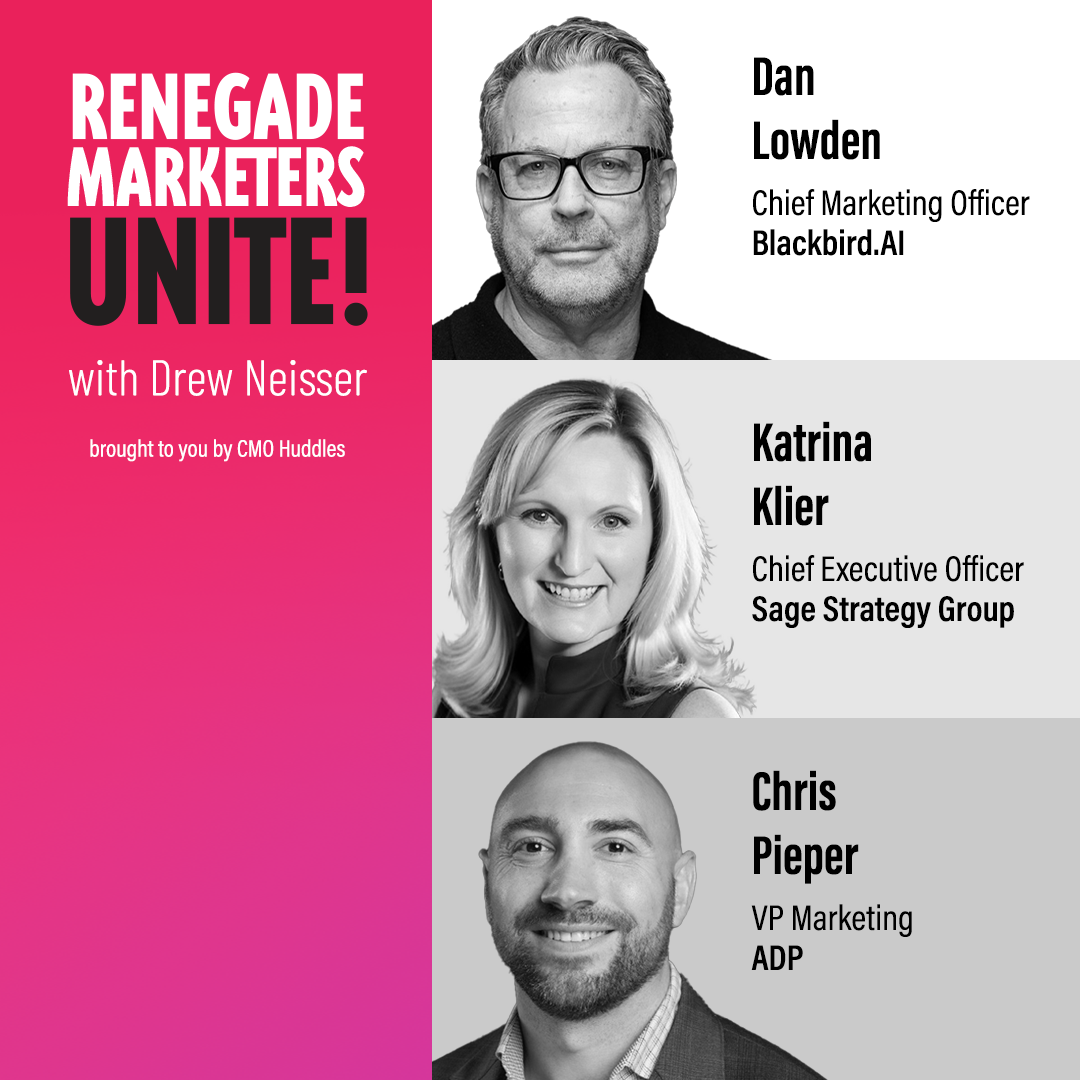
[00:00:07] You are about to listen to a recording from CMO Huddle Studio, our live show featuring the flocking awesome B2B marketing leaders of CMO huddles. In this episode, Dan Loudon, Katrina Clear, and Chris Piper make the case for a different kind of leadership, one where the job is not to be the hero, but to design the system that wins consistently.
[00:00:34] They explore how to build teams and operating models that help better work happen more reliably, and why the strongest leaders are often the ones who make success less dependent on themselves. If you like what you hear, please subscribe to the podcast and leave a review. You'll be supporting the quest, our quest to be the number one B2B marketing podcast.
[00:01:00] Alright, let's dive in.
[00:01:01] Welcome to CMO Huddle Studio, the live streaming show dedicated to inspiring B2B awesomeness. I'm your host, drew Nier live from my home studio, New York City, and today we're tackling a leadership shift. Every modern CMO needs to understand. For years we've been celebrating the hero leader, the smartest person in the room, the one with all the answers.
[00:01:25] But in a world of ai, hybrid teams and constant change, that model feels like it's breaking down. today's most effective leaders aren't necessarily heroes. Their system designers, instead of trying to outthink everybody, they build operating systems that help teams think. Better Together, they create clear workflows, strong feedback loops and environments where learning happens every day without everything running through them.
[00:01:53] So in this conversation, we're gonna explore how to move from chief problem solver to chief system builder, how to design a marketing teams that learn faster than the competition, and how this shift makes you more scalable and more valuable as a leader. So you know that if too much depends on you, if your calendar is packed with decisions, only you can make this conversation is for you.
[00:02:16] With that, let's bring on Dan Loudon, CMO of Blackbird ai, and a returning guest who has previously appeared on the show to discuss many topics including analyst relations, growing high performing teams, and cybersecurity. Hello Dan. How are you? And where are you? This fine day.
[00:02:35] Hey Drew. Good to see you again.
[00:02:37] Good to be on this show and I am in. New York City as well. I'm in our office near Bloomingdale's. So what's a good day to be in the city?
[00:02:45] Uh, it is indeed. We had a little rain, but it's all good now. let's talk about how you build operating systems, if you will, that stay agile. And this sort of, you know, it's almost a cliche to call it a fast moving, tech driven environment, but that's what you're in.
[00:03:02] So talk about that.
[00:03:04] Yeah, I mean, for us, I, I have three quick examples that I can share that we've turned into systems that have made us incredibly productive. Yes, we're leveraging AI in every way we can through the workflow, but I'll give you three quick examples. One is around content. We have a, what we call a Raven narrative intelligence team that publishes all these reports with primary research around how we protect customers from what we call narrative attacks.
[00:03:31] So they go into deep detail. It's incredible work. And then, uh, they pass that to us and then we anonymize that as a marketing team, so we can then publish that as a blog or as a report. And it's become this process where the analysts are very excited to participate, they want to be heard, and the process and the system that we created makes it super easy for them to publish.
[00:03:56] Without doing any extra work. We do take on the work and, and summarize things and polish it and put it out there. And from that we've put out about 150 pieces of content over the past 12 months. Because we're leveraging all the reports they're already creating. So that system's worked really well across multiple departments and it's been very successful with us.
[00:04:16] another thing we've been doing, lightning strike announcements where there are important things that we wanna put out and tell about. The company or the industry. So the World Economic Forum Risk Report just came out, or a big Gartner report came out that said Blackbirds the company to beat and disinformation narrative intelligence.
[00:04:34] We have 10 lightning strike. Events happening, and we're repeating the process every time of what needs to be created and the workflow and how it's published and when it's published. So everybody participates, everybody gets behind it, and these are really important events for the company. Um, and then finally, like I mentioned, Gartner's publishing a lot of reports on our topics.
[00:04:57] That we cover. So we're leveraging their quotes and their quote systems over and over again and incorporating it in all of our content because it's really valuable what they're saying. So we're leveraging it across the marketing team, but incorporating other departments in it as well.
[00:05:13] So a lot of these systems relates to content and, and obviously my guess is that content is a huge part of your whole marketing.
[00:05:24] Program, a
[00:05:25] hundred percent right? We're a new category, so we have to educate the market. So content, content, content, and it can't be slop, it can't be boring, you know, data sheets with marketing language, to be perfectly honest. It has to be hard hitting findings, reports, use cases, Customer stories, attacks on geopolitics or, you know, we summarize, unfortunately, there are digital attacks on executives that turn to physical.
[00:05:53] So we're able to protect the customers that we serve. So we leverage a lot of this content, but we anonymize it in a way that it's easily shareable and understandable, but without putting any risk, you know, to the people we serve.
[00:06:06] Got it. And so when we go, we go back to you as a leader. Obviously you can't review all this content.
[00:06:14] So talk a little bit about the way you make sure that your team knows there standards to be met. What is good, what is, and would Dan approve this or not? And, you know, as a leader setting the, tone and the, The system, right. For, for this, I mean, I, I get all the content and that it sounds amazing.
[00:06:34] It feels like there's some leadership parts of this, uh, involved. I just wanna make sure we, we uncover
[00:06:39] so a hundred percent, like guidelines are critically important. We have to give direction so that say like an analyst doesn't mention something that they shouldn't mention, or one of the content people on my team makes sure something is anonymized in a way that.
[00:06:54] Again, protects the customers that we serve, or, hey, this is a topic that we don't wanna delve into. You know, disinformation is a hot topic across the world. you know, we just announced a, a big, partnership with nato, right? They're involved in disinformation attacks by Russia, China, North Korea, all the time, and there's a lot of sensitive material.
[00:07:13] So we have to set up these guidelines so that my team feels empowered to be able to publish these things. And yes, I do have to, some have to be involved in the reviews pretty much towards the end of this, but it's, it's written in a way where there's not much that I have to really look out for.
[00:07:32] Yeah. And you, I mean, given the fact that you mentioned earlier, you 150 pieces of content, you couldn't possibly read all those.
[00:07:38] No way. No
[00:07:39] way, no way. And so the guidelines have to be very clear. The standards have to be very clear, and I seem to recall that you have, one of your first hire was a very senior. Ex journalist, right?
[00:07:51] Yeah. CBS News reporter. So that was my first hire and that's why this is so important, right? our target market, we work with Chief Information securities, chief risk officers, chief communication officers, and it has to be compelling content that's valuable to them, to educate them, to help them do their jobs better.
[00:08:08] So this has to be really, really good content. It can't just be an AI generated and put out there. It needs to be. Personal human and really provide a, um, value to the people we're engaging with.
[00:08:21] do you have a Dan GPT that your team can use and say, what would Dan say?
[00:08:27] the answer is yes to all the above.
[00:08:29] In so many ways, we're using so many different tools to help us get a head start on things. Um, 'cause that's kind of how we're, we're looking at. You know, thousands of data points in a, say, a narrative attack. We're using AI to help us say, here are the most important ones, or the prioritized ones, and our customers are using that too.
[00:08:50] And that way we can make sure what we're publishing is gonna have the best impact. When, uh, when we share it, right. But we're, we're an AI company, so everything that we do is AI based, whether it's images or video or content, texts that we create. and we're, we're pretty productive with that. I, my goal is to have our company look like a billion dollar company, uh, but our marketing team is five people.
[00:09:13] I love it. Well, it's funny, I'm just thinking about this. Uh, so we do have a Drew GPT, which is, I use quite a bit, which helps with my writing and challenging my thinking and so forth. But I don't have a, uh, a Drew GPT that someone could go, uh, you know, on our team and say, what would Drew say? And, uh, it, uh, at some point in time, I, you know, I think a lot of it's fear that if we do that, then we really don't need to work anymore.
[00:09:37] Uh, yeah.
[00:09:38] Yeah. I mean, I think it, we have to be human. We have to sound human. It has to be us, has to be our voice. And that's important.
[00:09:44] Yeah. I, I love it. Well, from a man who, uh, had a company named Human. I get it. Alright, with that, let's bring on, Katrina Claire, who is the CMO of. eSource and an industry expert who's graced our stage before to discuss many topics including fractional CM Oing content strategy, and the CMOs path to the boardroom.
[00:10:05] Hello, Katrina. Wonderful to see you again.
[00:10:08] Thanks Drew. Thanks for having me. I'm, uh, on the road today, so in between places, but really happy to to be here and join this. So
[00:10:16] are, uh, may I ask what country you're in?
[00:10:19] Going back and forth between the US and Europe for a variety of things. So
[00:10:23] I see.
[00:10:23] Okay. So
[00:10:24] fine on the road.
[00:10:25] You're an international, uh, woman of mystery. We'll just leave it at that. so let's talk about, uh, you know, AI is changing roles and workflows, and I, I'm wondering, so, uh, for eSource, how are you thinking about your team systems? So. The learning is compounding and I, and I feel like that's a really important place to start, because.
[00:10:52] it can be that every challenge looks new and it's say, no, no, no. We solved that over here before. So talk a little bit about the systems and the way you're thinking about them, particularly for, for learning.
[00:11:02] Yeah. You know, I think it's, uh, we're all kind of figuring this out as we go, right?
[00:11:07] And I think one thing. That's helped me, with resources and then in other places as well though, is to really kind of think of your team as really having more three categories of resources now. I mean, we used to think of tech and then our people. Now you have the tech that you have. You have your people, which might be employees, agencies, vendors, you know a whole lot.
[00:11:28] And then you have AI related things, whether those are agents or tools or that kind of stuff, which kind of span a little bit of tech, but span a little bit of what people used to do as well. So thinking about it in three categories I think is helpful so that you don't, Accidentally either think of AI in particular as being only a tech thing or only something that takes human tasks off the plate of your team.
[00:11:51] It can do a variety of both. So that's one. the second one I would say is. You know, kind of really shop at home first. So when you work with your team and stuff in designing more of a system, you've probably got a lot of stuff that could make your lives easier. Today. Maybe you just haven't used all the features like your CRM is an example, your email automation or other tools.
[00:12:10] There's a lot of AI enabled features. You just need to pilot it, plug in the right data sources, and give it a go kind of thing. So you can experiment and bring in that learning element, both for people to learn about AI and systems thinking as well as the system you create, like learning as it goes and getting better without necessarily having to go drop massive amount of your marketing budget to do so.
[00:12:33] so I would say those are two main things and then it, it's really. This sounds like such a nuance, but it kind of isn't when you get into it really architecting an operating system for your team, so how the workflows, what you do, what you don't do, how the system evaluates itself, the system being, again, that combination of those three buckets of resources and improves over time.
[00:12:56] And it's a different mindset, right? Because I think some, many of us, you know, got promoted to being A CMO. 'cause you could solve problems, you could harness opportunities. You know, you were the turnaround CMO or you were the whatever, acquisition, CMO or those were the things that you were known for. And those specific things propelled your career.
[00:13:17] But those things now can change in terms of how you do them so rapidly that I think the differentiator today is really more how well you design systems that can hold up beyond the one thing or the group of things that you need to do today. And it sounds like a nuance, but I think it's a, just a whole new way of thinking about it.
[00:13:33] And I think AI is that differentiator for CMOs going forward. Are you a
[00:13:38] Yeah. Larry,
[00:13:39] stop you, CMO or System one?
[00:13:41] Well, and I, and I think that's the point of the show and we will be, uh, you know, this was, uh, Chris's idea for a show. We'll be talking to Chris in a second, but I do think that this we're really talking about, right.
[00:13:52] You were, it's well framed. You were really good at this, you were a. Help a company get from 35 to a hundred million. You had a playbook that did that, and you'd hire a certain number of people on your team and so forth. And, and now it feels like there could be a shift where. You are designing this system, if you will, that helps you and your team in a way that you probably never could have done it before.
[00:14:19] I, I'm curious with you, you mentioned, I mean, I think everybody understands people. You, you know, you, you still want really good people. I think we're looking at people maybe differently, right? We might be saying, Hey, they, they need to be tech, not necessarily tech savvy. They need to be. Tech aware and tech curious, right?
[00:14:36] Mm-hmm. Or I should better say ai. Curious, AI first, then, tech as in, you know, MarTech and so forth. All of that's up for grabs now. So now we gotta look at, uh, where, I guess one thing that you could help me understand is you talked about agents. I'm just curious where you're seeing those on the org chart right now.
[00:14:56] Yeah, and so in fairness, we're still working this out at, at the E-Source specifically. Um, but in general, like the thinking is more, you know, think about what. People really need to do, what do humans really need to do? And those tend to be things like. Framing the problem, defining the parameters for success.
[00:15:17] Creative direction is a big one there. relationship building, you know, criteria and frameworks you're gonna use to make trade-offs. 'cause we all know marketing is all about trade-offs. stewardship's a big one that your, your humans need to be out in front of your people as well as. Ethics, and ethics in particular with how we work with ai because that includes a lot of data related things, privacy things, and a whole bunch of of stuff there.
[00:15:41] So I think it's important to really think about what do humans really specifically need to do? And that's gonna vary by company, quite honestly, what you're, what you would put in that bucket or not. Processes and things, I think become more modular so you can do shorter cycles. I think a lot of us got really good at iterative improvements on things, and so that kind of lends itself into more experimentation with things to see how far you get, and then the agents and the AI tools kind of fit in between things, right?
[00:16:08] So if you identify a lot of tasks, as an example, that are really repetitive. Like you've got the data you need to, to do them. You kind of roughly know the volume of them you need to do, you know, what needs to happen on the other side of it. that's kind of perfect for an AI agent.
[00:16:23] Right? And you can go put them in there with the caveat that like, building an AI agent is a bit like hiring a new person in your team. you hire someone and they have all the capabilities to do the job. That's why you hired them. You built the AI agent with all the capabilities to do the job. 'cause you built it that way.
[00:16:40] It doesn't mean the first thing that this AI agent, just like your employee does, is gonna be like the best thing since slice bread or the best thing ever. It needs. Those agents need feedback. They need feedback in terms of tuning, tweaking, adjusting different things, feeding it different data, feeding it better.
[00:16:58] Reference models and examples for things just kind of like you would a human when you hired them, you sit down and like, this could be better. That's not quite right. You know, do this or this, less of that. and I think in setting up agents, that's a piece that a lot of people miss. They just think, well, it's ai so the first time it does something, it's gonna be right.
[00:17:16] Like, you know, awe inspiring. And that's rarely the case. It's like hiring a new person. You like you have it. You have to coach it along to be better. Perfect. So we, we've been looking at places where we can do exactly that. Like what do the humans really need to do? Where can we, um, rinse and repeat some things with some agents or AI enabled tools?
[00:17:34] Like, again, a lot of this is built into stuff you probably already have, so can you turn that on and use it? And then I think it's less about, you know, what so many of us have done in the past, which is build a manual process and then automate it. If you start there, I think you miss. What AI can do for you.
[00:17:51] So you need to use AI to help you figure out how to use ai, right? Plus your people and input from that standpoint.
[00:17:58] Perfect. And we're gonna come back to that. We'll, we'll come back to that. I wanna get, I wanna give Chris, who's been waiting patiently, I wanna bring him on chris is the VP of marketing at ADP who has previously joined us to shed light on the intricacies of product launches and leading through transformation. Chris, welcome back.
[00:18:15] Thank you. Happy to be back
[00:18:17] How are you and where are you?
[00:18:19] I am good. I'm, I'm in my, uh, basement today in America, New York, I think.
[00:18:23] Too fancy. Last week I would've been in Prague, which was way cooler and
[00:18:28] much cooler.
[00:18:29] What an awesome city. just for, for the audience. But, uh, amazing city worth, worth a visit.
[00:18:35] Well, I wanted sort of, I mentioned earlier that you had this concept for this show and some very specific things in mind, and I know Dan and Katrina attacked it one way, but where would, this was your idea of, for a show, where do you see, uh, approaching leadership as a system designer instead of a hero?
[00:18:54] I appreciate the question. I, I think the biggest thing is that the job of a leader. Isn't to win the game, it's to design the machine that wins consistently. I think that is kind of where we are today. So, and Drew, I think you actually mentioned this before, I think I heard it from you directly, but I love this and I think about it like every week, not to, you know, kind of blow up your head too much, but if the internet democratized access to information, which.
[00:19:18] A statement, generative AI promises to democratize expertise. And what does that mean, you know, in theory really changes what leadership needs to be. So I believe personally that the future, you know, the leader of the future is not the deepest specialist in the room. It's a generalist who can do two things extremely well.
[00:19:35] So the first one is learning new domains and challenges very quickly and very effectively. Obviously, AI assisted and number two. Age old does not change. Still relevant. Building high performing teams, right? People in the right roles doing the right thing. So as I look at my organization, I try to think about it as more of a, an engineer overseeing the system.
[00:19:57] My job is not to execute marketing programs and events. Of course it is, but it's really to build and refine a repeatable operating model that improves over time. So if hero leadership creates dependence on kind of approvals and things of that nature. I think system leadership creates progress
[00:20:14] system leadership.
[00:20:16] All right, so what's so interesting, I always talked about the roles of, of any leader as, as three things. Uh, uh, one, build a team, two, allocate, set the vision. Three, allocate resources, right? But it's really set the vision. Build a team, allocate resources. What I love about your framing is learning do new domains becomes a a really interesting, in some ways that's sort of part of setting the vision, but that's a lot of stress right now and I think a lot of CMOs are freaking out about, because there's an infinite amount of domains to learn right now.
[00:20:51] Yeah.
[00:20:52] Like have you spent any time on Open Claw? I haven't gotten there yet, but it's, everybody's talking about it, right?
[00:20:59] Mm-hmm.
[00:21:00] So I'm curious as you think about your personal journey to learn new domains as part of it. 'cause look, we could talk about building high performance teams all day long. Yeah.
[00:21:11] And I think we should. But it's this learning new to Bains that I think is the one that, might give some CMOs pause.
[00:21:18] I think it's a great question. I, I, I think it's, it's, it's just an understanding of the world we're living in now, but I also think it's always been kind of the case outside of companies that are, you know, very much kind of top to bottom, consistent, repeatable, here's what we do.
[00:21:32] if you are an organization or, or a market where you're pivoting and you have to change, I think a good leader would always have to. Kind of deal with that. And a good example I, I can give from my, my experience in terms of just like, how do you apply this concept is, and, and, and I know in a previous, uh, podcast I mentioned our kind of account-based marketing approach and, and how we've implemented that.
[00:21:53] But just this kind of agile a BM machine, if you would. Not a one-time launch years in the making, testing, learning, refining, iterating, what have you, and instead of treating them as more of like a waterfall kind of start and end date type of campaign, more of an evergreen model with cross-functional pods, with sales, product marketing, you know, content and creative from my team, sales enablement experts and demos, other relevant SMEs, et cetera.
[00:22:19] And what we've done in terms of like really. Systematizing. This is creating a clear operating rhythm. So we have not two week sprints, but three week sprints. Not that it matters, it just kind of works for us. But three week sprints, we actually have a dedicated scrum master that leads these sprints. We have three standup meetings a week.
[00:22:36] We have a monthly performance review. With sales leadership, and we have quarterly recalibration sessions, if you would, just to kind of understand what's working, what's not, how do we iterate and improve? And obviously ai, as we've kind of mentioned, like, you know, increasingly, you know, plays a role on the team, you know, more so over time with aspect creation, personalization, automating workflows, what have you.
[00:22:57] and, and just as we look at the system, at least in terms of, of my world, like. How do we determine if this system is healthy? So we measure three discrete things. The first one is the obvious, most straightforward business outcomes. If we're doing a, a program, you know, a campaign, our close rates improving is sales cycle length reducing is pipeline velocity increasing.
[00:23:17] That's the obvious one. The second one is, is like the execution discipline. So we actually in, in our team, we use, Jira cloud. So we're actually looking at like a, like a traditional, kind of think of it as a, a sprint team in the product development world, but like, what are our tasks? How are they be being, you know, completed?
[00:23:34] Are we seeing any problems? Is it being completed based upon expectations? So like business outcomes. Execution discipline. And the third one, which I think is as important as any, is like team health, like in terms of engagement. So we actually have engagement tools that we use at a DP to measure the members of the team, that are part of these kind of sprint teams.
[00:23:55] And we've seen increasingly, like over time, but like regardless, like no question, increased level of engagement and, and, uh, commitment for members, you know, members of this team versus just kind of the status quo. So. You know, over time, like all of our kind of business outcome, ma you know, ratios and metrics I mentioned have, have improved.
[00:24:13] it's really looking at this holistic aspect in terms of just general kind of what are you accountable for traditionally. is a team working and, and being as efficient as we expected? And how are they feeling? because again, we're not fully automating, you know, Skynet AI kind of situation at this moment.
[00:24:30] We still have humans, right? I love the word human that was mentioned earlier, like we, we can't forget that word, which sounds. So ridiculous as humans, but like how are the humans feeling?
[00:24:41] I don't know. We better ask the machine.
[00:24:43] Right? Exactly.
[00:24:46] you know, this is, so what you laid out for us is a system, and I love that with the steps and the software and so forth.
[00:24:54] I couldn't help but think. You could have done that system pre ai.
[00:24:59] Mm-hmm.
[00:25:00] And I think a lot of folks are looking, so how is AI turbocharging that, uh, if it is at all, so really great example of system. Got it. And the sprints and all of that Makes sense. And, uh, it feels like anybody who, and by the way, it feels like a go to market team as much as a marketing team, which I think is also important.
[00:25:19] So as that's going along, you could do that Scrum, you could have done it three years ago. You're gonna obviously do it today. What's happening that's somewhat different as a result of, infusing AI into the process?
[00:25:31] Great question and, and maybe I'm wrong. How we're approaching it is we know the world and we're approaching the world as if we know the world.
[00:25:40] AI as an augmenter, a catalyst, an opportunity, that is again, kind of increasingly being infused versus a, you know, complete delegation to AI go solve our problems for us. So, you know, we're still humans running this company. Um, as I was saying before, so it really does matter, but obviously, like I said, in terms of like the tasks within this model, you know, whether it's content creation, automation, summarizing team meetings, like what are the key takeaways?
[00:26:05] All of that increasingly is, is being, you know, injected into this process. where I'm sitting, where we're sitting is, it feels very important to have that kind of human element where the people are, are running the ship, um, while using AI as an augmentation tool versus a governing tool.
[00:26:21] Yeah. And I, I think I, I'm certainly, agreeing with you and, and I'm not pushing to say that, oh, AI's gonna run it. I think the inflection, the question that I have, and we'll talk about this, uh, after the break is sort of are we at an inflection point where leadership has fundamentally changed? and therefore, uh, the people on your team need to change the way you lead changes.
[00:26:44] And that's the part I wanna sort of get at when we get to the second half. But right now, let's talk about, and it's time for me to talk about my favorite subject other than CMOs, which is. CMO huddles launched in 2020. CMO huddles is the only community of flocking awesome B2B marketing leaders, and it has a logo featuring penguins.
[00:27:06] Wait, what? Yes. Well, a group of these curious, adaptable, and problem solving birds is called a huddle. And the leaders in SM o huddles are all that and more huddling together to conquer the toughest job in the C-suite. And as this discussion has, uh, shown, it's not getting any easier out there. But Dan, Katrina, Chris, you're all incredibly busy marketing leaders.
[00:27:28] I'm wondering if there's a recent example of how CMO huddles has, has helped you. You guys have all said nice things before, uh, so if anything, new to add.
[00:27:38] I'll just add, I had a great one-on-one with another Huddler. Right. And to me, you're introducing us based off of what their needs are, their challenges are, and some of them I've solved and some of them I haven't.
[00:27:50] But those conversations to me are incredibly important and powerful.
[00:27:55] I, I appreciate that. I appreciate you taking the time to have that one-on-one. It's something we are emphasizing more and more this year, because I do believe we may be at this leadership inflection point. So thank you for that, Dan.
[00:28:09] Chris, anything?
[00:28:11] Yeah, I can go next for sure. I, I, I think two, two things, the networking aspect and the perspective gaining kind of part and parcel. But, you know, no question. You know, at one point, uh, last year we were talking about our new measurement framework and I was able to reach out to you and the team and CMO huddles and it connected with an SME who was so deep in this.
[00:28:30] And it was enormously helpful. So I think those are certainly, and there's many more, but those are definitely what's been pertinent to me.
[00:28:38] Katrina, any. Additional thoughts?
[00:28:41] I agree with all that. And I would say just the, the network effect of CMO huddles because if, if you're trying to solve something, there's a good chance someone else in huddles has solved it already or has at least been thinking about it as much as you have, and two heads are better than one.
[00:28:54] So it's been incredibly helpful from that standpoint and hiring people as I've been building teams, like some really great referrals from folks I
[00:29:01] love it. All right, well, we appreciate you, uh, you three. Uh, if you're a B2B marketing leader who wants to build a stronger peer network, gain recognition as a thought leader and get your very own stressing one, please join us@cmohuddles.com.
[00:29:16] Okay. We did have a question from the audience while we had our lovely conversations and they asked this sort of million dollar question that, or maybe it's a billion dollar question. What do you think about AI and the ability to transform and make leaner companies? Anybody wanna jump in on that one?
[00:29:30] Chris, I'm just looking at you.
[00:29:33] I'm happy to. In theory. Yes. Right. I mean, we all kind of feel this. It does feel, to me at least that, not only a adoption, but I just feel like we're on the, you know, the, the absolute peak of the Gartner hype cycle right now. I think this is different than, uh, things like IOT and 3D printing and maybe other things in recent years that have come up that are, you know, kind of at that same kind of peak.
[00:29:57] I think this is clearly, you know, systemic and, and this is gonna change the way in which we all. Work and operate, communicate, and we can go into the dystopian, prophecies, if you would. But I, I think that it's, I think the prudent way, as I was kind of saying earlier is, Not a, you know, we're gonna throw the chessboard, you know, topple the chessboard and reimagine everything all at once. But it's more about insertion, thoughtful, uh, kind of insertion in terms of how we think about this. yes, and I've heard Sam Altman and others mention that, In the next five years, we'll have the, you know, the first single person, billion dollar market cap company.
[00:30:38] And maybe that's true, but I think just generally for the masses, it needs to be more of an augmentation engine. It needs to be more of a, how do you kind of, just do better work. How do you be more efficient? How do you plug it in to kind of optimize processes? But at this stage, as I was saying before, I think it's very important that humans still have the reins and are still running the ship to get into Skynet Terminator two.
[00:31:00] Kind of like negative, but I mean, it, it, it's just important. Um, and I think we're, we're early in this stage, but I think it's important, obviously from an existential perspective, from an adoption perspective to really kind of, you know, be involved in this versus kind of wait and see, this is not a wait and see kind of moment.
[00:31:18] Yeah. So, uh, dan, I'm thinking about you. You have a small team. do you see yourself, adding five more in the next year or really saying, no, we're gonna get 50%. our team is gonna be that much more productive.
[00:31:30] We don't need to.
[00:31:32] Yeah, great question. I mean, I think we're still gonna need. More experts, um, to join the team. My team, there's no question, right? But we're gonna make those experts more effective, more efficient, and I, I like what Chris said is like, with ai, we're gonna enable our systems to win more consistently, be more repeatable, right?
[00:31:51] More scalable, and more valuable in my minds. But it, it's gonna give us better ideas. It's gonna make what we create that much better. I, I look at AI as a good friend or a colleague, or. An assistant that can help me be better, it will help my teams be better. So I do feel we're at this inflection point.
[00:32:08] it is fascinating to see daily, weekly, like what's new in the world around ai and you know, how that impacts marketing. So it's just fantastic to be a part of this next wave. To understand how we can leverage marketing and do it even better. and that's my view of where it is. I still will say the human element and human relationships will still be really important.
[00:32:30] Yeah, it's, it's funny, the, uh, I've been using, uh, the tool a lot for, uh, uh, strategic work and I'm also listening to the, uh, AI driven, uh, leader right now, and my mind is spinning with. How much the tools can do as an augmentation, but the speed at which it can do it certainly frees me up to, do other things and frees our team up to do other things.
[00:32:57] And I know, it's funny, I, I think larger companies, and you may be seeing this, uh, Chris, larger companies are struggling because. you know, say 25% of the employees adopted this stuff and went crazy and then 25% said, no, no, it's using, you know, for whatever reason has have an issue. And I just don't know if there's room on any team at any company for anyone who is, uh, not, I'm gonna say.
[00:33:23] An AI first thinker. Anybody wanna argue with me on that? Go for it. Come on, let's get spicy.
[00:33:32] I think it's hard to be an AI first thinker. and there's so many companies and major, major multi, like, literally like Cent a billionaire. Brands that are out there that have got all in on this. I mean, I think about Salesforce, I think about others like for sure. And, It makes sense. And listen, we're marketing right.
[00:33:51] We, we, generally wanna be ahead of the curve. We wanna be a visionary depending upon the brand. We wanna be out there and, and kind of profess this vision. it's just so unpredictable now. I think more than any time, probably in human history for 75 pounds. We really do believe that. Like this is not one of those fly by night again, hype cycle things that will go away, even though we may be overhyped at the moment. This is clearly a, a, a, a structural type of a change. So we have to embrace it, but I, I think we have to not be crazy.
[00:34:19] I, I'm gonna challenge that. I think you have to be crazy. Okay. I think you really do. Okay. I think that any like. Go on the whiteboard, erase everything that you've got other than you are a leader who takes care of your people and builds an effective team. However, if that team isn't being as effective as they can be because they're not using the tools you are gonna lose.
[00:34:40] Two, you're gonna lose out two. And I, I, you know, I, I mean, I've drunk the Kool-Aid way probably too much, but I, I, again, the deeper I get into this and suddenly I'm writing code over the weekend that's solving a major problem. I'm doing this and I'm, I'm doing it only so that I can understand what to ex.
[00:34:58] What, other folks can do it. so this is a moment, guys, and so I really wanted to talk about the system because if it is about leadership system, and not necessarily even your wisdom, but your ability to ask questions and then have judgment, but so much of this can be processed faster. Doesn't that change how you lead?
[00:35:19] Yeah, I'll, I'll say a hundred percent. Katrina, did you want to go?
[00:35:23] Yeah. You know, I think it's, I, I get asked a lot what's the difference between all this AI stuff, right? And digital transformation. 'cause I did a lot of work in digital transformation over the years, My answer is generally that the biggest difference is digital transformation.
[00:35:37] Like you kind of worked through it systematically across your company. versus AI is everything everywhere, all at once, you know, you can't, you can't contain it to certain things. You can't say, we're only going to use it on go to market, but we're not gonna use it in our product, or we're not gonna use it in operations.
[00:35:54] ' cause then your whole company gets out of balance, right? So. I think there's a speed part to it. I think it is probably the most pervasive category of technology that we've seen. I don't know, maybe ever, at least in my career anyway. Right, and, and I think it's, it's a mistake to think about it as it will make your company leaner.
[00:36:13] 'cause that means your company is static, right? It's just smaller. And I think because of the everything everywhere, all at once, part. That's not necessarily the case.
[00:36:22] I, you know, just agree that this, you know, I don't wanna, this, if you had five people and suddenly they can be four times more productive, in theory, you should be able to help the company gross.
[00:36:32] but I do think. There is a gap, and I wonder if this is fair. you're building a system that relies on your team members to do stuff, right? And in theory they're doing it in an AI powered stuff, but I'm wondering if you're investing enough in training so they actually, at least at this moment in time, know how to do stuff and then three months from now know how to do stuff.
[00:36:53] And so, ' cause it's kind of hard. To just say, okay, go figure it out. Ask the AI what I could do with this today to make my, you know, and so I'm wondering, and Chris, yours is a big company, as is training part of what you are doing as a leader to make sure that people on your team are deploying and operating under your system.
[00:37:11] But better, better and faster.
[00:37:14] I think, yes. Mm-hmm. No question. how do you use these tools? What are the new tools? They're all emerging Profound. It's not, it's not, obviously we're way past like just chat CBT for writing emails we're way past, we're way past that, as we know, in terms of process, auto automation and, and all of that.
[00:37:31] I'm gonna come back to the humanity for a second, 'cause I don't wanna, I don't wanna lose it because, you know, going back to terminator 2, like, I think it's most effective, not as a, you tell me what to do, ai, but a, I want you to be faster. Help me with this task. Help me design. Maybe help me think about this in a way.
[00:37:49] I haven't thought about it before, but generally I still think it's important to have the humans governing the approach. let's have a podcast in five years. Let's have a podcast.
[00:37:59] Yeah. Let's, most likely there will be the Drew Bot doing these interviews, I'm pretty sure,
[00:38:04] right?
[00:38:04] Yeah. Your avatar
[00:38:05] and I'll be going into, it'll be interviewing your, your. Things. It's funny you mentioned writing your emails. If I, Hey, can I just beef, just whine a little bit, copilot, like, give me a break. All I wanna be able to do is repeat an email that I sent three days ago on this topic. Just find that information, put it in the email.
[00:38:23] Can't do it. Right. It simply can do a, sorry, Microsoft, but I'm calling, calling you out on this. This is huge opportunity. You could change our lives. There are lots and lots of repetitive emails that we're doing that, um, you could solve for if you were just a little bit better at this. Yeah.
[00:38:39] So, so Drew, let me just add, 'cause I think my team is a little bit different.
[00:38:43] We're, we're smaller, but we are an AI. First company, right? So everything we're doing is leveraging ai. And I asked my team, they're, they're actually helping train me because I asked 'em to go try a new tool every week or multiple tools every month and report back like, Hey, was this tool helpful in your job?
[00:38:59] What was the good, what was the bad? What was the ugly, you know, for example, uh, two of my team members are going to A GEO, event today to learn about how we can be more discoverable in LLMs, right? So they're going out to this conference. And they're gonna report back and say, Hey, these are the things that we learned.
[00:39:16] So the training aspect, I'm pushing them to learn and then they're bringing it back to the team to train and, and educate the entire team and educate me, right? So I think that's critically important for us to stay on top of things and to be aware of what's coming and what's happening. I'll just say the other thing, like product cycles.
[00:39:34] I used to work for hardware companies and we put out a new product every three to six months. In this world of ai, we're putting out updates to products every week. Right. And you have to, to move with marketing that fast to be able to update that story. And you know, that's one thing we're leveraging AI to help us do that.
[00:39:51] So it it's changing the whole company. I think to move faster, as you said. and at the same time, it's making us better. And, and I agree with, what Katrina said. It's not, you know, what could we do with less people? It's, it's how do we make those people more efficient, more effective, and make the company more successful?
[00:40:08] And my team is gonna grow, but. I am gonna have AI help us, you know, do a lot more things than we ever could do before.
[00:40:16] I love it. I wanna ask if we're moving from a hero structure of, I guess, being the decider to a systems designer, is there a metric or two? Uh, and I'll ask, uh, Katrina, that, gives you a sense that your operating system is healthy, that you, you're, you're on the right track.
[00:40:34] You know, I think we all think about this a lot. Where my head's kind of gone on this of late is, you know, less of a metric that some system spits out for me, right. That I can point to and say, aha. On the graph it did the right thing. Right. And more around the time it's taking us to get from like an insight to an implemented change that creates impact.
[00:40:54] because that's the part where marketing makes the difference, right? You know, we've had dashboards forever and this, that and the other, and it takes 10 meetings and 55 conversations and 3000 emails and then you can action that insight and then fast forward two months and it has an impact, right?
[00:41:08] So if you think about how much faster you can do some of those things now, That's what gets me excited and kind of what I'm watching to see if the system is effective because at the end of the day, that's what it's all about, right? It's an ability to serve our clients better, do the right thing for our employees, like be better members of the business and broader community.
[00:41:27] And so how can we turn those action, those insights into implementation that creates action. Faster. So it's not, it's not necessarily something that spits out from a lovely system someplace and gives me the answer, but that's kind of what I've been keeping in mind.
[00:41:41] No, I
[00:41:42] love it. I, it's like insight to impact is really an interesting, I think that's a really interesting way of thinking about this. Dan or Chris, did you wanna weigh in on this, uh, system metric notion?
[00:41:55] I mean, I, I'll just, I'll just say from a production perspective, you know, that's how we look at it is are we producing. Better content? Are we better producing better outcomes? And do we see that in, you know, more inbounds, more pipeline, more customer success, more feedback from customers? And to me, those are the metrics that we normally track.
[00:42:16] Are they getting better because of this?
[00:42:19] Got it. Okay.
[00:42:20] And Chris
[00:42:21] Drew, I, I, I think it's, I mentioned it before, but it, it's three things. Like the first one is obviously the business results. Are we being effective in terms of pipeline, generation, win rates, what have you? are we kind of getting through those tasks that we need to deliver, which we've all agreed upon in this system, if you would, um, effectively, and, and then like I said, how, how are the people.
[00:42:41] Feeling that are part of these teams. ' cause if they're melting down, maybe a great system, I'm presenting to the CEO and then it's like, not great. Um, so it, it's, I think it's, it's those three elements from us.
[00:42:52] Yeah. It's like I can just feel it. I, I love your scrums. Uh, Chris, uh. But you three weeks is killing me.
[00:42:59] Yeah. And, and I mean, the irony is that scrums used to be four weeks or six weeks, and now it's three weeks. And, and the machine, the the, and all you have to do is run it through the AI and the AI say, oh yeah, we could, we could take a week off of that. Just do this.
[00:43:13] That's
[00:43:13] right.
[00:43:13] Yeah. And Chris, your point about team health, I totally agree.
[00:43:16] I had my team in the office with me over the past two days. It's important to still get together, right. And sync up and make sure everybody's feeling good about things and what's working, what's not. And those are discussions. So I, I think the team dynamic is really important that you point out there.
[00:43:32] I a hundred.
[00:43:33] Well, last thing, if I can say Drew, not to hug too much of the airtime, but like Dan kind agree more like we're people. We're people and, and like, I think COVID was an accelerant, no question about it. But this whole notion of like completely remote work. And I know a lot of companies operate that way and they're very successful, some of them, and that's great.
[00:43:50] But like people were meant to be with people and like there's just, I, I just, I will fight to the death about this. Like, there's no substitute for that of getting together, whiteboarding, collaborating, getting to know each other. You can't replace that as long as people are having jobs and it's not all agents.
[00:44:06] So God forbid that happens, and maybe it will, but for now, people have to be people.
[00:44:10] I feel like I'm gonna break out in a Barbara Streisand song. You know, people who need People. Holy cow. and yes, I think it. Could be tempting. I thought you were a PE backed firm.
[00:44:21] They might be putting a lot of pressure on you as a, as a leader in the organization. And I think part of this conversation is about the world is shifting a little bit, or a lot, a lot. And, You are still going to need human, but I think the type of humans, not, not the way you treat humans, that can't change, right?
[00:44:43] We still need to be, but you might have a slightly different makeup of those folks based on. The skillset. And it's funny, this may be a terrible example, but, um, I did talk to a CMO who said, I'm not as strong at product marketing, but you know what, I've been, I built a sort of, uh, program for myself and I can fill in that gap.
[00:45:05] So I'm not gonna hire a product marketer right now. I'm gonna hire somebody else who can help me do this. So that kind of decision. Was never possible before. So you're still in the business of allocating resources. Right. And and that is fascinating at this moment. ' cause it's like, okay, what are we really gonna allocate towards?
[00:45:26] And what's really hard is it's almost impossible to keep up with what is possible right now. So, God bless you for doing what you do, um, and, and fighting the good fight. Thank you for that. I wa I wanted to, a new way to wrap up, which is if you could, you've all participated in this conversation, if you could provide your one key takeaway from today's conversation, not necessarily something, maybe you heard it from one of the other guests, but gimme one key takeaway from today's conversation.
[00:45:58] Uh, and we'll start, uh, with Chris because you were last, uh, at the start.
[00:46:04] I think the big takeaway is we all appreciate the world we're living in, but we're all figuring it out. I don't think anyone has truly figured it out, partially because technology is evolving so fast, but generally speaking, this is, bigger.
[00:46:17] Like we were saying, this isn't some iot thing or whatever. Like, it, this is an existential like. You know, I, I heard estimates of, you know, 10, 20% of, the employed workforce in the United States in five years being unemployed. Like, what does that mean? that, that's obviously separate from our jobs in terms of achieving outcomes and selling and, and of course.
[00:46:37] But I, I just feel like there is a bigger implication of what we're all talking about. Not that anyone's gonna take a stand in a capitalist society. I'm not like making a political, I'm, I'm not at all. I, I like, of course, I'm here to make money. Like, let's not make a mistake. But I think there's additional, additional consideration of like, how do we think about all of those things versus just, yeah, I had a team of 49 and now I have 47 agents, and two people, and I'm so happy.
[00:47:00] Like, is that good? I dunno. Well,
[00:47:02] that's a different issue, but your big takeaway is we are in a moment. This is a moment. All right. Um, Dan Loudin, what's your big takeaway from the conversation today?
[00:47:11] Yeah, I agree. We are in a moment. yeah, I love the idea about, you know, the systems designer, systems leadership, where you can.
[00:47:18] Create repeatable success, right? To empower your customers and serve your customers better. 'cause that's what it comes down to, right? how that's gonna play out over time with people versus AI tools and agents. you know, it's really gonna be fascinating to see, but I think it comes down to how do we serve our customers better?
[00:47:36] Uh, and if we stay true to that, then I think we'll find the right balance.
[00:47:41] Love it. And Katrina, one quick takeaway.
[00:47:43] you know, at the risk of being cliche, I think you have to be very comfortable being constantly uncomfortable, because that means you're growing, right? And, it's important for your team too.
[00:47:54] Humans need context, right? Humans need a lot of context, and so part of that context is it's okay to try stuff. It's okay that some of it's not gonna work. It's okay to experiment. It's okay that you don't have all the answers because nobody has all the answers. Right. and so I think it's that we're all used to being uncomfortable in moments of time but your new homeostasis is a constant state of uncomfortable, which I think is foreign to most of us.
[00:48:19] But, uh, it's a good thing at the end of the day because it means you're growing and you're learning, and your team is too.
[00:48:23] I love it. Alright, well we are, uh, I am certainly getting more comfortable being uncomfortable, but not when it comes to talking to you guys. It is a treat for me. So thank you, uh, Dan and Katrina cli.
[00:48:35] Uh, Chris, uh, you're all amazing sports. Thank you audience for staying with us.
[00:48:39] To hear more conversations like this one and submit your questions while we're live. Join us on the next CMO Huddle Studio. We stream to my LinkedIn profile. That's Drew Niesserr every other week.
Show Credits
Renegade Marketers Unite is written and directed by Drew Neisser. Hey, that's me! This show is produced by Melissa Caffrey, Laura Parkyn, and Ishar Cuevas. The music is by the amazing Burns Twins and the intro Voice Over is Linda Cornelius. To find the transcripts of all episodes, suggest future guests, or learn more about B2B branding, CMO Huddles, or my CMO coaching service, check out renegade.com. I'm your host, Drew Neisser. And until next time, keep those Renegade thinking caps on and strong!