AI in B2B Marketing: Wins, Misses, Next Moves
GenAI now sits inside content workflows, SDR outreach, and competitive intelligence. Marketing teams are seeing real wins and real growing pains, and the open question is where to focus next.
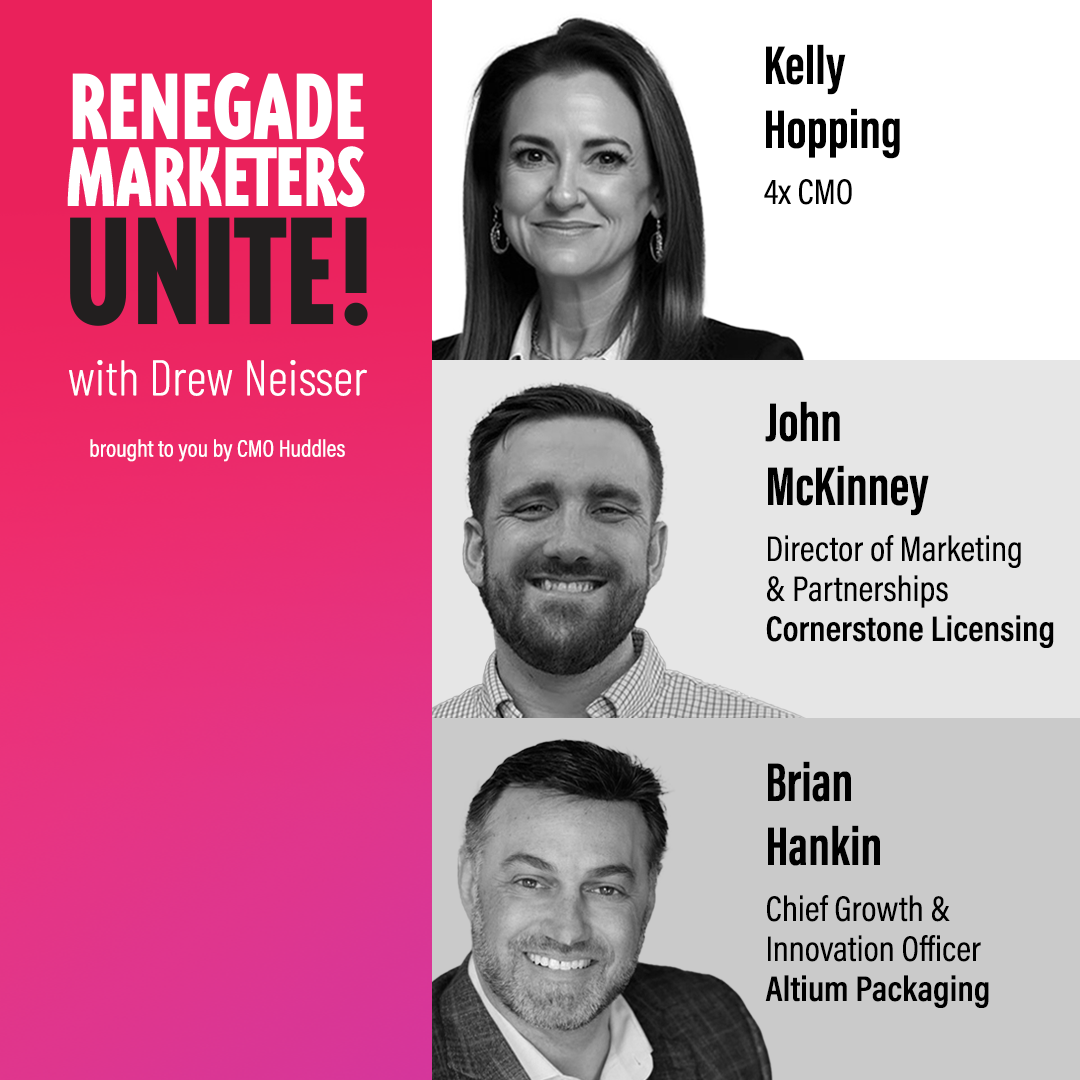
To answer that, Drew brings together Kelly Hopping, John McKinney (Cornerstone Licensing), and Brian Hankin (Altium Packaging) to share the AI plays they are running right now and how they’re leading the charge. Here’s how:
In this episode:
- Kelly shows how AI weaves through content, SDR workflows, web chat, product work, and SEO, plus how OKRs and certifications lift AI fluency across the team.
- John uses AI agents for competitor tracking, outbound support, and coding, and treats AI as a sparring partner for strategy before it reaches the C suite.
- Brian runs an AI campaign engine that builds multi-touch programs in minutes and tracks lifts in engagement, qualified leads, proposals, and wins.
Plus:
- How AEO connects to SEO and what needs to shift for LLM-driven discovery
- How leaders model AI use with internal knowledge bases and cross-functional pilots
- How to structure AI readiness
- Where CMOs can start
Tune in if you want AI use cases you can put to work now and a clearer view of where to point your team next.
Renegade Marketers Unite, Episode 497 on YouTube
Resources Mentioned
- CMO Huddles
- Tools mentioned
- Past episodes mentioned
- Kelly on Building Marketing Teams
Highlights
- [1:53] Kelly Hopping: From content hacks to full-stack AI
- [5:00] The SDR Human-AI sweet spot
- [7:33] AI replaces SDRs on web chat
- [9:57] John McKinney: AI agent for competitor intel
- [12:34] Brand safe agents that ship posts
- [16:14] AI agent spins campaigns from CRM
- [18:20] Brian Hankin: About Altium Packaging
- [19:10] AI campaigns for every persona
- [22:25] Proprietary inputs, human edits, higher CTR
- [26:59] CMO Huddles: Connect, learn, act together
- [29:20] AEO, GEO, AIO… or is it just SEO?
- [34:21] Make AI readiness everyone’s job
- [42:33] Are cross-functional champions in place?
- [46:20] Advice on adopting and disseminating AI across org
Highlighted Quotes
" AEO, GEO, and AIO are all a load of crap. I think they're consultants trying to convince you that you need some extra service that you didn't have. SEO is SEO."— Kelly Hopping
" Use it as a sparring partner. Let it be the thing that tells you that you're wrong about something so you can defend that before you present it to your board."— John McKinney, Cornerstone Licensing
" Get comfortable with it, start somewhere if you haven't, and then keep growing and learning from others."— Brian Hankin, Altium Packaging
Full Transcript: Drew Neisser in conversation with Kelly Hopping, John McKinney, & Brian Hankin
You're about to listen to a recording from CMO Huddle Studio, our live show featuring the flocking awesome B2B marketing leaders of CMO huddles. In this episode, Kelly Hopping John McKinney and Brian Hankin share how AI is woven into. They're marketing teams. They talk about where is speeding up work today, how they maintain firm human oversight, and what it takes to roll out AI in a way that frees teams up to focus on higher value problems.
If you like what you hear, please subscribe to the podcast and leave a review. You'll be supporting our quest to be the number one B2B marketing podcast. Alright, let's dive in.
Welcome to CMO Huddle Studio, the live streaming show dedicated to inspiring [00:01:00] B2B greatness. I'm your host, drew Eer live from my home studio in New York City today. We are diving into the ever evolving world of Gen A AI in marketing. Not the hype, but the real world wins, learnings and growing pains from campaign optimizations to strategic innovation.
Our guests are here to share what's actually working, what's not, and how they're preparing their teams and their companies for what's next. It's a lot. We got a lot to cover here, so we're gonna get right into it. With that, let's bring on. Kelly Hopping, CMO of Demandbase, and a returning guest who previously appeared on the show to discuss integrated campaign strategies and building marketing teams.
Hello Kelly, how are you? And where are you today?
Hey Drew. I'm doing great. I am in Austin, Texas.
Austin, Texas, home of U of T. so. I know you were an early advocate of using gen AI in marketing. Is there a particularly wording [00:02:00] project that your team has initiated in the last six to 12 months that you can share with us?
Yeah, I mean, we've been using AI in a lot of different, we sort of started testing and then we've just expanded more and more over time. So we've been, you know, we started, as everyone kind of did in marketing around, uh. Sort of content creation, right? We started using, there were all these kind of special tools like Jasper, Orry, any of those.
And then you kinda had your basics of chat, GPT and Gemini, which continued to get better and better, and I think are kind of replacing some of those. kind of niche, uh, functions and cov covering a much larger, scope. So we started there, then we started going, um, really into the SDR world, and messing with all the things related to that, whether it was, uh, web chat or it was automated campaign responses.
Event follow ups, data augmentation, um, so that we could, really fill out a pretty robust profile before we reached out to customers. tracking job changes, like leader, you know, movement from company to company, where our champions were going, all those kind of things. And then we [00:03:00] worked on, some things that were, weaving into our own product and integrating that together, whether that was.
Um, using agents to automate workflows within our product or using agents to talk to other agents from other products through the MCP. and so we've kind of run the gamut of, of AI across the different parts of the tech stack. and then of course, you know, the biggest thing. Also being the world of SEO and uh, and figuring out what we need to optimize there to make sure we get found, in the GPT world.
So, yeah, it's been a lot.
Yeah, no, and there's a lot to dive into. I wanna cover a couple things quickly and then go deeper on it. Interesting about, uh, Jasper writer started there, but I'm assuming now you have your own sort of brand GPTs and don't really need. That tool?
Well, I mean, you know, I don't, there's nothing against those two.
We spend a lot of, of money and time and effort to get Jasper built up to, um, run. It comes with 50 prepackaged workflows. It's great kind of prompt training, function training so that it automatically sort of builds for LinkedIn, LinkedIn post, or builds for a blog or [00:04:00] builds for whatever kind of article you wanna do.
You can train it on your own brand documents. You can train it on your own, capabilities. You can teach it brand voice, right? Like it lists it. Listened to 20 of my podcast and created like a Kelly AI voice because it knows what I sound like after talking so much. so there's a lot of those things that we really trained it to do.
and we're still using Jasper. It's very helpful. But what you're seeing is that chat, GPT, the original's coming up with all of those capabilities now and Grok is coming up with a lot of those capabilities and Gemini is getting really smart 'cause it's doing all that, but then connecting it to your, productivity suite.
it's a tough like, race Yeah. On all of those guys as to who's gonna win and they're all kind of fighting for the enterprise, uh, uh, share of market. I'm sure.
Yeah. Now, if I had the Jasper cmo, she'd say, well, yeah, that's fine. But we pull from all of the, uh.
Sure. You know, not just one. And so, you know, and then Claude may have an advantage at this moment. So yeah, that is certainly a thing. but, so that's one, uh, thing. Great. We got that. [00:05:00] But let's talk about sort of SDRs in the SDR R world a little bit, because I know that in number of. Members of our community are approaching this.
some have, you know, no longer have humans doing their outbound, they're, they have SDRs sort of running campaigns, if you will. I'm curious how far you've taken it and what's that looking like right now?
Yeah, I mean, you know, I don't think that it's a. AI replacing SDR world. Like I think there is an absolutely a human component that needs to go.
there. I don't think. You know, companies may be able to reduce being able to say, Hey, we can outsource more of the SDR functionality, research, follow up scheduling, data augmentation. We can, we can outsource some of that to the bots, but we still need humans in the middle. So what it means probably is that, I would assume, what we're seeing is that individual SDR quotas are gonna go up.
Because the amount of time they're having to spend on some of that repetitive stuff will go down. But I don't think that the number of SDRs [00:06:00] will reduce va, you know, in, in entirely. If you raise each of their quotas, you either get more productivity or you just need less of them. But I don't think what you need is a world without SDRs.
I think it's still the combination of the two. That sweet spot in the middle still requires a human touch, I believe. And we've got AI all around our SDRs. Before, during, after. And that human, element is so critical.
Okay. So, got that. we talked, you mentioned, data augmentation for example, and I know this is a big thing.
Is this something that you've developed on your own where you have sort of agents going out. Finding, uh, the fact that, you know, x, y, Z person is no longer at the company and moved on, or, or how, what exactly are you doing there?
Yeah, it's a little bit of all of it. So we are, so first what we did was we used Clay, to augment that data.
So we brought in clay and said, Hey, kind of fill in our gaps here. track our champion movement. So meaning we're the advocates for, for our [00:07:00] product out in the market. As they change companies, can we make sure we know that we follow them. so there's part of that. so we built some of that. We've used clay for some of that.
but Demandbase also does a lot of those things and so I think Demandbase is catching up and can replace that workload, um, eventually. 'cause Demandbase has so much of its own kind of third party data, and then you have the customer's first party data. The combination is pretty robust. Uh, we just use Clay to kind of fill in the gaps.
that's all happens on the backend automatically, so that when it gets to the SDR and they've seen intent signals from demand base, then they can outbound immediately because they have the, the full profile.
is there one project that you did that sort of stands out because it's like exceeded your wildest expectations?
I mean, I think the biggest thing we saw from a, and we are now building on it, is, I think the biggest thing is we. Replaced SDRs Manning the web chat. so we have, uh, you know, we use qualified, on our web chat. and it's been great. We can do marketing messages, we can do intercepts, we can promote [00:08:00] events, whatever it is through that web chat, but we have that on the website.
But it used to be manned. When I first got here, it was manned by SDRs. and now what it is, is it's, uh, it's been trained in such a robust way that. It manages, uh, all that communication AI does through, like I said, through the company of qualified, and they, and it's been tremendous. We've seen our numbers go up.
We've seen the, the time to answer much quicker. We've seen the conversions on the site. We've said the reque, we've seen the request for meeting scheduling go way up. And so what it's meant is, okay, well let's, what else can we do with qualified? We have a lot of trust now in their product. It integrates well with, with our website, integrates well with demand-based data, and so now we're extending that.
into the, the Piper Ai SDR work, which helps do campaign follow ups, it helps do meeting scheduling, it helps do a lot of things. So I think that's the big challenge if you're looking at this AI world, is there are a million AI companies. And the companies are either native AI niche case. We do this one thing, but we built it in AI from the very beginning, and it does this thing better [00:09:00] than everybody else.
We've got established companies that are trying to add AI workflows into what they already do. Even if they weren't founded originally as an AI company. And then we have companies who are, far enough in enterprise that they're like, oof, I'm getting too much resistance from my data team and my security team, that we've gotta stay all away from that AI world completely.
And I think they're gonna lose top talent. So to me, that's where we sort of are interesting. Somewhere. Everybody's on that spectrum somewhere.
Yes. we'll come back to you, but now let's bring on John McKinney, director of Marketing and Partnerships at Cornerstone Licensing, who is joining the show for the first time.
Is that possible, John? Oh my gosh. Well, welcome. How are you? And where are you?
Doing great. Just, you know, gearing up for end of year, which apparently is apparent like right around the corner. And, uh, I'm in, uh, Jacksonville, Florida,
Jacksonville, Florida. Okay. Is that the Jaguars sort They down there? Ja. Yep.
The Jaguars. Alright, well, so. Um, anyway, welcome. I'm wondering, in terms of the use cases [00:10:00] that you are doing, is there one right now that stands out as having a, you know, surprisingly good, good or bad results?
Yeah, I mean, there's so many that come to mind. you know, we, being a smaller market company, we really have to stay pretty agile and, and experiment quite a bit, uh, in order to kind of, Experiment and, and grow our team, capabilities with a, with a small team that we have. And so, you know, we do a lot of different things with it. but one that that comes to mind that I I really like is that we've set up an AI agent that, watches all of our different competitors and creates bullet points for me on a weekly basis of, you know, what are they posting about on their site, what are they posting on, on socials, what events are they going to, what PR are they doing?
and it looks for trends over time so we can look back at data that it, it's posted to me in the past. and then it, it suggests a couple things that we can do moving forward, uh, to kind of counteract some of what our competitors might be doing.
Interesting. You could get obsessed with that.
Right. And then, because if it's gonna find stuff, and it's just so funny, I [00:11:00] just remembering a, uh, an interview I had with, uh, A CEO from a company who had been the head of marketing of that company before he became CMO and he was obsessed with the competitors and he was not getting anywhere. So I'm wondering how you use that to sort of make sure that Okay.
We're going in our own direction, right? Mm-hmm. And, and I guess that's a, it's a tricky part, but it's very cool that it can just deliver this. And did you have the in-house capabilities to build this agent?
Uh, yes. Yeah. So we use, uh, relevance ai, which, uh, was one that, uh, we found out about through CMO huddles, which makes building AI agents super easy and, connects in all the different connectors.
So it's connected to, LinkedIn. Uh, we use it for other things to, uh. Talking about what, Kelly had talked about before, that we use it for our SDR function to, to grow that, that strength. And so it has access to our CRM data and different things like that. And, I actually have an AI agent, uh, through relevance whose entire purpose is to review the AI agents I have and look for optimizations, which is [00:12:00] very funny to me to, to have created.
But it, it, it creates some, it's some nice suggestions on how to do that, but yes, I, I agree it can get. All consuming to look at the, the competitor stuff. And we have to remember that, you know, we wanna be the market leader, right? But it's still good to, to see what others are doing and, and look for gaps where, oh, we didn't post about something like that.
That does seem to be a trend that three of our competitors are posting about. Why did we miss that, uh, type of thing.
Well, and also it prevents that awkward meeting with your boss who said, Hey, I noticed this, uh, one of our competitors are saying X. What are we gonna do about it? Right. You're in theory.
You're, you're ahead. I wanna get into the agent thing and a little bit more. 'cause I think there are a lot of folks that have not built these agents yet and don't quite have an understanding of what we're talking about. Mm-hmm. So maybe you could take the, Competitive agent, for example, and just talk like what did it take to actually create that?
we've done agents in a couple different places, you know, in Native chat gt it's becoming easier and easier to build them, but [00:13:00] I, relevance.ai is, is a great one. It, it walks you through it. It's, you know, wizard based where you're, it just asks you what do you want to do, and then it starts to create the tools that are necessary and then you can tweak those and make changes.
But for the competitor one, I started actually in Chatt BT and said, I'm going to be creating a prompt in relevance AI to build this agent. this is the, here's our, our top five competitors that I wanted to go after. I want this information. what else am I missing? that's one of my favorite use cases for AI is to identify where I might, uh, miss some gaps and then.
You know, ask me questions of relevant data. You know, look at, look at who we are and, and who we might be missing, and, and then create a prompt for me that I can feed into relevance, to, to build that agent and then go from there. It does make it very easy, which is nice.
and I'm just thinking is the next step.
So speaking of meta, so we've got this agent who's building this thing, is giving you the competitive thing. Is there another agent that, uh, analyzes what that information is and suggests responses and then puts [00:14:00] it in the queue for a, a social campaign? I mean,
that is, yeah, that's where we're heading. Uh, so, relevance has a AI workforce where they can talk to each other.
So the fact that my AI agent can review my. AI agent, like the optimization one, reviews the other ones, and it reviews the output on a weekly basis and then sends me suggestions on ways to improve it. But yes, the, that's what we're working towards is that once I'm really confident in some of the suggestions, it's, it's giving, then it can send to me for approval and then get passed to our, person in front of, in, in charge of social to.
To post those and can generate, you know, three or four posts for her, for her to look at and decide whether she wants to move forward with those or, you know, for blog posts or a pr, you know, whatever it is.
Uh, it's so, yeah. Interesting. And I'm, and I guess I wanna make sure that, so within the response agent, there's brand guidelines, there's brand voice, there's history and stuff, which is what Kelly was talking about as well.
Right? So all that, and, and that actually lives within the agent. That [00:15:00] relevance has helped you build.
Absolutely. Yes. Yeah. So we, we built out the, the brand voice and then, uh, and then what I've done is taken that and given it to chat DBT and said, you know, put this in a format for an AI agent to review, uh, as opposed to just a bunch of PDFs or, or texts, you know, and then ask questions as I said.
Uh, but yes, it, it has full access to our brand voice. It understands, you know, it, it looks. Kinda what Kelly was talking about instead of just looking at her podcast, it looks at every post we've ever done, it looks at all of our website that we have all this, you know, marketing copy that we've created. in the past before ai, so the brand voices are brand voice and it takes that and then synthesizes it down to something that, uh, it can use on a regular basis.
and then, you know, it, we give it to other parameters. we work in a really highly regulated industry, we give it parameters about. Hey, you can't make certain claims. We don't, we're not a law firm. You can't, you know, you can't say certain things. You, you gotta, you have to give it the, the don't as well as the dos.
Yeah. it's interesting. In the case of the competitive [00:16:00] one, you probably would've done that, but you would've done it manually and less frequently. Right. You might've done it even on an annual basis. So that's additive as opposed to time saving, right? Mm-hmm. I mean, it's doing it very fast, but are there some.
Use cases like you mentioned SDRs. I'm just curious if you're, where you're seeing just incredible efficiencies as a result where you can say, this used to take our team 30 hours and now it's two.
Yeah. So I mean, for the, the SDR initiative, it's actually. A slightly different thing for us because, cornerstone historically has never really done any outbound.
Okay. Uh, so we created an AI agent. I gave it certain voice, voices to listen to. Like ones that I, that I curated a list of people that would actually be worth listening to, not just generic outbound information. and then, Gave it the information that you are helping us build the outbound muscle that we, we don't have.
and so, you know, you're going to be asked questions from salespeople who are looking to come up with campaigns. It has access to CRM data, and then it can, uh, it has access to like what [00:17:00] tier, uh, of client that would be and things like that. And so instead of, you know, to your point of. What used to take 30 hours could take two.
Very much so. I mean, this would've been something where we would've sat down as a whole team and said, here's all these accounts that we want to go after. Here's the different lists. we had to come up with different campaigns between, you know, phone calls and emails and written letters and all those different things that now it can just spit out a, uh, a potential, Campaign that that works based off of all the information you can find online and through our CRM data.
I, I get the sense that you're in there, right. In relevance building these agents. Am I wrong?
Yes, very true. I, I spent a lot of time in the, in that, uh, both relevance and chat, GBT most of my day is spent within ai.
It feels like,
uh, amazing. And that certainly wasn't in the job description when you took it, but, uh, uh, no. It feels like it is something that, uh. CMOs, uh, really need to do, uh, as we move forward. But anyway, we're [00:18:00] now gonna bring on, uh, we'll be back on that topic. John. Uh, let's bring in Brian Hankin, chief Growth and Innovation Officer of Altium Packaging, who is joining the show for the first time.
Hello Brian and welcome.
Yeah, great. Thanks for having me, drew.
And, uh, so how are you and where are you this fine day?
So I'm in Atlanta, Georgia, I wanna mention sort of my role and, and a little bit about the company. 'cause we're coming from three very different companies. Altium is a packaging and recycling company.
We have 70 packaging manufacturing plants around the continent. Uh, so anything you'd buy in sort of a grocery store or Costco, et cetera. we might make for the, the brands, we have thousands of, of customers ranging from the very largest, uh, CPGs down to, you know, um, much smaller organizations. my role as chief growth Officer, um, so I have marketing and my background, I sort of grew up in, in marketing and innovation.
I've got marketing, innovation, sustainability. Strategy and business acceleration, which is, EBITDA improvement, and commercial excellence. and it [00:19:00] sounds bigger than it is, we, we sort of like to keep the, keep the teams pretty lean. we're a manufacturing company, and so that's, that's a little bit about us.
got it. And that it's helpful. So I, you heard Kelly and John's use cases, and I'm just curious where there was alignment with, with some of the things they're doing, but if there's an initiative that you are seeing, uh, that's really been helpful for you.
Yeah. And, and, This is already a great use of, of time because I learned so much already from Kelly and John and I wanna follow up and, and learn more.
it sounds like, you know, we're further behind, I feel like in our industry we're, we're, you know, leading, but not in the overall grand scheme of things. But I do wanna talk about, uh, um, how we've been using AI very effectively, um, for about a year, year and a half here at, at, at Altium.
And that's in sort of our, our campaign development. and so what, what used to take us about two weeks to develop a campaign, let's say we're, we're targeting brand owners. We have three personas, brand owners, sort of marketing and management folks. At, you [00:20:00] name the company and the brand. we have packaging engineers and sort of packaging, technicians, and then we have procurement.
Um, we're al always, um, talking to the procurement folks. so three different personas. What we did is we deployed a tool, uh, called Blaze. It's like Jasper and there's other tools out there, taught at everything we could about our company, our. Our brand guidelines, our content, the decks that we've created.
a lot around sustainability 'cause that's really important to our space. More about our personas and then use the tool to, generate campaigns. And so what used to take us about a couple weeks to, to develop across our design team and the, and the product team, now takes us really, frankly just, just minutes, um, with the right prompting and, and, and the right editing.
and the campaign is a lot more robust. we're targeting all three personas with customized messages that are important to them. and, uh, it's just been really, really effective for us. And, and, uh. paying for itself, you know, five to 10 times over.
So I'm curious, let's go into that deeply because I know there's lots of folks out there listening who have not [00:21:00] done campaign development.
there's some, obviously some setup time, some learning time. Talk about how you were able to make this transition to Blaze and you know, now that you're doing it, it's great, but I'm imagining there was some experimentation that. You know, sort of validated that this was gonna work for you.
Yep.
Great question. And, and the good news was for us, um, we like to test and learn. So we don't wanna make a huge investment and then have it not work. this was a very approachable way for us to get in. Using, using a tool like, Blaze ai, um, enabled us to fairly efficiently get in. Test it. We didn't have to enter all of our content at first.
It sort of works with what you have. and so we're able to, to run some test campaigns, see what kind of response we're getting, in terms of open rates and clickthrough rates. Saw that it was showing great promise and said, okay, we're gonna, we're gonna go more fully into this. I also assigned. one person on the team is kind of the expert, the coordinator to learn everything she could about this, functionality.
and she remains kind of our, our point person coordinating with the [00:22:00] design folks and the, and the product folks to get the right messaging and the right. Graphics, and, and then putting it into the AI engine to generate the campaigns and, and edit. So yeah, a little bit of experimentation, but it was not a heavy lift for us to get in.
I mean, if there's people out there that are saying, should I, shouldn't I, or whatever, not yet. There, this was a really great way to approach it, to get, uh, familiar with it, to get some, some results. And now we're fully using it across the board, all, all campaigns.
And, you know, I could hear the sort of.
the lawyers and, and maybe, uh, maybe even the IT people, but saying, wait a second, where's the human in the loop on this? And how do we know that copy's gonna go out? 'cause that that isn't, sort of not legal or make a promise. And so how, how, where's the human part in the approval process?
Yeah, good question.
So, um, for one thing, it only draws on, what we input. And so we're not going to sort of the open, you know, chat, GPD. Uh, open AI universe. We, and that's why we, we want to use a proprietary tool control the, the [00:23:00] resource material. that's check number one. check number two is we do carefully review everything that's, that's developed, and make sure that we can stand by it.
If there is any kind of question, we'll, you know, we'll run it by our, our, our legal team. But that, that's rare. I think in the beginning we did that once or twice. and then we do humanize something is sounding too generic, then we'll, we'll further edit it, um, or maybe actually have a human edit it.
it's just a, an efficient. Tool to kind of develop that. If we're developing a drip campaign, you know, how many message we can develop, you know, how many messages we want to hit to each of the three target personas. and we sort of will review and edit as we need to. The kind of results we've seen, by the way, and just the sample campaign, click through rates on pre AI was around 22% among those who opened.
Um, which we thought was pretty good. but now we're seeing about 34%. so about 54% increase in click-through rates. in terms of lead development, you know, we've generated over time, probably last 18 months, about 2000. Marketing [00:24:00] qualified leads, so not just inquiries, but leads that our marketing team said, yes, this is a legitimate lead.
Something that in theory we could produce, we could do. translated that into about almost 400 different, uh, proposals. and then have a total of 50 wins. We really only need. It depends on the size of the, the opportunity, but, you know, one medium size win would pay for, for what we're investing, or several smaller wins.
So it's, it's been, um, really effective for us in terms of new business, new project, um, generation,
and I really appreciate the fact that you were able to share that data because it feels like this is essential for this longer term conversation that you're having with your CFO and others in that.
This is an investment of modest amount of time. This is the return. And I think what's also, and this is a, a question, but a speculation, that there's also a continuing opportunity to optimize, optimize, optimize, right? You've got this one thing that's working in, performing at the 33, 30 4% click through rate or whatever that number was.
And now you [00:25:00] have a, you know, you have your, primary one. Now you can test against it. See if you can beat that,
right. Yes, continually optimizing, continually getting better. and, you know, we have setbacks too. Um, and, and try to learn from, from those as well.
And well, let's go there. What, what's that look like and how can others learn from those setbacks?
Well, not everything works, obviously, it's, um, experimentation. I'd love to start to use AI to experiment, um, you know, through AB testing. Uh, maybe other folks on the call have experienced doing that. but we sort of will put something in the marketplace if it's performing less well. We'll, we'll just kind of have humans think about, you know, why.
Develop hypothesis and then, and then focus again on what what we think is working. And obviously it's an evolving marketplace, so things change outside of our control all the time.
Right. Right. but it is, yeah, it feels like the place we're gonna get to very quickly is you have your standard campaign and then you're constantly attesting against it.
Right. Whether it's a persona or an offer or an image [00:26:00] or something. And, and the fact that, these tools can iterate so much faster than humans can. that is. Is a is a place that we're gonna end up. I have more questions for you, Brian, but I think we're gonna, we're gonna go to a break and then we'll come back and bring the whole group together.
cause it's time for me to talk about. CMO Huddles launched in 2020. CMO huddles is the only community of flocking US and B2B marketing leaders. And that has a. Logo featuring penguins. Wait, what? Well, yes, A group of these curious, adaptable, and problem solving birds is called a huddle. Get it?
C huddle. Huddle. Okay. And the leaders in CMO huddles are all that and more huddling together to conquer the toughest job in the C-suite. And let's bring back. Kelly, John and Brian, and I know you guys are incredibly busy and I'm putting you on the spot, but I'm wondering, and I'll start maybe with you, Kelly, you could share a specific example of how CMO huddles has helped you.
[00:27:00] Yeah, I mean, I'm a big fan. I think the main thing that. That you guys have done for me is connect me to people that are in similar situations. So people who are in the middle of, a job change or someone who's in the middle of trying to add AI to their, their mix, or someone who is getting ready for a board presentation and needs help thinking about the structure of their slides.so I've appreciated that because you've been able to connect me with, uh, with different CMOs who, uh, who have gone through that.
And we appreciate the fact 'cause we've also connected you with others who wanted to talk to you. So really in reverse. Yeah. Yeah. Grateful for, for you to participate that way.
And, and John, any thoughts to share? Yeah, I mean, very similar to Kelly. I mean, it's been invaluable to be a part of CMO huddles. Uh, I'm a younger leader and so it's really nice to, be a part of community where I can bounce ideas off of people. And, uh, it just feels like, uh, a great place that no matter what my problem is, somebody's been through it before.
And, drew you and your team do a great job of kind of connecting people, together to have those conversations to make them really [00:28:00] meaningful.
I love it. Well, I appreciate that and, and you and, Brian, I, can I put you on the spot?
Sure. And as you know, I'm, I'm newer as, um, in huddles. Um, you and I have known each other for a couple years now through professional circles.
but the conversations like this, I, there's, there's three things. I've already texted some people on my team say, Hey, let's check out this. Let's talk to Kelly and John about this. and so, you know, just every interaction I think is helpful. I'm also looking forward to some of the in-person, uh, interactions that you're, you're, you're planning down the road.
We're doing it. All right. Well, uh, we appreciate that and, and you. And if you're a B2B marketing leader who wants to build a stronger peer network, gain recognition as a thought leader and get your very own stress penguin, please join us@cmohuddles.com. Okay. I learned a lot in this call so far. I'm looking forward to learning more.
I don't think you can have a conversation with marketers without talking about AEO, you know, others are calling it [00:29:00] GEO or a IO or E-I-E-I-O, I don't know. But, we can talk about showing up in LLMs and I know we're all this, and, and by the way, Brian, when you said you're just getting going, it's early days for everybody.
It is really early days for everybody and even the folks that are doing this all the time are still saying, this is early days, but let's talk about, and Kelly, I know you probably spent a lot of time thinking about it or people on your team about a EO, what has been your approach so far with that?
Yeah, I mean, to be honest, I sort of think that. A-E-O-G-E-O and a IO. Those are the three terms I've heard. are all a load of crap. I think, honestly, I think they're consultants trying to convince you that you need some extra service that you didn't have. SEO is SEO, like if you optimize your content to be searched.
By Google, by Reddit, by Wikipedia, by all the different search platforms. It will show up in the GPTs the same way it shows [00:30:00] up in Google search. It's all SEO. So to me, whatever you're doing, if you can double down on, on optimizing for SEO, now you're gonna measure it differently because you're not gonna just look at Google search results anymore.
You're not gonna just look at at Google, click through rates anymore. but you're going to look at, you know, your, your GPT Clickthroughs and all that kind of stuff. You're gonna look at a different set of measurement, but the actual act of optimizing the content, I don't think is any different. And so I have a, an SEO consultant, I have an SEO expert on my team.
Both will say the same, like, yeah, we're making sure it gets picked up on Wikipedia or Reddit because GPT tend to. Source those. I think the, the big thing that you'll see is that if you are doing SEO, well, there is a, a quality of content and a brand authority that comes, that influences the volume. So I do think the.
Bigger brands are gonna win GPT more than the startup brands. just by sheer volume, and scale and brand authority. So that's a difference, I think. But in terms of the [00:31:00] act on the backend of what you need to be doing, it shouldn't look any different.
Interesting. I love that perspective. I'm so glad you said that.
I think I disagree and I think I, there are a lot of experts that do, The similarity, let's just say arguments say 80% is similar, but there is 10% of the front end and the back end that are really, really different. Mm-hmm. And my sense is there's some coding that matters with schema that matters, and where you show up what, what the Reddits, the Wikipedia, and, and so forth.
And those are not strategies that most brands have had. So you can't do that. And then there's just the. Difference between what a Q and A on your website might have looked like and what it needs to look like now. Mm-hmm. And I think that's really, really significant. And I also do think there's gonna get to the point where it's gonna be, you're gonna have a bot on your website that's gonna respond to the bot asking.
Right. And there's, so there's some technical aspects to all of this. But anyway, this isn't about my opinion. This is, let's, let's hear, uh, John, uh, and, and by the way, I also think [00:32:00] there's tests that have been run. You're absolutely right. In terms of authority, 50% of the big brands are still showing up in LLMs, just like they were in SEO.
Yeah. But that's, they're still small brands that weren't showing up in Google search, that are showing up in LLMs for very specific reasons. Mm-hmm. And you know, John, I just curious if you have a perspective on this.
Yeah, absolutely. Uh, I, I agree. The, I think the 80 20 you mentioned there, drew, I think is, is the right balance there because I, I agree with Kelly that a lot of it is very similar.
Uh, I think there are some differences, like SEO didn't really care about pr, but PR seems to be really big for, you know, AI picking up your stuff. What, you know, you mentioned Wikipedia and Reddit and reviews and things like that, uh, seems to be important. And then there's, uh, the, the schema piece is, has been important from SEO perspective for a long time, but Having like FAQs and kind of like, you know, t LDRs, uh, available for the, the chat bot, which is hilarious to me. Like, this thing can read faster than any human, and yet it's the one that needs A-T-L-D-R now, uh, on, on all of our [00:33:00] posts. I think also following the right voices is really important.
Uh, I follow, uh, will Reynolds of SEER Interactive. absolutely amazing voice in this. He's doing a lot of experiments. They've been doing SEOA really long time and he did a lot of experiments and gives all the data as to what they're seeing, which is really helpful. but yeah, I mean, it is, it is a challenge.
We are a smaller company and, uh, but we, we show up in a lot of, SEO and GEO, terms, even bigger, even over some of the bigger brands. Partially we've been doing a long time and partially we're just a little bit more nimble in certain things, which is a worry of mine. 'cause eventually they will catch up.
Right. Uh, they have just more budget than I will ever dream of.
And, and just for folks that are sort of new to this area, just one of the big differences is. So the way L LLMs will give a different response every single time to exactly the same questions. So you'd literally have to ask that question a hundred times and see what percentage of times that you show up.
And now, so we're actually looking at a share of voice metric per 24 word search. Yeah. And that's [00:34:00] very different than SEO where it was one word tracking it,
but yeah, it is, it is definitely a challenge to track. It's also. very inconsistent to track.
Whereas like SEO there was all of these UTM parameters made it very simple. So many times all I get is question mark source equal GPTT. I'm like, fantastic. That doesn't get stripped out super easily.
Let's talk about how you're thinking about AI readiness, um, whether it's content infrastructure, org structure, cause there's still folks that are, you know, at companies that are resistant to this. It seems like marketing is leading the way.
So what are you thinking about? And, and John, I'll hit you up on that. What does that idea of AI readiness mean to you?
Yeah, I mean, for us at, at our organization, I'm really thankful. My CEO is very AI focused. It, uh, is a really important thing to him. So like we, we get time to focus on this and, uh, he tries to stay on the cutting edge of it.
for a lot of what we do is, uh, myself, and the head of. Product [00:35:00] and the CEO spend time brainstorming ways that we can, use AI more, across the organization and how we can bring it to our account managers, the people actually doing the work, how we can train them better on it, because, you know, the marketing team's going to train on it anyway because it's just, it feels like it's part of our everyday life.
And, uh, but then how do you bring it to other people and make sure that the org is, is also leveling up so that the, the marketing team or the product team or whoever it is, that's. Championing it is not just so far out ahead and then not seeing that the rest of the, the company doesn't know how to properly prompt something, for instance.
Interesting. Uh, Brian, are you ready on that one?
I do, I am, and I've got three thoughts on this. Um, one is alignment. So it's great in John's, case to have A-A-C-E-O that's really driving it. not all of our senior team is entirely comfortable, with the new world. And so, um, it's trying to get that alignment, at every level in the organization, senior level, uh, throughout the organization.
That's one. Two is modeling. So, and I'm constantly thinking about how else can be applied re regardless of the conversation I'm in. So. I was on [00:36:00] a operations call a couple weeks ago, and there was a plant that was struggling with an issue and solved the issue. And then, another plant solved, working on a different issue.
And so I talked to the ops leadership. I said, why don't we build an AI engine of best practices so that when the next time this something related. Occurs that you query the AI engine and our knowledge base comes, comes back. And so that's, that's in development. But not everyone is always thinking about the opportunities for AI yet.
And so modeling that behavior is point number two. And then the third is around experimentation. just trying things. and seeing what, what works, um, in our organization. some of us, those that have really sort of embraced there are, are doing these, these things and ultimately we'll get there just a little bit, a little bit slower than, than some others.
Uh, it's funny when you think, talk about experimentation, uh, there is a training aspect to this. 'cause remember, A-A-C-M-O in our community, the CEO went on and did a query, uh, about something very, Hey, we're this. We're thinking about doing this, what should we do? And it just like, there was [00:37:00] no context at all.
And it said, well, don't raise your price. that was the answer. obviously that was missing a lot of context and and so forth. So Kelly, how are you tackling this issue of getting people to train so that they're using this differently than Google, that they're providing as much context and, and really giving enough information so that they can get better answers?
Yeah, I mean, a couple things on that, and one, I, I wanna go back and make clarification on the last conversation when I was sort of being provocative about that. I think it's sort of the same thing It's, you know, we're in an era right now where everything is ai. And so there is this little bit of like.
Yes. Is GEO different than SEO? It is in some capacity, but everything, like we're right now, we're calling it sort of AI powered or AI optimized SEO, right? Eventually that will go, that disclaimer will go away because it's all ai, right? Like software companies used to have software and SaaS. Now you just know that everything's sas, right?
Like there's kind of this like [00:38:00] evolution that's happening. So when I think about SEO, obviously a lot of the techniques and the optimization from technical perspective, content perspective is gonna change and evolve around the ai. around the GPTs versus just Google, but the concept is the same. You optimize your content, you optimize your channels, you optimize your brand authority, you optimize, the sort of thought leadership component and the keywords or, or phrases.
So I just wanted to clarify that. I was sort of making a drastic point, but I wanted to like clarify
which I, which I appreciate and, but I, I'm gonna give an example that I think. In the g uh, SEO world, you might've been not inclined to have a pricing sheet or a pricing comparative thing. If you don't have that, you will be penalized right now.
Another example is, having, Fully competitive charts on a level of detail that you never would've had, and making sure that data is actually readable from the LLMs. Again, you could not have that before, 'cause you wouldn't say, why would I wanna do that? Um, and share that. But not having that puts you at a disadvantage because the LLM will define it for you.
Yeah. Well, and the challenge on that is like, I [00:39:00] think people who are really, really good at SEO, were doing that already, right? Like pricing was the number one page we built on the website because we're like, that's what's gonna optimize for Google. It's the number one question we have. And so I think hopefully companies weren't that far off because they were optimizing in that direction.
But I definitely hear you that there's these nuances that are gonna make you break through. Um, we've fortunately been able to be very successful on both. And made that switch just very easily from Google over to the, GPTs, which I think is then tied to your, your question about how are we doing it.
Um, so we did a couple things. One, we had, um, an OKR, uh, this quarter that was tied, or in Q3 that was tied to AI prompt training. So we had, um, somebody in our customer enablement team. Um, we actually had one of our, our managers who wrote this book on AI prompt training, put together these certifications for, uh, internal.
And so we made that part of our OKRs as everybody needs to get trained on the optimized AI prompts. I've reimbursed for course of memberships, right? They're like 1999 a month or whatever, and you can get trained [00:40:00] on prompts for GR or try or Claude or Chachi bt, or whatever it is. So I think that's really important to answer your question about how do you make sure your organization is trained.
I think the other thing that we're looking at for next year is, do we need a, I dunno what the title would be, but let's call them a go-to-market engineer. who's sitting and doing and making sure that they are building. GPTs or agents that are talking to all the different things. For example, we know that, the thing that makes our go to market motion the most successful is when all of our data and platforms are integrated together.
And so there's, and that's an easy thing to do when you think about the data and then the reporting of it with. These, these gpt or agents connecting, um, all of these together. And so having somebody who every time there's a new, piece of the tech stack, a new piece of technology, or anytime we're bringing in new reporting or new metrics or adding on new, um, overhead with, uh, functions or whatever else, that we're able to automate that whole process together and make sure it all is talking together.
that's [00:41:00] a big role for us. And so I think that's gonna be, um, that's gonna be an investment that most companies need to make going forward is having somebody dedicated, to that the engineering of their go-to market from a an AI perspective.
Yeah, I've been calling that role AIOps, for lack of a better word, but I do think that that is gonna be something.
Uh, and some folks have been, it's like they suddenly, the engineer that was on their content team suddenly is like, Hey, I can do this. And, and you know, their job just got a lot more interesting. Mm-hmm. And profound and important. And for the folks who don't have that, I think they're really gonna miss an opportunity because there is, connecting all these things is not.
As simple as going into chat GPT and say how I, how do I do it again? 'cause we're working on a massive workflow project right now, and the guy who's running it is a engineer. Just there's no way we could have done that from prompts. But I wanna go back to one thing. It's just kudos on the certification and I think that's brilliant in, in one that, you know, I put a big box on and would think, [00:42:00] and by the way, you could probably create a certification program using chat GPT to help you do, to develop it, but.
To get to a place where you know every employee. Is it, 'cause I know that this came up in another, in a huddle where, you know, you had Jasper and you had one of your key writers was never using it, so that's a problem. Yeah. Right. Which is a different issue. but I love that idea of certification and I'm imagining that it's gonna have to ramp up.
Like today, certification is this, but tomorrow, certification's gonna be here, in, in getting that started. So that's really helpful. Do you find, and this is for all of you, that as marketing leaders, that you need to sort of lead by example and, and how are you doing that when, in terms of, because you got so much else to do, it's like, oh my God, I gotta try this new tool.
And so how are you managing that? And, uh, uh, Brian, I'll hit you up on that one.
Sure. A couple things. One is finding other people in the organization that are as passionate about it as, as I am. it's not everyone, [00:43:00] but finding other proponents regardless of the function they're in. This clearly was some on my teams, but, beyond my teams in I or, or operations or even finance.
Procurement. as I said before, um, modeling the behavior, modeling the, the thinking, and then also encouraging us as an organization to learn like we're doing in this, in this example today. Talk to others. we're bringing in a variety of consultants to talk to us about this, to build capabilities.
So we didn't talk much about, lead gen today, but we have a whole initiative. where we're, you know, using AI to build sort of a best practice, database that we can update, um, over time, for potential, you know, prospects and, and all that. So it's, it's leveraging expertise from the outside as, as, as well.
John, we already talked about this. I mean, you are in their coding agents, but, but, and what does that, you know, do you find that any of your peers, are looking at you and going, wow, that's really cool. How do I do that?
Yeah, I mean, it, it comes up quite a bit, uh, in, in our leadership meetings and like I said, it is nice that my [00:44:00] CEO and my director of product are also in, in this quite a bit.
And, you know, and, and one that we didn't even touch on is, won't call it vibe coding. I call it AI coding. we do a lot of AI coding, uh, trying to create new experiences and things like that for. Uh, you know, uh, for our users coming to the site or, you know, on the, on the backend for people who are already using our site, like through our, through our app.
And, uh, my director, uh, product and I were commenting the other day that, you know, if you would've told us a year or two ago that we'd spend an appreciable amount of time just. Doing prompts to code things, it would've, you know, it would've been crazy to hear that. But, it's true. Like we, you know, become these like Swiss army knives of you know, using different use cases and learning different tools.
And then, uh, but I think one of the biggest things is figuring out the, the prioritization there. Like that there are so many tools, there's all these different things you could do. Uh, but one of my favorite quotes is, we can do anything, but we can't do everything. So you have to choose, uh, what to focus on.
I, uh, before I let you go on that one topic of the vibe, coding and so forth, is there one thing that you built that is like, for the [00:45:00] website, for the customer experience, uh, or that your product I built that you're sort of. It's like, that's cool.
Uh, I, we're very close to launching one that I'm very excited about, uh, that will allow a prospect to come to the site and we have a lot of different service lines and a lot of different industries.
They'll be able to come to the site and choose kind of like almost a choose your own adventure of different paths and it'll ask specific questions. And then there's always the. Seems like you're struggling here. Let's, you know, let's make a, let's have a call with our sales team, type of thing. But it's gonna, streamline a lot of both the customer experience and the sales admin time where they're not having to ask these questions later down the line.
Yeah. Well, yeah. Amazing. I so appreciate the notion of there's infinite amount of things that you can do, but that is not the definition of strategy is knowing what you say no to. Uh, and so it, that is great, and it, it feels like the right place to go is what are your biggest challenges right now and then.
How can AI help you solve [00:46:00] them? as opposed to what can AI do? Which is everything. so, all right. Well, we're at the point now where it's final words of wisdom for CMOs when it comes to sort of adopting and disseminating AI across, not just marketing, but the organization. And, and Brian, since you were last at the beginning, you get to be first here now.
Embrace this because, and I say it to all my employees as well. we're really in, the very early stages of, how this is going to transform everything, how we, how we work, you know, how we do everything, how we build our, businesses and our, our, our companies.
get comfortable with, it start somewhere if you haven't, and then keep growing, and learning from others.
I love it. All right, uh, John.
Sure. Yeah. I mean, uh, I look for ways that AI can help improve your skills, and I think that's one of the ways that, uh, I love using ai. So I will, develop a strategy.
I'll give it to AI with the context of our audience and, you know, and our company. And then I'll ask it to poke holes in it and tell me why it won't work. It's one of my favorite [00:47:00] ways to use it. And if you haven't tried that, you know, please do it. Use it as a sparring partner. let it be the, thing that tells you that you're wrong about something.
So you can defend that before you have to go present it to your board or your, leadership team.
And I love that. And, and by the way, one of the things that's a few CMOs are doing is building board, persona, GPTs and CEO persona gts so that they can then run those. So here it is. What do you think?
Um, all right. Kelly, final words of wisdom.
I think AI is a bottoms up and a top down and a focused effort.
So I say that meaning from a bottoms up perspective, I think there's a lot to be learned, right? We as individuals, we want. To learn it ourselves. We also want to be in a company that we feel like fosters that, um, that place of innovation. So the bottoms up, what you can do, you can set, goals for your team.
If you, you can talk about it. You can start a Slack channel for the company, invite anybody in the company to come where you just share things. I tested this platform, I tested this thing. This helped me with meeting scheduling. This helped me getting through my emails, whatever it happens [00:48:00] to be. So do that so people can start kind of sharing their own individual ideas.
I think as a company, as leaders, we have a responsibility to put, a vocal, kind of face, face on it, meaning we need to build OKRs related to, AI adoption or usage or training or certification. I hear often that people feel like if they work in a company where AI is not a priority, that they are getting behind in their talent skillset they are gonna be looking for another company to work.
For. And so if a company wants to hang on to great talent, they need to show that they are investing in their people. And AI is a big way to do that. And then third one is focus. And you know, I think, uh, Brian mentioned earlier about lead generation being a big piece, right? There's so much work now being done on how do we, um, how do we build campaigns that are outcome optimized?
Meaning instead of like, I'm gonna, I have a million bucks. Throw it out at all of these things and hope it works. Instead, what we're gonna do is we want to use ai build a campaign that says, I'm optimizing for this outcome with [00:49:00] this persona based on this budget. Now go run it for me. And I think AI can do a ton of that.
So if you can really focus the use cases, um, where you can use it, then it's not as overwhelming. Like John said, you can really focus on, um, you can't do everything, so focus on the ones that are gonna move the needle in the business.
I love it. All right. Well, thank you, uh, Kelly, John, Brian, you're all great sports.
To hear more conversations like this one and submit your questions while we're live. Join us on the next CMO Huddle Studio. We stream to my LinkedIn profile. That's Drew Nier every other week. Renegade Marketers Unite is written and directed by Drew Nier. Hey, that's me. This show is produced by Melissa Caffrey, Laura Parkin and Eschar Cuevas.
The music is by the Amazing Burns Twins, and the intro voiceover is Linda Cornelius. To find the transcripts of all episodes, suggest future guests and learn more about CMO Huddles or my CMO coaching service. Please visit renegade marketing.com. I'm your [00:50:00] host, drew Eiser. Until next time, keep those Renegade marketing caps on and strong.
Show Credits
Renegade Marketers Unite is written and directed by Drew Neisser. Hey, that's me! This show is produced by Melissa Caffrey, Laura Parkyn, and Ishar Cuevas. The music is by the amazing Burns Twins and the intro Voice Over is Linda Cornelius. To find the transcripts of all episodes, suggest future guests, or learn more about B2B branding, CMO Huddles, or my CMO coaching service, check out renegade.com. I'm your host, Drew Neisser. And until next time, keep those Renegade thinking caps on and strong!