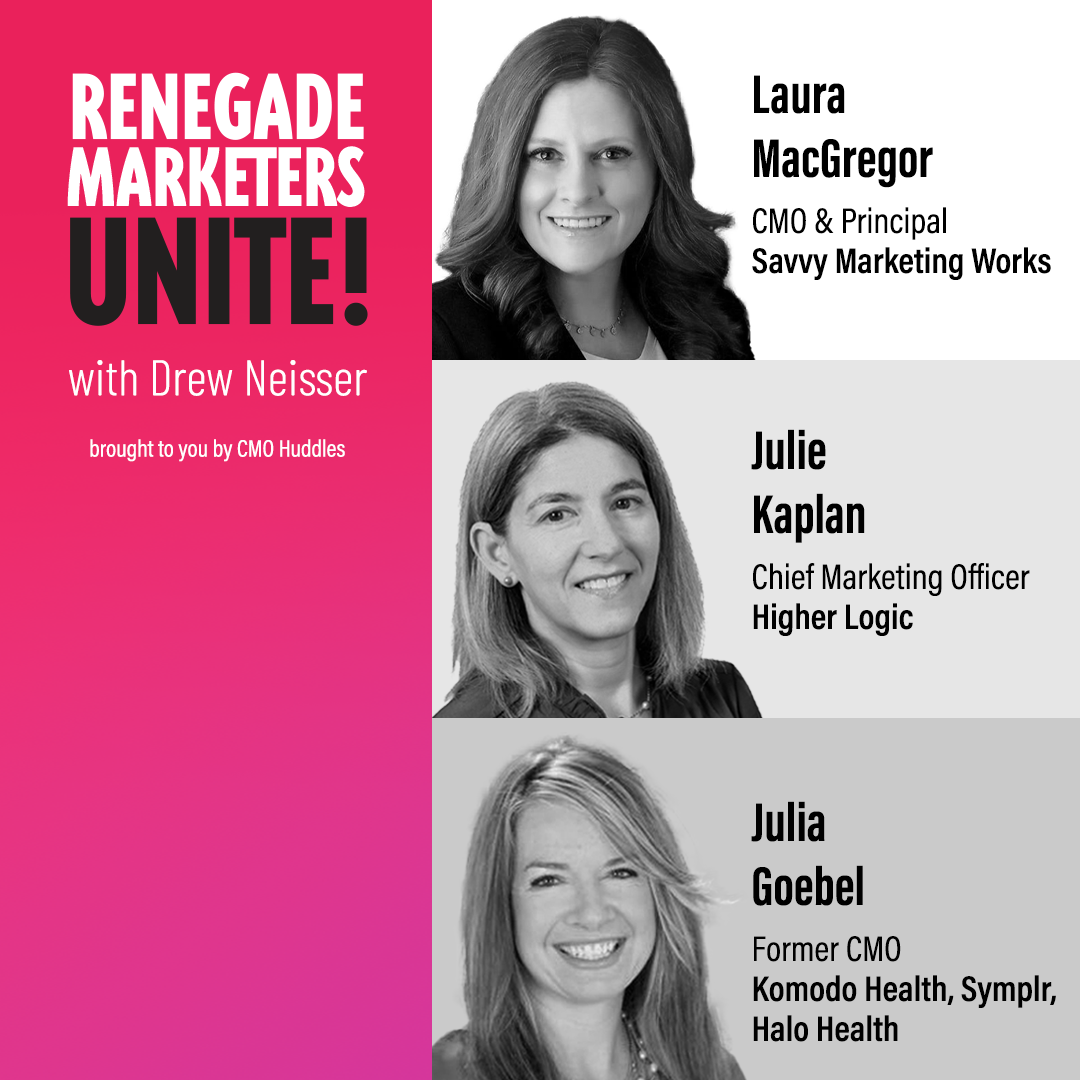
Quick Wins: How CMOs Build Momentum Fast
In the first 90 days, perception outruns reality. So where will you find the quick, visible wins that turn “new CMO” into “trusted change agent”?
In this episode, Drew sits down with Laura MacGregor (Savvy Marketing Works), Julie Kaplan (Higher Logic), and Julia Goebel to unpack how CMOs convert early pressure into progress, spot quick, visible wins to bank now, and use that goodwill to earn the mandate for bigger changes.
How Three CMOs Win the First 90 Days:
- Laura listens first, learns the business, and picks intentional early moves that build trust.
- Julie starts before Day 1, using interviews to find a wish list and deliver one visible win fast.
- Julia anchors early success in data and customer calls to sharpen focus and reveal opportunities.
Plus:
- How to align expectations with a marketing maturity matrix and shared success metrics.
- Why small conversion gains build credibility while foundational work ramps up.
- How to partner with sales, learn from top performers, and scale what works.
- Why customer conversations beat inherited assumptions every time.
Stepping into a new CMO role? This episode shows how to turn early pressure into wins that build lasting momentum.
Renegade Marketers Unite, Episode 487 on YouTube
Resources Mentioned
- The First 90 Days by Michael Watkins
- Past episodes mentioned
-
- Laura MacGregor
-
- Julie Kaplan
-
- Julia Goebel
Highlights
- [3:27] Laura MacGregor: Quick wins start with people
- [4:54] Earn trust before transformation
- [8:21] Small tweaks, big wins: message and process
- [10:09] Julie Kaplan: Your 90-day plan starts in the interview
- [11:32] Turning wishlists into strategy
- [14:05] Progress buys you time
- [20:13] Julia Goebel: Come in with a point of view
- [23:29] The 30-call crash course for CMOs
- [27:10] The 90-day credibility playbook
- [32:17] CMO Huddles: Learning what’s next, from each other
- [34:33] Thriving under the 90-day microscope
- [37:45] Simplify before you amplify
- [39:09] Turn win-loss calls into gold
- [43:00] Don’t skip Gong, but call anyway
- [45:13] Win fast by listening first
- [48:22] Quick wins for new CMOs
Highlighted Quotes
“Take the time to meet people, understand what's going on with them, what's working and what's not, and try to distill that information down into some common things that really align with the business objectives."— Laura MacGregor, Savvy Marketing Works
“A lot of the listening can begin before day one. In the interview process, there are an awful lot of hints that are given as to processes that need to be updated or an activity that's never been done."— Julie Kaplan, Higher Logic
“I want to call 10 most recent wins, 10 most recent losses and 10 lapsed customers. So right away you've got 30 data points that can bring your perspective."— Julia Goebel
Full Transcript: Drew Neisser in conversation with Laura MacGregor, Julie Kaplan, & Julia Goebel
Drew: Hello, Renegade Marketers! If this is your first time listening, welcome. If you're a regular listener, welcome back. Before I present today's episode, I am beyond thrilled to announce that our second in-person CMO Super Huddle is happening November 6th and 7th in Palo Alto. We're excited to have five flocking awesome founding sponsors: HG Insights, Boomerang, Webless, Firebrick, and Webflow, and an amazing VIP dinner sponsor with Vidoso. Last year, we brought together over 100 marketing leaders for a day of sharing, caring, and daring each other to greatness, and this year we're doing it again. Same venue, same energy, and same ambition to challenge convention with an added half-day strategy lab exclusively for marketing leaders. Tickets are now available at CMOHuddles.com. Do yourself a favor—check out some of the speakers and experts we have. It will blow you away. You can also watch a video that I am confident will get you pumped up, and it also shows what Gen AI video can do right now. Grab your ticket before they're gone. I promise you we will sell out, and it's gonna be flocking awesomer!
You're about to listen to a recording from CMO Huddle Studio, our live show featuring the flocking awesome B2B marketing leaders of CMO Huddles. In this episode, Laura MacGregor, Julie Kaplan, and Julia Goebel break down how to find and deliver quick wins that build credibility fast. They talk about listening for what matters most, acting on opportunities with visible impact, and using early wins to earn trust and momentum for bigger moves ahead. If you like what you hear, please subscribe to the podcast and leave a review. You'll be supporting our quest to be the number one B2B marketing podcast. All right, let's dive in.
Narrator: Welcome to Renegade Marketers Unite, possibly the best weekly podcast for CMOs and everyone else looking for innovative ways to transform their brand, drive demand, and just plain cut through, proving that B2B does not mean boring to business. Here's your host and Chief Marketing Renegade, Drew Neisser.
Drew: Welcome to CMO Huddle Studio, the live streaming show dedicated to inspiring B2B greatness. I'm your host, Drew Neisser, live from a friend's house in the Poconos. Today's topic: quick wins. Because in your first 90 days, perception is reality and momentum is your best friend. So let's face it, if you nail a few fast, visible victories, suddenly the new CMO label turns into trusted change agent. However, fail to deliver in those first 90 days, and your chances of making the big changes that you know you need to make diminish faster than we can say "quick wins." Think of quick wins as deposits in the goodwill bank, which you'll need when you initiate major changes. So buckle up. We're breaking down the art and science of early impact. And with that, let's bring on Laura McGregor, CMO and principal of Savvy Marketing Works, and a returning guest who previously appeared on the show to discuss cybersecurity and marketing and comms alignment. Hello, Laura, how are you and where are you this fine day?
Laura: Hi, Drew. I'm doing great. Thanks for having me back on the show. I'm located in upstate New York, where we are finally enjoying some really nice summer weather.
Drew: Yay. I love that. Okay, so let's get into the quick wins quickly. When you step into a new role or face pressure to show fast results, what's your go-to approach for identifying and executing quick wins?
Laura: I think really taking the time to meet people—your counterparts, your team members—understand what's going on with them, what's working and what's not, and try to distill that information down into some common things that really align with the business objectives and where there are hits and where there are misses and rooms for opportunity.
Drew: It's funny because you can listen to it, and folks will have complaints, and "Oh, this isn't right" and "this isn't right." But as the outsider, it's funny, you could just see things that others don't right away, right? And you're like, "Oh, I can fix that."
Laura: Yeah. And I think, you know, not going in blind to it too, right? Doing your research ahead of time so that you understand the products they're talking about or the content. So I do tend to spend a lot of time reading a lot of the material that I can find ahead of time. And AI is great now because it can help you synthesize and summarize and look for things that you may not have thought of. So it's even faster now than ever to get up to speed on some of those things.
Drew: Yeah, oh my God, you make me want to create a quick wins GPT for our community where we just pile them all in there and then say, "Okay, if you're in this scenario, right, here's three that have worked for these kinds of folks." So the listening part—and it's funny, this comes right out of Michael Watkins' "First 90 Days." I mean, it is so much about that, yet there's this push on you to get something done, to show you're a wizard, you're a marketer. And so the listening tour is great, but you got to do something quickly, right? I mean, otherwise it's like they're tapping their finger going, "Okay, let's do this." And so how do you manage that?
Laura: Yeah, I think I can give an example of something that I did early on in my time at the Center for Internet Security. In fact, you know, it's something that we had done there recently. There are a lot of things that are running that are not necessarily set it and forget it, but sometimes they can be treated that way. So we had a pretty robust lead nurturing pipeline, and it was really just a matter of taking a look at that again, taking a look at the content and how it was doing, and then the scoring model that went along with that. And we often found that there were some new trends, things that we hadn't seen, and it was pretty low lift to make some changes there that translated into big results in terms of increasing leads and conversions.
Drew: It's funny because it is about revenue, and that's obviously one of those areas where if you can actually just through a little tweak, you'll make a lot of new friends quickly. Is that part of the knack—just focusing on revenue-type things?
Laura: I don't think that's necessarily the only thing you should look at, but it was a pain point at the time. So that helped generate a good relationship with the head of sales, who was trying to make some increases there, and it just built some credibility that then you can go on. So I don't think that's the obvious place to look. If that's not the immediate goal and problem, it could be messaging. It could be something else. So really looking at the situation and factoring that into where you might want to start.
Drew: How do you—any thoughts on managing that pressure for instant transformation? "Oh, you're the new head of marketing. Great. Let's do something new." When what quick wins are often about is, as you described it, a little thing that we could do better while we're trying to figure out the bigger things. But how do you sort of hold off the wolves, if you will?
Laura: Yeah, I think sometimes showing, even just demonstrating that you have a bigger plan, and letting them see that and the timing for that, because oftentimes, if you don't share that information, they'll assume that there is no plan and you don't know what you're going to do next. So just being transparent about that and then reporting back at the milestones along the way again can demonstrate the results and build the relationship.
Drew: Yeah, they've got to know that you're going to get there. And I guess the question, "Well, how long is this going to take?" And, you know, that's, again, part of what we're talking about today, and really zeroing in on this balancing act, right? You've got to show some activity, but chances are you're not going to, in the first 90 days, you know, reinvent the company.
Laura: Right. And especially if it's an established company, it took them a long time to get to the point where they are. So untangling complex systems or making sweeping changes across a large sales and marketing workforce, that's not going to happen overnight. But communicating and over-communicating that plan to get everyone on the same page as quickly as possible will help you to move faster.
Drew: And I'm wondering if, so we're looking at—you looked at pipeline, you got in there, you found some tweaks that can be made. So after pipeline, is there another, like, another little vein that you found consistently you can get into that helps you sort of uncover a potential quick win?
Laura: Yeah, there's two other places that I tend to go. Like I said, messaging and segmentation, just to make sure that that's even still current. When's the last time that someone looked at that? Are the audiences you're going after still your priority targets? So that's a place that I would look, and then another one, especially if you're resource constrained or have a large workload, is process. Is the process efficient? Most people aren't going to be opposed to helping make their job easier and smoother and go faster. So taking a look at that in a thoughtful way can also be a good gain.
Drew: Yeah, oh my gosh. And we'll talk about this in a little bit, but it's funny—all of those, the impact of AI. I hope we can get into that after I talk to Julie and Julia, because you talk about process, and you know, there's folks at existing companies, a lot of those folks are still doing it the same way they did it 10 years ago. So it's so interesting. All right, so we're gonna—let's bring on Julie Kaplan. Now we'll be back with Laura. Hello, Julie. Julie Kaplan is a CMO and a rev ops leader and an industry expert who's graced our stage before to discuss many topics, including marketing metrics, introverted CMOs, and ABM. Hello, Julie. Wonderful to see you again.
Julie: Thanks for having me again. It's wonderful to be here.
Drew: Of course, and so where are you this fine day?
Julie: I am in Maryland. I'm in the suburbs between Baltimore and Washington, D.C.
Drew: All right, so we've gone from upstate New York to Maryland. Awesome. So you heard what Laura had to say—did that spark any thoughts as you were listening to the two of us?
Julie: I mean, it sounds like Laura and I have a similar approach. What I would add to that is, you know, a lot of the listening can begin before day one, and she mentioned that. But in the interview process, there are an awful lot of hints that are given as to processes that need to be updated or an activity that's never been done. If you're listening for them, you're ready on day one to connect—which, you know, to start to understand which of those activities will nest into your 90-day plan and allow you to sort of take an action quickly that's consistent with where you want to go. It starts before you start.
Drew: And that's such a great point. And it's funny—it feels like if you can use the interview process to create, like, everybody's wish list. Gee, and it's like if you could ask everybody, just finish, fill in this sentence: I wish we could X.
Julie: And you know what? The people in the interview process are your champions. They're the people who advocated for your presence in their company. And so you are establishing a relationship more tightly, more quickly when you show that you've listened to them and you want to take an action.
Drew: Well, and that's interesting, because now we get into this question. So everybody you talk to, you gather the wish list, and now you have this thing. Well, I'm one person. I've got a department. I've got to prioritize, you know, decide whose wishes am I going to fulfill and in what order?
Julie: Well, I don't think that that's as hard as it sounds. It can be, but it's not like most people will enter their new job with a 90-day plan, right? They know what the goals are, they know what the objectives are, and they know what they need to accomplish in that 90 days. A lot of it is sort of deep-dive research, but that enables you to see where you're going to start to move the department and move the company, and you can identify which of those wishlist items are consistent with that plan and that learning.
Drew: Right? And by the way, that will also make it easier to sell it later on, because you get to say, "Remember that wish that you had? It's in here."
Julie: Yeah, and then you're nesting in, you know, a milestone that's been achieved, even though, you know, that 90-day plan again is not about action often. It's about setting up how you're going to learn what you're going to do, and then, you know, starting to orient your department and your company towards, you know, whatever it is you're trying to achieve. Let's say it's a transformation of a marketing department from, you know, old-timey, old-school form-filling manual process to, you know, leading-edge AI department. You're not going to make all of those implementations in 90 days, but you know where you want to go. And if there's something that's easy on a wish list along the way that's consistent with that, you can do it.
Drew: Yeah, there's a couple of gems that I'm going to repeat. One is that you can do a lot of this work—the thinking about and knowing what your quick wins are before you even land. And I think that that's sort of an eye-opener for me. The other thing I want to point to is, so for the transition team call earlier this week, one of the CMOs who had landed told the story of how a competitive candidate submitted a highly tactical 30-60-90, and then when the candidate who got the job submitted theirs, it was very much about process and high level. And I think that's so interesting, and maybe that's the big part of that. I think people may be thinking about 30-60-90s wrong—that it's not the tactics, it's what are you going to do to be able to help you make important decisions? And I think part of this—and so quick wins, though, are often tactical. And so I'm wondering, in your experience, if there's, you know, a quick win or two that you could share that sort of helped you? Again, I think part of this is buying time.
Julie: That's exactly—you took the words right out of my mouth. Oh no, sorry. No, that's great. That's great because it sort of supports my point that there was a company where I started—I had to build the marketing department from scratch. There was no infrastructure in place, right? But during the interview process, the CFO, right, the CFO said, "We've never sent out an email about our products." Okay? They didn't have a marketing automation system. They didn't have anything. But you know that you're going to be sending out emails eventually, right? So, you know, within, you know, the first month or so, we sent out our first email. It didn't produce results. It wasn't like a giant win or revenue coming in, but it showed an action and it showed progress, and it bought time to fulfill the rest of the 90-day plan, to sort of do the research, the homework, understand the environment. And when I reflect on the next year, let me just give you some of the numbers. I think I had year-over-year—even though, you know, all the quick win was an email—but it bought me time to do all that infrastructure work. And when I look year-over-year, I had a 10-fold increase in blog visits, we had a 68% increase in website sessions, we had a five-fold increase in form submissions. So it bought me the time to do the work that needed to be done that was going to produce real results, and I needed that time.
Drew: Yeah. I mean, it does. I mean, there are very few—I mean, unless you have an e-commerce brand where it's transactional, there are very few business-to-business brands where you can push a button and suddenly see revenue go up 10x. No, it takes—there's a lot of groundwork from a strategic standpoint. There's a lot of groundwork from a messaging standpoint. There's alignment work to be done with sales. There's so many different things that you need to build, particularly in your case where you were building it from scratch. And so, yeah, somebody asked for an email, and that's great. That is something—progress, right? Yeah. I mean, I remember in one of the conversations I had with a CMO a few years ago in the first 90 days—it was in an old-school industry, I think it was construction, and they were software in the construction business, and, you know, he discovered they didn't have a telephone number on the website. And you know, it turns out the contractors just like to make phone calls. Put that up, and guess what? The phone rang off the hook. So, right? Yeah, sometimes the quick wins are just really little, obvious things like that.
Julie: And it shouldn't be. It's not necessarily hard to find. Like, if you have an established marketing department, I promise you, there are some things they have not had the time to stop and look at carefully. When you're in your first 90 days, you don't have all the meetings set up. You don't have all the administrative responsibilities. You don't have all the sort of cross-functional, you know, responsibilities that you will have just six months later, right? So take that time to take a look at some of the things that you wouldn't ordinarily have the luxury to look at, and you just need to find one or two that are consistent with, you know, your plan and your strategy, and demonstrate progress.
Drew: Yes, demonstrate progress. I think Michael Watkins talks about not only that, but demonstrate that you can make a decision. Yeah, and which is funny, as simple as that is, you show that you can make a decision, which is part of being a leader. I wonder, just before we move on, you've got executives that are tapping their fingers, who go, "Okay, when is marketing?" And how do you say five different ways, "I need more time"?
Julie: Again, that's what the 90-day plan shows, right? At the end of the 90 days, you show what the one-year plan is, you know, and then it's framed up, not in a whole list of tactical things. You want your people to come up with the tactical things so they're bought into it. But there needs to be a show of vision for marketing that's consistent with a show of vision for the CEO. And if those two visions are aligned, you're going to build some credibility there. But your plan is not, "We're going to do this thing on day one, and this thing on day five." You're going to have, "In year one, we're learning. In year two, we're experimenting. In year three, we're scaling," right? Those are the terms under which, you know, a CEO is going to be thinking about things. And along the way, you will see progress depending on your sales cycle. You might not see progress for 18 months, but once you hit a certain benchmark, you will start to see things grow. Activity is happening now. There's a delay in when that will pay off. If you are unable to have those conversations, it just might not be the right fit for you.
Drew: Yeah, all right. Well, it's a great transition because that sparked some conversations. And then we're now going to welcome Julia Goebel, who is recent CMO of Komodo Health, who has previously joined us on the show to shed light on the intricacies of being a chief collaboration officer and developing and deploying metrics. Hello, Julia, welcome back.
Julia: Hey, Drew, it's great to see you.
Drew: So how are you, and where are you this wonderful day?
Julia: Thank you. Well, I'm doing great, and I'm speaking to you from my home office in Chicago.
Drew: All right, we have the Midwest. We've got this. I'm in Pennsylvania. We're covering the country here, scouring for quick wins. So you've heard now your two fellow Huddlers. What did this make you think of the conversation so far?
Julia: Yeah, so first of all, I love the points that Julie and Laura have made, because they're very similar to the guidance that I'm going to share, and I'm going to put a new spin on it as well. You know, when I think about how to make an impact, it all begins, as Julie said, before you begin. And so you've interviewed, you've had an opportunity to get to know the organization. You've done some homework. You know the pipeline situation and the goals for demand and digital. You know the rates of retention. You know what their next 12 months looks like. You've had exposure to the product and demos of the products, so you have a point of view, and you've been through a process in which the stakeholders—and I love that, Julie, you called them advocates, or people who have, you know, voted for you against in a competitive process—so you have a point of view. And I think that's really important to come in with a point of view, calibrate that point of view. Now that I'm here, this is what I'm observing. We have some big needs in demand or digital, for example. From there, there's a few areas I look at for quick wins. You've got that perspective, right? 30, 60, 90, you have areas you want to learn more about. And that is really what that period is for. By the end of it, you want to have a point of view that includes a quarterly plan, let's say, or an annual plan that you're going to refine on a quarterly basis. Maybe you even fine-tune month to month, but that is because you've done some work. And so during those quick wins during the first time period, the quick wins that I like to look for start with conversion rates. I like to look at where opportunities are closing, where are they dwelling or sitting too long, what sources are moving to a proposal stage, and then all the way to close. And then do those match what I expected? So for example, when I joined Komodo, in the prior 12 months, no opportunities had been generated through paid search, through keyword search, and that's simply unheard of in B2B marketing. And so that piqued my interest. The same was true of email, and I know from past experience—you know, in each of my CMO experiences—when you email current customers, you have a better response rate than if you email someone cold, a cold prospect. So when there are differences from what you know to be standard or norm, you look further, right? You want to understand, why are they occurring that way? In addition, now, you know, a few years past that start, I now look at traffic from AI, and this is possible with GA4, right? You can see what is sourcing from ChatGPT or Claude or others, so that you can understand, is this where I want it to be? How is it trending? Is it going up or down? That's another area where you can identify a couple of quick wins. And this is important because your very next step is meeting with all the best sales executives. So you want to spend a lot of time with your sales partners to understand and hear what's occurring. In particular, you want to understand why what you've observed, maybe in conversion rates, is occurring, hear from them what their experience is like, and, very importantly, be an ally. You are all in it to win. Marketing is much more credible when we speak in revenue terms, and that is where our heart should be. The other piece I want to do is I want to call 10 most recent wins, 10 most recent losses, and 10 lapsed customers. So right away you've got 30 data points that can bring your perspective that's forming into a sharper focus. And nothing's more credible than a marketer saying, "The customer I spoke to this morning told me..." So I think when you've amassed these data points now that you're inside the four walls—a lot of research you can do before you join and, of course, you've done research to even win the job opportunity—when you're in the business, now you can have an even closer look, and those will help you prescribe those quick wins around conversion rates, around customer engagement, or around product.
Drew: You've helped me frame this a little bit differently than I was thinking about it. And so I'm going to just highlight a couple of things. One is, look at where the rubber meets the road, like the conversion rate. Is everything right? Because if you can find something there and you can fix that, you know, I'm imagining, the same thing applies for deal cycle. Like, if you can see, are we selling it? Is it 18 months for every sale? But one of them closed in a year? What happened there? That was different. That was one thing, just starting at the sort of most critical thing. You use the term POV. I might have used the term hypothesis because, right, you have some working hypothesis.
Julia: And you should call it that. "I'm testing this theory. What do you think of this theory?" You know, share that with your clients.
Drew: What I also love is, and I think this is really an important one for folks to think about, too often, you walk into a new place and someone says, "Oh, well, events don't work for us," right? They'll just say that and you'll go, "Right." 50% of B2B relies on events for late-stage deals. So you have to really make sure that you don't just accept what is the prevailing wisdom in terms of what works, because your point about "their paid isn't working and email isn't working," I mean, it wasn't. Chances are they're just doing it wrong.
Julia: Maybe it could be done better. And nothing is perfect. Nothing we ever inherit as CMOs is perfect. And so I remember speaking with a new CMO who was trying to get his bearing, and he was saying, "I feel like I'm just running around polishing things." And I'd heard that from other CMOs. Someone had relayed that kind of story to me. I get that, you know, you feel like you're running around polishing everything, but you really do need to look at—there are several places, many places, perhaps you could level things up by doing them this much better.
Drew: I want to sort of tactically—I love the fact that you talk to 30 wins, 30 losses. I mean 10 wins, 10 losses, and 10 lapsed. Do you do those personally? Or do you, like, hire a firm or a company?
Julia: No, I do it personally. And you say, "I am the new CMO at [blank], and I'm so appreciative you've chosen to take your business to us. Can I ask a couple of questions about why that was?" And you can do that by email. You can cold call them, but you ask for 30 minutes of their time. You give your account manager a heads-up, right, the person, or perhaps an implementation manager, whoever's working with them closely. If you encounter friction on investigating, that's something to look at.
Drew: Yeah. I mean, there's often, "You can't talk to them, we're—you know, the relationship is sort of iffy, and I don't want..." And so there's a lot of protection over that. But you're absolutely right. And I say this a lot in Huddlers that particularly for new CMOs who are presenting to the board, the most powerful sentence always starts with, "I was talking to a customer the other day," watch the heads turn. You'll get everybody's focus. And to the extent that you can continue to do that after the first 90 days, the stronger your background. So that was really important. And then Julie was talking about learning year one, and I'm thinking, PE firms would never allow that, like they are—you know, they're, particularly if they're later stage in their cycle, and you've worked for PE-backed companies. I'm just curious.
Julia: I am starting my 10th year in PE-backed companies. So I will tell you, first of all, I like Julie's counsel, and you need to be able to show progress. There is no doubt about that, but you are not going to be able to implement a marketing automation platform in 90 days. You aren't going to be able to implement ABM. You aren't going to be able to—you have some quick wins that you can achieve, and that's why I point to conversion rate. If you can make it 0.5%, 1%, 2% better—and by the way, most CMOs, I would advise, have weekly reporting, and so you're able to see how did it do week over week over week. You have 12 weeks, perhaps, of data that you will be able to show pretty quickly if you make some tweaks that can be actionable. And one I like is conversion rates on a website, because it is something that you could change.
Drew: Oh, conversion rates on a website, meaning they come to visit and then they request a demo, for example?
Julia: Yeah, 100 visits and only one person filled out a form. Check your form. Why is that happening? You know, things like that. So there's little wins, and then there's opportunity conversion rates as well. But when I think about, like, quick wins and establishing credibility with the board—you know, you may have had an opportunity to interview with a board member during the hiring process. You may be meeting the board for the first time. In those first 90 days you have, there will be a board meeting. It's almost always quarterly, so maybe it just happened and it'll be the last part of your 90 days, maybe the first part of your 90 days. In two of my CMO roles, I presented to the board within weeks of starting, and so it's an excellent opportunity to show that research that you've done before starting and after, and it's important to set expectations. So I have used a marketing maturity matrix to help illustrate where we are today and where we want to go by year one or year two. You can build your own, right? There's lots of these available. You can search for a few and then combine and create one that's custom to your point of view for this company. You know, where is it on product or digital or brand or awareness? You know, you have columns, and you might say, "We are here. We are in column one, and I want us to get to column three by the end of the year." In column seven, maybe that's full, fully activated or fully—you mature by 18 months from now. But you probably will be educating them on the state of affairs. There will be things that they didn't know because maybe the prior CMO highlighted a strength over here, but there was, "Don't look over here." You will need to be very candid about what is possible. You do not want to over-promise. You do not want to sandbag. You want to be pretty, pretty accurate about what you think can happen, because if you over-promise, you know the results. If you under-promise and then you overshoot, it seems surprising too. So I like that matrix, that maturity matrix, that shows where are we from—maybe one to five, one to seven—and we're going to go.
Drew: So I mean, because they're so used to looking at the numbers, which is the only thing they care about in the PE firm, because they just, you know, it's about, "We have an exit," and—
Julia: Well, some don't. I mean, some—they all care about that, but they might be early in the hold, and they have a five-year plan. They might be late in the hold, and then your activity is different because you want to be acquired by a strategic. It depends.
Drew: But the point I was going to make is they've got to love the framework, particularly if they haven't seen a marketing maturity matrix. And then they see it, and we're a two. Oh—
Julia: It can be surprising. And then you say, "I think we're a two because of this," and you explain.
Drew: And suddenly you're not talking about—yeah. It's so interesting because you're really driving the conversation. You're giving—and then you're creating a shared scorecard. And we're going to need to get to this level of maturity for our marketing flywheel to really be working.
Julia: And I love—well, I love what Julie said, or Laura, please excuse me—showing a plan, and here's where we are in the plan. Once they know you have a plan, there's more confidence than if they don't know what you're doing. So if you have a plan, you can go back next quarter and say, "Hey, this maturity matrix—please, just to share—we've made some progress on item one. Here's how we're working toward that." You know, you've got then perhaps a common language you can use. It starts to become more familiar. You might even have inter-quarter meetings where you have a touch base with a board member. Between, there may be someone who's an advocate for go-to-market, for example.
Drew: Love it. All right. Well, we could keep going, but it's time for me to talk a little bit about CMO Huddles, and then we'll bring the whole group back. Launched in 2020, CMO Huddles is the only community of flocking awesome B2B marketing leaders, and that has a logo featuring penguins. Wait, what? Right? Well, a group of these curious, adaptable, and problem-solving birds is called a huddle. And the leaders in CMO Huddles are all that and more—huddle together to conquer the toughest job in the C-suite. So Laura, Julie, Julia, you're all incredibly busy marketing leaders. I'm wondering if you could share an example of how maybe Huddles has helped you.
Laura: Yeah, I think one of the things about marketing in this profession is it has such a broad scope. And so what I really appreciate about the CMO Huddles community is that I can learn from others who are talking about topics and things that I'm not dealing with day to day, but it gets me up to speed and keeps me apprised of that. And you know, an example of that that you've helped with, Drew, is keeping us all on top of AI and the advancements, because it's not always something we are doing in our day to day, but you knew it needed to be at the forefront and have kept it there for us.
Drew: Oh, thank you for that. And then, boy, we have a lot more coming down the pipe on that area specifically. I think it's going to be so transformative. Julie, anything?
Julie: One thing—you know, as a leader in a company, you need to learn how to see around corners, and I can see around a few, but by being part of CMO Huddles, I can see around many more corners than I would have otherwise been able to do on my own. So Julia or Laura may have a particular issue that they're dealing with that's six months away for me, and I think those are things like how to collaborate with your CFO, how to collaborate with your chief commercial officer, things like that that help those conversations go smoother when they happen.
Drew: I love it. I love it. Julia, any thoughts?
Julia: Yeah, absolutely. So I think one of the things that I love about Huddles is it gives me an opportunity to compare notes with other leaders. So when you are the senior or terminal marketer in a company, you don't have peer marketers with whom you can compare notes. And so I think it's really important to have community in that regard. I can, you know, share an opportunity or a problem that we're solving. I can also get feedback on it to say, "This is how I'm thinking about approaching this. You've had this experience of launching a new category or, you know, joining a crowded market," you will get great feedback. There is not a problem under the sun that someone else hasn't also faced, and so that, for me, is one of the ways that I like to stay sharp.
Drew: Well, so appreciate the three of you. If you're a B2B marketing leader who wants to build a stronger peer network, gain recognition as a thought leader, and get your very own stress penguin, please join us at CMOHuddles.com. All right, let's sort of bring this back. And I seem to be the only one here who's obsessed with this pressure that you all feel in the 90 days. And maybe it's because I have one-on-ones with a lot of CMOs in the first 90 days, but I feel that—like there's the sort of dumb, whatever that thing is hanging over their heads, and they've got to show massive progress. And I'm just curious, am I making this pressure up, or do you actually feel it? And if so, how are you dealing with it?
Julia: Well, you know, I like to joke that we signed up for this, you know. We chose this pace and these roles and this career path, and so I'll speak for me first. You know, I like to stay busy. I like variety. I like challenges. I also know that we are setting the pace or setting the standard for our team. Our team is watching. Our peers are watching, and our, you know, others in the company are watching. You don't even realize at times that that's occurring, but I like to think that pressure makes diamonds. And so if you're faced with overwhelming challenges, the thing I do is I make a list. I start writing them down. I prioritize. I plan accordingly. If there's pressure that is making me feel like I'm not showing up the way I want in a meeting, I conclude the meeting to the best I can, and when it ramps up, I take a quick walk around the block, right? There are things you've got to do to stay healthy, centered, and, you know, focused on wellness, and that is something that we don't talk about enough. I think, as leaders, that what we do is hard. We chose it. We're maybe, like, a little nuts for that, but there are ways that we can focus on navigating the pressure to the best.
Drew: I love that this is the life that you have chosen. Yes, so thank you. That is true. And I'm reminded of, you know, the Billie Jean King quote that sits in front, right as players walk out onto center court of the US Open. It says, "Pressure is a privilege." We need that for all of you, you know, a little sign that you can wear to exit CMO: pressure is a privilege. So, yeah, I think that is a realization. So I don't know what, Julie or Laura, if you wanted to add on that one.
Laura: Yeah, I think Julia said it really well. And I would come back to something she said earlier around, you know, establishing the rapport, having the plan, and helping them understand. I think marketing is a misunderstood profession. A lot of people think it's like magic. Just sprinkle a little bit of marketing over there and great things will happen. But, you know, we talked about quick wins. Most of them are tactical. The long-term strategic things just take longer. Like anything else, if you want a high-functioning, highly segmented CRM, you're not going to get that in 30 days or 90 days. And so helping educate them on the value that it will bring and what they can expect and when it's coming, and keeping them apprised of that along the way, would take a little bit of pressure off those early days.
Drew: Wait. You mean you don't have a magic wand with some pixie dust back in there? There's no—you know, Julie, you don't have one. Come on. You guys are miracle workers.
Julia: The cape isn't visible. It's back here.
Drew: Got it. Oh, okay. I'll keep that in mind. I wonder—I was thinking about it, and it should be a strength. And is that you all kind of grew up creative problem solvers and connecting dots that others couldn't connect? And I wonder if that gives you an advantage of sometimes seeing the obvious, like the emperor has no clothes. And have you had a circumstance like that where, you know, it was like, we need to fix this and we can fix that fast?
Laura: Absolutely. I think you hit the nail on the head, Drew. Marketers, especially marketing leaders, have a unique purview across the company's leadership team, and ideally, they're seeing everything and talking to everybody. So there have been instances where I say, "Hold on a second. We have five or seven tools that are doing the same thing. How are we differentiating those and positioning those so that people outside of our company understand?" Because a lot of the people inside the company don't understand. So, you know, there's a way to do that diplomatically so that you're not telling people, you know, the baby over there is ugly and the one over there is the winner. But, you know, finding a way to get that common ground and understanding to shore up some of those things internally so that when you're talking about it to your prospective customers, it's easier for them to understand.
Drew: Yes. To mothers, all babies are beautiful to the mother, I will say. But I want to move on a little bit and sort of make sure that part of this is being able to see what the problem is, right, and identifying the thing. And then part of it is sort of getting that quick win implemented. And like in the case that Julia, you were talking about, you're trying to impact conversions. Now you can impact conversions, obviously, with form fills, but I was thinking—when you were talking about that, I was thinking conversions like as in sales, I'm talking about. And so suddenly you're one voice in the room with sales and whoever else is responsible in the sales process. Is there such a thing as a quick win in that circumstance?
Julia: You know, that is something that I've been able to uncover when I call the losses—the people who took us all the way to proposal or maybe down to price negotiation and it just didn't convert, right? So it's worth understanding that, and that's why I like to call those customers who went a different direction. Often, if you do a formal win-loss study, you'll find that there are reasons in your CRM and your Salesforce. But if you do a win-loss study, you'll find that there's a different reason. And so I find that that quick 10-call survey of customers who didn't sign, and then also the 10 customers who chose to or went elsewhere, is a way that I get a lot of information. It helps me be more conversant when I'm with my selling partners. And sometimes there's something really obvious. This is a while ago, but we had an inside sales rep who was doing very well—so much better than peers with the same training, the same balance. And what we learned—and this was selling to doctors' offices who actually continue to use the fax machine to this day and age, because it's often the way that there are workflows that are fax-dependent, prescriptions and so forth. So anyway, this person was somehow at a remarkable close rate, and what he did on the phone as an inside seller was he would say, "I'm going to walk to the fax machine and wait for your signature." And it was so simple, but what he was doing was creating urgency. And so in a sales process, fax machine aside, the seller who creates the urgency to move from status quo is powerful. So that's why I like to talk to the top-performing sales reps, because you'll uncover something. And it might be as simple as saying to your sales partner, your sales leader, "Hey, Jane Adams is really doing well, and it's this one thing. Can we make that the norm across the team?" And that shows you're a partner, and that shows that you're concerned about the bottom line. Because there are many people who haven't worked with a marketer like the three of us and like so many in the Huddles group that are really concerned about how do we win revenue. And when you're that marketer who shows up and says, "I'm ready to help pull on this rope with you," not only does it give you credibility, but it makes you a partner.
Drew: I love that example, and I love that story. I'm wondering if that inspired a story, Julie, for you, because it's just such a great one. It's like this guy's winning, everybody else is okay, and all he's doing is waiting by the fax machine. I mean, come on.
Julie: I wouldn't say that I have a similar story, but when I think back to other times when I had early quick wins, again, it goes back to some of the conversations I had before I started. So in one company, I knew that one of my main jobs was going to be a major rebrand, right? So that was going to be my number one responsibility. So before I started, I emailed the CEO and I said, "I'll be able to accomplish this faster if I have a list of all the touchpoints in the company on day one." So instead of starting the list myself on day one, I was working the list on day one, and so I was able to show progress much quicker. And a lot of that is, again, just listening to what the big goals are and what the sort of, you know, real sticking points are during the interview process.
Drew: And so this brings me to—it's impossible to have a conversation with three marketing leaders right now without talking about how AI might change all of this. And I think we can have some fun, because suddenly, you know, the world of information is available and the analysis is available. And I was thinking of what, you know, Julia said—talking to, listening into calls and talking to folks. I mean, if you're using Gong or some other service to record all those conversations, you can run all that, turn it into a GPT, figure out a lot of this stuff. And yet I also know that probably the fact that Julia, you made those calls yourself—besides the fact that you build a relationship with a customer—you heard something the machine might not.
Julia: You would hope, right? I still believe that the human element must be part of AI workflow. So of those 30, you will have made some connection. And when you have another question, a good closing, you know, as you're wrapping those conversations, is to say, "Can I reach out to you again if perhaps I have a question?" Most people will say yes. Very rarely will they say no. So you'll have someone that you could pulse again when you say, you know, "We're thinking about adding this product or enhancing this feature," or, "How do you consume new information? What do you like best?" You have resources then. So that's one of the reasons I like that. Don't skip Gong, right? You can still use that to identify sentiment, and I love a lot of the ways that you can use Gong insights to feed into your website so that you could customize your site based on that particular account and what they care about. So there's some really cool tech solutions with Gong, but a personal call is always, I think, a winning strategy.
Drew: Yeah. I mean, one would hope that this is particularly, you know, that folks might move and go to somewhere else. So remember, they talked to the CMO. What was that company they were working with? Maybe we should put them on the list for the thing. So there it is. And what's so funny—if you're at a startup as a CMO, you're another salesperson. That's what you have to think about yourself. But I know that most CMOs at larger companies don't think of themselves that way. But why not?
Julia: We're all in sales. We're all in sales, whether we're selling a concept, whether we're persuading on an initiative.
Drew: So part of this, in the quick win thing, is you have to move a team, and you have to sort of get them to go in a new direction. I know, Laura, you want to weigh in on that, so go for it.
Laura: Yeah, you know, we've talked, Drew, about getting on board and building relationships with our peers, with stakeholders, with the board, with our CEO, but one of the most important things are the people that you'll work with every day—your team. And so if you're walking into an established team, they may have some reservations about you or questions about their own future. And so the sooner you can talk to them and build that relationship and start to build that trust, I think the better. So one thing I would always recommend that has worked well for me is having one-on-ones with everybody, assuming you have a team of a size where you can do that, but it's something that I did at least twice a year, meeting with everyone. I kept the agenda loose. If they wanted to talk about personal things and where they were going on vacation, that's fine. We could have a conversation about that. If they had ideas for improvement or things that were difficult, we could talk about that too, but I was always able to walk away with something that I could use to help make the team better. And I think just them getting that dedicated time with me helped strengthen that relationship, so they were more willing to come to me in between times or reach out when needed. So really taking the time to build the relationship with your team, because they're going to talk about you when you're new, whether you're in the room or not. So giving them something positive to talk about is probably a good idea.
Drew: Well, and I imagine, and I'm sure this is true for Julie and Julia, is that they often have those things, those quick wins, in their minds that they recommended to their old boss that they couldn't get done. Hey, you know? And so just part of that is that, and you know, so you can empower them. But I think the other part of this is you're only as good as your team, so you've got to be evaluating them as well. And if they don't have any hip pocket ideas, if they don't, and you're going to need them, whatever big changes you're going to make, you're going to need them. So, Julie, you were shaking your head. I'm just curious if that sparked a thought or experience that you had with the team.
Julie: I mean, I think it's one of the great ways to establish a quick relationship with your team—to listen to them and solve problems for them as well, right? And they want the win with you. So giving them an opportunity to surface up a problem that they've observed, a solution that they have, and the space to be able to go for it, they win, you win.
Drew: Yes, and you give them credit, which is amazing. So we've really talked about, so far we've covered a lot of ground. We've all recognized that you absolutely have to have quick wins because that's a currency that you will need, that you can start before the job happens. You can do a listening tour up, sideways, and down with your folks, and all the while you're assessing, you're building relationships, you're listening for that opportunity. And then, of course, Julia, you emphasize customers as a critical part of the listening here. I'm just wondering, so with that, I think what we can do now is just go to some final words of wisdom and maybe one quick win every CMO should look for in their first 90 days, and we'll go in reverse order, so we'll start with Julia.
Julia: One of my favorite sayings is, if you have data and I have an opinion, you win, right? I like to know my numbers. I like to understand and be able to speak to the high points of the business. I like to know in marketing very deeply how we're performing, and I like to bring data to the conversation. So know your numbers.
Drew: And I love that. I'm assuming that you say that to the team too, right? That if they don't know their numbers, that's a problem because...
Julia: Well, if I know the number better than the web analytics manager, then what are they working on, right? So I want us to all be really fluent.
Drew: Right? And it's not just because it's a nice thing. It's because the CEO is going to corner them and say, "Hey, what do you think we are doing right or wrong in marketing? And why isn't this working?" And if you don't know that, you just lost a big opportunity, and you're probably going to have to update your resume. Okay, that's a great tip. Next up, Laura.
Laura: I would say, you know, take the time to build the relationships, find out what matters to your peers and other stakeholders and your team, and find common ground within that toward the business objectives. Then take a look tactically. Is there something you can improve that would move the needle on a lot of those things that you can share back? Along with that, be building your plan and share it and communicate it so everyone understands what you're doing behind the scenes that may take a little longer.
Drew: Yeah, it's so important. I mean, it's exhausting as we listen to all these things that we have to, you have to do, but in addition to listening, you do have to communicate back that you're working your way. And I do think that's where this 30-60-90 actually helps if you've laid it out on a broad basis, because you say, "Well, here's where we are. We're moving along. As I told you, this is what we were going to be doing." Okay? Julie, final words of wisdom.
Julie: You know, Laura and Julia just did a great job of it. So I'm going to summarize what they said, which is know your numbers, know your people, and take an action. And then adding what you just mentioned, Drew, is you need to bring people along your learning curve so that they can see what you've done and the progress that you've made, and that buys you time to do the bigger activities that will deliver more later.
Drew: I love it. Well, if you're new on the job, we have assembled a quick wins checklist that we're continually updating, and I realize that we probably have to update it again because I think there are a lot of workflows and other things from generative AI that are specific that you couldn't have done six months ago that you can do now. So, yeah, just ping us at support@cmohuddles.com and we'll get you that quick wins checklist. All right. Well, Laura, Julie, Julia, you're all amazing sports, and thank you, audience, for staying with us
To hear more conversations like this one and submit your questions while we're live, join us on the next CMO Huddle Studio. We stream to my LinkedIn profile. That's Drew Neisser, every other week.
Show Credits
Renegade Marketers Unite is written and directed by Drew Neisser. Hey, that's me! This show is produced by Melissa Caffrey, Laura Parkyn, and Ishar Cuevas. The music is by the amazing Burns Twins and the intro Voice Over is Linda Cornelius. To find the transcripts of all episodes, suggest future guests, or learn more about B2B branding, CMO Huddles, or my CMO coaching service, check out renegade.com. I'm your host, Drew Neisser. And until next time, keep those Renegade thinking caps on and strong!