Pilot, Prove, Scale: How CMOs Lead Transformation
If you’re not transforming, you’re getting left behind. That reality makes transformation anything but presto change; it’s a mindset shift, sustained motion, and a clear “why” your people can see themselves in.
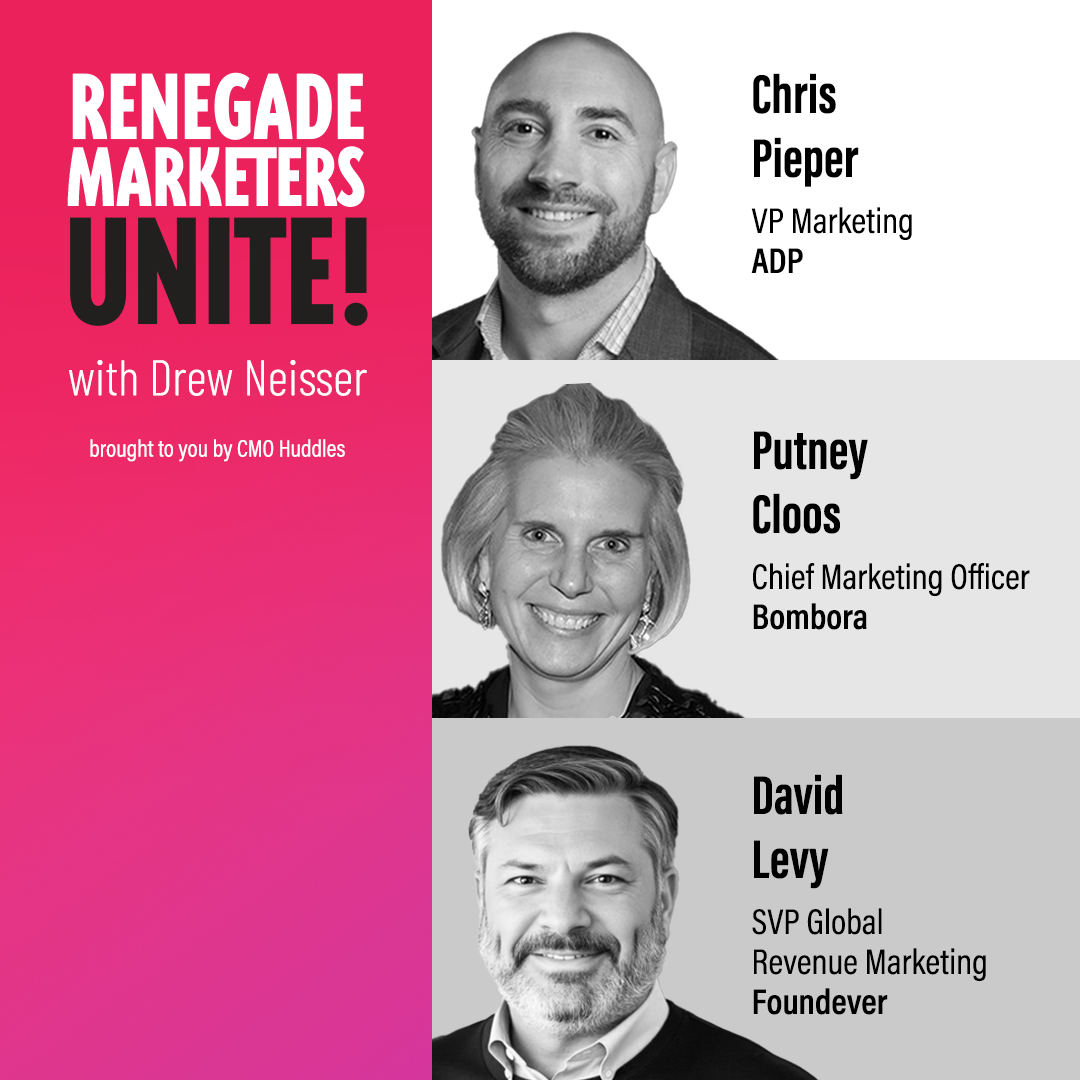
To turn that into visible progress while keeping the ship pointed at a destination the business recognizes, Drew brings together Chris Pieper (ADP), Putney Cloos (Bombora), and David Levy (Foundever) to share how each leads transformation across differently scaled organizations. From making progress visible to earning belief across the org and sustaining momentum through the messy middle, they show how change takes hold.
In this episode:
- Chris pilots with sales champions, proves pipeline impact, and turns small wins into momentum.
- Putney makes the case for change, maps “scrappy to industrial strength” milestones, and scales what works.
- David runs parallel lanes to protect the core while building the future, aligning his org to work ambidextrously.
Plus:
- How to make progress visible with simple roadmaps and real milestones.
- How pilots, quick wins, and pipeline proof bring sales along.
- Why stopping low-value work frees resources for what matters.
- What to hire for in ambiguity: people who try new things and move fast.
Tune in if you are steering big change and want practical ways to show progress, win belief, and keep momentum through the messy middle.
Renegade Marketers Unite, Episode 491 on YouTube
Resources Mentioned
- Past episodes mentioned
-
- Chris Pieper on Product Launches
Highlights
- [1:42] Chris Pieper: Mindset over mechanics
- [2:58] Winning sales through proof
- [5:07] How pilots turn into org-wide change
- [9:16] Putney Cloos: Transformation needs honest expectations
- [11:03] From scrappy to industrial strength
- [14:39] Validate fast then scale
- [17:49] David Levy: Balancing now and next in transformation
- [19:37] The hard part of proving transformation
- [22:30] How marketing builds transformation pressure
- [25:41] CMO Huddles: Your unfair marketing advantage
- [29:16] Signals every CMO must spot
- [33:32] Transformation needs vision and milestones
- [36:14] What AI unlocks beyond efficiency
- [43:34] Advice for CMOs leading through transformation
Highlighted Quotes
“Transformation isn't just about changing approaches. It's really about shifting mindsets as a key factor of success."— Chris Pieper, ADP
“Scrappy to industrial strength. We're in the scrappy mode. So it means we're piloting it, we're doing it in sort of a dirty way, but we're not letting perfect get in the way of good enough."— Putney Cloos, Bombora
“Transformation is not a campaign, it's not a value proposition, it's not a brand promise. It's an act of leadership."— David Levy, Foundever
Full Transcript: Drew Neisser in conversation with Chris Pieper, Putney Cloos, & David Levy
Drew: Hello, Renegade Marketers! If this is your first time, welcome, and if you're a regular listener, welcome back. You're about to listen to a recording from CMO Huddles Studio, our live show featuring the flocking awesome B2B marketing leaders of CMO Huddles. In this episode, Chris Pieper, Putney Cloos, and David Levy talk about what it takes to lead marketing through transformation. They share how they build the case for change, lean on pilots and early champions to show progress, and guide their teams through the messy middle as new go-to-market motions and AI take shape. If you like what you hear, please subscribe to the podcast and leave a review. You'll be supporting our quest to be the number one B2B marketing podcast. All right, let's dive in.
Narrator: Welcome to Renegade Marketers Unite, possibly the best weekly podcast for CMOs and everyone else looking for innovative ways to transform their brand, drive demand, and just plain cut through, proving that B2B does not mean boring to business. Here's your host and Chief Marketing Renegade, Drew Neisser.
Drew: Welcome to CMO Huddles Studio, the live streaming show dedicated to inspiring B2B greatness. I'm your host, Drew Neisser, live from the DoubleTree Hilton in San Francisco. Today, we're diving into leading through transformation, because let's face it, if you're not transforming, you're probably being left behind. From tech stacks to talent, everything's in flux, and CMOs who can steer the ship through the storm aren't just surviving—they're helping set the course for the entire organization. With that, let's bring on Chris Pieper, VP of Marketing at ADP and a returning guest who's previously appeared on the show to discuss product launches. Hello, Chris. How are you, and where are you this fine day?
Chris: Hey, Drew. Thanks for having me. I'm in Roseland, New Jersey today. Super exciting.
Drew: Well, you know, it is the Garden State, after all, Chris. All right, well, let's dive into how are you approaching transformation right now? And we're talking marketing strategy and internal culture, and it's a big company. So talk about your world as it relates to that.
Chris: Yeah, thanks for the question. I believe the transformation isn't just about changing approaches. Obviously, there's some kind of general objective of why you're even starting the project in the first place. But it's not about changing approaches. It's really about shifting mindsets, at least as a key factor of success. So I think pairing both a bold and inspiring strategy with a cultural story that people can see themselves in is really the key. So you can't just bolt on new tools, new ways of doing things, or use profitability as an inspiring rallying cry—it doesn't necessarily work. So I think it's really important to connect the why to both growth and pride, showing teams how this transformation makes their work more meaningful, not just that we're adding extra steps.
Drew: You know, it's so funny because I know as marketers—and you and I have had this conversation over the last several years—that it's easy to see for the marketer often where you want to go. You can set that strategy, you know exactly, and you're ready. You're already there, but then you've got to bring all these people with you. And I love the notion of... So what are some of the challenges and things that you need to do? Because let's say we've got the big idea. We know where we want to get to. How do you sort of bring people along and generate the pride that you're talking about?
Chris: I think it's a great question—super critical. I'll give you an example of one transformation initiative: really adopting ABM or ABX (pick your kind of terminology that you like to use) as really the go-to-market standard for how we deal with approaching the enterprise market at ADP, which we define as organizations with 1,000 or more employees. So we're an extremely sales-driven culture. You heard that on the last podcast—one of the largest sales forces in the world, about 11,000 sellers across the world, and it's massive. And this was a big change. We've been very sales-driven historically. So just really kind of positioning this new approach, which could obviously be scary because change, you know, inherently can be scary, especially when it's disrupting the status quo. There were a couple things that we did to really kind of focus and try to kind of bring this along. Change management, obviously core, is key—what are those key things? Shifting behaviors, like mandating Salesforce compliance, instilling data quality—obviously important. You know, the whole kind of cross-functional orchestration across sales and rev ops and marketing and other teams. But the real key for that one is really that the sellers, especially in this kind of sales-driven world and history that we've had, really needed to believe that marketing wasn't just air cover or just kind of fluffy pictures, as the things that we hear sometimes, but a real partner in revenue that will help them make more money. And this was not easy to do, but once we really proved, you know, the pipeline impact that we had, the improved deal velocity and quality, it really unlocked momentum across the organization. But that kind of bringing sales along every piece of the journey, kind of showing the small wins—without that, I mean, it's kind of just another kind of thing that's lost in the noise, frankly.
Drew: Well, it's so interesting. I mean, 11,000 salespeople—that's just like, that's an army. And I can imagine that they had their way of doing things. And I'm also imagining that you couldn't go to all 11,000 right away and say, "Hey, we're changing this." So how did you build the case to sort of—what, through a pilot or something—to get a few people and show that it works so that you could start to get, you know, again, this army on board?
Chris: That's exactly how we did that, rather than just kind of launching it from day one. And, you know, we have about 11,000 or 12,000 accounts—that's it, even though they're meaty across our entire enterprise market. So just doing that all in one shot, especially coming from the kind of previous state, which, again, was more sales-driven, that wouldn't have worked. It was really important for us to figure out who are those sales champions—specifically sales, in our, at least in our environment—who are those sales champions that want to do something differently? They want to be on the cutting edge. They want to have differentiation between them and their peers. Versus, we have plenty of people that have made literally 15 or 20 President's Clubs because they've been here that long. They're not necessarily, you know, not to kind of paint a broad brush, but not necessarily the ones that are most, you know, kind of eager for change. And from their perspective, why would they? So it was really important to figure out how do we do small-scale pilots, you know, take a sliver of the market, strategic accounts, whatever that kind of key focus would be, get those sales champions that have the appetite for this, and then over time, you know, share those small wins, you know, kind of use them as the mouthpiece and really kind of use them as credibility, frankly, for their peers. That was critical to kind of have this land and expand. And just kind of rough math, you know, a couple four or five years ago, started with, let's say, 5 to 10% of our addressable market through an ABM motion, and the rest kind of sales-led, some traditional demand gen. Yeah, we went from 25 to 50 to now our entire market of 11 or 12,000 accounts all going through this ABM-type motion. And that would not have been successful, particularly in this environment where there is, you know, there's a lot of change that was required, if we didn't have that kind of approach to really build in those early adopters that can be our evangelists as well.
Drew: It's so interesting because there's such urgency among CMOs and a lot of CEOs—we've got to change fast. And what's so interesting here is, obviously, with a company the size of ADP, one, changing that fast is probably impossible. But two, there's an advantage of doing it from—to go from 5% to 100% over what, four years? Yeah, four or five years. Four or five years. So there's an advantage in that you get better and better and better, and you learn smarter. So when you finally get to 100%, it's not a thing anymore, right? It's just the way we go to market. And it's so interesting that there isn't that moment where, you know, we're transformed. It's a thing that takes time because of all of the program elements. It must be very gratifying, though.
Chris: I think you nailed it in that statement, and it feels gratifying as you're saying it. But it is a journey. And I think that kind of like remembering the small steps and capturing ground—that's where people burn out, and that's where it gets challenging. But you're right. And you look at it kind of, you know, where am I going to be in a couple of years and kind of zoom out a little bit more—that's exactly right. Bill Gates has a quote—just going to throw this one in there—kind of butcher it a little bit, but people drastically overestimate the amount of progress in the next two years and drastically underestimate the progress in the next ten, which I think is very apropos for the world we're living in now. But that's kind of this type of an approach. It feels like a slog at times, but when you zoom out, it's like, that actually was pretty effective for a 75-year-old company.
Drew: I love it. And by the way, thank you for quoting Bill Gates. I think that's the first time he's been quoted on CMO Huddles Studio. All right, perfect. Well, and this is great because we're now going to bring on Putney Cloos, who is CMO of Bombora, who's joining us for the first time. Hello, Putney. How are you, and where are you this fine day?
Putney: I am in New York City, in Bombora headquarters, and thanks for having me.
Drew: I love it, and you look fabulous. I just, you know, had to get that out there. It was just—
Putney: I did dress special for this, Drew. Not in a penguin outfit.
Drew: That's okay. We, you know, there's only one other huddler who actually has a penguin hat. So you're good. You're off the hook there. Well, first of all, welcome to the show. And it must be interesting, because you heard Chris talk about ADP in four years. You don't get that kind of time at the kind of companies that you've been working at, necessarily. So, I mean, it just must have been like four years that feels long, and yet, you know that it's not easy to turn those ships.
Putney: No. And so much of what he said resonated and at the risk of being duplicative, you know, one of the first things that I would say about the notion of transformation is that the word itself sometimes bothers me in the various contexts in which I have encountered it and the initiatives I've led, because it sort of suggests a presto change-o that I think is not actually possible, and sets up the wrong expectation for the team you're leading and the team you're delivering for. And really what we should really be setting the expectation is that a major change is going to be a long and difficult slog, and there will be some really bright spots, but there will be times where you really feel like you're pulling the cart through the desert. And that's important to set that expectation up front, because otherwise the process of leading the transformation will be disappointing and more difficult than it should be.
Drew: It's so funny. I was at an event last night here in the Bay Area, and expectation was probably the number one term and recommendation, because when there's misalignment in expectations between CMO and CEO, we know there's a problem. But when we talk about transformation, we are talking about something that is inherently long-term when the CEO and everybody else in the C-suite is under short-term pressure. So these are really interesting, conflicting things. And frankly, they don't care about the process. They care about, as somebody said, they care about the vacation. What's it going to look like when all things are good? So all right, well, let's be specific. I mean, I know that you did this at Cision and now at Bombora, you've been focused on rebuilding marketing strategy and go-to-market motions to sort of align or realign with company strategies. Walk us through some of the steps required, or things that you've been doing at Bombora to bring this along.
Putney: Yeah. I mean, I think the first thing is you do have to, and again, sort of echoing what Chris said, there's the case for change that needs to be put together, even when—and I think the risk in a place like coming into Bombora, where maybe you felt like everybody knew what you were brought in to do—I think you still need to really, as the leader, set up your own case for change the way that you're going to articulate it, articulate the roadmap of how you're going to get there and what people should expect. That's work that I have done here that is really, really important. Don't come in and just assume that everybody knows what you're brought in to do and are aligned. Really laying that out, because then it becomes your reference point all along the way. Remember why we're doing this. Remember what we said we're going to do, remember what we expected to see, and you just start tracking to that. And that's something that we have been talking about here at Bombora. And most important, I think, for me, here, has been articulating what we're stopping doing, what we're no longer doing, and tying that to the story we put together at the front as part of the transformation. Because in our case, you know, we're a small organization, big opportunity, but limited resources. The what we're not going to do as a part of getting to where we want to be is just as important as what we are going to do.
Drew: Amen to that. That's Peter Drucker. You know, the definition of strategy is knowing what you're not going to do, right? Because you have to have some focus. But I want to go back just one bit and just put a pin on the fact that with that roadmap, you probably had milestones. And you could say we're here, and now we're going to be here, and here we go. And so eventually you train the rest of the folks around you to know, okay, this is where we're going. This is how we're going to get there. And we can be more specific.
Putney: One of the things I'd like to bring in there that I used at Bombora, 100% used at Cision: there are milestones of what we're going to achieve, like, you know, we're going to change our tech stack, and like, these are, that's the milestone of doing that. I think there's also a "how" set of milestones that I like to bring in, and the language that I use around it is "scrappy to industrial strength." And I'll say we're on this particular part of the transformation, and we're in the scrappy mode. So it means we're piloting it. We're doing it in sort of a dirty way. We're hopefully making, you know, validating that the impact is worth it, but we're not letting perfect get in the way of good enough. And once we have that feedback that, yes, you know, the way that we're going to attract leads, or, you know, work with leads with our sales colleagues, is working, and we're seeing the impact, then we're going to focus on making it more automated, making it industrial strength, et cetera, et cetera. And that notion of, sometimes, the way that we're going to do something during this transformation is going to be sort of messy and not actually the right way of doing it, but it's going to validate the hypothesis before we invest in the industrial strength is really important to how I think about transformations.
Drew: So okay, so we've made a case for how to—what we're going to do, we create this. And I love this "scrappy to industrial strength," because it's really visceral. You understand what's going to happen when, when you talk about messy. I mean, in some ways, messy and pilots could be the same thing. They're just you're doing them fast, I guess is the key thing there, right? You're trying stuff to see what sticks.
Putney: Yep, and I'll give you an example, actually, from my days at Amex. And this is sort of a meta example, and you'll understand why. I led a transformation of how our middle market team was going to market, and really moving them off of cold calling to warm leads. Bombora, which is where I met Bombora, was a key part of this. When we started bringing in Bombora data and getting our sales colleagues to follow up on those in-market leads, we used a spreadsheet that we sent once a week to a pilot group of sellers, just the way Chris was talking about—totally messy. Think about American Express. That's not how American Express does stuff, but industrial strength was going to mean getting into Salesforce, getting all of our data scientists all involved, et cetera, et cetera. That was going to take years. We needed to validate that there was an opportunity that was worth going after, and all of the pain of going after it, and that's the scrappy part. And then industrial strength is there are 1,001 ways to make this the right way of doing it, within the tech stack, within all the sellers, having all the measurement metrics, et cetera, et cetera, but trying to go all the way there right away, you were never going to get there. You were going to lose people's interest.
Drew: Yeah, it's so interesting. It just reminds me of so many different famous case histories of skunk works. It's just people over there on the side doing it in any way they could, because the company couldn't get out of its own way. This messiness as a way of trying, and, you know, I guess, in the language of startup, failing fast, getting through it, and then say, "Oh, wait, this really works." And then doing that.
Putney: And are you surrounding yourself with the right people? Another point that Chris made in that messy, scrappy part is really important, because not everybody has appetite for that.
Drew: So what does—what do good people define by their willingness to try new stuff?
Putney: Their willingness to try new stuff, their willingness to do stuff in quick and dirty ways, having the incentive to do so, right? Like, often, you can pick people where it might really make their career, or really jump them up in where they are in the organization if they can try something new and be successful.
Drew: I love it. All right. Well, so we have to have a goal. We have to have great people to get there, and it's going to be a little bit messy if we want to sort of test and learn before we roll it out and build the, as you called it, industrial strength. All right, with that, let's now welcome David Levy, who is the Senior Vice President, Chief Marketing Officer of Foundever, who is also joining the show for the first time. Hello, David, and welcome.
David: Hi, Drew. How you doing?
Drew: I am fantastic. Thank you. And where are you this fine day?
David: I am in Salt Lake City, Utah.
Drew: All right, we have covered the country. We've got East Coast, we've got West Coast, and we've got Salt Lake City. All right, so you heard both Putney and Chris. I'm curious what you picked up as you were listening, and how that relates somehow to what's going on for you at Foundever.
David: Well, I mean, you know what Chris was talking about, bringing people along in the idea of, you know, sort of creating momentum. We've got 150,000 employees, and, you know, transformation. The tricky part is sort of running in, you know, parallel lanes where you've got to keep the core business going, and you've got to sort of start managing to the future business, whatever that transformation state is. You've got to get people internally on board with that, and you've got to kind of get them to sort of function in a sort of ambidextrous way, where they can have, you know, both worlds going at the same time. And I think, you know, Putney, you know, was kind of alluding to similar things, as far as having people who are willing to be a little bit scrappy, do things quick and dirty, a willingness to try new stuff. Because, you know, when you're an enterprise and you've got a legacy established, you know, core set of services that you do in an enterprise way, and then you've got this future state transformation initiative you're trying to get to. You can't do it the same way. You don't have that legacy, established process and tools. And so not only are you trying to stay anchored in the present while going towards the future, you've got different skill sets, tools and processes for both. And so when Putney is talking about good people, I think that it's a pretty tall order for some people. It's a combination of soft skills, hard skills, personality types, ability to be collaborative. I mean transformation at the end of the day is the end result of the effort of people definitely getting the right people.
Drew: And not everybody's cut out for that, because there's uncertainty, right? And so, but I think we should probably take a step back for people who are unfamiliar with Foundever. Maybe you could talk about the transformation, going from a traditional services company to more of a solutions company. And just what Foundever does today.
David: Foundever is the result of two BPOs, contact center CX BPOs, Sitel and Sykes, coming together a few years ago, and between all of them, all the entities you're talking about, 100-year legacy of service delivery, basically defined by labor arbitrage, you know, contact center CX around the world, you know, at scale for all kinds of brands across all kinds of verticals. And then, of course, CX technology started to creep in, you know, over the last 10 years, maybe longer, you know, moving to the cloud, interaction analytics, automation, and just like everybody else, this AI inflection point seems to be accelerating the need for transformation and customer support and CX. It seems to be an industry that is at the front of the line for it because of some of the things that already exist around chatbots and voice bots and things like that. So we are essentially going from a service-based organization to a solutions-based, meaning services plus product plus tech. And it's easy to say that. It's not necessarily easy to do that, because it requires all kinds of muscle, all kinds of discipline, all kinds of org design changes, sales enablement, you name it, to really support that.
Drew: Yeah, and it's hard because you have a business model that, in theory, was working, but it's also clear the marketplace is changing. And so in order to avoid this, this is a case where you probably don't have a choice.
David: Yeah, well, I think, I think Putney said, you know, define the why, and I think the why is pretty well defined for us, and it's just, and now it's just a matter of how. I don't think there's anybody that doubts the why. It's the how, and then it's, you know, what does good look like? What's the incremental steps along the way? So that you know you're headed towards the right destination. Because, you know, transformation isn't actually a real thing until the market believes it, no matter what you do and say and try to do, what you operationalize, until there's some validation from the market that you have turned into something else. I'm not sure you can claim transformation.
Drew: Yeah. I mean, it's, it's interesting. We were talking—I mentioned this event I was at last night. When you have been successful as a business for a long time, you establish some sort of mental state, you know, brain. You have some portion of the brain in analyst mind and your customers' mind. This is what you do. And it was really hard to get it there. It's like writing on steel, and now you're saying, no, no, this is what we do. So it's hard, and it's, obviously, it's more than simply marketing saying something, but talk a little bit about marketing's role in this transformation, and how you see it playing out over time.
David: I think marketing, at the end of the day, I think we create the pressure that actually makes the change happen. I don't think any marketer with integrity wants to put something out there that's not real, but you do have to start sequencing things—pilots and early wins—and set a vision. You know, you can't wait for perfect to start putting your messaging in market. And so, you know, I was talking to someone the other day, and we were talking about the fact that it's almost like manifestation marketing—manifestation. You don't want to—you have to sort of act as if the future is already here. That doesn't mean vaporware. It means taking those early wins, taking those pilots, taking that roadmap, articulating where you want to go. And then I think marketing does create the pressure for internal alignment and for people to sort of start moving in the right direction, and it's a little chicken and egg, and it's not necessarily comfortable, and it's a balancing act. And, you know, but it's interesting, because I do think marketing has an interesting role. I mean, every function claims to own transformation. You know, product builds it, ops delivers it, finance funds it. But marketing makes it visible. We make it coherent. Obviously, none of us owns transformation alone, but we do connect the dots into the story so that the market can believe in something.
Drew: And I love this notion of marketing manifestation. I've got several examples in my mind. I remember years ago with IBM launching WebSphere, when it was really four different systems that were still different, but they launched it, and they already had customers, and eventually it became a very real single suite. In the early days of e-commerce, there's even a funny story way back when. And I think it was Sunoco gas stations and Wells Rich Greene created this campaign called "We Can Be Very Friendly. Yes, We Can." And it was a song. And the magic happened when suddenly these gas station attendants, when there used to be those people, became friendly because the advertising said they were. It literally happened that way. There was one friendly attendant, and next thing you know, they all were. So marketing manifestation can happen. It is real. I've seen it many, many times, and it's an exciting notion for marketers to grab onto. Awesome. Now it is time for me to talk about CMO Huddles. Launched in 2020, CMO Huddles is the only community of flocking awesome B2B marketing leaders, and that has a logo featuring penguins. Wait, what? Yes, well, a group of these curious, adaptable and problem-solving birds is called a huddle, and the leaders in CMO Huddles are all that and more, huddling together to conquer the toughest job in the C-suite. So Chris, Putney, David, you're all incredibly busy marketing leaders. I'm wondering if you could share a specific example, maybe, of how CMO Huddles has helped you.
Chris: For me, the most value, I think, is the peer sounding board, right? Access to other senior marketing leaders facing similar challenges, whether it's AI adoption, agile, org design, measurement, attribution. There's a certain—we're all in different industries, different companies—but there's a certain kind of set, especially with AI kind of transforming everything around us. We're all in this together. So I think that's always a good reminder being part of Huddles and having that community to be there to really have these conversations. And also, and I said this before to you, Drew, even if I can't make a huddle, and my attendance has not been terribly stellar, frankly, and I'm sorry for that. The recap that you send after the fact about these kind of structured conversations and huddles you're having are remarkably beneficial. So even that alone is worth it for me.
Drew: And by the way, I don't know if you realize it, but when you said AI, agile, and attribution, I mean, you're almost alliterative right there. So the triple A for that response. Thank you, Chris. Putney, David, any thoughts?
Putney: Yeah, I mean, I'll jump in. I completely agree with Chris, like reducing the cycle time on stuff is a significant benefit, whether it's, you know, considering a cultural change within your team, or a strategy change or a tool change. A lot of this stuff is covered by the other Huddles, and so you can benefit from all of that collective knowledge. The other thing that I would like to really call out is the one-on-one conversations with you, Drew, are incredibly helpful. You are nothing if not honest and direct. And the beauty of it is you don't actually know the people involved, or you know, often the exact instance or context, but you can see through to the clarity, the point. And there's something that you said recently to me about sort of a back-and-forth debate I was having with one of the sales leaders. And you basically said, to summarize, you know, you're going to lose this battle, and you might as well do X, Y, and Z now. And it was really, really clear. As soon as you said it, I was like, you know what? He's right. And that clarity that you bring, given your experience in our one-on-one conversations, is incredibly valuable.
Drew: I love it. Well, thank you for that, and thank you for doing the one-on-ones. We appreciate it. Both you and Chris are taking advantage of those. David, any thoughts? And by the way, David, I know you are the CMO of the US market for Foundever, and I wanted to make sure that we got that in here.
David: Yeah, make sure my colleague in EMEA is not typing up an email right now, exactly. So I too enjoy the one-on-ones. I know we want to talk about Huddles, but it's hard to separate, you know, one from both, because you really drive those Huddles. You know, the difference between knowledge and wisdom. I agree with Putney. There's sort of this ability, whether you know the specifics or not, you can kind of apply some of these universal truths that you've come across in your career. And I think the Huddles are people in various states of that journey. And I like seeing the topics, because it almost, it's like the marketing zeitgeist. I start seeing the topics of the Huddles pop up, and I think, wow, I was just thinking about that, or I just read something about that the other day. So I think it's the ability to remain grounded in sort of what's happening now and then, of course, bringing in the collective experience. So appreciate it a lot.
Drew: I really appreciate all three of you. Thank you for being in the community. If you're a B2B marketer who wants to build a stronger peer network, gain recognition as a thought leader, and get your very own stress penguin, please join us at cmohuddles.com. Okay, so let's all come back here, and I'm wondering if there are signals. I mean, do you know this when you take the job, or does it happen when? How do you sort of recognize those signals that, okay, we are going this way, but now we got to go this way? And I'm going to ask Putney first, because it feels like yours, you arrive with the, it's almost like your mandate is transformation.
Putney: Yeah, I think the last two roles I've been in, I was hired in with a notion that there needed to be changes within the marketing and larger go-to-market organization. So yes, I came in knowing that was the job. And I do enjoy, I guess, the fixing, the building, the transforming, as long as everybody's aware it's going to be a bit of a slog at times.
Drew: And I'm just wondering, on that standpoint, the people, you know, when you arrive, there must be trepidation, because you get to tell them, hey, I was hired to transform. And so that's got to be a very tricky thing for you.
Putney: I think it is. I think in both of the recent cases, I think that the team that I was inheriting felt the need, right, for what was coming. It wasn't that it was a surprise to them. I think that even that said, of course, you know, change is difficult, and that's where I think the storytelling that I think all three of us have talked about comes in, so that you articulate clearly the what's in it for the company, what's in it for the team, what's in it for me, which helps bring people along. And it doesn't necessarily address the trepidation directly, but it creates the payoff, or articulates the payoff.
Drew: Got it. Okay. Chris or David, you want to weigh in on that notion of, and I think it's interesting for both of you, probably it's the transformation you were there, and it's like, oh, we need to do this.
David: Well, first, I just want to say that, Putney, I felt like I was watching Liam Neeson in Taken, where it's "I have a particular set of skills." I could see how that might be a little intimidating and effective. So thank you for that. Sorry, Drew, I lost, I lost the beat on your actual question.
Drew: No, I love it. I've, you know, suddenly, and now I'm thinking of you. You got me to Liam Neeson and his latest movie, Naked Gun. So I just went into a completely different direction.
Putney: We started with Bill Gates and ended at Naked Gun.
Drew: All good. And yes, this is a live show. Okay, Chris, bring us back to this topic of transformation, please.
Chris: Sure. I do want to see the Naked Gun movie, so I'll start with that. I'm intrigued by it. You know, I think, as Putney kind of said, a lot of times it's really my interpretation of it. A lot of times it's handed to us what the doctrine is going to be. So that's kind of part of it, where it's not necessarily the kind of discovery of those elements, so that the bigger strategic business-changing pieces of it, a lot of times you have to attach to that or you're dead. However, I think just generally speaking, like things we can identify. I mean, customer behavior shifts is one, right? Has anything materially changed in the way buyers consume information, want to be addressed? We're obviously living in this world where this is changing every single day. Looking at pipeline is a big one that we like to do. Is our sales cycle slowing? Is customer acquisition cost going up? Are our win rates slipping in our target segments? Like, why, and what do we do about it? Competitive disruption is always something that across, you know, top to bottom, the organization, of course, we're all obsessed with and hyper-analyzing. And I think one way to look at this one is there's a tendency, of course, like, oh, our competitors are doing this, we must jump in. But like, what are these prevailing trends? And, okay, they're all in here. Is that actually an opportunity not to jump on the bandwagon, but to do something a little bit different, to differentiate? The last one, I think, is just technological waves. And again, I'm almost tired of it, even though we're just getting started here about AI, but it's literally transforming the world around us. And I think every company must be in some transformation relating to AI. You know, I think that's just kind of universal, that if you're not kind of addressing that, I mean, you're just behind the eight ball already in some way, shape, or form.
Drew: Yeah, and I do want to talk about AI transformation, because I do think it is a thing that is happening right now. But I want to ask David something, because the difference between, if we're going to use this word, incremental change is fixing a lot of little things, transformation is changing kind of everything, at least when it comes to go-to-market. And that's really hard for a company with the number of employees that you have. So just, and you also talked about the fact that you still had to keep this existing plane in the air flying it. So just, you know, I know there's a question in there. I just haven't said it so well. Come up with an answer for me.
David: I think maybe part of the question is, you know, transformation is not incremental, because the vision is not incremental. The vision of transformation has to be complete. You have to begin with the destination in mind, but the milestones along the way, the tasks that make up the milestones, the actions that make up the tasks that make up the milestones, those are incremental. And I think maybe Putney alluded to it earlier, you kind of have to celebrate the wins along the way to validate that the vision of the ultimate destination is still worth heading towards. And so I don't think anybody can go a year or two simply waiting to arrive. So I think you have to create a series of destinations along the way that are directionally correct, obviously still needing to pivot with market realities and forces beyond our control along the way. But yeah, transformation is not incremental. Transformation is a crystallized vision of a destination. But if you don't break it up into smaller chunks of incremental wins and change along the way, I think you risk losing the people that you need on that journey with you.
Drew: Right. You can't just say, go there. Okay, you're there now. And I think the point that you made really was an aha moment for me, when you said you have to have a destination in mind. And I think the problem with AI transformation right now is we don't have a destination in mind. It's one thing for you at your organization where your product could become AI. That is a transformation in mind, right?
David: Still a little moving target, though, if you know it, you know, dog years, you know, AI years, you know, we're talking days, a new model comes out. Agentic is suddenly real, whatever's after that. So at least our transformation is one that we have to grip loosely, because we have to plan for the changes along the way. So the destination still needs to be crystallized, but it's more of a description of the destination. We'll know it when we get there, as opposed to an actual plotted point on a map.
Drew: And so, and I'm going to throw this at you, Putney, as we think about digital AI transformation, but it feels like so the place that we want to go that AI enables, in theory, and this may apply to you, David, is faster, better, and cheaper, right? I mean, when you hear John Lombardo talk about synthetic research, he talks about it being six times faster and half the cost. That's a very clear value proposition. So okay, I get it, but I'm just wondering, we've talked here, Putney, a lot about just the business transformation and how you go to market and so forth. But I'm wondering, as you look at AI, are you tackling it with a destination in mind right now?
Putney: Within my own team, I think the destination, but we don't know the full potential. I think is the challenge is exactly that, the productivity destination. What I ask myself and my own team to do is think every day about, am I doing something right now that could be done probably faster or easier if I used an agentic tool, an AI-based tool? And that is an exploration and an experimentation right now, with the destination being enhanced productivity. Yeah, but I think it's hard because none of us know where we're actually going.
Drew: But it really is. And I read a startling statistic, and I got to dive into it more, but it was an MIT study that said 85% of AI pilots have not proved to be cost effective, exactly. Now I wonder what those pilots were, and specifically, because, I mean, look, we use Descript to produce, you know, our podcast. It saves us eight hours every episode. That's real, right? I don't—that's not a business strategy. That's just efficiency. Nothing changed because the product didn't get any better, didn't get any worse, it just got done faster.
Putney: And when you hear, you know, target, you know, goals like we're going to reduce the number of humans or we're going to change what the humans are focused on, those all sound great. I don't know how to define those right now, and until we get farther into this transformation. And I think till we've all done more of the discovery and exploration, we couldn't set targets that are real.
Drew: Yeah, and it's funny, I'm really torn, and we think about this a lot in CMO Huddles, and I'm sure you're thinking about it elsewhere, is you can't ignore it. There's an expectation. There's probably a leadership opportunity. We don't want—we want marketing to be at the forefront of this. We're already using more tools than anybody else. We can lead it, but leading implies we know where we're going, and it's hard right now. It's like, where are we going? We got to solve that one. That's a super huddle challenge. We really do need to solve that.
David: We're operating on two tracks as well. And I kind of mentioned the two tracks of the core business and the future, but there's also two tracks of AI enables the faster, better, cheaper, doing the script in 30 seconds versus eight hours, the productivity, things like that. But at least in our business, and I'm sure there's a parallel in everyone's business, at what point does it unlock an entirely new set of value propositions? And so just for instance, the customer support contact center world. We all know that loyalty can be won and lost in those interactions, but those contact centers are built for scale and they're built for efficiency and speed and the cost. It's seen as a cost center, and so through that lens, AI is about making things more efficient, making things cheaper and making things faster. But there's a point at which AI enables so much data at scale to be applied that you can start doing that hyper-personalization, that next best action, that predictive intelligence, and suddenly there's a paradigm shift from your cost center to your value creator. And the thing that we always do intuitively, that loyalty gets won and lost in those moments becomes an entirely new way to frame the business, and the value creation becomes front and center. And what comes along with that when you get reclassified from a cost center to a value creator? It unlocks budgets. It unlocks C-suite relationships. It unlocks all kinds of things that can completely truly transform your business and change your model too. So yes, the faster, better, cheaper, efficiency is the easiest, most accessible thing today, but the commitment to trying to stick with it long enough to really change a business model or change the way the market sees you. That's the bigger promise, I think.
Drew: Well, and I would say, you know, the real focus of AI for the last six months has been just faster, not cheaper, because we don't even know if that's it. It's just faster. And I think what you're talking about is the better part. And I'm wondering, then, if we just frame all of these, how do we do this, not again? Take fast out, take cheaper out, and just say better in the context of, say, serving our customers, what's that look like? Then maybe that's where we can unlock this thing is by really, because, Putney, you were talking about efficiency, great, and I think everyone will appreciate you. I didn't have to make that phone call because the agent did it for me. But better, what does that look like? Does that spring any thoughts for you, Putney?
Putney: I think I'm just back in the exploration mode, you know, like, I think really understanding the vectors of value creation and how to get there is where we all are.
Chris: I'm in a very similar boat to Putney as well. It's exploration, for sure. And I'm already seeing some of these conversations, like, you know, extract planning and just like, what's your key initiatives? And you'll get those comments in there. It's like, oh, that was a really successful program we ran last year. Like, now you have ChatGPT. Like, just do it five times or five different verticals. It's like, well, hang on a second. Like, expectations already coming. But what about all that on the back end? Are we actually going into making up the space? Healthcare, we're obviously a very big player in healthcare, but are we going to have that kind of full service experience, the sales experience, implementation experience, or are you expecting me with quick ChatGPT kind of personalization of existing content to go and be a believable presence in X vertical? So it's just interesting, like still looks exploration. My point, I guess, is really just kind of productivity targets being thrown out there with expectations when we're still kind of exploring and trying it out. So that's just kind of some of the things that I'm seeing, but, but yeah, I mean, those things that I'm saying are like, that's not, not quite yet. We are obviously exploring that because we believe that is the future for sure.
Drew: It feels like it's a managing expectations challenge, like just about everything in the marketing leadership role, and certainly because you have people like Sam Altman saying, oh yeah, there'll be a billion-dollar company with one employee. That kind of expectation does make it a little more challenging in it. And I want to sort of wrap up a little bit with this. We're talking about messy middle right here. And Putney, you talked a little bit about that, how? And we're in the messy middle with ChatGPT, with AI, and you guys are in your other transformations. What advice do you have for other CMOs in managing that part of it? Because you don't get to the destination right away. I mean, Chris, it took you a long time and talk a little bit about that, and you feel free to repeat yourself, Putney, if you need to.
Putney: I think I probably will, unfortunately. I mean, I think one just acknowledging where you are is a really important thing. I typically, as a leader, am incredibly honest about how things are going, and I think if you're in the messy middle, you just got to call it out as such, while being clear about where you started and what you think your destination is. If you're in the difficult messy middle part, just call it like it is, and then continue to articulate where you see the progress, the milestones, the tasks, the actions, as David laid out, and continue to remind people of what the destination and the value you think that's going to bring, but it's okay not to be there, and I think that's the part that we all have to be confident to articulate, because you're going to get yourself into trouble if you over-promise where you actually are.
Drew: You have to have some kind of promise, right? We have to, because there is a promised land that we're trying to go to. But I get the other thing I heard unstated here is the need for employees that can deal with ambiguity. I mean, we as marketers are kind of used to that right, long term, short term. Chris, what do you want to add in here on this messy middle part?
Chris: That alone, I could talk to you for an hour and a half on just human and being comfortable with ambiguity, like, there's always been some are, some aren't in the spectrum, but I think there will be no world other than, how do you effectively navigate ambiguity quickly? Like, so that's different, different topic next podcast, but if you're familiar with the Kübler-Ross model, it's also known as the stages of grief, which is not good marketing for this podcast, but in transformations, we actually look at this like people follow a pretty predictable set of steps, if it is a, as you were saying, a transformation of significant scale, not like an upgrade of a small thing, but denial to anger, to bargaining, to depression, to acceptance. So again, that doesn't sound very optimistic, but that is how most human beings go through massive change. So a few things, and Putney kind of hit on a lot of these, but I think the celebration of the small wins to get people engaged is huge. Success stories of the model working, you know, early and often, probably more than even feels right. Like just over-communicate that piece, check in, check in frequently. Like it's not enough to just kind of assume everyone's going through this journey in a kind of holistic way with the rest of the group. That's not the case. So yeah, also not just tracking tasks, but genuinely listen to concerns, and Putney nailed this one for sure, like just repeating the why, reminding leaders and employees of the bigger picture and why we're on the journey we're on. Not just this more work for you to do and you have to do it. It's got to be again, back to that with them and really kind of painting that vision of why this is going to make their lives better.
Drew: Yeah, I feel like I've taken you three through the stages of grief in my meandering question. So I appreciate you bringing us back to that, David. Bring us home here with some key words of wisdom for folks.
David: If you just want wisdom, no problem. The messy middle, you know, obviously doesn't feel great, and if your transformation story feels totally safe, you're probably too late. So it is everything that they just said about being comfortable, or at least be willing to live with ambiguity and uncertainty. And I think ultimately that leads to something, you know, Putney's talking about this is her third, second, fourth round of transformation. And I'm certainly seeing and starting to notice executives who sort of build a career around transformation, and they're much different animals than the business-as-usual executives. But ultimately it comes down to the fact that transformation is not a campaign, it's not a value proposition, it's not a brand and promise, it's an act of leadership. That's what I think is most interesting about transformation, and I think Chris was saying that, communicate a lot, communicate often, communicate to people who are only seeing one side of it. It takes leadership to know that and to be willing to act on it continuously.
Drew: Marketing transformation is an act of leadership. I love that, and I think that it's an opportunity, if you're not aiming for a transformation as a CMO, kind of, what are you doing? Right? In some sense that this is you're sort of saying we can, we can really transform this organization. We also had this language of marketing manifestation, and that it we're not talking vaporware, but we are talking about painting a vision that maybe we're not 100% fulfilling today, but we certainly know that if we did, we would achieve this vision that marketing and hopefully the CEO have in the C-suite are all articulating. All right? Well, so what we learned today is transformation isn't easy, and it can be messy, but it certainly is worthwhile and exciting when it happens, because it's like, oh my God, look at what we did. All right, with that, I want to thank Chris, Putney, David, you're all great sports. Thank you audience for staying with us.
To hear more conversations like this one and submit your questions while we're live, join us on the next CMO Huddle Studio. We stream to my LinkedIn profile. That's Drew Neisser, every other week.
Show Credits
Renegade Marketers Unite is written and directed by Drew Neisser. Hey, that's me! This show is produced by Melissa Caffrey, Laura Parkyn, and Ishar Cuevas. The music is by the amazing Burns Twins and the intro Voice Over is Linda Cornelius. To find the transcripts of all episodes, suggest future guests, or learn more about B2B branding, CMO Huddles, or my CMO coaching service, check out renegade.com. I'm your host, Drew Neisser. And until next time, keep those Renegade thinking caps on and strong!