The CMO’s Path to the Boardroom
Think CMOs don’t belong in the boardroom? Think again. Today’s top marketers are stepping beyond the C-suite, bringing strategic insight, customer obsession, and data-driven decision-making to board-level conversations. But how do you actually make that leap?
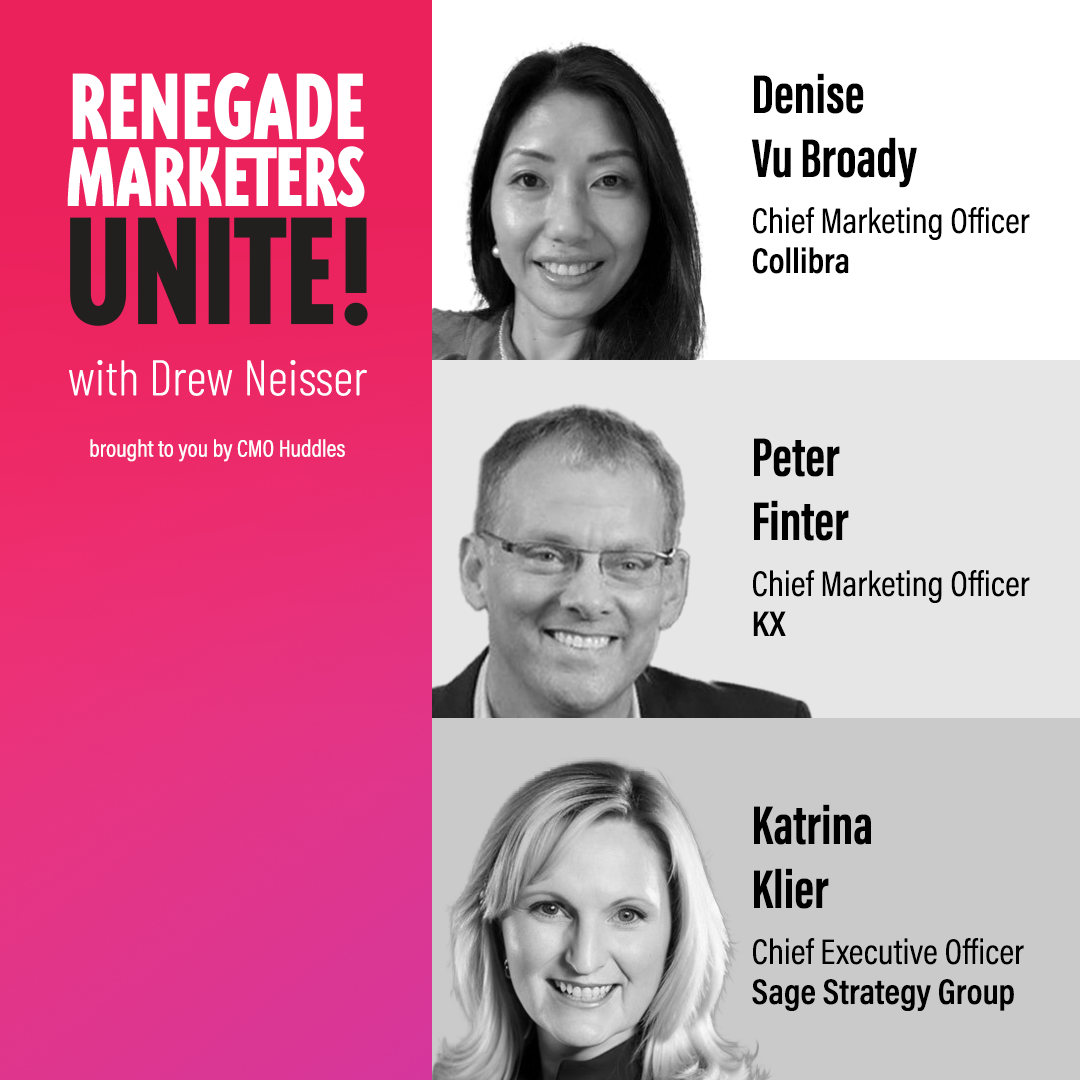
In this episode of Renegade Marketers Unite, Drew Neisser sits down with three marketing leaders who’ve done just that: Denise Vu Broady (Collibra), Peter Finter (KX), and Katrina Klier (Sage Strategy Group). They share how they earned board seats—and how you can too.
In this episode:
- How Denise mapped her board journey five years in advance
- Why Peter leads with risk and strategy to earn trust at the top
- What Katrina looks for in a board-ready résumé (hint: it’s not brand metrics)
Plus:
- Why nonprofit and advisory roles are the best launchpads
- When to invest in certifications like NACD and PDA
- How to talk board ambitions with your CEO (without raising red flags)
- Why CMOs are more board-ready than they realize
Whether you’re just curious or actively pursuing a seat, this episode is your inside track to the boardroom.
Renegade Marketers Unite, Episode 448 on YouTube
Resources Mentioned
- CMO Huddles
- Books
- Betsy Atkins books
- Liz Wiseman: Multipliers
- Matt Abrahams: Think Faster, Talk Smarter
- Past episodes mentioned
- Denise Broady
- Peter Finter
- Katrina Klier
Highlights
- [3:38] Denise Broady: 5-year path to a board seat
- [8:39] You’re not the boardroom CMO
- [11:48] Peter Finter: Think beyond your domain
- [14:14] Be the headlights
- [18:47] Katrina Klier: You’re more board-ready than you think
- [25:31] Build the relatability bridge
- [29:43] CMO Huddles: The CMO’s best friend
- [33:26] Board-worthy qualities
- [38:11] How to get a “yes” from your CEO
- [46:35] Not all board certs are equal
- [49:51] Words of wisdom: Developing board level skills
Highlighted Quotes
Denise Vu Broady, CMO of Collibra
“When you start the journey, don't give up. It could take 3-5 years to get into the spot, but in the interim, get yourself ready. Get educated, have targets, network… and stay resilient during the process.”
Peter Finter, CMO of KX
“Bringing clarity to mission, purpose, and how we communicate value externally is one of the key superpowers CMOs should be bringing to the table.”
Katrina Klier, CEO of Sage Strategy Group
“Think about yourself as a product: here are my features and functions and how I help you as a board director.”
Full Transcript: Drew Neisser in conversation with Denise Vu Broady, Peter Finter, & Katrina Klier Drew: Hello, Renegade Marketers! If this is your first time listening, welcome, and if you're a regular listener, welcome back. Before I present today's episode, I am beyond thrilled to announce that our second in-person CMO Super Huddle is happening November 6th and 7th, 2025. In Palo Alto last year, we brought together 101 marketing leaders for a day of sharing, caring, and daring each other to greatness, and we're doing it again! Same venue, same energy, same ambition to challenge convention, with an added half-day strategy lab exclusively for marketing leaders. We're also excited to have TrustRadius and Boomerang as founding sponsors for this event. Early Bird tickets are now available at cmohuddles.com. You can even see a video there of what we did last year. Grab yours before they're gone. I promise you we will sell out, and it's going to be flocking awesomer! You're about to listen to a recording from CMO Huddles Studio, our live show featuring the flocking awesome B2B marketing leaders of CMO Huddles. In this episode, Denise Broady, Peter Finter, and Katrina Klier share what it takes to earn and succeed in a board seat. They offer insights on positioning, preparation, and how to step beyond the CMO role with confidence. If you like what you hear, please subscribe to the podcast and leave a review. You'll be supporting our quest to be the number one B2B marketing podcast. All right, let's dive in. Narrator: Welcome to Renegade Marketers Unite, possibly the best weekly podcast for CMOs and everyone else looking for innovative ways to transform their brand, drive demand, and just plain cut through, proving that B2B does not mean boring to business. Here's your host and Chief Marketing Renegade, Drew Neisser. Drew: Welcome to CMO Huddles Studio, the live streaming show dedicated to inspiring B2B greatness. I'm your host, Drew Neisser, live from my home studio in New York City. As CMOs ponder the next big leap in their careers, many look to the boardrooms of public and private companies, but getting there isn't easy. Less than 20% of public boards have someone with any marketing experience. I said that correctly, yes, less than one out of five public boards have someone with marketing experience. There are a few reasons for this. Boards tend to replace outgoing members with individuals who have the same professional background. So if you have a CEO, a former CEO, going off the board, then you'll replace them with a CEO; a CFO going off, you replace with a CFO. So it's hard for these boards to find a spot for marketing. And then there's this general perception that marketers don't bring the breadth of business expertise of, say, a former CEO, CFO, or chief counsel. So overcoming this perception is just part of the challenge, and in the rare time that a board decides they need a marketer, the competition for that one seat is fearsome. So in today's episode, we're diving into what it takes to not only secure a board seat, but also to excel and thrive once you get there, so that you have a full amount of influence. All right, with that, let's bring on Denise Broady, CMO of Collibra, and returning guest who has previously appeared on the show to discuss B2B market research and partnership marketing. Hello, Denise. How are you today, and where are you? Denise: Drew, so, so great to see you. I'm in New York City, so back in the city. No complaints. Drew: I love it, I love it. So, okay, let's talk a little bit about you, the boards that you're serving on right now, and the process to get on them. Denise: So, Drew, maybe just a little refresher for the listeners. I've been in B2B marketing for the last 28 years. I've held a couple of roles also as a COO as part of this. And I think, like with any, whether you're doing a job interview or you're looking at a board position, the question is, how do you brand yourself and what makes you unique as part of this? But you've got to get the experience. So I was really interested in trying to get onto a paid board, whether it was private or public. This has been, for me, a personal goal for the last five years. So the first thing I did was I went to get some education, right? I went to Harvard on a course in Women in the Boardroom. I went through the studies for NACD as part of that, read quite a few board books. You know, Betsy Atkins has written a couple of great ones. She actually mentored me when I was at Workday, so we happened to meet in between, and with her help, I was able to come in and sit on a couple of startup advisory boards as a starting point. So I did that for about three years, and gave them kind of the extension on go-to-market marketing, thinking through the go-to-market in general as part of it, built great relationships with the CEO there as part of the overall piece. And then, you know, if you think that getting a C-level job is like this from a funnel perspective, the board is even skinnier. And I think that even in my desires, it was through the network and getting in touch with people. I had the awesome opportunity through another network from SAP where the person was a CEO in the past, and there was a board position open on the board that he sat on, and he referred me. And the process in itself is very different. So sometimes you'll interview with five other candidates. I made it to the last couple of slots a couple of times, but it did take a good five years as part of the process, right? Because, just like you probably get pinged for CMO jobs probably every two months or so, board roles open maybe once a year. So I was interviewing once or twice a year, and eventually last year, I got called by one of the recruiters. Ironically, I had worked with her as a peer in my previous life at SAP, and she was running Egon Zehnder, which is an entire search arm for Europe. And they were looking for a very specific profile, somebody that had a no-code background, a previous CMO, also go-to-market chops as part of it, and they wanted a U.S. director, and it just felt like all the stars aligned. I actually interviewed for the role as part of it, did a case study with the board members and the investors, and I've been sitting on a paid, private board for the last 10 months, almost 11 months now, and it's been wonderful. I mean, I've learned so much from the chairman of the board and all my colleagues, and if anything, I think it's made me a stronger operator as part of the process. Drew: Okay, a lot to unpack there. One thing I just noticed: this is not something where you wake up one day and say, "Okay, I'm going to be on a board, and it's going to happen tomorrow." You've talked about five-year plans and 10-year plans. The Harvard program—worth the money? Denise: Definitely worth the money. Had some amazing guest speakers as part of this, and just learning from other colleagues—definitely worth the money. Drew: And probably good networking. NACD, I think you mentioned; I'm not sure what that is. Denise: Yeah, NACD, which is the National Association for Corporate Directors. I'm really fortunate; I'm with a great network. And you'll hear a little bit later from Katrina. Katrina was the one that said, "Hey, go look at the certification." So I'm forever grateful for my peers also in pushing me to continue that journey, because sometimes, as you know, in a five-year journey, it's very easy to give up in the process. Drew: Yeah, and so this is, again, a very considered process. It doesn't happen overnight. You got educated. Another thing that I just want to remind folks is you've built a network, and you maintain your network. And I know we talk about this certainly with the Transition Team, but a lot of times folks don't wake up to keeping their network going until they're out of work or they want something. And you know that's a problem. So just a note: if you're thinking about being on a board, first ask yourself, how are you doing with your network? Are you still connecting with all your peers, going way, way back? And are you bringing value and helping them? Okay, so we got education—that was part one. And then I sort of call it like training wheels. I mean, you get on these advisory boards where you learn the ropes of this and how you add value. And I know one of the bigger complaints about when CMOs do get on boards is they think of themselves as the CMO of the company. And that's not right, is it? Denise: No, that's not your role. Your role is not to replace the operator. What they always say in the board role is "ears in, hands out." And part of this is your role is to look at the impact of marketing and the impact of potentially other things in the company, but to learn that through asking questions. It's not to say, "Hey, you need to have a different website strategy," or "You need to update your branding." It's more to guide the CEO as well as the management team. Drew: Yeah, get to know your Socratic method. You can influence by asking really good questions, not like how their PPC is doing, but big strategic questions. And so your training wheels and so forth with advisory boards—and of course, you're a longtime member of the CMO Huddles advisory board. We're most grateful for your input and appreciate that. And then again, I'm going to just go back to the planning and the patience. Then the next part I was getting into is presenting yourself as more than a marketer and as a business person is obviously really important in all of this, because you are there as a business person. So to the extent CMOs listening to this are thinking about what their "plus" is—like, we talk about CMO Plus a lot in Huddles—you had been a COO, but also your advisory board work has allowed you to think broader, right? Denise: Absolutely right. I mean, touching everything from new products, thinking about different entrants to the market, thinking through the competitive landscape, all topics. Sometimes we talk about compensation. And, of course, as part of the board prep, which we'll get into a little bit later, really understanding financials and being able to read the financials of the company, and, if anything, just doing all the legwork and keeping up with the market. Drew: Yeah, no, it's a great point. And you remind me, whenever I talk to folks who have, say, joined a nonprofit board, I always advise them, if they can, to get on the Finance Committee, because then you'll really understand, even for a nonprofit, how it works. Okay, so let's bring in Peter Fenter, CMO of KX, and an industry expert who's graced our stage before, to delve into the topic of sales enablement and the future of B2B marketing. Hello, Peter. Wonderful to see you again. So where are you, how are you this fine day? Peter: Midtown Manhattan here in New York today, yeah, in a rather wonderful coworking environment, hence the beautiful artwork behind me, and yes, excited to be with you again, Drew, and loving the insights we were just hearing and reflecting on my own experiences. So thank you for the invitation. Drew: It kind of looks like you have a surfboard behind you, but so far we have three of us, and we're all in New York City. Oh my gosh, we should be having drinks later. Okay, so let's talk. You heard what Denise had to say. Let's talk about your experience, what you heard, what resonated with you, and where you want to add. Peter: I resonate very strongly with the discussion around the strategic nature of this. If your desire is to serve on a public, private, or indeed nonprofit board, understand that it's a journey, and you're going to want to show up in a way that would cause others to say, "This is the standout CMO," because most CMOs don't make it to the board for whatever reason. They're not always invited. They're not even seen as necessary. So what is your value prop? I always like to believe, as a marketer, we should start with: what problem are we able to solve, what distinguishes us, what are our unique characteristics, and what do we need to do to stand out in a busy market? There are plenty of candidates who want to serve on boards. The question is, why would you be the one that makes it all the way? I think, first of all, one of the things we do well as marketers is understand the power of networks, and so I really appreciate the focus on that. I think that the issue that we have, of course, is that when we're in our own echo chamber, we may not have the external perspective that is necessary to serve on a board, and I would suggest that the best way to find out how boards work is to be a very active participant as a CMO. You have an opportunity, hopefully, to be able to get in front of your board on a regular basis. The question is, are you? Are you listening to the discussion about topics that are of little interest to you or peripheral, or maybe you consider them to be fully covered by others in the room? Or do you have perspective and commentary and insights that will help you to demonstrate that you are bigger and broader than the role that you occupy? The functional domain expertise is taken for granted. No one's questioning whether you're capable of being a marketing leader. The question is, can you contribute outside of your domain in an informed and intelligent way? And that takes some learning, in my experience. Drew: Yeah, you really have to think about yourself more broadly. You bring up such a good point. And it's funny, because I've had a lot of conversations with new CMOs and the angst they have as they approach their first board meeting. And what they're thinking about is, "I'm presenting to the board, and they're going to be examining my marketing in detail." And what you're really saying is, you have an opportunity to build relationships with these individuals as business professionals. So let's go to that first meeting. Here's this nervous CMO who's presenting to the board for the first time. How do they even get from, "I was going to talk to you about marketing," to "What I really want to talk to you about is the business and how marketing fits in," right? That's complicated. Peter: Something that boards really appreciate is a broadened perspective from informed individuals. Oftentimes, for board members, they have limited time windows to spend with their particular companies. They come in with a whole raft of information that's probably been provided in slide form in advance that they may or may not have time to really look at. They're trying to net out: What is the situation? Where are we now? Where are we going? Are we going to get there in the most effective way? Have we thought about all the angles? Are we managing risk appropriately? They're coming in with a lot of things going on in their heads, including the current state of the numbers. As a marketer, the first thing that you can bring to the table is an outside-in view on what's happening in your market. That's extremely valuable to the board. And although they may be very well-informed individuals and have fantastic relationships with clients or partners or other ecosystem members, the reality is they're not looking through the lens that you are, because you're thinking holistically about the business. I'm a firm believer that the marketing leader's job and the marketing function's job is to be the headlights on the business. Are you seeing ahead of the current state? Are you anticipating what's around the corner, and are you bringing that insight and knowledge back into the team? It doesn't just have to be into the operating team, but into the board. They will appreciate perspective, and they love topics like category design, definition, participation, market leadership. What does it take to become the profit owner in the category? Which category are you in and how is that changing? These are topics that are on the minds of board members, I have found, and they are where they find a way into the business. The alternative route for them will be, "Do we have enough pipeline to cover our bookings number next quarter, and the one after that, and the one after that?" You can take them down that path. And by the way, you should be an expert, and you should have a very well-informed opinion about that and an understanding of the risk associated with it and what you're doing to mitigate that risk. They think a lot about risk, boards, so that's something to keep in mind. So it's certainly legitimate, and your slides, if you get given the opportunity to present, are probably going to be on that topic. For many boards, that's the regular topic they want to hear about. After they've heard the CRO, they're going to be listening to you and saying, "Is what you're saying aligning with what I just heard? Is there a disconnect? Where are you at?" So there are a couple of entry points, but I would always want to start from the point of view that you are informed, but you don't know everything. So be curious, have a defensible perspective and point of view on the things that you should be an expert in, and be willing to accommodate other points of view. You're not there to tell everyone else that you're right and they're wrong. You're there to contribute to the success of the organization that you serve, and the board members have their own value to add, which you want to be participating in. You want to be encouraging that, you want to leverage it. So it may sound like a lot for a first board meeting. I would just say, prepare well. Anticipate the questions they're going to ask you on the things you are equipped to present on. Get that right, and then you're going to earn permission to speak about other things. Drew: "Headlights of the business" is a great metaphor. You're the headlights of the business. That also implies how you look at timeframes, because pipeline has a tendency to be quarter by quarter. You're looking at 18 months to three years. I think that's a really good perspective. You are bringing that, even if they're only interested in this quarter or next quarter. You can broaden their aperture by shining light on the future. I love that perspective. I also have to say that you probably want to read and practice what Matt Abrahams talks about in "Think Faster, Talk Smarter," because there is a bit of spontaneous conversation that you need to be prepared for and comfortable with. You can't shut down when they ask these questions, and so you might as well get that out of the way. All right, awesome stuff. Peter, thank you. We're going to now bring on Katrina, and then we'll all come back together in a second. So let's welcome Katrina Klier, CEO of Sage Strategy Group, who has previously joined us to discuss content and leadership strategies. Hello, Katrina. Welcome back. Katrina: Hi, Drew, it's nice to be with you on this curiously sunny day in Metro New York City. Drew: Oh my God, yeah. So here we are. We are very New York-centric here. But now that we know where you are, you've heard the two of them, both Denise and Peter. What did you hear, what do you want to add, or just put a check mark next to? Katrina: Well, I think there are a few really key things in what Denise and Peter have said that I'll add on to. One is knowing your value proposition—what do you really bring to the table? And it's different from a board perspective than as an operating executive. I can give you an example if you want. Drew: Yeah, go for it. Katrina: So, I worked at Accenture. They hired me originally to do the digital transformation of everything market-facing and to build a robust digital marketing function and capability. Great. So on my operating résumé, there's all kinds of great stuff on there: increased brand value 50%, did this, drove this much pipeline, done that, right? That's the stuff that a CEO is going to care about if they want to hire me to do something like that again. What the boards care about is the stuff that is not really on my nice, little, tidy bullet operating résumé, and that's things like: the company at the time didn't have a governance strategy broad enough to encompass digital channels and formats, so I had to help build that policy and that governance structure internally for the company. Our PII strategies and governance and compliance also weren't inclusive of things that happened in the digital realm, and so I had to work with legal and with all kinds of other people to shape that compliance and governance strategy in a highly digital world. So that's not stuff that shows up on my CMO résumé, but that's stuff that boards are really interested in. How did you make those risk trade-offs in data that you collect, capture, and use? How did you think about the paradigms in a global marketplace? How did you adjust to different regulations around these kinds of things in different markets, like when GDPR came out, and all the other ones that have followed since then? You have to manage a lot of that stuff as a CMO. You probably think of it more as a means to an end in your current job. So I encourage people to sit down with their operating résumé and go back role by role by role, and think about the things that you had to do to build a cohesive strategy that connected to other parts of the company, that identified and mitigated risk, and how you were going to know and what you were going to do that had any kind of governance around it, whether it's data governance, compliance with different things—you name it, that can cover a lot of areas. And then also, if you've had any significant events in your career that could be beneficial to a board: Have you done a lot of acquisitions as an executive that you can talk to? Have you been through some significant ownership changes? Have you been through some IPOs? Have you been through some take-privates? Have you been through a big shift in your investors overall? So if you take a step back and think about all those other things, I think CMOs have a lot more board-relevant experience than they realize. And being able to talk about it that way can help boards actually realize that you have a lot more board-relevant experience than they might think. Drew: Yeah, and I'm going to pile on to that. Obviously marketing is one, but a lot of board members, particularly in public companies, tend to be over 65. They're not digital natives. There are regulations you mentioned; there's a lot of legal involved in marketing and cybersecurity. I mean, think about it: marketing is probably the biggest risk that companies have when it comes to cybersecurity. So there's a lot more. And I think that this just helps you think about: you're not the marketer in the room, you are a business professional who happens to be a marketer. Denise mentioned the NACD. Talk a little bit about that and the role of that organization. Katrina: Sure. Being a corporate board director is, a lot of times, something that people do as kind of a portfolio part of their career. And just like any other kind of role that you might have, there are industry organizations and groups that support that kind of a job. The National Association of Corporate Directors, or NACD, is one. They focus more on public company boards, but they do cover private companies, ESOPs, private capital, and so on, and they do have a really good certification program and some ongoing training programs. If anyone is interested in that, you do have to be a sitting board director to join. However, it doesn't have to be a public corporate board to qualify you initially to join, just to be clear on that. There is ongoing research around culture within the boardroom and its impact on operating performance, technology trends, and cybersecurity trends. They do these Blue Ribbon Commission reports every year, and they're some of the best research you'll find out there. So NACD is one that's quite good. Another one is the Private Directors Association, or PDA, and they have chapters all over the United States. You join nationally, but you can go to events and different things anywhere in the country. They focus entirely on privately held companies. So that could be private equity-backed, venture capital-backed, family-owned businesses, employee stock ownership program companies—ESOPs—where it's basically almost like a co-op, and any number of other private capital type structures. They also have some excellent training and certification programs, because the legal structure of the company does have an impact on the type of oversight and governance and risk management that you provide as a board director. I would say those are two leading organizations I would encourage people to check out and potentially join if you want. Everybody likes the public company board idea, which is fantastic. There are a lot more private companies in the United States and around the world. As Denise just mentioned before, many of them have boards made up of investors, but they often look for some independent directors that can balance out the investors on the board and/or have domain expertise in some area that's beneficial to the company. Drew: Having been on a nonprofit board now—gosh, I guess it's 12 years, and I just got renewed—they, in particular, appreciate that I'm not from the industry, but they wanted some broader marketing and trends expertise. It's been great. I've learned a lot about the green building industry in 12 years, but it's been helpful to them. I sit on a couple of committees, and it's been really helpful. I think, obviously, they've renewed it. So to me, part of this is making sure that you can be discovered. And the truth is, as you mentioned, it's not that you're discovered; it's that you've networked into it. Katrina: Yeah, absolutely. I'm on three different growth-stage company advisory or corporate boards and one larger corporate board and a national nonprofit board, and I will tell you that they all came about through a combination of networking and just showing up consistently enough that I was findable. Drew: This is really key. So if you're listening to this relatively early in your career, you have time to build and do it. If you're looking at this late in your career and you haven't invested in your network, well, you better start now, right? You talked about showing up. What did you mean by that? Katrina: See, you know, you need to show up in places where, you know, think about yourself as, like, you know, we all say this is easier to say than to do sometimes, as a product. I am a product of a board director, and here are my features and functions and how I help you as a board director. So be clear on that. Be open to some space around those things and give people a relatability bridge when you talk to them. Don't assume that they're going to know that you might be interested in board work if you haven't told them, right? So, you know, you can introduce yourself and say, “Hey, you know, I've been a CMO for a long time. I also have a background in strategy, operations and global scale.” This would be what I would say. And I'm really interested in expanding my portfolio of board seats. How I add value is, for example, again with me, marketing technology, revenue technology, or professional services companies that are looking to scale because they've sold to people like me in the past, or I've done some of that work, and I understand what's involved in driving growth at scale in those different markets. I build governance in new areas. I've managed government regulation shifts. I can save them some, you know, scraped knees and bruised elbows by asking some questions to help them as they're building their strategy, not build the strategy for them, because, as Denise mentioned, that's not your job as a board director. Your job is to really help them think through if there were blind spots they didn't know existed, and should they go close some of those. Are there other people in the industry that they should meet to add some perspective, that you could make an introduction to? So just be clear on kind of how you add value. Be open to possibilities. Be able to name a few companies that you would like to be on the board of, mostly so that people can say, “Oh, okay.” I don't want to name a specific company, so I'm going to use you, Drew, as an example. So let's say you say, “I want to be on the board of CMO Huddles.” Okay, maybe CMO Huddles isn't looking for a board member right now, but people who know CMO Huddles know, okay, CMO Huddles is an executive-level company, or their customers are executives. They help people with leading trends, getting through them and navigating through content, peer-to-peer mentoring, and a whole host of other things. CMO Huddles may not be looking for something, but you know what, I know of two other organizations that might be interesting for you to meet, right? So create that relatability bridge for them by giving them some company examples, because you can say CMO Huddles or a company like that, and then that gets them thinking, “Oh, who else do I know that might be looking for some of that?” It's more helpful than just saying, “You know, I want to sit on a corporate board.” Okay, well, throw it down. That's like saying, “I want a job.” Drew: Yeah, it's a difference between a goal and a strategy. And the goal is, yeah, I want to do this, but a strategy gets you there. And I love the relatability bridge. Some might have called it an elevator pitch, but you've already done your homework. You say, “I want to be on this type of board, and I want to do it because I've got this kind of experience. And here's a name.” You're making it really easy. Okay. Love all that. Oh my god, we packed so much in the first half hour of the show. I can't wait to see what else we come up with. But now we're going to talk about CMO Huddles, which you've already started the conversation on. Launched in 2020, CMO Huddles is a close-knit community of over 350 highly effective B2B marketing leaders who share, care, and dare each other to greatness. Newsflash: someone just described us as the CMO’s best friend, which I love. That made me very happy. Given the extraordinary time constraints on CMOs these days, everything about CMO Huddles is designed to help leaders save time and empower them to make faster, better decisions. Okay, let's bring everybody back. Denise, Peter, Katrina, you're all incredibly busy. You're also longtime huddlers. I'm just wondering, can you share a specific example of how Huddles has helped you? Peter: Happy to do so, absolutely, Drew. So I was thinking about this question, and the thing that came straight to my mind is this: everyone in marketing today is confronted with the biggest opportunity of our age, arguably, which is how to leverage AI effectively, not just in our function, but for our companies as a whole. Most of us are incredibly busy. We just don't have a lot of time to spend exploring the topic. I personally have found CMO Huddles to be incredibly helpful on the topic, bringing experts and expertise to me that has saved me a ton of time figuring all those best practices out, and also how to apply them in my organization. So tapping into a network of experts is incredibly beneficial for me as a CMO. Drew: I so appreciate that comment. Thank you for that. Denise, anything to share? Denise: Yeah, so I think very similar to what Peter mentioned, you've got top CMOs all together, you have the ability to really not only network, but learn. So kind of think about this as when you're sitting on a board, you know, what I really love is CMO Huddles. I could be learning stuff in B2C as part of this, even though my background is B2B, different topics. And when you're part of a board, you're in there for a certain background and expertise, but you may be interfacing with, you know, different folks. Like I'm now with one of the board directors who I'm very close to, who is B2C, coming more from a sales background as part of it. And I think it just gives you the experience, really, to see how other people are asking questions, and how do you strengthen that and build your expertise as part of it as well, and just exposure in general. Like anything, you know, you may not be an expert, but to have enough exposure where you could ask the right questions. I love it. Okay, Katrina, any extra words to this? Katrina: Yeah, I agree with all that Peter and Denise said. The other piece I'd add to that is that it's a great sounding board of peers. You know, the beauty of CMO Huddles is that network that happens during official CMO Huddles events, but then afterwards. I mean, you broker connections between people. You know, we can call you and be like, “Hey, you know, I'm trying to figure out this thing. Like, who else has solved this thing?” And you're like, “Oh yeah, there's three other people. Let me make an introduction,” and you can have some of these other conversations then offline. And it's an amazingly powerful sounding board and support system. Drew: I appreciate that. I appreciate all of you. It's funny you mentioned that one particular one, because we just had a—I got an email this morning from a huddler who said, “Hey, I just added this whole other area to my thing. Any thoughts?” And not only was I able to have a thought, but a huddler was about nine months ahead of them in heading that, and so we could simply connect them. So it's a wonderful thing. Anyway, if you're a B2B senior marketer who can share, care, and dare with the best of them, do yourself a favor. Go to cmohuddles.com, sign up for a free starter program. If you are a CMO, we'll upgrade you to a guest pass. Okay, let's get back to this. Let's all come back and talk about this. So we want to be board-ready. And so I guess the question to you, and it'll be interesting to see if we can avoid complete redundancy, but three qualities a CMO needs to have to be board-ready, and let's do this in reverse order, starting first with Katrina. Katrina: Yeah, you know. So I would say the first one is really strategic planning or risk assessment experience and being able to extract the models and frameworks from what you did, that you've led some of that work. Like Denise said, you kind of need to have done the executive stuff to be qualified to be on a board. Second one, which is the no-brainer, and that's financial acumen. If you cannot tear through a P&L, a balance sheet, any other financial statements, investment documents, all those kinds of things, with a level of comfort and understanding, then go get yourself signed up for some classes to learn how to do that. And the third one, I would say, is a great network. You know, go expand your network of executives, investors, and other board directors, regardless of whether it's public, private, nonprofit, industry, any other kinds of boards. People that sit on one board usually sit on more than one over time, and so get to know them. Get on the radar. Drew: I love it. Okay, well, that's gonna make it tough, Peter, but what's on your list that wasn't on Katrina's? Peter: Well, I think let's start from who we are as CMOs and what we do. I think bringing clarity to mission, purpose, and the way that we communicate the value of the organization externally is one of the key superpowers that we should be bringing to the table, and I think that's something we sometimes think is the marketing job. But actually, the board needs to evolve their understanding of mission and purpose, because companies don't stand still. Markets don't stand still. And so leading that work and being instrumental in redefining those elements is something that we can bring and should be bringing appropriately into that context. I think we talked about networking. Actually, networking to secure talent and to build the ecosystem around the company is something that every board member is expected to do. You are an advocate and an ambassador for the organization, and so that means operating at that higher level. You're functioning not just in terms of the focus of your own role, it's that bigger piece. And then something that probably we don't think about a lot, which is, as a board, you are responsible for evaluating the performance of both the management team and the CEO. And as a board chairman for the last eight years, I won't say that's an easy part of the job because of the relationship between CEOs and boards, but it's a really interesting dimension, and it's something that you might want to build your muscle around as you contemplate taking on board responsibilities. Drew: Yeah, well, it is. It's so interesting. I can think about some moments on the boards that I've served on, where it did come down to, “Does that CEO get a raise? You know, are they really hitting their roles? Are their direct reports inspired?” That's such an interesting point. Okay, Denise, so we now have six characteristics. Any ones that you want to add to this list? As we said at the beginning of the show, this is not easy. You got to be really good to get on a board. Seven, eight, and nine, Denise, if you have it. Denise: Drew, I don't have nine, but I have two things that are a little bit more soft than what, between Katrina and Peter mentioned, right? One is, get to be a good listener. Part of your role in the boardroom is really to listen and to figure out where do you ask the tough questions as the management team is presenting, as well as sharing some of their strategy as part of that. And then I would say the second part that becomes so important is we think that as operators, you know, curiosity is important, but when you go to the boardroom, it's not, right? But for me, like, I look at part of the impact of sitting on a board right now that is in the no-code middleware space. I'm always reading what's going on in the market from a competitive perspective. I'm curious to see how other companies are approaching certain things. Again, I'm not trying to be the operator. I'm just keeping myself educated. I am really thinking through the market, helping them around the strategy, and that curiosity needs to remain with you in the boardroom. So I would say listening skills and curiosity are the two additional things that I would add on to the list. Drew: Yeah, I love it. Those are great. So, wow. Pretty healthy list. We've got strategic planning, financial acumen, a good network to help. Peter mentioned this in a different way, clarity on mission and purpose, ability to network in terms of helping with talent, and then being able to evaluate the CEO. And then, of course, Denise talking about listening and learning, being curious and being able to ask the questions. Those are awesome lists. So Denise, you mentioned this, and I want to ask everyone this question, which is, let's say you're lucky enough, you finally got asked to be on a board. In some cases, you have to go to your CEO and say, “Hey, I'm gonna be on a board,” or “I've been invited to be on the board. Is that okay with you?” And I'm curious, and you talked about the value that it brings back to you as a CMO to the company, but talk about that conversation and how that goes. Denise: Sure, and probably my approach was a little bit different. I talked about it actually in the interview process before I came to manage expectations as part of it. You do have to go through a legal process, regardless of you going, you know, participating in a private board or public board, to make sure there's no conflict, especially if you're in adjacent markets as part of it. So the legal counsel typically has to sign off. And then I would talk through the expectations, right? Because for myself, what opened up was a Munich-based company, which meant at least a couple times during the year, I would be taking vacation and participating in that set of board meetings, but at the same time, there would be remote work. Now, the good news is, because it's in Europe, it really didn't collide with my schedule too much. And then, of course, we're always looking at the schedule to make sure there's no conflicts. So I really think managing expectations and making sure that the CEO or whoever you report to understands your aspirations as well. And, as mentioned, it really helps you to, you know, drive additional knowledge into the company. And I know that in my experience this past year, as the market was shifting, you know, I said to our management team, I said, “Hey, it's interesting. I sit on this board, and if you're in mid-market or probably in the SME side, you get, you know, less churn. And I noticed, hey, you're in the enterprise. Here's what I'm noticing.” And that was just based on my board experience, which led me to the curiosity of going out and asking two or three other colleagues that were also in different market segments to do that validation. So again, I think that what you learn on your board can get, you know, shared across as well. You're not sharing anything confidential, but that managing of the expectations with the CEO is critical. Drew: Yeah, it's such an interesting thing because it's broadening your perspective. And I'm just imagining being on a board helps you deal with your own board. Peter, anything that you would add in terms of your being on a board and the conflict that it potentially—because it is time-consuming to be on boards—selling that into the CEO and the value that it brings to the organization that's paying your paycheck? Peter: That's absolutely true. But, you know, one thing that I think all managers generally are concerned about is to see that the people that are working for them are developing and broadening their own skills and capabilities to bring more value to their organization. Nobody wants a static individual in their team. If you're not growing, you're possibly withering on the vine. So what you're bringing to the table as a result of being engaged in a board is a perspective which is extraordinarily helpful, both to the CEO, even where the company relevance to the market category may be insubstantial relative to your existing company. But the fact is that you learning to serve on a board is going to help you bring a perspective to your executive team who may not have board positions today. They may be, in fact, earlier in their careers than you are in that respect, and you can help them perform better in front of their board, and that's a critical consideration for a CEO. All CEOs that I know are extremely concerned about who they put in front of the board, because the potential for it to go wrong is pretty high, and so they are thoughtful about that, and they are looking for partners in the room who are going to help manage the conversation, who are going to bring value, and are going to help the CEO to look great in front of the board, himself or herself. And you can do all of those things by serving on other boards and bringing that to them. So I would focus in on the personal growth and contribution perspective in my conversation with the CEO. And that's a good way you can challenge, because you're really saying, “Are you invested in me? Do you believe that I have long-term potential? Are you concerned to see me contribute at a high level in the organization?” If so, this is a perfect way to do it, and that may just tip the balance for you. Drew: It's so interesting because I'm actually listening right now to Liz Wiseman's first book, “Multipliers.” And, you know, there's the term multipliers, and then there's the term diminishers, and there are CEOs—and there are leaders—who are diminishers, who are all about, “Well, what are you doing for me right now that's good for me right now?” And, “How is it that you could be on a board when I'm not on another board?” And, you know, jealousy and control. And I could see this conversation going that way. But you're describing some multipliers in the CEOs that you've been fortunate enough to work with. So I love the positioning that you're presenting. I just don't know if everybody in that role has the maturity to recognize what you're putting forth. Peter: I'm not going to argue with you, Drew, but you got to work with what you have. I've always believed, hire the best boss you can. Drew: Hire the best boss. There you go. Katrina, anything on this conversation? Because, you know, it's really rich, because hopefully you have a CEO who believes in you. Hopefully you have a CEO who wants you to grow. Hopefully you have a CEO who looks to you to do more than marketing and bring that expertise. And of course, serving on a board would do that. It does mean they have to trust your time management skills, because you're going to be spending time somewhere else. Katrina: You know, it does, and I think I agree with Peter in particular that I would have the conversation, because it's going to be enlightening for you one way or another. Whether they say yes, you can do the board, or no, you're going to walk out of that conversation with a lot more context than you walked in with, and that's helpful from a career standpoint. Have a plan for yourself on how much time you can invest in board service and use that as a guide for the kind of boards that you go after, and have an answer to that when it comes up in that conversation. Their only worry is, how are you going to manage time? That is just a hair away from a yes—not a problem with you to do this—but a big cliff to be a no if you don't have a good answer. So have done your homework. Board meetings, people usually schedule relatively far in advance, you know when they are. Make sure they don't conflict with the board work you need to do in your operating role. Have a plan for yourself in terms of how far you're willing to travel or not. Can you take an international board, or a board that's, you know, on the other side of the country from where you work? Time-wise, does that work for you or not? Do you need to be able to drive to that board meeting in the morning, get back home that afternoon, and be back online to finish out the day? Then just know that and spend some time thinking about it ahead of time, because that is the question that you really want to have an answer for, because it means that CEO is like right with the cusp of saying yes, but if you don't have a good answer, then it's going to be no, because they don't have any other answer they can give you. Drew: And particularly if it's a public board, you just have to recognize that's a very time-consuming thing. I mean, public boards expect you to be able to spend a certain amount of time, and God forbid you do get on the finance committee, because you're going to have a lot—or certain other committees are very time-consuming. So that's part one of this thing. I love something that Denise said, and I think going into any job, even if you're not on a board, the conversation in the interview process, to say, “Hey, I aspire to be on a board because it's going to help me do this and this for our company, and help me have a broader perspective and bring that to the company.” Get that on the table early, even if you're thinking about it five years from now, because you're really saying to your CEO, “I am bigger than this role, and I want to be bigger than this role, and I want to help you in any way I can. And that's just one of the ways I can.” Don't wait until you have the offer, because that's an awkward thing, because you are at that moment saying, “I'm going to take some of my time and I'm going to put it over here.” And unless you're really good at connecting those dots, connecting the value over here—time spent—to the value to the business, your CEO may question it, put a kibosh on it. So plan ahead. So at least that's what I'm hearing. So I want to ask a different question, just a small one, but I know that a number of folks consider certifications and so forth. And I have sort of heard that, yeah, if you can get an Ivy League one—Columbia, Harvard, Penn—they have some really high-level things. Plus, the network is really good, but you're not necessarily going to do the one at, you know, an unknown or not-prestigious one. And I'm curious, Katrina, because I know you're involved in this organization, because you could spend a lot of money on these certifications and these courses. When's it worth it? Is there a threshold? Katrina: So I'd answer it in a couple of different ways. So one, if you have your CEO's support to go do board work, maybe they'll contribute to some of the cost for you to go do some of these programs. So think about it, because, you know, you get professional development out of it at multiple levels. So that's kind of one thing to consider. Another one is, you know, what are you trying to get out of this work? Are you trying to understand how boards—corporate boards in particular—really work from the other side of the table, from the rooms you may have already been in, and decide for yourself if this is something you want to do or not? Have you not done a lot of board work or a lot of networking, and you need a little boost to say that you're qualified in some capacity and de-risk the decision to talk to you by the nominating and governance committees? And so I think that's good, and they are great networking opportunities. I will say, you'll meet people throughout these that, if you make the effort to stay connected to, can be really, really wonderful and helpful relationships. The cost for this can be all over the map. I would say, don't do the—like so many things in one's life—if you pick a program that's run by an organization that kind of does that program to generate membership for themselves, or does it because they think it's something kind of good, but nobody's going to look at it and go, “Oh, that's fantastic, I'll definitely talk to you because you've done it,” then it may or may not be worth your time. If you're just exploring and it's the price threshold you want, then, you know, no harm, no foul. But if you're really looking for something to propel your career, just like you invest with any other education that you do, choose the provider carefully. Drew: So as I'm listening to all of this and trying to summarize it before I ask for your final words of wisdom, what occurs to me is a lot of CMOs start to think about this later in their careers, and they're thinking, “This is my exit plan. I'm going to get out of this role and I'm going to go off onto the board.” And I think there's somewhat of an irony there, because if that's what you're thinking, you may have not planned enough, part one. But part two is, if you think about this journey of preparing as, “This is going to make me a better executive”—not “This is going to make me a better marketer,” this is going to make me a better executive, no matter where my career goes—then you're broadening the perspective, and you're opening it up to opportunity for the company you're currently at, right? They won't necessarily challenge you on, “I know what you want, you want to get out of this job and you want to get on a board, and then that's your ticket out of line job.” That may be true, but I'm not sure that perspective gets you there. I think that, as a career development thing, this is something that will really help you with your current board and so forth. Okay. Final words of wisdom for CMOs when it comes to developing board-level skills. And we'll start with Denise. Denise: I was gonna say, when you start the journey, don't give up. It could take three to five years to get into the spot. But in the interim, as mentioned at the start, get yourself ready, right? Get educated, have targets, network. And at the end, you know, it's a very small pyramid as part of it, and I think that you need to stay resilient during the process, because you'll get a lot of no's. And take every interview as an opportunity to try and get onto the boards. Test-run it, but also make sure that the company is a cultural fit for you as part of it as well. Drew: Yeah, you got to, again, just like Peter said earlier, you got to pick your boss well, you got to pick your board well. Okay, Peter, final words of wisdom. Peter: What I've learned as a CMO on a board is that I'm surrounded by people who have come up generally financial routes inside of their companies, or have become very proficient, and there is a language that they speak, and it's called spreadsheets. It's called P&L. It's called profit and loss statements. It's essential that you learn the love language of the board if you want to communicate effectively. Talk in their terms, and the best way to do that is to partner with your CFO. Your CFO has the best understanding and insight into that world and the way that that manifests in front of the board. Typically, they sit on the board, but they will certainly have very strong relationships. So my encouragement to us as marketers is to become proficient in learning the language of the audience that we're trying to influence. That's not new news to marketers, but we should think about that. Drew: We should indeed. You need to speak spreadsheet, folks. And what's so funny is I just wrote up our recap that goes out to our huddler community, and Peter, I happen to quote you on it. And since you made it public, even though those meetings are private, I can now attribute that to you. Yes, and speak the language of love of CFOs. I love it. All right, Katrina, bring us home, one final word of wisdom. Katrina: Well, you know that saying, “Luck is where preparation meets opportunity.” I would say that's never more true than in your board search, because, like Denise mentioned, this could take a lot of time, and there's not a lot of these opportunities out there, and it could take a while, and you might need to learn other languages, like Peter mentioned. If you don't speak finance well, then you need to learn finance and be able to speak it. And a good way to do that is to get involved in other kinds of boards in advance of corporate boards, if you want to. And that could be an industry association board, a nonprofit board. The university you went to might have an advisory board for the business school or something like that. And go sign up for some of these committees that are a little outside of your expertise. They'll want you because of your marketing capabilities in those organizations, which is awesome. And sign up for the technology risk committee if you don't know that much about that. Sign up for the audit committee and go get yourself a class on financial acumen and go do those kinds of things. And so, be prepared so that you can make your own luck as it happens. Drew: I love it all. All right, well, this has been one of the richest—I mean, boy, if you're thinking about this, I bet you're going to want to see the transcript and take a lot of notes. Anyway, thank you, Denise, Peter, Katrina, you're all amazing, great sports. Thank you, audience, for staying with us. To hear more conversations like this one and submit your questions while we're live, join us on the next CMO Huddle Studio. We stream to my LinkedIn profile, that's Drew Neisser, every other week. Renegade Marketers Unite is written and directed by Drew Neisser. Hey, that's me! This show is produced by Melissa Caffrey, Laura Parkyn, and Ishar Cuevas. The music is by the amazing Burns Twins and the intro Voice Over is Linda Cornelius. To find the transcripts of all episodes, suggest future guests, or learn more about B2B branding, CMO Huddles, or my CMO coaching service, check out renegade.com. I'm your host, Drew Neisser. And until next time, keep those Renegade thinking caps on and strong!Show Credits