The Event ROI Reality Check
Events sit at the crossroads of joy and heartburn for B2B marketers. The magic of getting customers together in real life is real, and so is the pain when sales skips the pre-work and ROI gets fuzzy. With every dollar under scrutiny, CMOs are treating events as strategic bets that have to earn their spot on the plan.
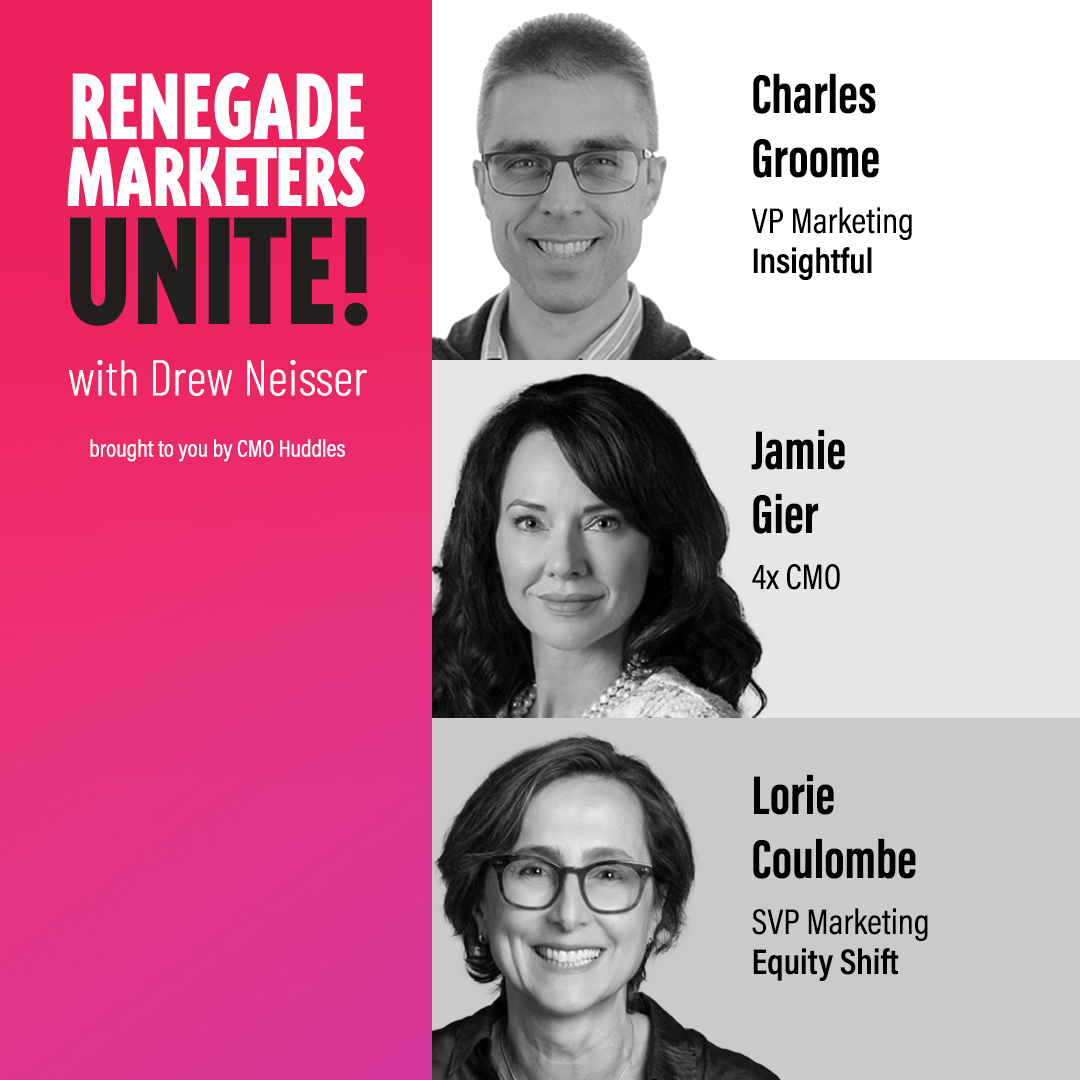
In this episode, Drew talks with Charles Groome (Insightful), Jamie Gier, and Lorie Coulombe (Equity Shift) about how they decide which events to do, design experiences people remember, and turn field time into pipeline. They cover event portfolios, sales pre-work, and the simple tools that keep everyone aligned before, during, and after the show.
In this episode:
- Charles sorts events into three buckets, leans into a listening circuit with smaller meetups, and looks at target-account impact to decide where bigger bets belong.
- Jamie frames events around getting discovered, creating memorable experiences, and driving deals, with customers on stage and pods focused on key accounts.
- Lorie sets clear goals for each event, does deep homework on audiences and geographies, and locks in sales pre-work and follow-up expectations.
Plus:
- Build an event portfolio that blends big shows, listening trips, CABs, and customer moments.
- Use themes, news hooks, and customer voices to stand out in crowded halls and drive recall.
- Align sales and marketing via pods, shared KPIs, and simple scoreboards.
- Tighten spend with regional focus, partner co-hosting, and clear criteria.
If events are on your 2026 budget and you want them to pay in pipeline, this episode will help you pick, plan, and prove them with more confidence.
Renegade Marketers Unite, Episode 499 on YouTube
Resources Mentioned
- Past episodes mentioned
-
- Charles Groome
-
- Jamie Gier
-
- Lorie Coulombe
Highlights
- [2:22] Charles Groome: About Insightful
- [4:05] B2B events in three buckets
- [6:24] Field meetups as ABM plays
- [10:08] Jamie Gier: Three-part B2B event playbook
- [16:03] Pods at events advance key accounts
- [19:10] Lorie Coulombe: Pick events that match your goals
- [22:38] Win local before you go big
- [25:53] Pre-work drives event ROI
- [28:12] CMO Huddles: Your sounding board on demand
- [31:30] Weekly sales syncs build accountability
- [32:34] Marketing runs events & sales books meetings
- [37:52] Tie your event to real news
- [42:11] Put your CEO on stage
- [46:54] Event Strategy tips for 2026
Highlighted Quotes
"You need to brute force this if you're taking an account-based approach. I could be going to five events with a hit rate of 10/100, or I could be going to two big events with a hit rate of 30/100."— Charles Groome, Insightful
"The human psychology behind how you engage is super important. You are competing with hundreds, sometimes thousands of other vendors vying for the attention of these buyers."— Jamie Gier
"One thing that’s working well is Building consensus and accountability with my small but mighty sales team during the planning stage. The earlier they're aware of the plan and expectations, the more they're on board with it."— Lorie Coulombe, Equity Shift
Full Transcript: Drew Neisser in conversation with Charles Groome, Jamie Gier, & Lorie Coulombe
You're about to listen to a recording from CMO Huddles Studio, our live show featuring the flocking awesome B2B marketing leaders of CMO huddles. In this episode, Charles Groom, Jamie Geier and Lori Colo. Dig into how to make events pay off. They talk about being ruthless, about which events you do, getting the sales pre-work locked in, and creating an experience that carries past the event.
If you like what you hear, please subscribe to the podcast and leave a review. You'll be supporting our quest to be the number one B2B marketing podcast. Alright, let's dive in.
Welcome to CMO Huddle Studio, where marketing leaders come to share care and dare each other. To flocking awesomeness. I'm your host, drew Eiser live from [00:01:00] my home studio in New York City. Today we're diving into a topic that sparks both joy. And frustration for B2B marketers, and that's events. We love them because there's nothing quite like the magic of bringing customers together in real life.
But we hate it when like salespeople don't do the pre-work, like scheduling meetings, leaving ROI to chance with every dollar under scrutiny, CMOs are putting C events under the microscope. Asking the tough questions, what's worth it, what's not, and how do we make every event count? And there's so many different types of events.
So it's tricky here to have this conversation. But fortunately for you, we've got three amazing marketers to talk about this. So let's bring in Charles Groom, VP of Marketing. Insightful and a returning guest who's previously paired on the show to discuss category creation and a BM. Hello Charles.
Hey Drew.
Yeah, thanks for having me back.
How are you? And where are you? [00:02:00] So I'm doing great. I am 45 ish days into a new role here at Insightful, and I am in rainy and somewhat chilly New York City, just a few blocks away from you, I think.
There you are. All right. Well, yeah, we could almost do this in the same place, but, uh, yeah.
You know, it looks like we've cleared up here.
We have to, we'd have to plan an event for that first.
We do. We do. So, By the way, congrats on insightful for, maybe you could quickly just, so what is insightful and explain what that, what's going on there?
Well, you're, you're gonna test my positioning, uh, knowhow in the first 45 days, which is always good for a perfect leader.
we are a work intelligence platform, which really brings together three components of the, especially the remote working world. Workforce management and insights, workflow optimization, insights, and then the security especially of remote and hybrid work. bringing it all under one reporting analytics platform that, you know, has AI built in as one would expect these days to prompt and figure [00:03:00] out, where work trends are, on policy, off policy or where employees may be experiencing burnout.
Some very cool insights that we can obviously bring up, relative to our business. But the good, the kind of relevance aspect of this is that we are a B2B and we are selling to a very diverse range of businesses. It's a horizontal SaaS product. so events is gonna be one of those areas we have to spend a lot of focus time on so that we don't, waste money and that we can prove.
ROI.
Well, in terms of the key takeaway, it feels like, insights is the big word, and with your name as insightful, you're not too far from that. I got it. So, insights,
you know, how, how do you spend your time? What apps are distracting you? Uh, you know, if you, if you have that, tab up in Google Calendar about how many meetings you have, we tap right into that data feed and we're, we're going into the intel of where you're actually concentrated versus, uh, out of focus on tasks.
Yeah. If only you could solve my ADD problem, [00:04:00] we'd really be in business here. So, all right, let's get, uh, not about me. This show is about events and planning. So talk about your. Planning, uh, in, you know, what you're looking at went from an event present standpoint.
Yeah. I, I wanna speak generally, you know, in B2B about this topic because, you know, my experience spans multiple different verticals.
I was in the FinTech SaaS world before insightful, the use cases are quite consistent. I like to break the world into roughly three types of events. and everybody has their own way of looking at this, but this is my, my mental picture of it. And it tends to be the way that we organize our budget as well.
So it's helpful in that respect. You might have a fourth or fifth category, Right, which I'm lumping together. Big buckets. Number one, are those sponsored events where you're gonna go out to an industry conference, a trade show perhaps, depending on the vertical. You might wanna align those, you know, with, the ICP list that your product team has developed.
Uh, but [00:05:00] those, you're gonna do some sort of sponsorship. Those are your, your fixed. Play events where you need to have a full bore strategy, and you're very often looking at those as kind of top of funnel feeders just as much as, you know, mid Funnel momentum builders. The second category is one that I, I, I really resonate with is actually.
Equipping our sales team to become a listening device out in the field. Go into these smaller, whether they're regional events for your industry. Like in the FinTech space, we would send salespeople to individual meetups that were happening locally in Charlotte or New York or New Jersey of just small, small gatherings, Huddles, if you will, of bankers and people that are in your ICP.
So to me, that's category two, where. Marketing's role is a little different. It's not the big brand top of funnel, but it is helping to listen and learn to the industry, and there's a lot more product intel that you get from that. And then the third category, I like to put everything that we co-host or self-host under one grouping in my [00:06:00] strategies.
And I think about that as being your cab event. If you're gonna have a client advisory board summit. Uh, I think about that also as. User conferences if you have a much larger, more diverse user community. And it could also be those networking happy hours that you wanna do for field marketing and, and business development purposes as well.
So in my mind, those are the three varieties.
And. Do you see in, in terms of your mix in 2026, leaning more towards one than the other?
We are gonna lean pretty heavily in my first year in the role. We're gonna lean pretty heavily into category two, those listening meetup type events where we send a salesperson with a mission.
to a venue or to a small gathering, or even to a larger conference where we don't know if we want to invest in the long term. So it's very much the listening circuit. Then the other two categories are probably gonna take up in combination, at least. 40% of the [00:07:00] events budget that I'll have for the year.
but we're only gonna do maybe two, maybe three max big events throughout the course of the, the season and just learn from that experience. What is generating the right kind of awareness and what's bringing in leads and opportunities to, to show ROI. Then we will have our, our owned and operated events, the networking happy hours, and, uh, one client advisory council summit that we're planning.
So it's all in there in the budget. it's a lot to get done, but I would say by just sheer volume, we're gonna have the most of those like field meetup type events where sales is out as our listening post.
And so it's. Curious 'cause I, the first bucket and the third bucket I'm sure we're gonna find in a common, the second bucket is one that's frankly a little, uh, less familiar to me and it feels like the sales guys might have done that as sort of a prospecting, you know, fishing, hunting kind of a, a thing on their own.
I'm wondering how [00:08:00] much ownership. Marketing needs of that 'cause I've also noticed a trend out there that some marketers are saying, you know what? You wanna go to that event? Great. Put it on your budget. You manage it, you take care of it, and you, and you figure out, because if you don't have a marketing presence, it's really a sales initiative that you just want to listen in on.
Yeah, so we're di we're gonna be listening, but we're actually orchestrating these as a BM style plays as well. And so I think the marketing support around those events that are in bucket two or in this sort of field sales, mode. That's not going to stop. Now, this, this is something that we've done both, that I've worked on both in the FinTech space and here at Insightful, a much more horizontal SaaS.
And I find it to be productive to have a marketing, strategy around each of these so that you're tying into the error cover that you might be running on advertising and email campaigns. Also so that you can just check that target accounts list for exposure. Did we get exposure to the right accounts When the sales rep comes back and says, I had meetings with 5, 6, 7 [00:09:00] companies.
Is there anybody in that target accounts list that we're lighting up? and where we can now have that intelligence going forward of this is the kind of event where we might actually wanna have a bigger presence. I might wanna. Put that in my next year, plan or second half. you know, a lot of these events companies have gotten smart with, there's a spring season and a fall season.
Right. And if you don't catch them in the spring, you can always reallocate budget to the fall.
Got it. Alright, well that's really interesting. So it is a little more than just sending a sales guy with a microphone. got it. Alright, well we'll come back to you, but now we're going to move on here and we're gonna bring Jamie Guyer in four time CMO and an industry expert who's Grace our stage before.
She discuss a lot of topics like first 90 days, B2B, marketing metrics and board management. And first I just have to think of, Jamie was our co MC at the super huddle, did a fantastic job and ran the uh, one of the strategy workshops. So wonderful to see you. How are you and where are you This fine day?
Hello, drew. I am [00:10:00] fantastic. Fully caffeinated and joining you from Seattle, which seems appropriate.
Uh, indeed. Yes. Coffee in Seattle, like, you know. you heard a little bit about what Charles is saying, uh, and, and I know you've done a lot of different, uh. Uh, events, uh, both outside, inside, anything to build on his, what'd you think of his three buckets?
Yeah. So, agree with his three buckets, the different types of events that you can activate to drive both brand and demand. Let me just say, I love events. and I love them because I know that they work. We know that they work. But the way that I've approached all of my events across my career are really in kind of three buckets.
number one is around motions that are going to get you discovered. and that really is like the stage moments. to carry your message, and I'll come back to each one of these. The second is how do you create an experience that is memorable? It's not just a booth, but you want the [00:11:00] memory recall for future brand, when you need your brand to work on your behalf, for those that may not be in market today, but will be at some future points in time.
And then the third is around driving deals. and so really integrating these into your ABM Engine as Charles had indicated in there, and I'll come back to that as well. So let me just start with getting discovered. This is where your customers are really, really important. If you are not cultivating your customer relationships, you're not gonna be able to activate them.
And getting discovered is about activating your customers who are also attending these events. You want them talking about your product. The problems that you solve to all of their peers, because especially in B2B, we are a peer industry. People go to their peers to find out and discover solutions. So, uh, one of the ways in which I do that is, uh, instead of putting the microphone in front of my, my company, I [00:12:00] get my teams to actually submit speaking proposals, that involve our customers, for example, around.
Being memorable. Uh, this is how do you create kind of an experiential, environment for buyers so that even if they're not in market, they're gonna remember you when it matters. And so, I'm notorious for not doing traditional booth. For example, I love to build environments that people can walk into and experience a real world environment.
So for example, in, uh, the healthcare industry where I've spent a big chunk of my time, our booth has. Come to life as a simulated mobile hospital that we can bring people into and showcase how technology can be leveraged in their environment. So that's memorability. And then on driving deals, drew this.
This is around the in the moment, so this is your pipeline today. This is where you can establish pods with your sales team around [00:13:00] specific accounts that you really do want to progress, forward. this is where you bring in your executives other influencers, but you agree and having, shared KPIs with the sales team on.
If we can advance five deals, who are those accounts and what are we going to do to give them a VIP experience where we're continuing to build a relationship and pushing them forward? So those are the three, the three areas that I really think about, regardless of the type of event.
I appreciate that perspective.
There's so many things that, uh, I can think of, uh, uh, over the years when I ran the agency, uh, our specialty among, uh, particularly in the first 15 years was these unique event experiences. And I don't know if you had a chance at the super huddle to meet Lynn Tornai, but we worked together on double at double click.
I mean, she was a double click on our client and she remembers an it, it's amazing, even a 10 by 10 booth. You can create a unique experience.
Yes, you can.
It's amazing. Yeah, it's [00:14:00] amazing. But it does take creativity and there are certain people who are just really good at thinking about these kinds of things.
And I think in this world of, of ai, there's, you know, the people may be discounting the power of human creativity because it is. Take a 10 by 10 booth and create a unique experience. Like that's a wonderful creative assignment for a creative individual.
Absolutely. It's,
and, and so a lot of times on events teams at, at companies, they're like logistics people.
They're not. Creative people. And so you have to make sure, I think, to get that memorable part to be discovered as you described. and nothing brings me more joy than to see that happen at an event.
Right. Well, and by the way, you just said something that, I think is important. I oftentimes, we think about logistics, we don't think about human psychology.
And events is about human psychology because you are competing with hundreds, sometimes thousands of other vendors and vying for the attention of these buyers who are [00:15:00] there for specific reasons. They're not going there to be bombarded by sales executives. they are learning, they are trying to get as many meetings in with their key partners.
But the human psychology behind how you engage is super important. It's not just logistics.
It's, uh, yeah. And, and here we are, we're having this conversation on B2B events, and, and we are, both personally excited about the experiences that we're creating. And there's so much, conversation always in advance is, well, how much revenue is in the room and how are we gonna close deals and advance them?
They're not mutually exclusive. But if you start there, if you start with this sort of, we gotta close a business, you don't necessarily get to, as you called it, human psychology. cause it, it's how are you gonna manage this dating process to get to this incredible proposal moment.
Exactly. I always like that analogy of, you know, the marriage and, uh, what do you do in a [00:16:00] relationship, You know, to really cement that.
So I'm just curious in terms of, driving deals because mm-hmm. That is obviously on the minds of the CEOs, uh, in the CROs. What have you seen, um, and do you see anything changing in terms of what is it that it takes to help really effectively close deals via events?
Well, number one, I think we have to set the right expectations.
So, and I don't think that this is what you meant, that the event is actually gonna close the deal. What the event is going to do is be another channel to establish trust when you are, when buyers are looking to partner. with a company, there is a tremendous amount of trust and faith that they're putting into that partner that they're not gonna let them down.
The way to establish trust is not behind a screen. It's to be in person. And this is where, because I value events so much, I wanna ensure that my executives are there. My board members, are there other influencers that [00:17:00] can aid in building the relationship with that buyer? And that is really, really important to establishing the foundation and just continuing to progress.
By the way, the other piece of that too, I'm gonna go back to what I originally said on, you gotta activate your customers, right? And so events are a great place to be able to do that and bring them into the conversation. In person where you're locking eyes, shaking hands, sitting down at a table, breaking bread, whatever it might be.
One of the most effective ways that I've seen marketers and sales partner is around this concept of the pod. So if you can get, around these key accounts and really gamify it, like create a competition as to how many of these key. Accounts that are in pipeline that you can advance and create a little bit of competition.
A pod is your demand gen person, your SDR, and a sales executive and maybe a, uh, thought leader that you might have in your organization. What are you gonna do around those five accounts that the sales executive needs to progress that's in [00:18:00] her pipeline, for example, and just create really good, good strategies and programming around that.
I love it. Yeah. and obviously if within that group, part of the thing is, is if there happened to be three customers there and they're talking about it and they're connecting with this, advanced prospect, uh, you got an opportunity to, to really accelerate that deal. Alright, well, we'll be back to you.
Okay. Um, but now let's bring on Lori Colo, uh, senior Vice President of Marketing at Equity Shift, who has recently joined. Us on the show to discuss analyst relations and introverted CMOs. Hello, Lori. Welcome back.
Thanks Drew. It's great to be back.
So, um, how are you and where are you this fine day? I am also in cold, a bit rainy New York City, on the Upper West Side.
And, uh, but feeling great
there we're Alright, well we have a, we're very, uh, New York City, uh, uh, and every time I hear the word New York City, now I just [00:19:00] think about the show. Can we do in the shadows? And it's New York City. So anyway, uh, alright, let's get to the, um, yeah. Key thing here. You've now heard two conversations about events from your esteemed colleagues.
Give us some wrinkles and things that you heard you, you wanted to do a plus one, not that you agree with, but that you can exp expand the conversation from what you've heard so far.
Sure. So I will say, going back to something that Charles spoke about, we, uh, so I work at a, FinTech legal tech startup, and looking at my event marketing planning.
I'm looking at event sponsorships, his first bucket and his second bucket. So the regional meetups and the listening circuit are really critical for us, as well as thinking about broader event sponsorships. Um, I think hosted will lean more towards that in 2026, but, uh, totally resonated with me what Charles said.
And then, oh my gosh, everything Jamie said about creating experiences in person. Being in person is critical. Um. You know, having, [00:20:00] I'm, so we're all about, brand discovery right now and, getting the word out about who we are and what we do. So I think they've both made really great, relevant points so far.
And, and I'm on board and I think for me. where I think about this is, you know, I'm starting the year small startup thinking about setting goals. Like what is the first thing that I have to do as the marketing leader in working with leadership and sales is. What setting goals, what are the outcomes we wanna achieve?
Is it visibility? Is it driving deals? Is it brand awareness? Um, at one of my previous roles, we relaunched our brand right before a big industry trade show conference, and our activation. Just centered all around the new brand. And, our booth and, uh, videos and giveaways all really reflected the new brand.
So, and it was hugely successful and going back to, what Jamie said about, you know, memory recall. Like we got people afterwards, you know, [00:21:00] months later. Yeah, that brand launch was great. So super cool kind of thing. So
I just wanna put a pin on that one is that, events are a great. Place to, um, do a, a, a relaunch, if you will, particularly if you have something newsworthy.
They not just say you've changed your colors, but you're actually bringing something new to market. because not only can you use that as a, Hey, we're at this conference and, you know, from a press standpoint mm-hmm. But, uh, in a reeducating customer standpoint, but you know, you can really get some good momentum as a result.
Oh, a hundred percent. And, you know, um. Thinking also about, strategy around event marketing and planning. You know, we look at. Is this the right event for us to be at? You know, I get a lot of inbound requests from, industry associations. And then if it is, what should our presence look like? do we want to be on a panel?
Do we want to have a table? Do we want, you know, what is our goal, but how should we activate at the event? So we do a lot of research [00:22:00] about the audience that will be at the event, what the content looked like at past events. There. Uh, we ask around, I'll ask peers. I'll have my colleagues ask peers of theirs who may have attended in prior years.
And overall just understanding does this event, align with the company's business objectives because. You talked about this, like we have a limited budget, We can't be everywhere, so we have to ensure alignment.
yeah. And it's hard, I'm imagining, You can't be big like at every show. and you have competitors who may be bigger than you as a, as a startup.
So how are you? You know, there are some who firmly believe that, you know, you go bigger, you go home when it comes to events, but that's so tricky, right? So in, unless you know that that room that you're going into is really fill filled or will be filled with prospects today, tomorrow, and 18 months from now, it's hard to make the big bet.
So you know, the, this is a [00:23:00] tricky balance, but it is that moment where some, some marketers go all in on a few and really make sure they're big and others. Sort of, you know, just try to be in a lot of places. How are you thinking about this?
Yeah, we're doing the second. So, um, we're looking at, you know, a couple large, a few larger industry events.
but we we're finding that the regional events. you know, being on the listening circuit really, benefits us as a company and, you know, budget aside, it gives the team that ability to have those one-to-one or one to few conversations that, enable them to, you know, develop relationships where they may not lead to a sale in three months.
Or five months, but maybe, you know, the sales cycle is long, longer in my, uh, sector. So, and we're targeting geographies. I will say, so that's also part of our research is targeting the right [00:24:00] geography where we see the greatest opportunity with the potential audience in.
And why is there some geographic ad advantage or disadvantage from a service or just it's a way of, slicing the market?
Yeah, it's a way of slicing the market. We have, uh, some very, strong incumbents. you know, that we, run up against to have, you know, huge, National, you know, market presence. So, you know, we're on the, we're based on the East coast, and a large competitor of ours is based on the West coast.
And we won't necessarily be going to, you know, events in Silicon Valley, for example. Right. So,
but maybe you can be stronger and bigger in the East coast and then work your way across, and that makes sense. New York, it proximity matters.
It does. New York, Atlanta, Boston, Philly. You know, the Mid-Atlantic, Midwest.
So, and it's finding those events, and maybe it's through a connection or someone in the network, right, that says, oh, come do a, you know, host a [00:25:00] dinner here in Chicago for, you know, we, we can bring, you know, some great people together. And, you know, so we look at those too. So a bit more nimble, a little less like longer term planning.
But I try and balance both.
Yeah, it's, it's interesting. I mean, we hear the cliche, don't boil the ocean, don't try. but I really do think there is, the strategy with events is you can't go to all of them. Right. So you have to have ability to discern which ones, and this is again, risk of being captain obvious here.
We need to have criteria for saying yes and saying no, and they need to be strategic criteria and add to our overall marketing plan. I guess one thing that is clear is, I wanna get back to this listening part of this is 'cause it feels like if you're not a, you don't have a booth and you're one or two people walking the floor.
It's kind of low investment unless you do surround sound like Charles was talking about. So when you're talking about listening, what else is there other than making sure that someone is a human is walking [00:26:00] the floor?
Well, it's a, it's the pre-work by the sales team and working with them to make sure.
That, you know, they know that they have to go into this, event, prepare, they have to have a list of people there they've reached out to in advance to try and, uh, connect to schedule meetings with, right? I mean, that's where the relationship between sales and marketing is so critical. To show the return on an event to the company.
if sales doesn't come into it, in alignment with marketing in terms of the pre-work. And the goals, and then the desired outcomes that we wanna achieve together, then it won't be successful.
and this is a constant frustration that I hear is from marketers. It's that that sales guys didn't set up the meetings.
and so I'm curious, is there any trick to forcing that?
Um, I think just constant, I don't know if there's a trick or a hack. I, I just [00:27:00] will. Talk to them all the time. And we create spreadsheets and I, we use, uh, we use HubSpot is our tool. Mm-hmm. for tracking, and then they understand too that, we have to show success, however we define that from an event in order for us to consider it for the next year.
Right. Right. All right, well, we're gonna take a second and I'm gonna talk about CMO Huddles and then we'll get everybody together. So launched in 2020 CMO Huddles is the only community of flocking awesome B2B marketing leaders, and that has a logo featuring penguins. Wait, what? Yes. Well, a group of these curious, adaptable, and problem solving birds is called a huddle.
That's an important fact, and it explains a lot of what you see here. and the leaders in CMO Huddles are all that and more huddling together to conquer the toughest job in the C-suite. There's a little punt hidden in there. So, Charles, Jamie, Lori, you are [00:28:00] incredibly busy marketing leaders, but you have long time members of CMO Huddles.
I'm wondering if you could share a specific example of how CMO Huddles has helped you,
Yes, let me jump in. Uh, I just took on a new role and I think the transition from an industry perspective and also a tech stack and vendor stack perspective is where CMO Huddles has been helping me just in the last two months. Checking references, checking who else is using certain tools and techniques in a different vertical.
You know, as you're making that transition and you're really trying to build the right strategy. I think having that at our fingertips, and I'll give my shout out to you, Drew, for this because you even gave me a personal reference earlier this week on a vendor that I've been talking to, which is, you know, gonna help us move that conversation forward.
So I think the interplay and networking of what are you using, why are you using it, how's it working? You can't really get that anywhere else.
I, I, I love [00:29:00] that. And, and really just help you make faster, better, more informed decisions. So thank you, uh, for that. I feel like I might owe you one other reference too, but uh, I've a note on that.
Lori, any thoughts?
Yeah, so, you know, I've been a member now for a while, and for me, I think some of what Charles said, but I'll also add on, um, the peer networking and the relationships that I've built with other folks through CMO Huddles have really helped me. Like I said, I'm at a startup and so, having people I can go to, to ask questions and say, you know, just, or ask for, you know, help or, Uh, you know, information has been invaluable and everyone is willing to help if you ask And, that just means a lot.
Uh, I really, I appreciate that. And so, Jamie, this happened in twice this, uh, last week where. you know, CMO said, you know what, I, I just, I don't have time. I just don't have time to network with the [00:30:00] my peers.
I don't have time. And I, and I'm just curious if, what would you tell them?
Make time. it's an imperative. I mean, when you have access, so. Similar to what Charles and Lori mentioned, when you have a peer group that you can use as a sounding board in your real time. So for example, I sent out a message to two of our Huddlers on a very specific thing, and within 24 hours I had a response, a very good response for something that I needed to track down that they had specific intelligence or knowledge on.
To be able to get that, that's not always easy. But also this role is really hard, so why would you not want to be around other people that are in the same boat as you for at least like validation or to a little bit of therapy perhaps, but so you're not so isolated in the role. And so, for me, beyond the sounding board, it's just when you get together with other Huddlers, you [00:31:00] also realize they're facing the same challenges as you. It's, you're not alone. And that's a really good feeling to have from other peers.
I love it. All right, well, uh, thank you for that. if you're a B2B marketer who wants to build a stronger peer network, gain recognition as a thought leader, get your very own stress penguin, make decisions faster and better.
Do yourself a favor and join us@cmlHuddles.com. Okay, here we are. We're all coming back now. I am curious as, uh, you know, we've, we've all been doing this a while. is there something you're doing differently or planning to do differently that you think is gonna help, or that's, that's already paid off in the last, say, three months?
or that you're thinking about We'll pay off in the next three months.
So I've been in my role for a little over a year now, and one thing that I've, been doing differently that's really, working well is Building consensus and accountability with my small but mighty sales team during the planning stage.
So as [00:32:00] early as possible for me, getting on the phone with them, having weekly meetings with them, the earlier that, that they're aware of, you know, the plan and expectations actually, the more they're on board with it, right. So that's been, uh, really great. And also, I'll say being in sync with my COO, who's the head of, who's the head of sales.
Like we've built a trusted relationship over the last year and, it's really paying off in terms of how we think about event marketing and planning and strategy.
Yeah. it makes sense. It's funny, the thing that keeps popping into my mind is, you know. If the fundamental issue is among these things, if sales doesn't commit in advance to doing what it is that needs to be done at whatever these things is, you shouldn't do the event.
Which makes me wonder, why can't we just put that budget for at least some of those things over on sales and say like, this is your budget, this is your expenditure. This is part of your [00:33:00] pipeline efforts. You do it, you spend it, you go, because. Otherwise, I, I just feel like you're, you're creating this weird, uh, thing and I'm, I'm throwing that out there, because, and I do know at least one CMO who's done that.
I can I just say with the, the benefit of a new role, fresh perspective, sales had a budget for events in 2025. Uhhuh. We used 7% of that budget because they didn't know they had the budget. they didn't understand in the way that marketing does about the accountability of dollars in at the top of the funnel to pipeline down the road, and they certainly don't have the time to be managing it in that way.
I will take this on in 2026. I do not own your t and e as a sales team, but I definitely own where, where we're gonna do in strategic investments. On the events calendar that are aligned to pipeline generation that are tied into our A BM and drew to the point we talked last month about budget season.
And I thought it was really, really timely for me because I was [00:34:00] doing an events budget from scratch, thinking about how do I make sure that the, uh, that we're getting value out of the, this entire cycle of events that we're gonna go to, right? And it starts from, we know what our strategic investment is based on the type of customer we're gonna be reaching, whether that's ICP by vertical, which is one of the ways we look at it.
Or a pipeline. We actually have a PLG pipeline versus a sales pipeline, and I know what my investment into non PLG pipeline generation needs to be. I can easily benchmark myself on a budgeting perspective. Meanwhile sales, they don't look at the world that way. They're thinking about it in increments of, you know, monthly or quarterly, targets that they're trying to achieve.
They're not thinking about the whole scope of the year all at one shot. So, at least what I'm finding is you definitely, you don't wanna make the, the sales leader also, accountable to that kind of, you know, strategic layer of planning It didn't go very well, uh, this year, [00:35:00] down that front.
No, that's really helpful and I, I could see exactly how that could happen.
The other part of it is you really think about this more surround sound, holistically. It's not just show up, send a sales guy and set some meetings. There's a lot else going on that really is marketing.
I, I think that's the most important thing is the sales team needs to understand that we are there to make them more successful.
Because it's an investment of time, it's an investment of energy that they could be committing to selling in another capacity or doing their own pipeline generation. I find that that is the best approach that Right marketing knows if not is fully accountable for the investment of the strategic spend.
The TNE piece of this, right? Like where, what hotel are you staying at? Stick that with sales. But when it comes to which events and where does it make sense and how are we gonna support that with ad investments or other kind of outbound, I think marketing needs to be in there all the way through.
Mm-hmm. Okay. Fine. Mm-hmm. Um, but then we're back to this [00:36:00] wholesale, uh, SLA issue of, you know, what, what are we committing to and how, and, and, and Jamie, I'm wondering if you've actually cracked this nut in the past, which is. We agreed this was gonna be on the calendar. We agreed this is a good event. We've agreed that you need to set up a certain number of meetings, yet we still have this problem of the meetings weren't set up in advance.
So is there anything that you've done in the past that have increased the likelihood that sales actually, hit their sort of pre-meeting planning number?
I think just the accountability and exposing that a little bit more aggressively. I'll go back to the establishment of a pod and game gamifying it.
'cause everyone likes a little bit of friendly competition. But if you have the right people in the room that can kind of lean into really. Make sure that those meetings are getting established, because you've set even KPIs around that. Not just what happens at the meeting, but what happens before if there's a problem with your sales counterparts, not booking meetings.
There is [00:37:00] a big, there's a bigger issue going on there. Right. And that's where the CMO needs to have a, a nice conversation, with the CRO on. Hey man, what's going on? we've gotta drive pipeline. We gotta progress pipeline. We're in this together, so, you know, here's what we're looking at.
But if you have visibility into where people are attracting, there's a little bit of, I don't wanna say public shaming, but I'll say public shaming. If you don't do that, so Right. That's gotta happen. I mean, we're all in it together, but the pod mentality at least puts all skin in the game To make that happen. But I would say if, if the sales executives are not leveraging those events to get in front of or get time between, say, your CEO and a, a prospect, there's fundamentally something wrong.
Okay. Right. And that, and that's worth diagnosing. So if you're, you're happen to be a CMO and you're seeing that happen over and over again, there is an issue that you need to dig deeper on.
I wanna go back to something that Lori said, and I don't think this has done enough, which is you're not just competing with the other people at [00:38:00] the, uh, event who have booze and so forth. You're competing with this world of, you know, message overload and data overload. And even though you're inside a room, um, there's still this world.
People are on their phones looking. And so to me, an event strategy could be. We have one big thing of news every quarter, for example, right? And that's the focus of our organization. Whether it's a new product or it's a new research study, or it's a new way of thinking about it or a new way of defining the problem.
And then you can take that to the salespeople and say, we have this news. This is the storyline, and this is your excuse, right? New product, you're probably gonna wanna see how that works so that you can take advantage of a customer. Right. for the upsell. Upsell. And I'm, I'm curious if that approach resonates with any of you and, and if you've, you've seen that work, or planning to make it work?
I, Charles, Charles, go for it.
Yeah. I wanna share a real life example or maybe two real life examples. [00:39:00] Uh, one that speaks to this point and one that hopefully speaks to the prior point as well. LA and this is coming from my FinTech background in, in the small business lending category at Biz two X. We did something that I think was really well tied into that one common story theme, drew, which was, we took a conference, which was already on a niche topic that was already very topical, right?
SBA lending, it's a specific, you know, piece of the bigger story. And there was news happening in that category related to the, to the government. Regulations were changing, people were talking about it. It was on the agenda, and so we made our entire event theme to focus on that regulatory news that's going on in the industry and a storyline around how we solved it product-wise We curated a happy hour on top of that. And we had all of the giveaways in theme. to get into it a little bit more specifically, it was a prohibition-themed event. Perfect. The topic was the [00:40:00] 1919 regulation. So we said party, like it's 1919. We had I think it was a whiskey giveaway that we did, at the happy hour.
So people who came you know, went away with a little nice something or other. I think that concept of. Latch onto a bigger picture is really, really important. And I would even go so far as to say you shouldn't be investing in events where you can't see your way to that kind of strategy because of the noise and the overload.
and then the other thing I, I would just say, going back to the previous comment a little bit, I feel like you do need to brute force this if you're taking an account based approach. You should have that account list that is event specific it's not huge, but it's sizable, right? 50 accounts, a hundred accounts that are in territory that are on ICP.
You should know what is your hit rate for that event or expected hit rate. And I would even just start there and educate the CEO on that expected hit rate for an event and maybe put it in a, a tracker [00:41:00] document or something upfront that says, look. I could be going to five events with a hit rate of 10 out of a hundred.
Or I could be going to two events really big with a hit rate of 30 out of a hundred. And I think our investment is better spent in those spaces. one thing I've experienced is this, uh, presence, bias that I think sales sometimes and definitely executives can have is if it's there we need to be there.
Right. And I think marketing should defend against that. And, and in that way, kind of be an advocate for, for ROI.
Yeah, it's such a tricky thing, right? Because your competitors there, they're gonna make some noise. but I do love the fact that, you got back to this, the creativity that Jamie started with, this isn't, it is not just about showing up.
Right. It's about showing up with a story, ideally that has some, some news value, and that you can execute a, you know, in a, an attention getting way. Because if you're [00:42:00] not gonna get attention. Don't bother. I, I am pretty sure we're, we're clear on that. I do have one thing that it, it came up earlier that I, I wanted to address, which is, I've noticed this particularly in MarTech conferences, is they're just vendor fests.
Right. And I'm wondering how you all are avoiding that because your vendors in whatever category it is that you're working in, right? And you see this event as value, and obviously others do. And I can see it like you're listening. One, it's just like everybody sends the sales people does the same strategy, who's there?
how do you avoid that? Uh, is it even possible in, just. What, any thoughts on that?
I'll say since we're focused, a lot on, uh, sponsorships this year, you know, being another vendor with a table at a conference, what I try and do is look at. The sponsorship prospectus and say, how [00:43:00] can I, instead of just having a table, how can I promote and get my CEO up on the platform as a thought leader?
is it worth the next level sponsorship level to have him in a fireside chat or have him on a panel discussing a topic that's relevant to Us. But you know, he's not selling. He's just, he's so knowledgeable and right smart. So I look at that and to me, the, those opportunities have been worth the spend.
Yeah, and it's interesting 'cause if it's so much easier, if part of the strategy going forward is that our, we are gonna establish our CEO as a voice of the company, a leader in the industry, someone with a distinctive perspective, and that shows up on social. And ironically, if you do that really well, that CEO will get invited to speak.
Right. That's a byproduct of it, but initially, sometimes you just have to pay for that opportunity.
So Drew, I'd like [00:44:00] to to add a couple things though. Yeah. Um, and, and Lori's spot on with that. But the other piece of it is, to kind of navigate that vendor fest. I wanna go back to this is why cultivating and activating your customer base is so important because what happens behind the scenes where you have peers talking to each other is really, really important.
You wanna get your customers to, I don't wanna say work on your behalf, that's not necessarily it, but speak on your behalf, Carrie. Because number one, you have a great product and they can proudly and boldly talk about that and the impact it's had. The other is, and we haven't really talked about it, is there's power in numbers.
So where can you partner? With a partner in cross sell at, you know, create an experience or an event, that is, uh, adjacent to the bigger, broader meeting, for example, and simply invite your customers because their customers or your [00:45:00] prospects and vice versa. It's a, it's a wonderful way, it's easier to get your customers to something than it is to a prospect.
We don't wanna forget that we have partners with symbiotic products with our own. And that can be very powerful. And I would say the third is you gotta have a magnetic draw. And I found to be very success successful if you can get people in a room that other people wanna be around.
So for example, in healthcare, inviting like former heads of, if it's the former secretary of the VA or the former secretary of HHS or whomever. That is a draw to get other people in a room. Your brand kind of takes a backseat and that's okay. Actually. That's preferable. I think you build more credibility that way, but create a venue by which.
There's a magnet effect of drawing the right people together. It's, it's influencer marketing, I guess.
Yeah. It's, uh, so interesting. I, and we're gonna have to wrap up really, really quickly, but I, you, you reminded me, uh, Jamie, building on [00:46:00] the theme of partnering at events, if you're a small. Group, you probably can't afford to necessarily throw a party for the whole thing, but if you band together with four or five, you probably can.
And then suddenly here, you're throwing a party for 300 people. And in theory, if they're the right partners, they're gonna bring in getting to Charles. Number of that a hundred that were there. Maybe 35 or 40 of 'em will show up versus if you tried to do it on your own, it is a way of being bigger without the budget.
And I think that's part of this challenge that, that we're all talking about. 'cause you never can go all events that you want. Alright. A lot of words of wisdom. but I'd like to get from you all, Two recommendations, four CMOs, two dues. We'll forget the don't four CMOs, uh, in 2026 to get the most out of their event strategy.
And we'll go in reverse order. So, Lori, you're first.
Two dos. Do your homework. And. A lot of research and [00:47:00] make sure that what you recommend for your event strategy, aligns with your business objectives and your target audience.
Okay. So we're doing homework, uh, and we're aligning with business objectives.
Okay, great. Uh, let's see. Uh, Charles,
I'm a so one partner piggybacking, I think what you and Jamie were just saying is so important. Find ways to make yourself bigger and lean in. If it's, if it's a true vendor fest, lean into that in the way that's going to get you noticed by partner piggybacking. Get together with somebody else that people already know and trust and add yourself into that conversation.
And then the second piece of advice for me is going to be plan The work events are not just about the day of or the week of. Events are really about having that idea upfront of what are the accounts that we expect to be there, talked about that hit rate before, how do I approach that event so that [00:48:00] I'm going to be the most memorable?
That is a lot of effort and you may need to assign a dedicated resource to it. The way I'm gonna be approaching that in 2026 is actually making somebody who's accountable for both events and SDR operations, uh, uh, accountable for, for the combination so that it's never. Far off of their radar screen.
I love it.
Alright, Jamie, bring us home.
Okay. This is pretty tactical, but I think can be very powerful. Make sure that you classify your accounts and there is a handshake agreement with your sales team on which. Buyers you want to move the needle with. 'cause you have only so much time that you can spend and have a scoreboard.
A scoreboard that you're going to go back to and use as your litmus test for whether you were successful. And it's a shared goal from marketing to sales. But who are the buyers that you want to focus on and create a VIP experience around? And move the needle.
I love it. All right, well, key things here [00:49:00] that, that easy that events are pre, during and post, and you really need to think about it.
We talked about, uh, having one big idea, uh, hold it together. you know, you're picking your bench by doing your homework. you are creating goals that are accountable for sales and marketing. Um, you're setting up teams, uh, whether it's the pods that Jamie said or just. Making sure that SDRs and, and, sales are deeply involved.
That was a lot to lay on you in a short period of time. I hope you got some value out of this. Thank you, Charles. Jamie, Lori, you're all amazing sports and flocking, awesome hustlers, and thank you audience for staying with us.
To hear more conversations like this one and submit your questions while we're live. Join us on the next CMO Huddle Studio. We stream to my LinkedIn profile. That's Drew Nier every other week. Renegade Marketers Unite is written and directed by Drew Nier. Hey, that's me. This show is produced by Melissa Caffrey, Laura Parkin and Eschar Cuevas.
The music is by the [00:50:00] Amazing Burns Twins, and the intro voiceover is Linda Cornelius. To find the transcripts of all episodes, suggest future guests and learn more about CMO Huddles or my CMO coaching service. Please visit renegade marketing.com. I'm your host, drew Eiser. Until next time, keep those Renegade marketing caps on and strong.
Show Credits
Renegade Marketers Unite is written and directed by Drew Neisser. Hey, that's me! This show is produced by Melissa Caffrey, Laura Parkyn, and Ishar Cuevas. The music is by the amazing Burns Twins and the intro Voice Over is Linda Cornelius. To find the transcripts of all episodes, suggest future guests, or learn more about B2B branding, CMO Huddles, or my CMO coaching service, check out renegade.com. I'm your host, Drew Neisser. And until next time, keep those Renegade thinking caps on and strong!