A Marketing Budget the C-Suite Believes In
Growth targets keep climbing while cost lines tighten, and planning season starts to feel very personal for CMOs. AI threads through every conversation, zero-based thinking pulls against last year’s baseline, and the goalposts never seem to hold still.
So the job becomes building a budget you can walk into the room with, own, and defend with conviction.
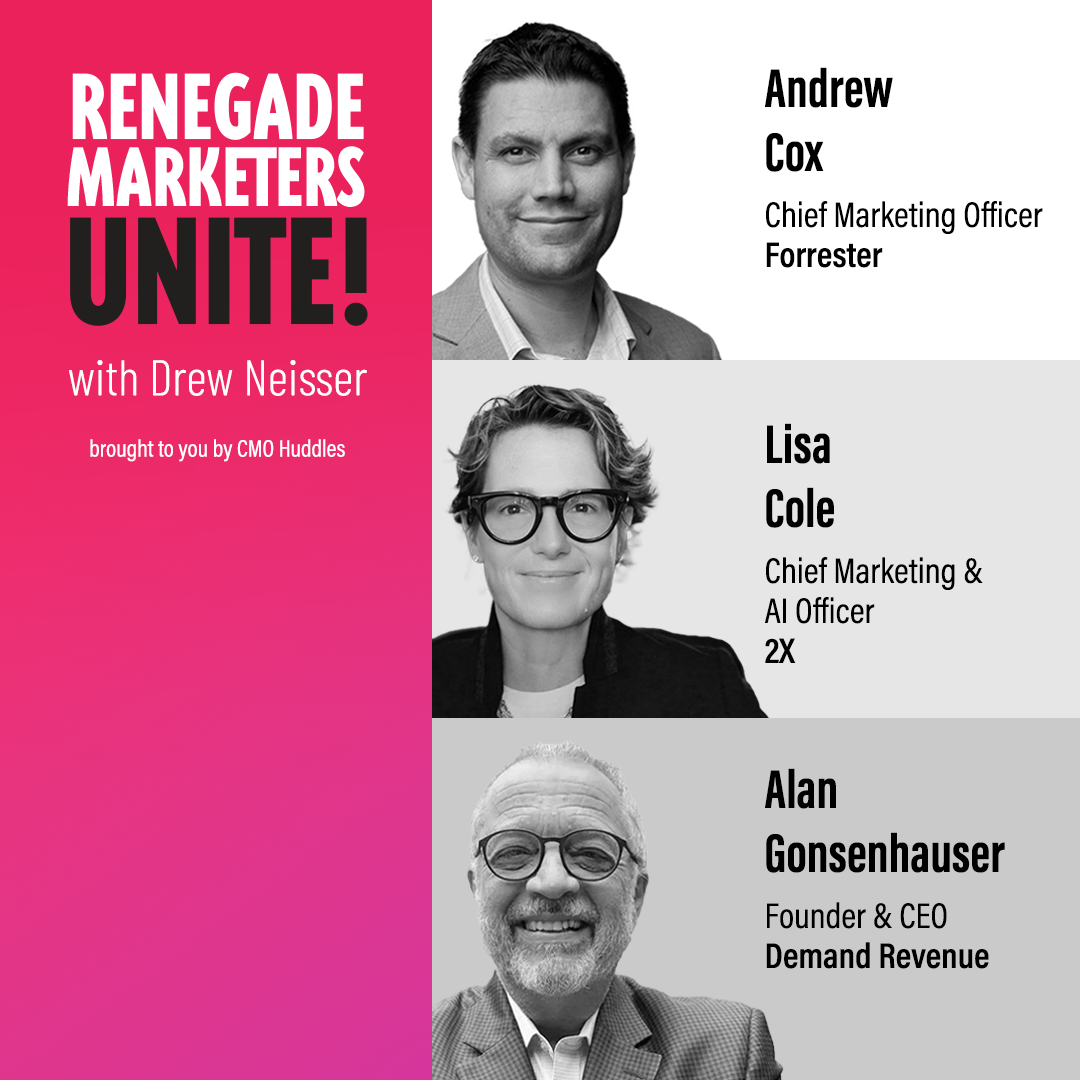
To get there, Drew brings together Andrew Cox (Forrester), Lisa Cole (2X), and Alan Gonsenhauser (Demand Revenue). The conversation centers on tying spend to strategy, translating marketing into CFO-ready terms, and giving AI a role in the plan that the numbers can support.
In this episode:
- Andrew shares Forrester’s view on moving past “last year plus X,” building budgets around corporate objectives and campaigns, and forcing prioritization.
- Lisa applies a zero-based mindset to business priorities, uses a 70-20-10 program mix for core, flex, and test, and frames marketing as an ATM of Audience, Trust, and Monetization.
- Alan outlines the signals of strong and weak budgets, tying the majority of spend to growth campaigns and long-term value plans, and maintaining a year-round working relationship with the CFO.
Plus:
- Keeping tech spend in check, including guidelines for MarTech mix and contract flexibility
- Positioning brand and PR in financial terms like pipeline influence, win rates, and pricing power
- Responding to AI efficiency pressure by fixing workflows first and framing value in utilization, speed, and scalability
- Why the budget should be the numerical expression of strategy, not a defense of legacy spend
If you want to walk into your next budget review with a clear story, solid numbers, and conviction, this conversation will help you get there.
Renegade Marketers Unite, Episode 501 on YouTube
Resources Mentioned
- Past episodes mentioned
-
- Lisa Cole
-
- Alan Gonsenhauser
Highlights
- [2:09] Andrew Cox: Align spend to corporate outcomes
- [5:39] Goals before granularity
- [7:36] Rebalance budget across brand, demand, tech
- [11:05] Lisa Cole: Earn C-suite alignment
- [14:39] Frame marketing like an ATM
- [19:50] How to measure trust
- [21:48] Alan Gonsenhauser: Pick 3 growth campaigns and align C-suite
- [24:37] C-suite commits to three-year plan
- [26:49] Translate brand into finance metrics
- [30:44] CMO Huddles: Templates, peers, & RepuTracker
- [33:42] No blanket 20% lift: Target AI workflows
- [39:40] Align leadership then rebuild around AI
- [41:26] Reframe AI around 5 value levers
- [49:55] Tips for budgeting with conviction in 2026
Highlighted Quotes
"You shouldn't budget based on last year plus X percent. That approach creates inefficiencies in how you do things. You need to look afresh every year."— Andrew Cox, Forrester
"I talk about marketing like an ATM machine for an organization. If you make smart marketing investments, you should be able to pull more money out of that ATM than what you put in."— Lisa Cole, 2X
"Marketing budget needs to be aligned to corporate priorities, not only annual priorities, but the three-year strategic plan. Investments you're making this year get you closer to where you want to be three years from now."— Alan Gonsenhauser, Demand Revenue
Full Transcript: Drew Neisser in conversation with Andrew Cox, Lisa Cole, & Alan Gonsenhauser
Drew: Hello, Renegade Marketers! If this is your first time, welcome, and if you're a regular listener, welcome back.
You're about to listen to a recording from CMO Huddle Studio, our live show featuring the flocking awesome B2B marketing leaders of CMO Huddles. In this episode, Andrew Cox, Lisa Cole, and Alan Gonsenhauser tackle one of the toughest parts of the CMO job: building a budget you can stand behind. They share how they tie spend to business priorities, put dollars behind campaigns and results, and get finance aligned early.
If you like what you hear, please subscribe to the podcast and leave a review. You'll be supporting our quest to be the number one B2B marketing podcast. All right, let's dive in.
Narrator: Welcome to Renegade Marketers Unite, possibly the best weekly podcast for CMOs and everyone else looking for innovative ways to transform their brand, drive demand, and just plain cut through, proving that B2B does not mean boring to business. Here's your host and Chief Marketing Renegade, Drew Neisser.
Drew: Welcome to CMO Huddles Studio, the live streaming show dedicated to inspiring B2B flocking awesomeness. I'm your host, Drew Neisser, live from my home studio in New York City. Well, it's that time of year again. Nope, not the holidays. It's budgeting season, and once again, CMOs are caught between the dueling mandates: drive growth and cut costs. Throw in the shiny but unproven promises of AI, the tug of war between zero-based budgeting and last year's spend with results, and you've got a perfect storm of pressure and possibility. So how do you build a budget with conviction when the goalposts just won't sit still? With that, let's bring on Andrew Cox, CMO of Forrester, and an industry expert who's joining the show for the very first time. Is that possible? Hello, Andrew.
Andrew: Oh, hey Drew. Thanks so much for having me. It's great to be here.
Drew: Let's get into it. By the way, where are you this fine day?
Andrew: I'm in Atlanta, Georgia. Accent confusion—nice southern accent, but southern UK accent originally.
Drew: Well, we're excited that we're going to be in Atlanta February 26th for our traveling strategy lab, so that'll be exciting to see you there. Let's talk about budgeting, and I know that Forrester advises other CMOs on how to approach budgeting. So talk a little bit about that, because you're sort of the CMO for a firm that advises other CMOs. So how much of the Kool-Aid do you get to drink?
Andrew: We always talk about drinking our own champagne, and I think a lot of it, Drew. I know you had my colleague Craig Moore on a few weeks ago talking about budgeting, and I think he did a fantastic, fantastic job of summarizing some of the things that we try and do ourselves. I think if I was to start with a big thing that we always say is you shouldn't budget based on last year plus X percent. That approach is so negative for us in terms of just creating inefficiencies in how you do things. You need to look afresh every year. So working in an organization like Forrester, we have so much research, so much opportunity to look at new things and new approaches, and that really feeds into our planning process overall, which budgeting is obviously the key part. So I think setting aside what you shouldn't do of budgeting based on last year plus X percentage, there's really three things that as I've come into budgeting season this year that I've kind of put as front of mind for myself. The first one, and this really fits with that planning model, is starting at the top, really aligning our budget with what we need to achieve in terms of our corporate goals and objectives. How is marketing contributing to those? So it's not aligning around, for instance, a function or a department within marketing. It's not saying the brand team gets this and the demand team gets that and the ops team gets that. It's really looking across the organization, saying, "What are we being held accountable for achieving, and how do we put our money towards that?" So that's kind of the number one thing I talk about. The second thing that we've been working on particularly is really thinking about how we put as much money as possible into our campaign-based activities. And setting personnel costs aside, if you think about your program costs, there's really two aspects to it. The first one is the kind of evergreen ops, kind of recurring costs that you might have—a lot of technology costs, that kind of stuff. There's going to be a percentage of your budget. You want that to not be the primary spend that you've got, obviously, and the rest of your money you really want to put into campaigns that have long, ongoing impact and have the most influence on achieving those corporate high-level goals that you want to achieve. When we talk about campaigns at Forrester, we talk about them crossing demand, reputation, enablement, engagement. So they're really looking at the full spectrum of things. It's not like executing an email campaign or sending an email. It's really looking at how can you drive the market as a whole successfully and putting our money into things like that in a bigger way. So that's the second area. And then finally, I'd say the other thing that we really need to do is force prioritization. I had an old CMO who used to say you should never spread the peanut butter too thin. That's exactly where we're approaching things as well. You're always going to have more things you want to do than you're able to afford, so you need to look at those. And I was lucky enough to bring my team together in Cambridge, Massachusetts a couple of weeks ago, and we went through a very difficult exercise there where, you know, people are obviously going to be wanting to make decisions that benefit their part of the business, but we have to make decisions that benefit the business as a whole. So being able to stack rank things and make sure that you're making the decisions to put money where it most matters, that's going to be really key.
Drew: Well, it's a great summary, and I sort of pity Lisa and Alan to have to follow you on that because you covered a lot of ground. But I want to get into a couple of specific things on the corporate goal. You know, the overall goal makes sense. Yeah, we need to know where we're going. How granular do you need to get? Like, are we going to say marketing is going to contribute 70% of pipeline kind of thing? Do we need to get there? And do we even need to go there by channel, and how granular are we getting with the overall goals?
Andrew: It's a great question, Drew, and I think it's one that's really pertinent right now. A lot of marketing measurement in the past, and a lot of the budgeting has historically been based on things like a reverse waterfall, where you've said, "If I put this much in at the top, here's what I'll get at the end. And therefore, how much money does it cost me to do that?" I think some of that methodology no longer works in the same way. So it's very difficult to say, you know, "How much do I put into this? How much do I put into that?" based on that old method. What we're trying to do is go back and say, "What are the main things that marketing is going to be held accountable for in this organization?" So it could be a question like, "We have a problem today—people don't know who we are. We need to overcome that." Or, "The problem is our salespeople don't have the materials they need." And what we're trying to do is get to a point where, with our executive team and our senior leaders, we're agreeing what those biggest challenges are, and when we can identify those challenges and say they're the ones that we really need to move the lever on, we're going to put more money into those and more focus into those. And then you can measure your success against that at the other end, so you can say what the percentage is against it.
Drew: So obviously, if you don't get the goals right, it's a little bit of a problem. Then we talk about—there was actually something you said at the very beginning, which is we don't take last year's budget and add 10% or whatever that number is. You know, in fact, I think most of the CMOs, at least in our community, are looking at, "Hey, your budget's flat, but we still have a 20% growth rate. So, you know, knock yourself out." Yep, right. And so, you know, the assumption is that that 20% will come from your just brilliant efficiencies using AI. But I want to make sure that when you say don't take last year's budget and, you know, add a percent, you're not saying zero-based budget either, though, right? There's a difference, and those are the extremes here, right? Because there are some folks that do think that zero-based budgeting is genius. And, you know, frankly, I think that is so problematic because you do have things that have worked for you in the past. Why wouldn't you keep going with those until they don't work?
Andrew: I agree, and absolutely some of what I talked about as being kind of the operating and evergreen spend—absolutely, throwing that out every year, for instance, when you're going through the process would make absolutely no sense. So I don't want to go back to ground zero and start from there. But what we're thinking about as we're looking at what do we do differently each year is how have our goals and our objectives changed, and what do we need to do differently to achieve them? And if we look at this year in particular, I mean, it's been such a year of transition for marketing with all the growth of LLMs, the zero-click world we're entering. What we did before is not necessarily going to work going forward, and we have to take that into account. So that's where I say I'm spending my energy now on refocusing what we do because it changes how we approach things like brand. It changes how we look at things like demand, and the spend that we had before is not going to deliver that return. So as you're saying, if you've got to get a 20% increase in efficiency, you've got to do things differently.
Drew: And I want to sort of—there was another point that I felt like was in there in your opening statement, which was be careful about overspending on martech. And this is something—I mean, I think I was talking to a CMO the other day, and it was like 33% of their whole budget was on martech. And I went, "Wait a second, if you had that other—let's say it was 10%—you'd have 23% more for programs. Isn't that what drives results?" So do you have a rule of thumb right now in terms of where, you know, obviously a PLG brand might have more tech than a services brand, so yeah, there's going to be some variance there. Also, what people define as tech can be tricky too.
Andrew: It can be, and I think as Forrester—so this is different from necessarily my own situation—as Forrester, we have a very rough rule of thumb, and it varies, as you say, by industry, which is kind of 40% programs, 40% personnel, and then 10 to 20% in technology. And that varies by organization. It might be 50-40-10. It might be 45-45-10, but somewhere in that 10 to 20% is often the kind of technology-level spend.
Drew: I was going to say you have really set this subject up very, very well—starting at the top, being campaign-based, I mean, starting with the goals, and then focusing and forcing the priority to avoid peanut butter stuff. So I think with that, we're now going to have to challenge Lisa Cole, who is CMO and AI Officer at 2X, an industry expert who has been on the show before to discuss sales and marketing alignment. Hello, Lisa. Wonderful to see you again.
Lisa: Nice to see you again too. Thank you so much. I'm all in for this exciting conversation.
Drew: Amazing. So how are you and where are you this fine day?
Lisa: I'm very cold. It snowed a lot, and it's, I don't know, single-digit weather right now, so I'm cold.
Drew: All right, well, but we're warm in here. It's like a huddle—we're very warm in here. So I'm curious, as you were listening to Andrew set this thing up, what resonated with you, and, you know, where do you want to start or build off of what he said?
Lisa: Yeah, well, the things that resonate with me, which are 100% consistent, starting with what the business is trying to accomplish. You know, what is the function's role? So in my case, let's think about marketing. What is marketing's role in those business priorities and goals? And so we are focused on improving net revenue retention. What's marketing's role in enabling that? And then the second question being, well, what capabilities do we need to deliver or enable the organization against that? I think we're fully aligned. Where I would like to add to that is making sure that the rest of the C-suite understands the implications of marketing's role in enabling that. So it's one thing if I had my point of view of what I think marketing can do against that business priority of, let's say, net revenue retention. But it doesn't necessarily mean that my CRO believes that. It may not mean that my CFO believes I should be focusing and investing in those things. And so a critical step of that layer is making sure that your peers in the C-suite agree that that's what marketing's role is and understands the implications of the capabilities that are required to execute against that. Once I have that, then it's a matter of—and I did hear the conversation on zero-based budgeting—I don't know that we have really a whole lot that we can say used to work that's going to work going forward. And while I may not start with a zero-based budget, I do start with that mindset and look at the investment strategy and say, "Okay, this is what we're going to be focused on, our strategic priorities. If I had no contractual commitments"—when I say contractual commitments, I mean commitments to personnel, commitments to technology, commitments to agency contracts that are kind of long-term retainers—"in absence of all of that, how should I be spending the money? How should I invest that money?" And then I reconcile it with reality and come back to the C-suite to say, "This is what we should be investing in. This is how we should be investing it. This is the reality of our current state. What do I need to do to get alignment with you all to maybe optimize the operating model?" And especially if there are any decisions that need to be made about, you know—and I think Forrester talks about this—what's the list of things that you need to stop doing? What are the lists of things that you need to lean into? Once you get that and you have that picture, then you can really focus on how do you go and invest it from a program perspective. And this is kind of the additional layer I think you were talking a little bit about, or at least I know he was, in terms of that program spend. How do you allocate it so you kind of maintain some flexibility? I tend to look at it as a 70-20-10 rule. And so 70% of your program spend should be on that core strategic execution—like the commitments I've made to the business, the stuff I've said we're going to go and do. Twenty percent for flex. And this is in case we need to pivot. So if your top two competitors get acquired and then merge together, and you have to completely redo your marketing strategy for next quarter in order to not lose a competitive advantage, do you have any money that could flex into a pivot like that? And then 10%—and I think this is super important in the age of AI—10% should always be protected for testing and learning. So that's how I tend to look through it. And so really, if I were to summarize that, same thing: business priorities. The big piece there is stakeholder management.
Drew: Let's go into that for a second. When we're talking about alignment, I'm just sort of thinking, are we starting with "Marketing can do this, marketing can't do this"? Because I know there are skeptics that say, "I just don't believe in marketing." There's that, or it's "I understand we need marketing. I don't really know how it works. I don't understand the timeframes of things." When we're talking about alignment, how granular do we need to get to get to this next phase, if you will? Because, you know, there's budget overall, and then there's sort of how we're going to spend it and how we're going to measure it. There's this constant issue of everybody in the organization is focused on quarterly revenue, and marketing's contribution is always going to be a lagging indicator to that, right? Yeah, absolutely. Revenue is a lagging indicator of whether marketing is working or not. So talk to me about that alignment part and how deep you have to go to really build an effective program.
Lisa: Well, one of the things I've learned through the years, even though executives, non-marketing executives, want to understand what kind of marketing, what impact marketing investments can have, they have zero interest in the sausage making. And so I would not be thinking about dropping down below anything, you know, strategic initiatives, high-level programs, key investments. They don't want to know the how. They don't want to know the detail, but they do want to feel confident that you know that you can connect the dots between a business strategy and a priority, the overarching business. Let's say there are financial goals related to that priority, what marketing can do in the context of that to enable the organization to achieve that, but not the how. And they would like to hear you be able to articulate, this is how this type of investment can influence this. And so this is where I bring forward—I tend to talk about marketing like an ATM machine for an organization. If you do marketing well, if you make smart marketing investments, the money you put into marketing, you should be able to pull more money out of that ATM than what you put in. And when I use that analogy, ATM stands for three different things. In my belief that any of the programs that marketing does accomplishes one of these three things: audience growth, trust and engagement, and monetization. And so some of the investments I'm going to make, certain programs, their focus is going to be to drive or attract more audiences in such a way that we no longer have to pay to reach that audience, right? Long term, how good are we at investing in programs that build trust and engagement amongst those new audiences? And then from there, can we monetize that engagement? And so I frame it in that way. And then if they ask me questions, well, what are the measurements you're going to use to make sure that your investment is tracking to delivering on this process? Then I can drop into the typical metrics that we might have, like being found and chosen by an AI model, for example. Does that help?
Drew: Oh, it's really helpful, and it's so interesting. You've used the word investment a lot. I really think that's such a great word. It is. I don't think necessarily that every CFO understands marketing as an investment like they do, say, R&D or hiring another salesperson, because they can, kind of, in their minds, go, oh, one salesperson equals X amount of revenue, right? So I love the fact that you use that language. I also like this notion of you're going to make an investment and the return is going to be XYZ. And I don't need to tell you how we get there because you don't care.
Lisa: Yeah, when I was earlier in my career, I thought people wanted to know the how. Then I found out very quickly, no one at that level, unless they are genuinely marketers, right? I report to a CEO that was a CMO, and even he, because of the nature of his role, doesn't actually want to know the details of any of these programs. He trusts that he hired someone that can lead that.
Drew: And if they do want to know those, then they don't trust you. So it's a pretty clear thing, because they're going to say—and this is where it gets really ugly, and Alan will get a chance to defend the PE firms. But get it when the PE firms start to dig in there and say, why do you spend money on this keyword? You know you have a problem, 100%, because that amount of granularization for a CMO is really just painful. But I—and we've talked about the ATM notion—the visualization of money in, money out, and money coming out is so helpful. I think that's great. I also think the framework of audiences—first of all, these are people that we want to reach. Do we need to reach more of them, or do we need to reach them and change their minds in a different way, right? So that's fundamental, and that gets us to, well, a reach goal in programming is about reach, hitting reach, so you can connect those dots. I get trust is trickier, yeah, yeah, because what's that look like? How do you measure it, and how do you budget trust?
Lisa: Yeah, well, that's right. I mean, at the end of the day, you can do things like, you know, your NPS survey. Trust could be as simple as we did attract a new audience. They subscribed, they've been engaging, and then they unsubscribed. And so we've broken some sort of trust in the way that we're showing up from a marketing or sales perspective. Trust could be that they actually do want to raise their hand. They trust in the brand and the promises that we put out, and they do want to talk to sales. So trust can show up in a number of ways. The biggest piece here is, you know, once they've decided that they want to hear more from you and they want to engage and stay in your orbit, that you don't screw that up. It's probably the best way to—you can—delivering on the promises that you're making. You know, if you are account-based, a good way to think about this is that you've driven, you know, engagement in these targeted accounts. Those accounts might be showing intent as you're driving engagement. You might have multiple influencers from that organization that subscribe and they begin to consume, and as they're consuming, is that consumption increasing? And are they engaging in more meaningful ways, like an event, right? Are they coming to and investing time in listening to stakeholders you bring on to, let's say, a webinar like this, to hear more? Like they're investing their time in us. So that's—there's so many different ways. I'll share on LinkedIn today the metrics that kind of fall under those three core areas.
Drew: Well, that would be great. All right. Well, I do want to—it's later in the show—get back to the monetization and how this is different. But we now need to bring on Alan Gonsenhauser, who has been so patiently waiting, is the founder and CEO of Demand Revenue, who has previously joined the show to shed light on the intricacies of fractional CMOing and customer-led growth. Hello, Alan, welcome back.
Alan: Hey, Drew, great to be back.
Drew: And so now you've heard both Andrew and the Forrester point of view, and Lisa, you know, what'd you hear that resonated? And where do you want to start when it comes to this budgeting with conviction challenge?
Alan: First of all, I don't think there's going to be a lot of disagreement here. I think they both—Andrew and Lisa—gave great points, and I think some of this will be reinforcing, maybe a little new. So maybe I'll tell you, you know, three things where I believe budgeting has been done well, and three things where it's been done poorly. Okay, let's start with what's been done well. You know, marketing budget needs to be aligned to corporate priorities, not only the annual priorities, but the three-year strategic plan. So, you know, the investments you're making this year is going to get you closer to where you want to be three years from now. And what I tell folks is to pick three things you need to do well that'll move the bar and, you know, define very clearly what marketing will and won't do. You know, strategy and leadership is not just deciding what are the few things you're going to do, but deciding on the things that you're not going to do and make sure you're aligned at the C-suite level. The second thing is to budget—and Andrew mentioned this—by major growth campaigns that drive revenue. And the way I like to think of that is putting 80 to 85% of your budget into revenue-generating campaigns that will drive brand awareness, demand, customer engagement, sales, and customer success productivity. And keep maybe 15 to 20% as discretionary, because things always change. And the third area, and this was mentioned, is really strong and ongoing alignment between the CMO and the CFO. That's really important. And, you know, also the other C-suite members. But, you know, marketing shouldn't be in a vacuum. Marketing is—you know, CMO should be a general manager that's very tied to the other functions. So I think those are three things that define marketing budgeting done well.
Drew: Well, let's stay there for a second, because I have questions for you on that, because it's a really important—so one of the things that you talked about, that I don't think happens as often as it should, is the three-year planning cycle. And what I love about that is that marketing does have a long-term impact. Certain aspects of marketing take longer than others, right?
Alan: And other functions as well to get to where you want to be three years from now.
Drew: I mean, we may have to change perceptions. We may want to improve product, increase loyalty, and there's a lot that can happen. But I don't necessarily hear a lot of CMOs, or an appetite even for CMOs to be talking about three-year plans, because everything's about this quarter or this year. And even PE firms, which you know very well—I mean, that year, the third year, is the year that you're going to be flipping. So it's all about EBITDA, and it's not about growth. So now what? So how do you make sure that the three-year plan is taken seriously in the C-suite?
Alan: It's that, it’s got to be taken seriously in the C-suite, and that's going to start with the CEO. And in terms of PE holding periods, generally, it's five to seven years. So the first year, you're—the first couple of years, you're fixing a lot of problems, maybe you're changing management. The middle of that, you're building infrastructure, people, process, technology, data analytics, brand equity, and pricing. And then the third period is the one you mentioned, where you're trying to dress it up and sell to either another PE firm or to a strategic or go, you know, go through an IPO. But I think, you know, we're working on this year's plan. But this year's plan has to ladder the company up, not only marketing, but the other functions too, to where the company wants to be three years from now. So there needs to be a value creation plan and image on where this company is going. And it's a good idea for the entire C-suite to think about, okay, this is what we want to get done this year. But where is that going to bring us closer to where we want to be three years from now? Does that make sense?
Drew: It does. Okay, I have more questions on this first part of it, which I hear from—this came up in a conversation yesterday in one of our huddles. A CMO said my CFO just, like, leaves the room when I mentioned brand and PR, but yet they want to know. And this gets back to what Lisa was talking about: if we could get rid of talking about the how, right? We could just say, here's where we want to get to. I've got the details in the sausage. I'll get us there, and I'll make that commitment with you. If they don't understand PR, and they don't understand how marketing works, or why you need to spend a certain amount of money in a certain way, you can get resistance on the how. Yeah. And so I wonder, in terms of budgeting with conviction, we did talk about—you talked about campaigns, and obviously, campaigns are lots of stuff. How do you sort of push back and say, don't worry about how PR works, and get them to just say, I'm committing to—to agree, this is the investment. Here's the output, the return we should expect, and not get them thinking about brand or demand or, you know, that kind of—right, frankly, it's a stupid exercise, but it seems to come up more often than any CMO would ever want it to.
Alan: Way too much short-term thinking, way too much thinking on the next couple of quarters. And I have these conversations with CEOs, CFOs, private equity all the time. And, you know, the way I coach and mentor CMOs to talk about this in terms of brand reputation investments, which is, I think, where you're, you know, heading, is translate the benefits of brand equity into financial terms. It's going to be our pipeline a year from now. We're still going to need pipeline a year from now. We're going to have more at-bats. We're going to have better win-loss ratios. We're going to have more pricing power. All of those things are financial. And in fact, you know, brand is actually an asset on the balance sheet, brand equity. So I think there are ways of positioning brand reputation investments in ways that CFOs and boards understand better by translating that into financial metrics and having—you can have some short-term indicators on brand, to look at things in the short term, like awareness, perception, and preference. But you need to be able to communicate the benefits of brand reputation in a way CFOs and boards understand.
Drew: I hear you. It's so funny. I'm just—I'm also getting in this—I'm in this moment where I'm hearing, yeah, what's the pipeline?
Alan: Well, plus, if you look at the research I just saw at the 6sense conference, Kerry Cunningham came out with Richard and says, hey, look, 80% of the time, companies at the beginning of their buying process, they've got four to five vendors in mind. 75% or more—actually, I think it was 90%—75% of the time they're going to go with the first one that they reach out to, right? So if you're not on the original list of companies they're going to be considering, doesn't matter what you do with demand. You've already lost. So the 95% of people that are not in market right now, you need to give them content that will make them aware and drive some brand preference. So when they do get in market, you'll be on that short list and you'll be considered. Otherwise, you're just not going to be considered.
Drew: So marketing spend equals short list, and you know, we're not on enough of them. So there it is. And I get that. That certainly helps explain, again, we're not in how land, we are in the output, in the what. We're almost out of time for you right now. But I did—you were going to share, maybe you could quickly share the bad budgeting.
Alan: Okay, well, marketing—one is to function and try to do too many things, being reactive, random acts of marketing, versus being proactive, and thinking, you know, picking the three things that are going to move the bar. Budgeting by function and each function trying to spend their—within marketing, their money by the end of the year, which is really, you know, not a cool thing. And poor CMO-CFO alignment, just, you know, trying to develop something with a CFO at budget time versus all year.
Drew: Perfect. That's great. All right, we're now going to—I get to talk about CMO Huddles, which was launched in 2020. CMO Huddles is the only community of flocking awesome B2B marketing leaders, and that has a logo featuring penguins. Wait, what? Oh, yes. So a group of these curious, adaptable, and problem-solving birds is called a huddle, and the leaders in CMO Huddles are all that and more, huddling together to conquer the toughest job in the C-suite. With that, Andrew, Lisa, Alan, you're incredibly busy marketing leaders. I'm wondering if you mind sharing an example of how CMO Huddles has helped you.
Lisa: I could go first. Yesterday was even a great example. We were talking about strategy in the huddle, and what I found really valuable is we've got a couple of marketing leaders that are sharing, hey, this actually worked really well for me, this template, and being able to explain our go-to-market strategy and our investment strategy from a marketing perspective to a board. I don't know about you, but anytime someone, you know, offers that they were successful at communicating a marketing strategy to a board, and it was really—I thought there were some really great examples of how they were visualizing their stories. I, for one, plan on using that myself this year.
Drew: I love it. I appreciate that. And that was a great conversation yesterday. It was a small group, but it was this concept that we're taking on the road of strategy labs. And was so glad you could be there. And thank you for sharing your template, which was amazing. Okay, Alan.
Alan: Always great to see things that work. To Lisa's point, I also would say the super huddle was tremendous. Met a lot of great people. I met a lot of people that I've known virtually, but never met face to face, and that was really awesome. And you had a lot of great presentations on AI, culture, emerging technology. I thought it was a great event.
Drew: Thank you. So glad you could go and contribute. Andrew, last but not least, any thoughts?
Andrew: It's so difficult to pick a single moment, Drew. But what I really appreciate is the peer network that you have here in terms of speaking with people who have the same challenges but different ideas about how to address them. And I feel personally that every time I attend one of the huddles, I have come away with more confidence. I come away with some validation in the way I'm thinking, and also the push to do more. So it really, really lines up very nicely with your "care, share, dare" mantra. It really makes a big difference. But what I'll give you is one other thing that I'm really super looking forward to, which is forward-looking rather than retrospective, from CMO Huddles is the rep tracker. I'm so excited to see some of the work that you're doing around that, and the ability for us to look at how we can measure the impact and the direction our brand in the new world that's emerging. And I think the work that you're doing around there is fantastic as well.
Drew: Well, I appreciate that. We launched in beta for all the members of the Leader program, this multi-dimensional reputation tracker using a bunch of APIs out there on various levels. And we've got that first three months of data for most of the members of the program, and it's fascinating to see the movements and what's causing them. So anyway, if you're a B2B marketing leader who wants to build a strong peer network, gain recognition as a thought leader, maybe get access to rep tracker and get your very own stress penguin, please join us at cmohuddles.com. Okay, that was a lot, and I appreciate all three of you for those great comments. We've managed to spend 35 minutes together and not talk about AI. That's maybe a record, you know. And I've mentioned this in CMO Huddles, there is a Silicon Valley-driven notion that everybody, not just marketing, but everybody, should be able to do everything they were doing 30 to 50% more efficient, thanks to AI. So marketing, you will lead the way. Show us how you're going to do more with less, thanks to AI. And I just—because this has to do with budgeting, right? Yeah, and I'm just curious, and this came up in the super huddle, and one of the CMOs says, "I think we are going to be able to do 20, 30% more next year, so we'll keep the same head count, but we'll be able to deliver more." I'm curious how you're seeing things, and Alan, since you went last last time, maybe you want to share, do you think it's realistic for CMOs to say, "Yeah, we'll deliver 20% more with the same people thanks to AI next year"?
Alan: It can be in some areas like content and some other areas, you know, following up faster. I think a lot of it is benefiting business development, BDRs, you know, with faster responsiveness, as we heard at the super huddle. But in terms of preparing, you know, organizations and teams, there are a few things, you know, I think companies need to invest in training resources. They need to create a culture of safeness and ability to, you know, for their people to fail and learn, because no one has it perfect. I guess 90% of companies are using AI, but only, I think, one stat I heard at your super huddle, only 1% think they have it locked. They need patience and change management processes to progress well. And, you know, pick just a few tools. Don't try to do everything and learn those tools really well.
Drew: What I'm not hearing from you is the—and I'm curious if Andrew or Lisa, do you think you can do 20% more next year thanks to AI? Lisa, go for it.
Lisa: The only way you're doing that is if you get out of the business of random acts of AI. However you define that, whether that's AI tools everywhere and you're testing and tinkering, but if you actually don't know how marketing gets done today, and your workflows aren't taskified and mapped, and you don't have that visibility, you don't know that it takes 127 days to get a campaign to market, because seven people have to approve the copy for an ad—one ad in that campaign—you can spend all the money you want on AI. You can create as safe of an environment as you want. You still will only get random faster execution of individual tasks. Like you're not going to get the 20%.
Alan: It's great at speeding up chaos. Fix your processes first.
Drew: But I think it's interesting, like saying I completely agree with you that if you benchmark your key workflows that are really time-consuming for your key priorities, there is a chance, because we did this in one of the tools that one of our partners built, where they were able to help us take a repetitive task. But here's the interesting part. So we took the 30 different recordings every month, and now it's all automated and translated and everything happens. And so the amount of time that we have to spend on it is very little. So it's incredibly productive moving forward. Had we had to build this ourselves, it wouldn't have been—it wouldn't have paid out. We couldn't afford to do it because it wasn't all AI. It was a lot of coding, it was a lot of integration, it was a lot of stuff. So this is the part where I'm really looking and maybe Andrew, you've seen somebody who has been able to rethink their approach to marketing, make it AI first, and actually get to this place, this promised land, of we're 20% more efficient, so we can do 20% more, and we can commit to growing the business without adding headcount.
Andrew: I think the points have been made so far actually speak to some of that already. I think if organizations are starting with a blank sheet of paper, maybe it's not gonna be 20% more efficient, but you can be 20% more efficient than other organizations. But I think where you're committed already to an ecosystem and an environment, and people who have ways of doing things, that transition time, the friction you've got makes it very difficult. I think Alan's point is absolutely right around content. You can be 20% more effective, probably pretty quickly. That's an area where it works. If you think a lot of the operating areas, a lot of the things where you're aligning with other parts of the organization—I look from my side, we're very careful about our security. For instance, you can't just pick random tools. You can't just create something in Copilot, necessarily, very easily and go and do something. You can't necessarily use tools like Zapier to connect things. And if you've got those kind of restrictions, what is technically possible and what is practically possible were very different. So you have to work on the basis of the organization you're in. And I think to Lisa's point, if you understand your workflows, you can really probably prioritize and say, "These are the ones where we're going to get the biggest bang for our buck, and here's the two or three areas where we should spend the time really making that workflow more efficient so we can make the biggest dent." But across, taking a blanket statement of 20% across marketing, that's not going to work. You might be able to get 40% in one area, but you're probably going to find lots of other areas where it's going to be a transition to get there in the time to enable your team to bring them up to speed, to get them on board with it. It's going to be a delay in getting to that result. And by the way, the change management, absolutely.
Drew: There's a couple of things I want to go back to with all of you, I don't think anyone here is saying we're not going to use these tools. We are going to—no, we're going to use them and we're going to embrace them. One thing we don't know is, is AI-generated content or assisted content going to be as effective as the stuff that we used to do? We don't know that. I think it's going to be faster, we don't know if it's going to be better or more effective. That's part one of this thing. Again, we're all embracing it. I know this is a group leaning in, but here's the thing that I wonder. You don't want to do this, but if you tore down your department and built it again, AI first, what would it look radically different? And should CMOs be thinking about that, as painful as that sounds, and easy for me to say, but is that—because you mentioned it, Andrew, you noted that if you're starting from scratch, you'd be AI first. It's amazing what you could do as one person.
Andrew: I actually think the point before mine that both Lisa and Alan made was around alignment as well, and the expectations that your CFO has, your CRO, your CSO, whatever it might be on what marketing is going to do for them—you actually have to be really aligned. And that's where you have the opportunity to start to think about what marketing does for the business differently, and where there's an opportunity to get the expectation change of what is possible now with tools and technology compared to what was possible three years ago. It's very different, but what the business expects of marketing has not changed necessarily in the same way. So I think there's a path to getting there where you could be doing things differently, but it's an education path, and there's still the change management that you need to go through.
Drew: Interesting. I do think also, Alan, your points about training is so critical in this thing, because there's this "Hey, this is amazing stuff. Go learn it and do it," and yet, because not everybody embraces the tools in the same way, not everybody plays with them on the weekends like some of us do. I mean, man, am I having fun with Gemini 3 and just playing. I mean, it's so cool and it's fun, but I'm a curious person and it represents a lot, so that time is well spent, but not every employee is doing that. So the training thing feels really, it is quite real. But I do think CMOs, whether or not you think they can do it, I think they're being asked for some efficiency improvement. And so where is that going to come from, and how is that going to show up in 2026 budgets?
Alan: You know, one analogy I heard recently that I thought was really good is there are a lot of AI crumbs. You've fixed this process, you've optimized this process, you've sped it up. You have a process over here, you have a process over here, but you want to take the crumbs and build a cake. You want to have some, you know, overall leadership and strategy around how you're going to use AI in the organization, whether it's marketing or finance or other functions, and how these use cases, as you learn different things, are going to fit together and help you in your overall goals. You know, one example is a lot of the work that Lisa is doing on org design. I've done org design with over 100 CMOs and marketing organizations, but the newer thing now is having AI bots below each of the people on your org chart to help them be more productive. So how are these all going to fit together? And I think that's kind of one of the next challenges that companies are going to be facing to try to make sense of all this. But you also have to make sure you know what AI is good for, what it's not good for. It's not good for divergent breakthrough thinking, and you can't use it for that.
Drew: It's just a fascinating moment that we're all facing, and we also know that if you really want to do what Lisa said, which is get at those workflows and create the things, you probably are going to need a new person on your team, an AI ops person who actually understands the technology, when to use AI, how to do it safely, how to connect some dots, how to bridge these things. So maybe you save some money in your content team and you can hire this ops person, but we're net even on staffing costs. So I want to budget with conviction in 2026. You need to know, is there going to be a place where a CMO can say with a straight face to their CFO, "Yeah, we're gonna be more efficient, and that's gonna show up here," and I'm not hearing that from you all.
Lisa: I haven't weighed in yet. Let me weigh in. How's that? I think the conversation has to be reframed by the CMO. There are five ways that AI can deliver value to an organization in the context of marketing. The first is it can actually enable budget flexibility and efficiency. And so how are you using AI to reduce costs of maybe execution, replacing manual, consolidating the random acts of duplicative agencies you might have? A second could be tech utilization. I know CMOs whose tech budget rivals that of a CIO's, but they die under the weight of random, you know, like swivel chair syndrome, with data being manipulated across that tech stack, which slows the entire workflow down. And so you can actually think about how do you use AI to address those gaps between the tech, deal with your structured and unstructured data, maximize utilization, and actually get the ROI of your tech stack. The third is pipeline impact that could actually be accelerated impact. So if you could think about your campaign workflow, and you can break down those silos, even just in the remap or reimagining the workflow itself and then applying AI to it, yes, you can get there. You can deliver impact faster. The next level is scalability. Can you scale up? Can you add a capability you didn't have before in a cost-efficient way? So for example, I may not be the strongest product marketer, but you know what? AI could address that capability gap and enable me to scale up thinking about a product launch without necessarily adding more headcount. And then overall, just, you know, the speed to market that is a competitive advantage. You know, brand is certainly part of our moat, but you know, the other piece is in an AI-first world, with these AI-native startups that are stealing attention and market share from these industry and large, you know, enterprise companies, speed to market actually is an advantage. And so if you can frame it in one of those five ways, rather than just a 20% blanket statement, come back and say, "You know what, how about I accelerate our speed to market by 25%? How about I, you know, accelerate opportunities through the pipeline to get us to a close faster or improve conversion rate?" Can we just reframe it in one of those five layers? That would go a long way to be able to set you up for something you can deliver on. But 20% blanket, "Oh, I can do 20% more." That's not more impact.
Drew: No, and I love that, by the way. And we had Carilu Dietrich, and she and I had a one-on-one fireside chat about her experience with Lovable, and it was all about speed to market. And they really, yeah, that can be really valuable. I keep wondering, from a long-term standpoint, is it really about speed? But certainly in that case, it was, and I love the fact that you've broken it into those five things. I still think a CFO will say, "Okay, great. I want all of those things, and that should add up to a number. Do you need more money? Do you need less money?" And that's gonna—and again, we talked about, what are the business goals? There's a commitment. I don't think that CMOs can get away with saying we're going to do these things and not quantify it somehow.
Lisa: Well, the good news is every one of those five layers is quantifiable, right? So budget flexibility—you know what? I had 77% of my budget locked up in personnel, tech, you know, traditional tech, and this agency contract that locked me in for a year. Now, I'm, you know, I'm 60% committed, 40% freed up for flexible program spend. That's something you can measure. Tech utilization, super simple. Are your people actually using the tech? Do they know how to use it, right? Are they activating on the new capabilities that were, you know, recently launched, and if so, is that having an impact? Pipeline—is it opportunity creation? Is it opportunity acceleration? Even a simple thing like 25% accelerated opportunities through the pipeline stages is meaningful. It can make a quarter versus not making a quarter, right? Adding a capability to your team without turning and asking the CFO and the, you know, the CEO for more headcount. Like, I don't necessarily need two more product marketers, but my one product marketer can now support multiple product launches. Speed to market—I mean, truly, that 127 days to get from an idea to getting, you know, a full multi-channel campaign in the market. That was a real example. What if I could get that to under one quarter, under 90 days? Would that be a difference? What if I could get that to four weeks, right? That would be a difference. And maybe it's not that I only do those—maybe it actually frees me up to do three campaigns a quarter. Every CMO I know can measure every one of those dimensions.
Alan: So make that part of the budget process. And I think it's 17.5% reduction.
Drew: We got a number.
Alan: You know, huge impact of responsiveness. Everybody knows that, of getting rid of the Frankenstacks that are out there and all the stuff that isn't used. And, you know, all of those five areas are great.
Drew: I love it. It really does help. And so I think if we go back to where we started with this conversation, and we talked about, you've got to start with what do you want to achieve. You've got to get alignment with the executives on "We agree on what we're going to achieve, and we agree on the role that marketing will play to achieve it. Leave how we do it to us, and by the way, we're going to be very flexible, because now we can even be more flexible," and that's a point. And then, you know, what we didn't really talk much about is measurement relative to budget, but I think you did in the sense in the very setup we commit to a certain business value that we're going to deliver, and in that is some measurement of it. I feel like we've covered a lot of ground, but I'd love to have some final words of wisdom for CMOs who want to budget with conviction in 2026, and we will start with Lisa.
Lisa: I think your budget is your actual strategy, just represented in numbers. So build it like, you know, it matters, like that budget to advance the business, not necessarily—I think we heard a couple of times—to preserve your org chart, or to preserve the, you know, contractual commitments to your old tech stack. Like, rebuild it and have that budget actually be the numerical version of your strategy.
Drew: I love it. Have your budget be the numerical version of your strategy, and by doing that, you will, assuming you have alignment on your strategy, you're gonna have alignment on your budget. Okay? Alan.
Alan: Less is more. Pick top three things that are gonna make a difference and move the bar and move your business forward. Maintain a very strong relationship with your CFO year-round, meet with them at least once a month, if not once a week, and tie your budget to corporate priorities and generate, you know, revenue-generating campaigns and, you know, budget 80% of your money there into investments that will really drive the business forward with the strategies that the company has, and be very well aligned cross-functionally.
Drew: I love it. I know one CMO who actually did know a lot about finance, but every time they had a new CFO, they would just go in and say, "Teach me about finance. Teach me about what matters to you. Teach me about that." And then was the sponge. And then along the way, that CFO said, "Well, you know what? Teach me about marketing." And then it became an interesting process. So a little humility and curiosity in that relationship building goes a long way. Okay, Andrew, bring us home.
Andrew: Well, I agree with everything that's been said. One of the things we haven't really touched on that I just want to leave you with is the reality of the here and now situation where there's so much uncertainty in the world, so committing to long-term contracts on technology, for instance, isn't something I'd be recommending and not something I'm getting my team to do right now, as an example. We just don't know what the future is going to look like. And I think the other piece within that is we have to be slightly adaptive about our planning. So we'll have an annual plan. We'll have our budget. We need some flexibility in there. We need the room to experiment. I think you're going to need strong ops teams to help you through that process to keep you but also be able to pivot when you need to pivot. Because I think even six months away, we don't know what the world's going to look like properly.
Drew: No, we don't. We are probably living in the most uncertain time that any of us professionals have dealt with. So yeah, build in that flexibility. Lisa talked about a 20% number, and then when you add in the 10 to 15% for experimentation, you really have about 35% of your budget that is available. Love that as a final word of wisdom. So thank you, Andrew. Lisa, Alan, you're all amazing sports. Thank you, audience, for staying with us.
To hear more conversations like this one and submit your questions while we're live, join us on the next CMO Huddle Studio. We stream to my LinkedIn profile. That's Drew Neisser, every other week.
Show Credits
Renegade Marketers Unite is written and directed by Drew Neisser. Hey, that's me! This show is produced by Melissa Caffrey, Laura Parkyn, and Ishar Cuevas. The music is by the amazing Burns Twins and the intro Voice Over is Linda Cornelius. To find the transcripts of all episodes, suggest future guests, or learn more about B2B branding, CMO Huddles, or my CMO coaching service, check out renegade.com. I'm your host, Drew Neisser. And until next time, keep those Renegade thinking caps on and strong!