The New Rules of Marketing Team Design
Marketing org charts may look innocent, but they’re loaded with meaning. Split your team into “revenue” and “corporate” and you’re sending a message, whether you mean to or not. Structure reveals philosophy. And in B2B, that philosophy had better be built for trust, speed, and results.
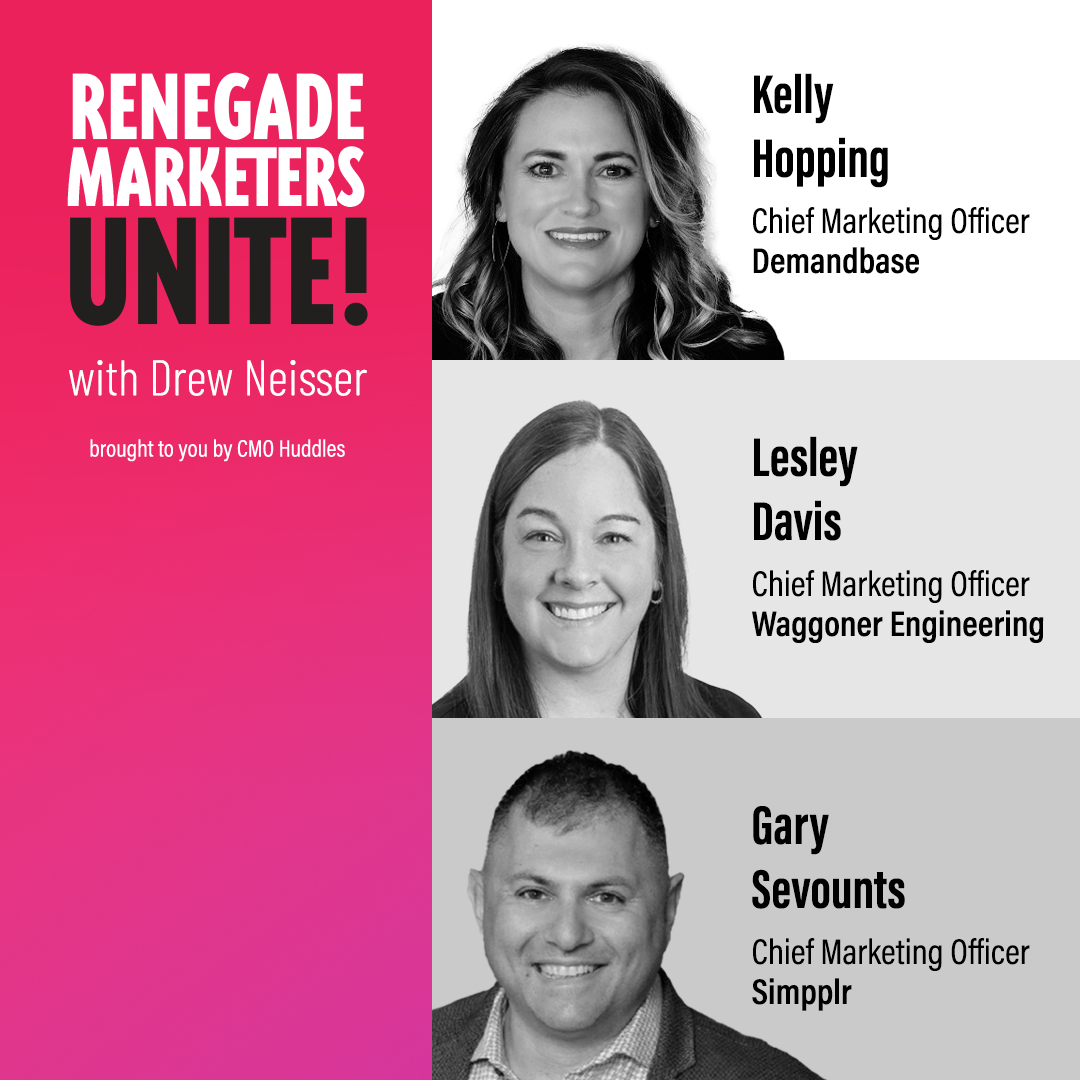
In this episode, Drew Neisser is joined by Kelly Hopping (Demandbase), Lesley Davis (Waggoner Engineering), and Gary Sevounts (Simpplr) to discuss how they’re shaping marketing teams that reflect clearer priorities, move in sync with the business, and operate at the pace growth demands.
In this episode:
- Kelly built her team around one goal: earning sales love. It reshaped her team’s structure, mindset, and KPIs.
- Lesley explains how cultural clarity and cross-functional trust helped her team scale fast inside a complex org.
- Gary shares how “Treasure Ops” became a full-funnel GTM engine, reviving stalled deals and tying ops directly to pipeline.
You’ll also learn:
- Why your org structure should follow how your buyers engage
- How AI is already shifting roles
- How shared metrics and a single definition of success align marketing and sales
Tune in for a look at how marketing teams are being built to meet the moment!
Renegade Marketers Unite, Episode 452 on YouTube
Resources Mentioned
- CMO Huddles
- Past episodes mentioned
- Lesley on Building a Dream B2B Marketing Team
- Gary on Pipeline Playbooks
- Gary on Growth Marketing
Highlights
- [3:05] Kelly Hopping: Sales has to love us
- [9:07] Measuring the unmeasurable
- [11:52] Lesley Davis: Dream team still holding it down
- [13:31] Chip away and cheerlead
- [23:16] Gary Sevounts: What Treasure Ops is all about
- [26:37] AI made the writing grind easier
- [29:29] CMO Huddles: How B2B marketing leaders level up
- [33:10] AI as the ultimate force multiplier
- [37:59] Earning sales’ trust early
- [40:53] Focus fixes everything
- [46:34] Last words on structuring marketing teams
Highlighted Quotes
“My number one goal is for sales to love us. We give them a brand that they love, pricing that’s simple to understand, content that’s easy to consume and share, and events they’re proud to invite their customers to.”—Kelly Hopping, Demandbase
“You've really got to look at your industry, the team you have, and what you're trying to achieve. I don't think there's a one-size-fits-all.” —Lesley Davis, Waggoner Engineering
“I’m looking for people that fit the right culture of my team. People that are aggressive, hungry, eager to learn, and, of course, have the experience.”—Gary Sevounts, Simpplr
Full Transcript: Drew Neisser in conversation with Kelly Hopping, Lesley Davis, & Gary Sevounts
Drew: Hello, Renegade Marketers! If this is your first time listening, welcome, and if you're a regular listener, welcome back. Before I present today's episode, I am beyond thrilled to announce that our second in-person CMO Super Huddle is happening November 6th and 7th, 2025. In Palo Alto last year, we brought together 101 marketing leaders for a day of sharing, caring, and daring each other to greatness, and we're doing it again! Same venue, same energy, same ambition to challenge convention, with an added half-day strategy lab exclusively for marketing leaders. We're also excited to have TrustRadius and Boomerang as founding sponsors for this event. Early Bird tickets are now available at cmohuddles.com. You can even see a video there of what we did last year. Grab yours before they're gone. I promise you we will sell out, and it's going to be flocking awesomer!
You're about to listen to a recording from CMO Huddle Studio, our live show featuring the flocking awesome B2B marketing leaders of CMO Huddles. The marketing leaders in this episode are Kelly Hopping, Lesley Davis, and Gary Sevounts. They share how they're redesigning marketing teams for what's now, where structure serves the strategy, AI finds its footing, and every role has a purpose. If you like what you hear, please subscribe to the podcast and leave a review. You'll be supporting our quest to be the number one B2B marketing podcast. All right, let's dive in.
Narrator: Welcome to Renegade Marketers Unite, possibly the best weekly podcast for CMOs and everyone else looking for innovative ways to transform their brand, drive demand, and just plain cut through, proving that B2B does not mean boring to business. Here's your host and Chief Marketing Renegade, Drew Neisser.
Drew: Welcome to CMO Huddle Studio, the live streaming show dedicated to inspiring B2B greatness. I'm your host, Drew Neisser, live from my home studio in New York City. Organizational design is not really my area of expertise, but here's what I do know: it matters a lot. If you divide your marketing department into functions—this is a pet peeve of mine—revenue marketing and corporate marketing, you are suggesting that one group is linked to revenue and one isn't. How you organize also reflects your priorities and overall philosophy of how marketing works. And on top of that, generative AI is already having a huge impact on staffing decisions. So what's the ideal organizational design for B2B marketers in 2025? That's what we hope to find out in the next 50 minutes. With that, let's bring on Kelly Hopping, CMO of Demandbase, who is joining the show for the first time. Hello, Kelly, and welcome.
Kelly: Hi, Drew. Thanks for having me. It's great to be here.
Drew: How are you, and where are you this fine day?
Kelly: I am doing great, and I am in Austin, Texas, today, where we are just starting to see a little bit of winter.
Drew: Austin, Texas. All right. Well, I hope to be there for South by Southwest this year or next year. So, absolutely. Let's talk about when you joined Demandbase. How did you sort of assess the team, and what was the structure like, and how did that all fit with your mandate? That was like five questions at once. You pick one of them and go for it.
Kelly: Sure. So I've been here about 16 months. When I joined Demandbase, I felt like we had a functional structure that felt dated a little bit. It didn't feel like it aligned to kind of a modern SaaS marketing environment. Even terms like you mentioned in your opening—terms like corporate marketing—feel like it's disconnected from demand, it's disconnected from revenue, it's disconnected from dynamic. It feels like you're making PowerPoint templates, and it just feels very stodgy, when the reality is a content marketing team is dynamic. They're demand-oriented. They're a center of excellence for whether it's top of the funnel, bottom of the funnel, middle of the funnel, and they're touching every single part of it, internal and external. And so to me, it was really about looking at the team, the talent on the team, but also the structure of the team, to say, "What is going to send the message that we are ready to be dynamic with our customers and with our sales team?" The first thing I told my team when I got here is I said, "My number one goal is for sales to love us." And that doesn't mean that we optimize everything for sales. It doesn't mean that everything is bottom-of-the-funnel pipeline. It means that we give them a brand that they love, a team that they like working with, pricing that's simple to understand, content that's easy to consume and share, and use events that they're proud to invite their customers to—all of those things, thought leadership that makes them proud to sort of be part of the Demandbase umbrella. So if we thought about all that, it drove a different thinking on our structure.
Drew: Yeah, I can see it. And it's funny, nobody's presented it that way. And we talk a lot on this show and in Huddles about sales and marketing alignment, but you're really saying you're going to set up the team with that very, very clear story of sales with a big heart on it, which I think is fascinating. So knowing that that's what the goal is, how did you sort of restructure the team?
Kelly: So, you know, restructures are interesting because one, you are assessing talent. So part of it is getting the right structure for the strategy. Another part is looking at the talent you have and saying, "Do I have the talent to deliver that structure?" Because there's a little bit of a dance between playing to people's strengths while also upleveling talent if needed or restructuring in a way that makes sense strategically. So the big pillars I think were most important: I needed product marketing to be a very strategic linchpin between product, marketing, sales, and CS. And so I needed to really build out that capability, invest in leadership, invest in development, invest in kind of redefining what that role was all about. So product marketing became a big one. I sort of think of it as the horizontal—it sort of thinks of, like, what are all the different products and use cases and competitive positioning and things that we need to go into the market? And then, kind of my hash across that was our growth team. And the growth team is really—they are the ones who officially carry the pipeline number, but it's a shared marketing goal. So everybody in marketing is carrying a pipeline and a revenue number, but growth is the one who's driving the actions that actually hit that. And within the growth world, you know, we talk a lot about, you know, we're an account-based company, but really everything go-to-market is kind of account-based these days. That's the reality. We just don't have the luxury of extra dollars to be able to do just blanket demand gen. We need to be targeting certain accounts. And so we structured our team to where we have global growth. So these are folks who are running programming that sits—that's really targeting our ICP—and it sits across the world. So we have both customer and new business, and we run campaigns across both that are targeting the ICP. These are broad strokes demand gen. And then a layer underneath that is we have field or ABM marketing, which is regional. So we have it for North America East and West. We have it for EMEA. And within that space, we have both new business ABM, we have customer ABM, and then we have it structured within the team as one-to-one, one-to-few, and one-to-many. And those—their overall goal is to hit our target account list, which is a subset of our ICP. And so that's sort of the way we think: global ICP, regional ABM at the TAL level, or the target account list level. That's sort of our growth team. And you have supporting functions. We have partner marketing as a part of that. They're also running targeted campaigns. They're tiering one-to-one, one-to-few against partners in the same way. And we have the SDRs, of course, which are an extension of that team that amplify all of these programs and the message in the market and catch them. And then we have the sort of shared content team, which owns everything from brand—our brand communication pillars, our key messaging lines, our quarterly themes, all the things we want to do there—and then all the folks that take that strategy and activate it in the world of creative production, content production, SEO content, website production, all of those things. So that's the general gist. And then sort of our fourth leg is just, how do we amplify all of that in the market? So we have an evangelism and influencer team whose job is really just to amplify that message. So they take all this great content, all this thought leadership, get it on a stage, get it into podcasts, get it into blogs, get it into webinars, and all the different channels.
Drew: So how many direct reports do you have?
Kelly: I have five.
Drew: One for each of those things that we just outlined?
Kelly: Yes, one for each of those. And then I have someone who supports me who runs all sort of operations for go-to-market across marketing and sales, and so she does everything from my calendar to offsites to internal events, that kind of thing.
Drew: Got it. So help me with this sort of question that you talked about it a little bit, but I want to sort of lock it down. You have a global growth team, right? Or we could call it the demand gen team, and then you have the shared content team. And if I look at that, I would say, well, the demand gen team—it's clear, you know what pipeline means, right? Because you're, in fact, controlling it. How do you set goals for the shared content team? I know that you did say, yes, that we all have a shared revenue goal, but how does that really actually work?
Kelly: Yeah. I mean, where it comes down to—to their KPIs specifically in the content brand team—is really about, one, they're driving the direct content influence. So they're looking at organic traffic that's coming from content. And, you know, that we've optimized for search, they are driving content-anchored campaigns. So if we think about—we run thought leadership campaigns all the time where it's all grounded in a piece of proprietary research that we've run or a great piece of content, and then the content team creates that. And so their contribution to pipeline where content is at the anchor is a big piece of that. Obviously, less direct is they're doing all the content for every campaign, whether it's a banner ad or, you know, web copy or whatever else. They're touching all of them. But the ones where they really can move the needle is SEO, content-anchored campaigns, and then obviously anything brand, because they sit in that. That's a little bit harder one to measure. We don't tie it—we do somewhat to pipeline—but a lot of that is, you know, sometimes it's in deal acceleration. Sometimes we'll invite a customer or a prospect to our podcast, which is hosted by our content team, and we look and see how much that podcast relationship influenced pipeline contribution. So there's a lot of different things that they touch, right? The way we sort of think about—if you think about the three types of major launches that you have, you have major product launches. In that, in a RACI, that A is going to be the PMM, right? They're going to be the one accountable for running that program, and they're going to take it all the way through from the go-to-market planning to the internal enablement to the SKO creation. Then you have sort of the campaign launching or program launching that's going to be run by the growth team, and they're going to be the A in that, and they're going to be responsible for driving it all the way through. And then we have campaigns that are content-oriented where there's an anchor piece of research. For example, we just rolled out the State of B2B Advertising Report. That piece—that was driven by our content team in conjunction, obviously, with our advertising PMMs—but driving that piece of work and all the pieces that go with it. So I think that's the way, because at the end of the day, they're all meant to accelerate revenue, pipeline, conversion rates throughout the funnel.
Drew: Got it. Okay. I think so much to go through. I'm so glad we're recording this because I want to go back through all of that. Now we've got to welcome Lesley Davis, CMO of Wagnon Engineering, who has previously joined us on the show to shed light on the intricacies of building a dream marketing team. Here we are again talking about marketing. Welcome back, Lesley.
Lesley: Thank you so much. Happy to be here.
Drew: And by the way, just set the stage. Where are you this fine day?
Lesley: I am at home in New Orleans.
Drew: New Orleans. See, we're just moving around the country here. So, okay. The last time you were on the show, you talked about how you grew the marketing team at Wagnon Engineering from two to six in less than four months. Now, so where are you now, and what kind of adjustments have you made to your team?
Lesley: We have the same amount of people we did. We do need to hire, and we're still looking to do that, but we have the same amount of people. I'm lucky that I have the same crew, so they're still the same dream team. I would say our day-to-day has stayed mostly the same, but we have expanded some ownership of massive company-wide marketing objectives, if you will. And that's really sort of, for me, been exciting, and I think it's made them excited too, to get out of that day-to-day slog that you tend to get into and to work on something bigger than them and different than what they normally do.
Drew: And how is your team organized?
Lesley: Right now, they're all direct reports to me. We have our proposals team. That's a big thing in the AEC industry. So we have a couple of people on proposals. We have a marketing specialist who really does any and everything, but she works hand-in-hand with our graphic designer, and those two sort of tag team all of those elements. We have an assistant, part-time assistant, who's lovely and has been with the company a lot of years, so she has a lot of insight. Looking to expand the proposal team at some point.
Drew: So here's a question then. I'm really asking this for the benefit of my team of CMO Huddles because we seem to come up with ideas every day, and so do our community, and at some point they say, "Uncle, we just can't do anymore." And this is a challenge when you're managing a small team with big ambition. How are you able to—and by the way, both you and your team come up with ideas, but externally, obviously, anybody could say, "Hey, let's get marketing to do XYZ." How are you managing it so that, you know, the fact that your team has stayed suggests that you are managing it, because if they were burned out, they would be leaving.
Lesley: I hope that's true. I try very hard to manage it. I think this recent change for us to own bigger company-wide marketing objectives has been a huge part of it. A lot of it is just reminding them that the needle is moving, and you might not feel it. And I say that probably every day: you don't feel this today, but there's an impact. Last year, I did a year-end wrap-up with just how much we grew in NSR and how many proposals led to that, and how many graphics did we make, and what slicks were effective or not. Or, you know, you try your best with the data that you have, and look how we grew in brand awareness because of our digital efforts. Those are all things that are moving the needle and making the impact that we need to make to grow. Like, we're trying to grow in different markets and geographies. But, you know, when you're day-to-day doing it, it's very, very tough. And so that's one of the reasons I brought in a marketing consultant—or I brought in a consultant, not specifically for marketing. We got together under the same roof for the first time in June, which we're all remote, and at first it was just, "We need to work on some objectives. What should we do?" But she allowed us—she was a great consultant. She allowed us to talk about what we see the company needs so desperately but we just can't get to because we're too bogged down. And to take that day and a half of time and say, "These are the things we've got to get done that are going to make such an impact." And then from there, we divided it out. We said, "I'm willing to own this, and I'm willing to own that, and I'm going to set my own schedule and pace, and we have a full year. However you want to do it, I don't tell you how to do it." I don't like to micromanage. For me, I set aside an hour and a half every Wednesday morning, and I just chip away. That's all I can do—is chip away at our objectives—and we're getting some things done. And I think, from what I can tell—I hope I'm correct—they seem to really enjoy that. And again, it's just something different, and it's helping move the company in a way that we have not been able to.
Drew: So interesting. Talk about the process of bringing in a consultant. I mean, that's sort of an admission that, you know, this isn't working as well as it could. And how did you find this person and select, and how did that work?
Lesley: Yeah. Well, I knew her, to be completely fair. I knew—we served on a board of directors together. That was a very involved board of directors—Anna Dearmon Kornick. I knew—I had seen her lead other groups, so I knew what she was capable of. And for me, I felt like if I showed up to this and I said, "Hey, guys, here's the things I think we need to work on," it's not going to hit the same way as when they are all sitting with me and we can all as a team identify. So if I step out of leader role and into fellow team member role, I feel like it's much more impactful.
Drew: Yeah. It's just another person outside observing and so forth. But what it sounds like you were able to do there was a lot of urgent stuff on the thing, and you managed to sort of say, "No, this is what's important." Yes. And this is what's important on a longer term. And then you were able to sort of divvy it up and give folks a sense of responsibility, which is another really hard thing to do in marketing.
Lesley: Very difficult. Just like you said, everybody has great ideas, and they are great ideas. And I do feel—maybe some of my teammates wouldn't believe me—I do feel guilty when I say, "No, we can't do that right now," but that's just the reality of the world we're in.
Drew: Yeah. We talk about that a lot in Huddles—just that, you know, you've got seven different ways of saying no, and, you know, all of them are quite polite, but, you know, a lot of this has to do both internally with your team and then externally, because I'm imagining sales will come to you too and say, "Hey, we need another X." And it could be a great idea, and you may say, "God, that sounds great. Let's do that next quarter." And that's just hard. And I think the other question for you is, do folks do end-arounds and go straight to your other people and say, "Hey, could you do this for me?" And have you empowered them to say no or taught them how?
Lesley: Yes. For a long time I said, "Punt it to me. I'll be the bad guy." And then as I'm growing in leadership, of course, I'm learning that's taking away their power. And so I did start to just say, "No." And I'm, you know, "I've got your back. I agree with you that this is not the right time, place, or maybe even strategy overall." So yes, I've been empowering them.
Drew: Yeah. And it's funny because I was always thinking about what Kelly said—that framework of "Our goal is to get sales to love us"—for her, at least, allows, "Is this a thing that is going to help, actually help us with that goal or not?" And if it's not, boy, that's easy.
Lesley: Exactly, right.
Drew: So you definitely need some kind of North Star in terms of what are we doing here. And how are you looking at that? Do you have a similar kind of a North Star for your group?
Lesley: There's marketing objectives, quite frankly, at this point. And also, we've revamped our three-year growth plan, and so I'm in the midst right now of reviewing those items and saying, "Okay, I'm not going to tell my team how to do it, but obviously, if we're trying to grow this industry, we need to figure out how to get to those people and make some things that sales can be using to assist them and give them some strategies to work with." So we're in the middle of that right now.
Drew: Got it. Okay. All right. Well, we'll circle back then. In the meantime, let's bring on Gary Sevounts, the CMO of Simpplr, who's previously appeared on the show to discuss pipeline playbooks and growth marketing. Hello, Gary. Wonderful to see you again.
Gary: Hello. Great to be here.
Drew: Where are you this fine day?
Gary: Well, I'm in Los Gatos, California. Really great to be here. And Simpplr is a leader in AI-driven employee experience platforms, and we're headquartered in Redwood City, California.
Drew: Got it. All right. I have noticed this—I have to, because you said it—AI-driven, because the thing that if you went and looked at Silicon Valley companies, you would find that everywhere. That's right. How are you sort of—why add that now?
Gary: Well, AI is redefining everything, right? You know, in employee experience, we're making a huge difference in employees' lives. I mean, we have a motto: work is good, life is better. What we have built is one place to access everything, from your information on HR records to where information is. And that makes things very easy, and it consolidates in one place. So, for example, where, you know, an employee is looking, "Hey, what is my 401(k)?" The AI is able to say, "Hey, it looks like you're over a certain age, and you qualify for catch-up. And here's a link, and here's how you can increase your contributions for catch-up." So AI is making life so much easier for employees and making them more productive and delivering stronger results and cutting costs associated with the burnout and people leaving because, you know, companies are disconnected, and the employees often feel like there's too many disconnected processes.
Drew: Okay. All right. Shifting gears. We now sort of have a pretty good sense of where—what Simpplr is and what it does. How are you organizing your marketing department? And has it changed since this sort of AI initiative has sort of taken over the brand and what your promise is to your customers?
Gary: Well, it's very interesting. When I joined the company, we had a very strong demand generation team. And what is really interesting is that the demand gen team is generating about 80, 90% of the revenue, which is coming from inbound marketing, which is quite unique in the SaaS B2B space. But what we did not have are a lot of other chunks of the marketing team. So in the six months I've been with the company, I went into building mode. So we built a product marketing team. Now we have a really strong leader that has four product marketers. I hired a marketing operations leader and built the whole marketing operations function. We moved sales development, which includes BDRs and SDRs, into marketing, established Treasure Ops, which is like Project Accounty—it's sort of like the next generation of account-based marketing. And finally, hired a corp comms person to drive the PR, content, social, and branding. So been a lot of building, a lot of hiring, and seeing really good initial results. I mean, we had—last quarter was a record quarter in early-stage and late-stage pipeline in the company's history. We have great partnership with sales, and, you know, we're revamping our core messaging now, and AI is playing a huge role in every one of those functions. What I talked to my team is that AI is the DNA of every single marketing function.
Drew: So let's talk about that, because as I look at your group—I mean, first of all, phenomenal inbound. That's just, you know, that kind of a dream scenario of where you have a marketing engine that is actually working and driving inbound. So that is amazing. And you obviously don't want to do anything to screw that up, right? So both you and Kelly talked about product marketing team, and I do want to, when she's back with us together, I want to go through that and what that looks like and why it's so important. As I think about, how many direct reports do you have, Gary?
Gary: I have probably seven or eight.
Drew: Okay. That's a lot. And you mentioned Treasure Ops. I don't—can you give put a little more definition on that? Because I'm not sure exactly what that is.
Gary: Yeah. Treasure Ops is something that I put together for the first time two companies ago, and it comes from the idea of, you know, demand generation creates a lot of demand, right? You know, there are inbound leads, there are, you know, outbound, there is content, there are qualified leads, there are MQLs, there are, you know, a bunch of other things, and it's very hard to find out, what are the best opportunities? What is truly treasure and go after that in terms of the BDRs, SDRs, as well as sales? And intent marketing is helping quite a bit, but it's not truly the only answer. So what I've done a couple of companies back and what we're doing here now is created this Treasure Ops role where we have a couple people looking at the leads on a daily basis and looking at intent signals from 6sense, which we use, and other sources and identify what are the most promising leads based on our ICP, based on their behavior, based on the intent and other factors, and then prioritize those, look at the history of those leads, and come up with a custom ABM type of approach, enhance the names, and then work with BDRs and SDRs to bring them into the fold, and then work with product marketing and content to develop quickly, like, a bespoke type of emotion to drive them into the pipeline, then through the pipeline, and to completion. So when I started that two companies ago in a company called Sociabble, we generated about $80 million of pipeline within six or seven months of the program, which was phenomenally successful. Here we've been doing this for a couple months, and we're approaching $10 million of pipeline, and it's really strong quality pipeline, and, you know, it looks really promising. And that's what Treasure Ops is.
Drew: Clearly, you need to get into that. There's a lot of things that you mentioned in there. The low-hanging fruit to me was just the notion of enhancing names. What you're talking about is building out like a buyer committee, you know, all the buyers in a particular situation like that, which is obviously one of the bigger challenges. And then I'm imagining by having this Treasure Ops that when you actually hand it over to sales, you're actually giving them kind of a complete package.
Gary: That's exactly right. And this whole thing started from my frustration where, you know, my first, second CMO jobs, I was looking at leads daily. I'm like, "Why are we not focused on those leads? Those are big companies, big names. Like, why are those leads not going anywhere, right?" And then, like, company after company, I realized that it's just a breakdown in the process, not just with sales but within marketing as well. So that's why we built the Treasure Ops. And yeah, you're absolutely right. We hand off to sales, but Treasure Ops are also incentivized to work with sales on a weekly basis to see how those deals are advancing through stages. And we also established with sales these two categories—one called stalled opportunities and one called at-risk opportunities. One is early-stage, one is late-stage, where we work together with Treasure Ops to see if they're stalled or they're at risk to revive the motion and enhance like buyer committees or go to other people to advance those leads and not lose them or not get them stalled.
Drew: I think we'll talk about this there, but really quickly, has AI had an impact on the structure of your team?
Gary: Yeah, absolutely. AI has an impact on every function. Of course, we'll talk about it later, but a couple of structural things that AI had impact is, one, on the content. Before, you know, we would say, "Hey, we need three or four content writers." Right now, I have one or two that are really good—like, really good writers—but they're also really good at AI and really good learners and very curious people. So if you combine that writing wisdom and brilliance with the curious mind and an AI black belt, the magic happens where all of a sudden we're producing three, four blogs with one person, and blogs are absolutely amazing, where before you would have like three, four people to do, to do similar type of work. And, you know, it would be much longer, and the results, quality, may have not been the same. So content is one. The corporate communications is the other one. The way you do PR is very different. It's pretty cool. For example, before you would work with a PR agency, right, to say, "Hey, who are the writers, and what do they write?" Now you can basically, if you know how to work the AI engines, you can tell, "Hey, I want to find out who writes about us, about our competitors. Create a list, and then give me like a small dissertation of what each author writes and what are the pain points, and then write me—here is all my news, all my relevant content—write the pitch to those authors, to those writers." You know, "Create like an email," and then the corp comms sends that and gets coverage and, you know, gets interviews, of course, from which we get coverage. So if you think about it, this whole work is done by one person within, like, let's say, like three, four days, which before you would have like a PR agency to do this whole work within a month or two.
Drew: Amazing. All right. We'll come back to all of that because I definitely—good stuff. Thank you, Gary. It's time for us to talk. Let's bring everybody back. Time to talk about CMO Huddles. Launched in 2020, CMO Huddles is the only community of flocking awesome B2B marketing leaders, and that has a logo featuring penguins. Wait, what? Yes. Well, a group of these curious, adaptable, and problem-solving birds is called a huddle, and the leaders of CMO Huddles are all that and more, huddling together to conquer the toughest job in the C-suite. So Gary, Lesley, Kelly, since you are all three incredibly busy marketing leaders, I'm wondering if you could share a specific example—and I know, Kelly, you're brand new, so it's okay, you're off the hook if you don't want to—of how CMO Huddles has helped you. And Lesley, you've been with us the longest.
Lesley: I think that every industry is a little different. I'm not in SaaS, for example, but there's something to learn from every industry. And so when we get on our Huddles and we're hearing about what people are doing, the challenges, I always leave with at least a page of notes about, "Wait, we could be doing that," or, "Hey, this would be awesome if we could incorporate this." And I don't have to start from scratch necessarily. I can sort of review what they've done and see what's applicable or not. It's been immensely helpful in our business growing because of the knowledge I'm able to bring back.
Drew: I love it. Thank you, Lesley. Gary, you've been with us a while. Any thoughts in terms of how CMO Huddles has helped you?
Gary: So I'm going to make a cheeky comment here about it. I think of CMO Huddles as, you know, human-powered AI for CMOs. If you think about it, AI is as good as, you know, the source of the data sources, right? And as a CMO, how do you get access to knowledge and experience and data from other lots of other CMOs and marketing executives and leaders that are specifically in the B2B space? There is really no other place. What I've loved about CMO Huddles is it's that forum, and it's all hands-on. It's actual practical experience, and not just, "Let's go hang out, you know, have a dinner and drink some wine and, you know, network"—which is important, it has its place—but the practical hands-on advice for the team and for executives is absolutely invaluable.
Drew: I love it. We're like AI, but not. And Kelly, you're brand new, and I just—if you feel free to add some thoughts, if you'd like.
Kelly: Yeah. I mean, I think in terms of being able to attend the CMO Huddles, I've only been able to attend a couple of the live ones, but I think the conversation is very lively. People are very engaged. They have lots of ideas. I hope that I can share more too, just in my nature, because I work with CMOs all day. They're the ones who buy my product. So hopefully, you know, I'm also able to share some of those insights back into the group, not just representative of my own experience, but as Gary said, like, being a CMO is—you know, there's not a lot of L&D time in the world of CMO-ing. Like, we have a busy job to get it done. And so it's our chance to develop ourselves and round out our skill set and make sure we're being wise and bouncing ideas off and hearing things that are working and hear the things that are testing—even what Gary was talking about with AI and how we change that. We're working it through every part of our org too. And so thinking about hearing people say that and what they've tried is great. And I will say the most tangible bit of feedback is I love the newsletter. Like, the newsletter is super tactical in the best way possible. So, for instance, back in September, we were in the middle of a brand redesign, which was a complete rebuild of our website, and you guys sent out a summary or an email—I think it was all from the CEO of Speero—that had done this whole talk about landing page optimization and CRO and all those things. And it was so helpful. And I literally sat down with my web team and said, "Hey, let's go through this. Are we thinking about every one of these things as we roll out this new design?" They're like, "Oh, we hadn't put product images on the homepage. That's a great idea. Let's do that." So there's just a lot of really, really meaty stuff beyond just the great conversation.
Drew: I love it. All right. Well, thank you so much, the three of you. If you are a B2B marketing leader who wants to build a stronger peer network, gain recognition as a thought leader, and outswim your competition, take a second to sign up for a free starter program at CMOHuddles.com. So this conversation—we started talking about AI and the impact of that. And I think this is the biggest question that every single CMO is facing right now: how is this going to change the structure? We know it's changing the expectation, like leadership. Kelly and Gary, are your leaders expecting you to, because of generative AI, need fewer writers? Is that just an expectation now? Kelly, you shook your head.
Kelly: Okay. Yeah, I would say no. I think they—I mean, I don't know, Gary, we'll hear what you think—I try to think of AI as a revenue accelerator, not a cost-cutter. And so I think of it as a means—like, maybe it will, but what I really think is that my team, hopefully, now gets to use their strategic brainpower on more relevant, impactful things than mundane, repeatable tasks. So that's where I really think about it. It's not about getting less people. It's about getting the best out of the people that we have. And so from that perspective, like, we use—for example, my SDRs, we just rolled out Clay as a data augmentation AI-powered solution for our SDRs. That doesn't mean I need less SDRs. It means that my SDRs are now spending more time outbounding or working inbound leads than they are doing research on these accounts. And I think that's a great value-add. My content marketing team—they're using AI not to outsource their writing. They're doing it maybe to create an outline to start their writing process, maybe to brainstorm, you know, innovative headlines for an article they've already written. They're using it to automate certain workloads, like grabbing win-loss data from certain fields in Salesforce and turn it into insights that they can then go write content about. So all these things that take a lot of time and manual labor are getting outsourced to AI so that the existing team—not a smaller version, not a scaled-down—the existing team can bring their best selves to work.
Drew: Go ahead, Gary, because you talked about efficiency, and I think it's such an interesting, different perspective and an important one to discuss here.
Gary: I agree that it's not about cutting the team. I think it's more about scaling fast and efficiently, right? You know, if you're scaling the company—it's in, let's say, fast growth mode, right—how do you grow fast? In prior lives, right, before AI, or, for example, for the same content, you know, you would hire more content people or more product marketing people or, you know, different PR agencies, et cetera, et cetera, right? That is still there, but the opportunity that AI brings—again, as I mentioned, the magic is finding the right people who are AI-first, and they're also great practitioners in their particular niche or area. That means that, you know, I can grow without as many hires. And with the new hires comes, of course, you know, all forming, you know, norming, storming, et cetera, and that takes time. And then you don't know—certain people work out, certain people don't, right? You still need to hire, but less, and the efficiency is much higher, and the results are better. And it gives a rare opportunity to out-compete much bigger competitors. And that's, I think, where AI makes a difference. The second part is by "AI-native," I mean there are so many things that we do on a daily basis, and a lot of times we have to invent those things, right? And the reality is that a lot of those things have been already invented by many companies, and they're working well. Now, what I'm not saying is that let's not invent amazing new practices. You know, that's still important, but the mundane things or things that they've been done, they've been success—AI will help to find those things, methodologies, and give a good starting point. And that saves a lot of time, money, and efficiency and dollars that could be redeployed to different programs to accelerate the growth.
Drew: I do say those are different perspectives, and it's interesting, and I think it's important. And it probably depends on where you are, but there is, ultimately, there's efficiency. Here you're using it, Kelly, in the case of sort of helping people be more productive. You are too, Gary, but you're also saying, "Well, I'll need fewer people to do more." And I think that's so interesting. And Lesley, I'm curious, you have a small team. One would think that this could be a godsend for you. And has your team adopted, and are they using it?
Lesley: Yes. And that was one of those objectives as we were all sort of using it, and we knew we were, and we talked about it. But we need some team norms that were built out and shared amongst each other and figure out as a team how to use it even better. It's been incredible for us.
Drew: I mean, there's no doubt that if you have members of your team that are resisting these tools, that they're going to be behind really, really quickly. I do think that it is—the larger the team, the bigger the challenge with it. So let's talk—we're going to shift gears a little bit and just talk about alignment. And Kelly, I'm going to come back to you because your overarching goal was so clear and so sort of emotional: we want sales to express love to marketing. And that's such a wonderful perspective. I'm curious, have you used that approach before in previous jobs?
Kelly: I have not. And I think that's probably a problem. Like, I think the reason—when I came in here, I think one, by the nature of the product that we sell, because we're in the account-based space, by nature of that, it represents sales and marketing alignment. That's why you use account-based—is to make sure that all your marketers and all your sellers are aligned around the same accounts. And so I think what it's allowed us to do is exemplify what we're promising. So if we're promising a product that's going to bring your sales and marketing teams together around the same accounts, that we then, as Demandbase, where we run Demandbase on Demandbase, that we are exemplifying that behavior and that we are operating as one team. And so, you know, my previous CRO and I even wrote a book all about sales and marketing alignment because we thought it was so, so important. And so I wanted to build that relationship from the very beginning so that if things weren't working, it wasn't this tense kind of "Marketing did this, sales did this," instead of—as we've already developed a relationship—that I can go to the sales team and be like, "Hey, like, you know, I don't think this is working. Can we make adjustments?" And just the same, that they could come right back to me and do the same.
Drew: Lesley, now that you've heard this, I'm just curious, is there an equivalent opportunity at your company to sort of keep that focus?
Lesley: That focus of loving sales and giving?
Drew: Or something similar.Because it's just such a smart and simple idea that I think to sort of get alignment across whatever the function is.
Lesley: I definitely think so. I personally have room to grow there. And it's not a dislike of sales. It's a sometimes forgetting we're trying to give them everything they need to succeed, even when I feel like they're drowning us. So I can definitely grow in that area. But I will say I'm very thankful that our chief growth and strategy officer and I do work hand-in-hand, and we get along. We agree on most everything. We would not blame each other. I just need to do better at supporting those who report up probably.
Drew: Got it. Okay. Switching gears here, and we started talking about compensation a little bit. And Kelly, you brought this up, but I'm going to go to you, Gary. So every PE-backed and VC-backed firm—there's sort of a high—a lot of pressure to tie marketing to revenue. Obviously, there's no—you know, in an ideal world, you'd be able to do that on a direct line, dollar spent, dollar out. But, you know, as John Miller says, you know, marketing is not a pinball machine. You can't put in a quarter and have a gumball come out. It doesn't work that way. So how do you—when you have these different marketing disciplines, some of which, in theory, you could say, "Oh, well, they clicked on that SEM ad, and therefore they went on through"—of course, the only reason they clicked was some of the other programs that you did. But how do you get sort of alignment within a group that has different structures on a compensation basis? Or do you even try?
Gary: Yeah. Good question. It all starts with a focus, right? In the end of the day, it's important to remember that marketing, in the end of the day, it's a financial tool, and it's, you know, setting the focus on what is the most important. And the most important thing in my book is ARR retention and growth and margins, of course, right? In the end of the day, once you enable growth, metrics are important, but it's less of a, like, finger-pointing, and everybody is much more aligned, working in unison, right? The wake-up experience for me was at my very first marketing CMO—I mean, CMO job—where the CEO came over and said, "Hey, what is your CAC?" I'm like, "Well, let me figure out. I mean, demand gen budgets this—" "No," he goes, "no, no, no, no, no. That's not how it works. Basically, we're going to look at all the sales, you know, and all marketing expenses, and, you know, we're going to look at what is the CAC, right?" That was kind of a scary exercise. And when we looked at the CAC at the time, it was like $20-something thousand per sale, and the average deal size was, let's say, you know, $18,000. Good, right? And we're just talking the marketing part, but that gave us a North Star to where we want to be. And the whole marketing team aligned around that. And within a year and a half, we were at actually at $1,900 on the marketing side, which was quite incredible, right? And that's what I mean by having a North Star and making sure that everybody's aligned around, like, "Hey, our goal is ARR and, of course, retention and other things, but you know, that's the primary goal," and then aligning every marketing function to have metrics that drive that, and they're coordinated, and they're working together. Now to answer the question about SEM, right, like, yeah, there is attribution. Attribution is never perfect. You know, there are elements there, and it's important to measure it, but what's important is to see how all this thing adds up and whether or not it's contributing to the goals and we're achieving the goals or not. If we are, then, you know, you constantly tweak, and you find out what works, and you accelerate. And if it doesn't, then you fix the parts, you know, and make sure that it aligns and realign goals, and eventually get to the point that metrics are adding up. And it's a really well-built and well-oiled machine.
Drew: And I appreciate all of that. I also sort of—one of the things that we've had conversations in Huddles, and certainly last month, as we talked about budgeting and planning, is trying to pull back a little bit and avoid getting ROI analysis on things like channels and ROI. Even perhaps we can get it to the campaign level, but maybe let's look at marketing overall and growth overall and just look at it that way. And so I'm curious. So again, we're trying to stick on organizational structure, but compensation matters. If there's a bonus structure and it's tied to a particular metric, that's all people are going to think about. That's what they're going to be focused on. So Kelly, how are you handling that in your team? Because you did say that everybody is tied to sort of revenue.
Kelly: Yeah. I mean, you know, we just for the first time this year—I'll say first time in a really company-wide concerted effort—are actually implementing OKRs. So we've done them in the past for years, but they were, like, a one-and-done sort of Excel exercise that, you know, six months in we'd be like, "What were those OKRs again? Has anybody updated those? Like, are we using them?" And so we decided this year is no. We need to drive. We want to really operate—we have high-performing individuals. We want to operate as a high-performance culture, which means we want to have infrastructure in place that facilitates that accountability, that responsibility, that deliverables against goals and all those things. And so we actually implemented, like, a platform to do OKRs. We have OKR coaches across the organization. We're doing this big kind of company-wide rollout. We're currently in, like, the L2 and L3 OKR setting for 2025, and part of that was really about being able to cascade from what are the core things the company needs to focus on, what are the core things marketing needs to focus on, what are the core things at the level below marketing—content marketing versus product versus growth—needs to focus on. And then, how do we measure individual goals at that level? And so for us, that's really—it's kind of a new muscle we're working out. Like I said, I think it's always been sort of theoretical, like, "Hey, we're all going after pipeline. Hey, sales cycles are getting shorter. Hey, our ASPs are going up." Like, these all seem like good things, but we couldn't tie them back to the specific actions that drove them. We had the data, but we just weren't looking at it through that lens. And so we could look at individual campaign influence. But now what we're saying is we're looking at our total—for example, our total pipeline number—and actually allocating that by program, by leader, so that every leader, or every person in growth, is carrying a number. If we have to hit, and I'll make it up, you know, if we have to hit 100 million in pipeline for the year, that I know that this one person is responsible for 10 million of it through her programs, but all organized so that you don't have a bunch of individuals running rampant in every different direction, all tied to quarterly themes, quarterly programming plans, quarterly big bets we're making across the company. So everything we're doing is laddering into that. And again, that's all facilitated through an OKR model.
Drew: Interesting and so helpful in so many ways for organizations. Because if everybody knows what everybody's doing and you have your big rocks and those are the priorities, then it's a lot easier. That wasn't on our OKR list—we can all come up with so many more ideas. All right. Well, we've reached the time. It's for final words of wisdom for other CMOs when it comes to building and structuring your marketing teams in 2025, with or without heavy emphasis on generative AI, all right. Lesley, final words of wisdom.
Lesley: I think you've really got to look at your industry, the team you have, and then also what you're trying to achieve—those high goals—and make the decision that's best for you. I don't think there's a one-size-fits-all there.
Drew: All right, so bespoke, customized thing. Gary, final words of wisdom for CMOs when it comes to structure.
Gary: I'm looking for people that fit the right culture of my team, people that are aggressive, hungry, eager to learn, of course, have the experience, and the hunger and desire to learn is a huge factor that makes a difference.
Drew: So we're really trying to just, regardless of the structure, just make sure your team is killer. All right, have a great, great hunger and curious team, because it is the time for curiosity. Okay? Kelly, final words of wisdom.
Kelly: Start with the strategy and start with the priorities. Build your org structure with functional responsibilities or objectives, not people's names. I think we make bad, biased decisions when we design an org for the individual humans. Instead, let's build for the business and then find the right humans to fit that model.
Drew: Yeah, I've seen that happen so many times. Well, this person's really good at this. No, no. Pull back. Set a structure that is just right for the times, and I think what may have been right for your business last year may not be right for your business moving forward, all right. Well, thank you, Gary, Lesley, Kelly. You're all fucking awesome sports. And thank you, audience, for staying with us through the craziness of live streaming.
To hear more conversations like this one and submit your questions while we're live, join us on the next CMO Huddle Studio. We stream to my LinkedIn profile. That's Drew Neisser, every other week.
Show Credits
Renegade Marketers Unite is written and directed by Drew Neisser. Hey, that's me! This show is produced by Melissa Caffrey, Laura Parkyn, and Ishar Cuevas. The music is by the amazing Burns Twins and the intro Voice Over is Linda Cornelius. To find the transcripts of all episodes, suggest future guests, or learn more about B2B branding, CMO Huddles, or my CMO coaching service, check out renegade.com. I'm your host, Drew Neisser. And until next time, keep those Renegade thinking caps on and strong!