When Org Design Shapes Strategy
Marketing org design isn’t an HR exercise. It determines whether your team spends the year reacting… or actually executing.
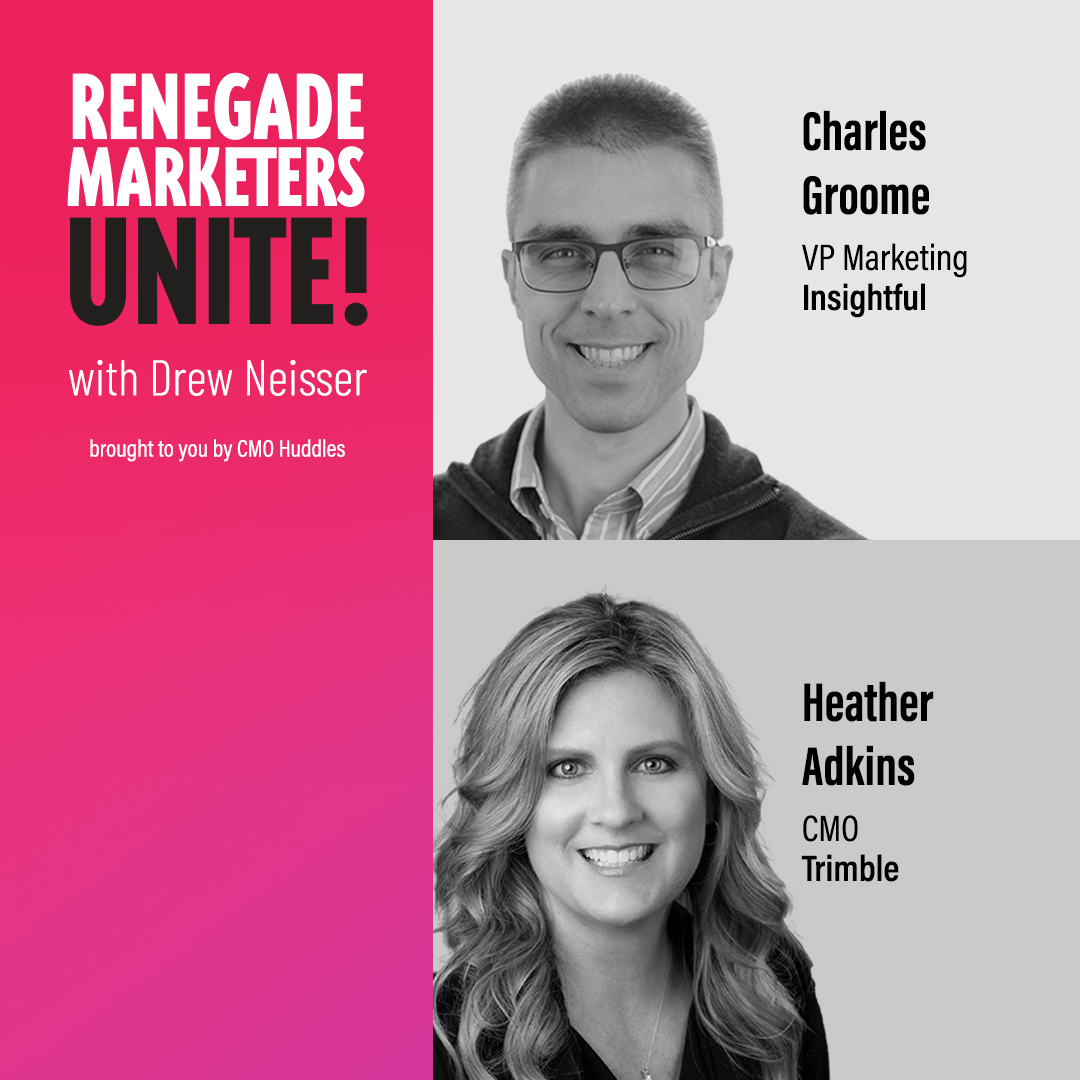
In this episode of Renegade Marketers Unite, Drew sits down with Charles Groome (Insightful) and Heather Adkins (Trimble) to unpack what a 2026-ready marketing organization really looks like.
Spoiler: It’s not built around functional silos.
Instead, they explore campaign-led team structures, mindset-driven hiring, and operating systems designed for speed, adaptability, and accountability.
You'll hear:
- How Insightful uses an effort + outcomes framework to evaluate performance
- Why Trimble reorganized around nine global initiatives instead of functional silos
- The rise of integrated campaign units to tighten alignment
- How to hire T-shaped marketers who blend storytelling and data
- Ways to give teams more autonomy without sacrificing accountability
- How better org design can reduce burnout and increase clarity
If your team structure hasn’t changed in years, your team may struggle to adapt when the market shifts.
This conversation will challenge how you think about structure, talent, and what it takes to build a marketing team that can pivot with confidence.
Renegade Marketers Unite, Episode 507 on YouTube
Resources Mentioned
- CMO Huddles
- Past episodes mentioned
- Charles Groome
Highlights
- [2:16] Charles Groome: The performance and effort framework
- [4:31] Track effort, then trust judgment
- [12:50] Build a distributed team operating system
- [16:47] Heather Adkins: Run the business while transforming it
- [19:57] Org design sequence: Roles, boxes, people
- [22:09] AI plus specialists beats silos
- [24:39] No more storytelling vs data excuses
- [28:45] CMO Huddles: Trusted peers & practical help
- [30:46] Hire thinkers who bridge silos
- [32:48] The best marketing teams are built on mindset
- [39:01] Marketing that rolls up to revenue
- [43:09] Scaling with autonomy and accountability
- [48:13] Tips for future-proofing teams
Highlighted Quotes
"At the back of every decision I make on org is hiring for mindset and hiring for that kind of strategic problem finder profile, whether it comes with a technical skillset, an analytical skillset, or a creative skillset."— Charles Groome, Insightful
“I'm looking for talent that can bridge the gap between storytelling and data science. I want creatives on my team to look at a performance dashboard and say, the data says this hook isn't working, let me pivot that story."— Heather Adkins, Trimble
Full Transcript: Drew Neisser in conversation with Charles Groome & Heather Adkins
Drew: Hello, Renegade Marketers! If this is your first time, welcome, and if you're a regular listener, welcome back.
You're about to listen to a recording from CMO Huddle Studio, our live show featuring the flocking awesome B2B marketing leaders of CMO Huddles. In this episode, Charles Groome and Heather Adkins take on a question every CMO is wrestling with right now: how do you design a marketing org that can keep up with constant change? They share how they're structuring teams around big business priorities instead of functions, creating space for innovation, and hiring for mindset as much as skill set. If you like what you hear, please subscribe to the podcast and leave a review. You'll be supporting our quest to be the number one B2B marketing podcast. All right, let's dive in.
Narrator: Welcome to Renegade Marketers Unite, possibly the best weekly podcast for CMOs and everyone else looking for innovative ways to transform their brand, drive demand, and just plain cut through, proving that B2B does not mean boring to business. Here's your host and Chief Marketing Renegade, Drew Neisser.
Drew: Welcome to CMO Huddle Studio, the live streaming show dedicated to inspiring B2B awesomeness. I'm your host, Drew Neisser, live from my home studio in New York City. Today we are diving into a topic that's top of mind for every forward-thinking CMO: marketing org design. And it's just like, at this moment, it's like, how many bots are we going to have on our plan? As the tech evolves, buyer behavior shifts, and budgets get tighter, how do you build a team that's not just built for today, but ready to crush it tomorrow? With that, let's bring on Charles Groome, VP of Marketing at Insightful, who has previously joined us on the show to discuss many topics, including event strategies, category creation, and ABM. Hello, Charles, welcome back.
Charles: Hey, Drew. Great to be here, and Happy New Year.
Drew: Happy New Year to you as well. So how are you, and where are you this fine day?
Charles: I'm doing fantastically. I am in our Bryant Park offices here in midtown Manhattan, New York City, and excited — this is, you know, first full week back for us. And you know, org is definitely front of mind for this team, so glad to be here for the conversation.
Drew: Awesome. I look forward to your input as always. So let's talk about you — you mentioned that you and your team use a performance framework based on an Eisenhower matrix, which is completely new to me. Can you walk us through how that works in evaluating and developing talent?
Charles: So the first thing I have to share is: what is Insightful? What do we do? Because it's really relevant here when it comes to building, especially a distributed org — which I hope we'll talk more about — what that looks like in the marketing world. Insightful is a workforce analytics software platform. So we use Insightful ourselves here, and we're developing a discipline with our clients that we try to deploy for ourselves. It starts by looking at the two factors that matter. An Eisenhower grid is a simple two-by-two: up and to the right — important and urgent; down and to the left — not important, not urgent, eliminate. Similar kind of concept here, but with the two metrics that matter when you're running a workforce. So we look at OKRs, or performance — the things that everybody as a manager, especially in marketing, is tightly focused on all the time. How are the people performing? What are their results? What are their outcomes? But the other piece that we found, and that as a workforce analytics platform we really focus on, is the effort. And that's where we find there's a really hard problem that has just kind of befuddled everybody for the longest time, which is: how do you accurately account for the effort that people are putting in? And so what we're looking for — and this lines up nicely with philosophies like radical candor and other management disciplines that are focused on how you get people motivated and keep them engaged — we're focused on finding the blend between high-performance and high-effort team members. When you put those two things together, you get magic to happen. So that's what it looks like. And if folks are interested, happy to share out what we use with our clients at Insightful. I find it a useful heuristic for anybody running, especially a large and distributed team.
Drew: I've got so many little questions. I have to get at outcomes and effort. Part of this — so much of my experience is that evaluations are, in fact, in the eye of the beholder. Do I like this person? Do I not? It seems to subconsciously come through in every evaluation. I just like them, I like having them around, right? And that's part of it, and that's important. So how — and then effort is another one. Are we just looking at 35 hours, 40 hours, 70 hours? We've all worked with people who get more done in 30 hours than most people get done in 60. So how do you look at those and actually sort of get to something that feels like it's not completely arbitrary?
Charles: So I love that you start with the hard problem first, because the subjective nature of evaluating talent is the thing that Insightful is built to unpack and resolve. And ultimately, why I'm getting so excited about it is because this is what I'm working on as a marketer — I'm trying to message this out, communicate about how do you actually solve something that feels on the surface incredibly subjective, up to the eye of the beholder in the manager's discretion. So the way that we're approaching that, at least on our team, is we're thinking about effort as an enabling condition. We like to have a little bit of flexibility around this. And a tool like Insightful is really useful because it will automatically filter out things like unproductive meeting time and flag those to the employee's attention. It will also look for elements of their schedule that might otherwise go unnoticed, right? They might have blocked out time for focus and deep work, and that is stuff that we're really focused on getting everybody on the team to deliver on — don't just be productive for the sake of having 75 meetings in a week, but actually move the needle forward on your most important objectives. And the way we think about this — we talk to a lot of companies that are PE-backed, and they have a mandate of driving efficiency, driving EBITDA margin for the business to deliver on a big-picture hard financial metric. And we find, over and over again, that the gap that exists is they're not able to get an objective measure of what effort is going in. Are the people on these teams able to give an input that will yield the output that we need? I mean, I'm working on this right now as a marketer — we're doing a website overhaul for our top-level navigation and our SEO. We just went through the holiday season, and I know that I'm already on deadline for three or four big rocks that the team has to move forward. So I'm measuring what our effort capacity is for the next week: is my deadline realistic or unrealistic, and do I need to start messaging or updating my strategy in relation to that? So it's that kind of fine-tuning, Drew, between having a hard, objective metric, but not just letting the metric manage the people for you. You need to combine your intuitive sense with having that objective data. It's just that so many companies and managers today are lacking that data.
Drew: And it's interesting — you have the data, and it may point to one thing, but I worry about the decisions that might make. I just think about my own personal scenario. Let's say there's an open period on my calendar and I decide I'm going to take the dog for a walk. Okay, that's not work — unless, while I'm casually not thinking about work, I'm actually solving a problem. Then it's like, boom, I just solved a problem because I let my mind rest. There's no data measurement for that. Drew's walking his dog.
Charles: There's never going to be something that fills that gap — although there are wearables now, if you want, Drew, that will let you record your voice in real time and have your AI assistant. God forbid. But the point here, I think, is more about how are you using objective measures. We have objective data on the performance side, but as you said, a lot of the management — and the development of talent — is still based on the heuristics of the manager. Especially for younger employees, or employees that are maybe in a transition or trying to break into a new domain — think about people who are upskilling or wearing multiple hats — getting a clear and objective sense of where they are spending their efforts and where those efforts are productive or not productive can be incredibly clarifying. I mean, I know for myself, I use this data on me all the time trying to manage the manager. I'll look at it and think, oh my gosh, I spent three hours working on this project when, if I just had the strategy outlined upfront, I wouldn't have had to put in that much time. I could have been back at home dealing with the kids instead. But it's that sort of insight learning. I think about Insightful like the Apple Watch of the tech world in the sense that if you're not measuring your heart rate, how are you going to learn when you're in a high-stress mode and how to take that deep, mindful breath? That's kind of part of what we bring to the table, at least philosophically.
Drew: It's so funny. I mean, I completely agree, and I encourage every CMO to think about doing a time audit. If you don't have a tool, do your own time audit. Where are you spending the time? Because obviously you want to be spending your time on the things that have the most leverage. And then I can bring us back to the conversation that we're supposed to be having today, which is designing organizations. The big pressure — particularly at PE-backed companies — the biggest dynamic I see is getting stuff done fast versus getting stuff done well, and the measures of performance. Look, let's face it, what every PE firm wants to do is say, "Hey, we want not $250,000 of revenue per employee — we want that number to be $500,000, and suddenly we're going to be epically successful." Those are big numbers. But the thing that I keep seeing — and this is where generative AI comes in — in theory, yeah, I can do this faster, but can I do it better?
Charles: That's such an interesting domain, Drew. Because one of the use cases that we've just been cracking into at Insightful are companies that come to us and they want to benchmark — they're benchmarking their employees against AI agents. These are some very large financial services companies, very large companies in the contact center space. They're benchmarking and finding that people are better. And that's what they're consistently trying to triage: where is AI adding value, and where is AI creating noise, so that we can discriminate between the two and keep people focused on the high-leverage work you're talking about. So I think, as you think about org design and future-proofing, I like the value that Insightful brings. Not everybody's going to have Insightful or even be the right kind of organization for it, but have that discipline as a marketing leader to say, "I'm not just going to throw AI at the people or try to automate everything that we do." You really do need to think through carefully, ahead of time: what are the jobs to be done in marketing that matter, and which pieces of those jobs should be left to the human — fully at the human's discretion on how they use automation, not just an LLM but all automation tools — and then truly, what should be high automation, systematic, something that you could audit in the middle of the night and it would still be running.
Drew: Okay, one quick thing. And then Heather, who has been incredibly patient so far — we'll get to her. But let's just talk about this: we have an org structure in most companies, including little CMO Huddles. We have a global team, and that's a lot of time zones that we cover. I'm curious if you have an approach to organizational design, at least in marketing, that makes time zones work — not just for the American leader.
Charles: Such a great question for me, because I feel like I've built my career in distributed marketing environments. I actually worked at the very beginning of my career with large franchise companies that had marketers, field sales teams, and franchisees in every time zone on Earth — all at the same time. How are they coordinating across that span? Working in the B2B world now, with relatively leaner teams and nimbler organizational structures aligned to either large discipline areas like demand generation writ large or product marketing writ large — or very cross-functional in nature — starting with that fundamental org design first has been effective. And then what you find when you go to a distributed model, especially when you start mixing time zones and crossing borders, is that you've got to have what I call the executive operating system, or the team operating system, calibrated. You've got to have a first draft of that when you come in or when you're beginning to build that distributed organization. It becomes something that you're going to update consistently, and it should just be telling you: here's where the team is effective, here's where the team is not as effective as they could be when collaborating together. I'll share from personal experience — there are kind of four things that I find work particularly well with distributed teams, and Drew, we can unpack that after Heather has had a chance to share. First: golden windows. Look for those time zone overlaps and make them sacrosanct. If that means one hour because you're literally on opposite ends, you've got to spend that one hour a day with that team. Second: guess and move — encourage and enable the team to make decisions on their own and don't nitpick. You don't need to fix things after the fact. And then have one metric that matters for everybody on the team and audit it at least once a year, but probably more like quarterly, just to be sure it's tightly aligned and that they know what metric they should be working toward.
Drew: I love it. That's awesome. Okay, perfect. All right, with that, let's bring on Heather Adkins, CMO of Trimble, who is joining this show for the first time. Heather, welcome. Nice to see you — how are you and where are you this fine day?
Heather: Yes, I am doing great. Ready for an amazing 2026, and I'm thrilled to be here today for what is already proving to be a robust conversation. I've already learned a lot from Charles. I am coming to you from Trimble's headquarters in Westminster, Colorado, which is right outside of Denver. And it is snowy here today.
Drew: Well, it is Colorado — the Rocky Mountain High thing going on out there. So, since you did get a chance to listen to Charles's comments, was there anything that you heard that particularly resonated with you?
Heather: All of his advice on global distributed teams and how to bring teams together. I also have a global, distributed team, and it's very difficult when you lead teams across multiple time zones. So I loved all of the very real and, I think, actionable tactics that he outlined.
Drew: It's funny — "golden window" definitely, but it's a great articulation of that concept when it works. I mean, it's really hard with Asia. The "guess and move" — I thought that was inspired. It's like you have permission to keep moving, do your best, and try not to really mess up. And of course, metrics that matter certainly makes it easy. Okay, so let's talk about Trimble. You're relatively new there. I'm just very curious — you came in, there was a marketing org of sorts. How have you changed it so far, and then we can talk about where you see it going?
Heather: Yeah, absolutely. So I've only been in my role at Trimble for three months, and before I joined, there had been a long path of transformation focused on technology and data, and we're continuing to innovate on the systems. But you can't execute your strategy without people. For me, the only way we're going to unlock that next level of growth is to get the people equation right. So that has been a huge focus of mine these past three months. The way I think about it is we have to run the business while simultaneously transforming it — today's needs, right, maintaining a high-performance engine focused on driving brand, demand gen, sales enablement, and regional execution. That part is really about precision and hitting the numbers quarter over quarter. But while we are doing that, we're also thinking about the future. So one idea that I'm about to implement is really carving out what I'm going to call "innovation pods." These are smaller, cross-functional teams tasked with thinking through a myriad of topics — it could be exploring AI-driven customer journeys, it could be exploring new subscription models, whatever it is. But the key here is that we want to give them space to do this without the pressure of immediate ROI. I've stood these up in prior roles, and I found that people are really eager to volunteer for assignments like this, and these types of initiatives tend to grow legs and really create a culture of curiosity. So as I focus on the people at Trimble, we're doing a lot of things to create that culture of innovation and curiosity. In terms of what I think the modern marketing skill set looks like — I'm looking for talent that can bridge the gap between storytelling and data science. You may have heard of this term: the rise of the "analytical creative." We used to think of people as either left-brained data or right-brained creative, and I think that wall needs to come down. I want creatives on my team to look at a performance dashboard and say, "The data says this hook isn't working — let me pivot that story." And then conversely, our analysts need enough empathy and brand sense to understand why a customer is dropping off a journey, rather than just simply reporting that they are. So that shared understanding and shared capability across both sides is key. And I think also, as we are transforming from a people perspective, the team needs to be really good at synthesizing and handling a lot of information. So I'm really focused on that — having marketers step back, take AI-generated insights, and ask, "What's the one big move we should make based on this?" We all need to have that synthesis muscle and the ability to ignore all of the noise around us, find that one signal that should tell us something, and then enable the marketers to really act on that signal.
Drew: Let me stop you for a second, because you brought up so many good points, and I want to go deeper on a few of them. I want to talk about the innovation pods, because I think that's such an interesting thing. And to do that in the first three months is a very brave and wonderful thing. I also have to say, sort of in my simplistic notion of what does a leader do and what are their three priorities — it's like: set the vision, build the team, and allocate resources. You can almost boil everything down to that. And what I was curious about in the team-building part of this is: are you replicating a team design? Because you mentioned a bunch of functions that is pretty much similar to what you've done in the past, or are you making some adjustments — not just because of the company need, but because of the technology that now exists that might not have existed before?
Heather: Yes, absolutely, and I am very fortunate to have inherited a team that has a lot of great skill sets already — a lot of, you know, core competencies and capabilities that we need. You know, it is another transformation story. And I have the playbook from other companies, but I definitely need to tailor it. I do sort of approach transformation across kind of people, process, data, and technology. So from a team design and people perspective, I've spent a lot of time thinking: what is our strategy? What are we trying to achieve in outcomes, and what does that ideal org design need to look like? So inheriting a team, my approach is taking the people out of the boxes. What do the boxes need to be again? What are those core competencies that we need to drive impact against the strategy? Put the people back into the boxes, and then start to assess talent and skill sets, and move people around to get the right people in the right roles, and help each individual really find the intersection of their passion, their skill set, and where we have the business need.
Drew: Okay, so interestingly, I have this sense right now that this is a different period of management and leadership in that it's easier today, because it used to be, "I don't know anything about this." No longer can you make an excuse like that, because at your fingertips is the world's largest repository of information. Are you finding that — because you said take them out of their boxes — are you finding that because of generative AI, people can think broader? You don't necessarily say, "Okay, you only do PR," or "you only do events," or "you only do email." Is that happening, or is this a pipe dream of mine? Is that something that you're starting to see happen when you think about taking people out of their boxes?
Heather: I think that's part of breaking down silos and really having that collaborative spirit and that shared understanding of what everyone does. So it's sort of the team model, right? I still want specialists who can go super deep in something, but we do need to all have our eye on tech, our eye on how we can leverage AI and build it into our workflows. And to do that, I think you have to have people that go at least a couple of inches deep across all of those roles.
Drew: I just want to bookmark something — I love the fact that your culture embraces tribalizing. I think that's really remarkable. To the extent that you're at a company where you can actually do that, that's amazing. I want to go back to innovation pods and talk about that a little bit more, because I don't think enough companies do this. But if you want to inspire curiosity, if you want to solve bigger problems and not just be doing the day-to-day stuff, you need something like this. I'm curious how you're structuring them and what kind of specific ambitions you're giving to these individuals or teams?
Heather: Yeah, and we haven't stood them up yet. I'm only three months in — but it's just — I know, right? Three months in and I'm behind. Oh, come on. No, just kidding, of course. Yeah, it's really about allowing them the space for trial and error, for failure frankly, right? And to test their way into something. And I think it's also a way that we're trying to break down silos — not only within marketing, but across other functions as well: sales, customer success, product. And within marketing, certainly product marketing, content, creative, and demand generation. So bringing different perspectives together and giving them a goal. Early on in my career, there was a CEO, and someone asked him, "How is it that you got to where you are?" And he said, "I find problems across the organization and I volunteer to solve them." So that's really going to be the remit for these innovation pods: find the problem, and then work together to solve that problem.
Drew: I love it. I mean, you're literally creating an organization of impact players, which is amazing. I want to go to this other notion, which I think is fascinating — this notion of storytellers who use data. I have to pause for a moment. Many years ago, I ran an agency. We had both creative services and digital production. It was very much like running two agencies. You had left brain, right brain. There were folks who were creative and thinking just outside the box all the time, and the digital people were all process-oriented. It's like, "Is it on the chart? Is it in the software? Is it there?" And they thought differently. So you're asking people to get both sides of their brains working, and you're looking for those people. I feel like those are unicorns. Are you actually able to get storytellers who are really good conceptually to think about data, and data people who are really good at organizational process to think about story?
Heather: That's the challenge, right? That's the remit. That's the challenge for the team. And I think it also goes back to upskilling, up-leveling your current team, and then knowing when you need to acquire certain skill sets or competencies externally. But for all of us — whether you're creative, whether you are data-driven or data-minded, left brain or right brain — it's all about taking what the machine gives us, so to speak, and then adding that 10% of human intuition and strategy that makes it something breakthrough. And again, whether you're coming from a data mindset or a creative mindset. So I challenge the team to spend less time thinking about what the differences are, spend more time coming together, less time on manual execution, and more time on that type of strategic synthesis. And then, really from there, designing my team around that.
Drew: Yeah, it is sort of funny. I think about it the same way as raising kids. You could say to your child, "Well, I wasn't good at math, so you don't have to be good at math." Well, the reality is, math is work — period. You just have to learn it. And that's not my idea — that's Malcolm Gladwell who talks about this. So what you're basically saying is, you can't get away with the excuse you might have gotten away with before: "Oh, I'm not good at this." There's no choice. If you want to succeed here, you have to pay attention. You can't say, "Oh, I don't care about that, because that's not my domain," anymore. So if you're a storyteller, you still need to think about data. And I think that's profound.
Heather: It makes us empathetic to one another as well — understanding where the other is coming from.
Drew: And less siloed. I mean, in theory. Where it gets really tricky — and this came up in the metrics and matter conversation in a peer huddle — is sometimes the data signals are anecdotal. Like, the sales guys are feeling a vibe like something is working, and it's not necessarily showing up in the SQOs, but the salespeople are saying, "Something's different. I'm having different conversations than I did before. Whatever you're doing over here is working." And so I think even being aware of this notion — that you just can't get away with not thinking about data, but there could be different ways of finding that data — is important. So, all right, amazing conversation. We're going to take a quick break for a second, because I get to talk about CMO Huddles. CMO Huddles was launched in 2020 — oh my God, that feels like six years ago. CMO Huddles is the only community of flocking awesome B2B marketing leaders like Charles and Heather, and it has a logo featuring penguins. Wait, what? Yes — well, a group of these curious, adaptable, and problem-solving birds is called a huddle, and the leaders in CMO Huddles are all that and more, huddling together to conquer the toughest job in the C-suite. There's a little pun in there if you're paying attention. So Heather and Charles, you're both incredibly busy marketing leaders. I'm wondering if you could share a specific example of how CMO Huddles has helped you. Charles, I'm going to start with you, because you're a longtime huddler.
Charles: So I will say, Drew, we're talking about org design, and CMO Huddles has definitely helped me in the day-to-day tactics of org builds, team design, etc. I mean, the number of great people who come through the CMO Huddles Slack channel alone is probably worth the price of admission. And I'll talk about this if you want to double-click on it — I love micro-experts on the team: agencies, referrals to freelancers and contractors. They're just coming through all the time from the CMOs in the group. Especially as you think about a distributed org, CMO Huddles is kind of the nexus where B2B CMOs who have already vetted people, who already know the right people, can make a great introduction. I just had three intros in the last couple of weeks. We're just starting 2026 and I'll probably hire one of them for a project this month.
Drew: Amazing, amazing. That's awesome. Okay, well Heather, I know you're very new, and I don't want you to feel any pressure, but if CMO Huddles has been of help, please share.
Heather: So we have grown a lot through acquisition, and have been on this journey to go from a house of brands to a branded house — like many other companies in the tech space, like many other CMOs. So why not connect with them and learn from them? I would say CMO Huddles has been the vessel to make that happen. Drew, you and I have had a couple of conversations on this topic, and then you put me in touch with a few others to connect with, and that so far has been just invaluable for me.
Drew: I love that. Well, I appreciate that — I appreciate both of you. That's one of my favorite go-deep topics, so thank you both for sharing. If you're a B2B marketing leader who wants to build a stronger peer network, gain recognition as a thought leader, and get your very own stress penguin, please join us at cmohuddles.com. Okay, so many things. And Charles — Heather and I were talking for a while, and I'm curious if you heard anything in that conversation that sparked some thoughts. How quickly are you going to get your innovation pods going?
Charles: So yes, breaking down the traditional silos — I feel like, Heather, I'm totally on the same page with you. I wanted to respond a little bit and elaborate on your T-model marketer, which I think is so critical right now. Because one of the things I have really at the back of every decision I make on org is hiring for mindset and hiring for that kind of strategic problem-finder profile, whether it comes with a technical skill set, an analytical skill set, or a creative skill set. Drew, I don't know if this is the solve to your big problem statement, but I definitely feel like you've got to look for the people on the team that have that ability to blend these two worlds together — enough to go and find the problem, articulate the problem so that it can be solved. That's kind of what I want to double-click on, because I feel like that's what we're all looking for in B2B. And we're looking to do that whether it's a product marketer, a customer marketer, a demand gen, or even sometimes an intern who can be a source of inspiration, because they're thinking about this with totally fresh eyes.
Drew: Yeah. And I just want to pin on two things. One: the team marketing model, which is so interesting, particularly if we can get to a campaign structure where a team owns a campaign. Budgeting by campaign is a lot healthier for an organization than budgeting by channel or department, because how you budget is also how you measure. If you have a team marketing model, you can have a team budgeting model, and that will help you get team results. The mindset hiring thing, I think, is so interesting at this moment in time. I wonder if we're getting any better than we were 10 or 20 years ago at actually hiring — increasing the odds of a successful hire by more than 50% — even though we're looking for this mindset. Are we good? Do we know the right questions to ask in the process to find these people?
Heather: I think, Drew, I want to go back to what you said around measuring by team, hiring by team, and bringing teams together versus just filling individual roles. Traditional org charts are vertical. I try to design our teams horizontally, around the customer journey and around our big 2026 marketing initiatives, which at Trimble we're calling the Global Nine. So we literally reorged around this. So instead of a product marketer and a demand gen marketer working in isolation, we formed what we're calling integrated campaign units, or integrated campaign teams. These units include product experts, global campaign strategists, regional marketing, content creators, a project manager, someone from the paid media team, and a data analyst. These teams of people — and it's times nine, because it's for our Global Nine initiatives — are rallying around the initiative, rallying around the customer, and they're coming together early enough and often enough to co-create strategy. By dismantling the traditional silos, these units really have transformed — or will transform — marketing from a handoff process into a continuous loop of innovation. In prior roles where I've done this, a major benefit is that it allows the customer's voice to be baked into the strategy from day one. An example of that is when someone from the BI team shares real-time intent signals directly with the content creator and a regional marketing lead. The resulting output isn't just a broad message, but a contextually relevant experience tailored to specific local needs. I've had great success doing that in prior roles, and I just reorged the marketing organization to do that at Trimble.
Drew: For those listening live right now — if you were wondering about the title of this show and what the future of the marketing org should look like — to me, what Heather just described as a team-based approach is flocking awesome. And I don't think it's as common as you might think, Heather. There are still a lot of vertical, skills-based teams out there with budgets siloed into those verticals, and once you have that, you have a problematic organization. Because then everyone is just worried about their own area — their PR, their website. But by designing around campaigns, they can also see the impact, right? Which means they feel better about the work that they're doing. Though I imagine it's a hard transition.
Heather: I think the benefits are realized pretty quickly, right? We just made this change in December, so it hasn't even been two months, and the benefits really extend beyond efficiency. I think it has already allowed these teams to pivot instantly based on market shifts, because all of the decision-makers are already in the same room. And by co-creating this vision, the global strategists and the regional teams stay aligned, which eliminates the one-size-fits-all approach to campaigns. When you do that one-size-fits-all approach, campaigns often fail locally, right? So it's also given everyone a shared appreciation of being on a global team and on a regional, local team — but coming together and maintaining that continuous feedback loop. So we're creating campaigns that actually resonate within the market.
Drew: Charles, I know you wanted to weigh in on this, so go for it.
Charles: Yeah, and I think what's interesting about this approach is when you scale it down — Insightful is just about a 100-person company. We're very nimble, but we serve an incredibly horizontal market. You've got to scale this approach down to size, and this gets back to mindset. Because now you need marketers on that nimble, lean team that can pivot from having one campaign on Monday and a different campaign on Wednesday, without losing the plot in between. So where Heather's org structure at a larger scale gets the benefit of having the team concentrated for a defined period of time, what we bring as an edit to that approach is that the team now moves and pivots its locked-in focus. Maybe we're addressing the PLG segment on Monday with a bunch of initiatives. Maybe by Wednesday, we're focused on a high-scale strategic enterprise named-account strategy, and then we'll go back to PLG on Friday. That kind of pivoting motion is what I think is really critical at my stage — a Series A SaaS — where you've got to not lose the cross-functional focus on the campaign result the way you guys are talking about, but scale it to size and hire for mindset. Because the challenge when you go with pure vertical skills is that those people just take the task and do the task, and they're not able to pivot between contexts very easily.
Drew: Yeah, we had Udi Ledigor at the Super Huddle, and he really talked about how all his first hires were all about mindset and not about any specific skill. He just figured they were all really curious problem solvers. I also — and I mentioned already that this team structure felt like it would be good for metrics, because you're sort of budgeting by campaign and team and so forth. But I also imagine — and I could be inferring, so I'll try to turn it into a question — does it make it easier to figure out? We've got a team structure that's going on your Global Nine. So Global One, there's a structure. They have a certain amount of AI martech support needs that they can collectively decide in theory. So it might be easier than when you have the siloed vertical where, "Oh, well, for PR I need this," and "For email, I need this." And so, finally, a question: Heather, has it changed the way your teams are approaching the tech stack and/or the use of AI?
Heather: I think so. And also, the beauty of that is we have — multiply this times nine — so one group figures it out first, and we can easily scale it to the other nine. But absolutely, because we're thinking about the end-to-end marketing engine versus, "I'm a content creator, what do I need, and how should the tech support and enable me.”
Drew: Well, there's certainly — no matter what — a psychic reward here, because people get a sense that what they are doing matters in the collective. You know, we as a team have these goals, and we're going to do it. I also just have to acknowledge that as a marketer, you often name things to make it easier for the rest of the company. And I love "Global Nine." Why nine, by the way?
Heather: Well, last year in Q4-ish, we had what we called the "Core Four," knowing that we were going to expand it broader. It's just through a series of ideation and coming up with nine initiatives that are just big bets for us in 2026 — it just happened to be nine.
Drew: Got it. That's funny. We just went through the strategic planning process for CMO Huddles, and we have five big initiatives, and then there are sub-initiatives under each one that support it, and you end up with about 20 in that process. But there are five big ones. So nine just felt like a lot. I just love the naming — doesn't matter.
Heather: Yeah. And it's also our approach of moving away from a series of disconnected tactics — everything that we do in marketing should roll up to one of the Global Nine, whether it be an event in APAC or an email that we're sending, a webinar, or whatever it is. Everything we do — a product launch, everything — should roll up to that Global Nine. And you know, 95% plus of our revenue is coming from those Global Nine initiatives that support, of course, the sales organization.
Drew: So Charles, should I expect a "Core Four" from you and your team?
Charles: Well, it's not a four — it's a three. Basically three revenue targets, right? And more or less the corresponding pipelines for the sales team that we're focused on delivering — again, scale from large global down to, you know, sophisticated but nimble SaaS. And those three pipelines, to the point you made about budgeting and getting the org to be responsive to the way you're budgeting and planning your year — that's really been the focus for me in setting the North Star. We have a PLG outcome that we need to drive, we have an enterprise strategic outcome we need to drive, and we have a customer retention — we're thinking about the entire lifecycle. If we have to make a trade-off, we're going to make it in the direction that the business is going to go for the next three years, not necessarily in the direction the business has been coming from. But we're not going to lose sight of any of those three top-line KPIs. That's what matters to the board. That's what matters to management horizontally as well.
Drew: So maybe "Project Triple Threat."
Charles: Maybe I'll outsource it, Drew, or I'll do what most marketers do these days and check ChatGPT first.
Drew: Yeah, but I feel like you need a name. I'm just saying. And I put "project" in there because one of my favorite books I read this year was Project Hail Mary — the Andy Weir science fiction book that's coming out as a movie this year. And one of the things that happens in that book is there's one guy who has to do everything, and that gets me to my next question, which is burnout. As a part-time CMO therapist, I know that every CMO I've talked to has been on the verge of burnout themselves — because of the pressures of the job, because of their sort of relentless drive. I mean, the fact is, you want the job, so you pursue it and you put in the time. And there's a never-ending amount of things you could spend your time on. How, from an org design standpoint, are you thinking about scaling? This probably starts with you, Charles — you're a startup, if you will, with 100 people. How do you do that? You want your people to work really, really hard without burning them out.
Charles: So again, this is where Insightful as a product actually has a little bit of an edge. For me as a manager, we've got an alerting system in Insightful that will signal to a manager — sort of a roll-up — is an employee showing tendencies that would relate to or lead in the direction of burning out, right? What are the risks as a manager? Get a little more objective about where they're burning the candle on both ends. I think that's one little thing. And again, not everybody has to use a tool like Insightful in order to get that insight. Just listen for it. Hear for it in your one-on-ones with the team. Be intuitive and empathetic at the same time. Don't abandon the fundamentals of good management as you're going forward and trying to scale and hit these objectives. And then I think the other piece of this is — we like to talk, and it's partly because of what our platform is built for. But I personally love this concept of giving employees more autonomy and finding even the small ways to do that, which creates a positive yield for the employee without costing the company anything. For us, that means we're a remote-first organization, which means people have flexibility. You think about employees who have kids or might have family members abroad that they need to see or speak to at odd times — give them that flexibility to be human first, and then come back to the business with a very clear framework. What we try to do on the team is equip them with tools that will help take the drudge work out and make them more productive for the same input of time and effort. Going back to that original matrix we were talking about up top.
Drew: A couple of interesting things. Thinking about global organizations, particularly the notion of time-shifting and the ability to be flexible — it used to be that in the old-fashioned world, a boss would see, "Oh, you got in at seven in the morning and you left at eight o'clock at night — you're a hard worker," which was just time-based. Now, with most people virtual two or five days a week, you don't see it. But what's really important is if you can shift time — like, "I spent two hours in the middle of the day doing this, and then I found that other time whenever I wanted" — I think that is what you're talking about: giving people the autonomy they need. It certainly feels good personally to be able to time-shift.
Charles: Look, the company — even before I joined — had great growth in response to COVID, and what we tapped into as a platform. But I fundamentally believe, as a manager, that when you add that level of flexibility and give employees the autonomy to find the way to deliver on their results in the time available to them, and you don't micromanage that aspect — maybe you want to micromanage performance, be really focused on outcomes — but give the employee that level of control and hold them accountable. The autonomy-accountability trade-off is something we talk about all the time, and I think every modern business has to be laser-focused on deploying that. It can't just be lip service. It can't be, "Oh yeah, we'll be flexible," and then everybody's on shift because that's what the CEO wants. It has to actually go through the culture.
Drew: And Heather, just one question for you. I'm imagining that the team structure enables additional accountability because you don't want to let your teammate down.
Heather: I'm definitely seeing that, Drew.
Drew: And I think that's so interesting, because you might let a company down — or even your boss — and say, "My dog ate it," or whatever the old excuse for not getting your homework done was. It was easy to make excuses. But when it's a team and you're all working toward a shared goal, and you commit to that team that you're going to get something done and then you don't — and you didn't find someone else to fill in — you've let them down. That little rowboat just went sideways. So it's really interesting how this team structure and campaign structure actually sets up potentially better metrics, potentially more accountability, and potentially easier insight into what technology you actually need or not. It's fascinating that all of that potential exists. Anyway, I love this show. I really appreciate the insights. I'm wondering if you can boil it down — what advice would you give to a CMO preparing to future-proof their team in 2026? Heather, we'll start with you.
Heather: So I think in 2026, the biggest risk isn't making the wrong hire. It's actually building a structure that's so rigid that you can't adapt — whether it be to the next tech shift or the next market pivot that happens six months from now. So if your org chart is carved in stone, your strategy will be as well. Final words of wisdom would be: remain open, remain flexible, listen to those early signals that you're hearing and seeing, and then take action from there.
Drew: Interesting. And as part of that, maybe have a couple more freelancers or outsource a little bit more so you have the flexibility to scale up or down if you need to.
Heather: Scale it up or down, but also just optimize. We just stood up these integrated marketing teams in December, so it may not be perfect, right? Just being agile and taking an iterative approach with that.
Drew: Love it. Okay, Charles, final words of wisdom.
Charles: I think as a marketing leader, you've got to be ready to own the mission — especially in this day and age, where technology, as Heather highlights, could throw things completely through a loop in two weeks or a month — who knows? So you've got to own the mission. And the other piece of advice, something I'm really trying to implement myself, is to free up the bandwidth you have by creating an operating system for yourself so that you've got the bandwidth to give the team more clarity on the "why" and do the real work. Heather's "Global Nine" is fantastic framing. You've had to put in a huge amount of effort getting that just right, and now you're going to have to go and monitor it. It's about freeing up your mental capacity to do the bigger things — less of the day-to-day admin, less of the micromanagement. That's the balance. It's not easy to pull off. You still have to make sure people are doing their jobs, but it is ultimately what I would be focused on going into this year.
Drew: Well, we really appreciate both of you and your perspective on this. I love that we had big business, smaller business, and the mix. But I can't emphasize enough — a CMO and a marketing leader is only as good as the team underneath them. I've talked about that before, but it's often thought of just in terms of talent. What we really talked about here is the design of the org underneath you. And I think you got some really good ideas to at least think about and implement in 2026. Thank you, Heather. Charles, you're great sports. Thank you to the audience for staying with us.
To hear more conversations like this one and submit your questions while we're live, join us on the next CMO Huddle Studio. We stream to my LinkedIn profile. That's Drew Neisser, every other week.
Show Credits
Renegade Marketers Unite is written and directed by Drew Neisser. Hey, that's me! This show is produced by Melissa Caffrey, Laura Parkyn, and Ishar Cuevas. The music is by the amazing Burns Twins and the intro Voice Over is Linda Cornelius. To find the transcripts of all episodes, suggest future guests, or learn more about B2B branding, CMO Huddles, or my CMO coaching service, check out renegade.com. I'm your host, Drew Neisser. And until next time, keep those Renegade thinking caps on and strong!