AI Velocity vs. Human Creativity
AI just handed every marketing team a bigger gas pedal. Now CMOs have to decide what deserves the speed.
Teams can now publish, prototype, adapt, and distribute at a pace that felt impossible a few years ago. The advantage comes from knowing where to accelerate, where human judgment matters most, and how to keep the creative spark intact. A strong idea can travel further than ever. A weak one can flood the market before anyone asks whether it was worth making.
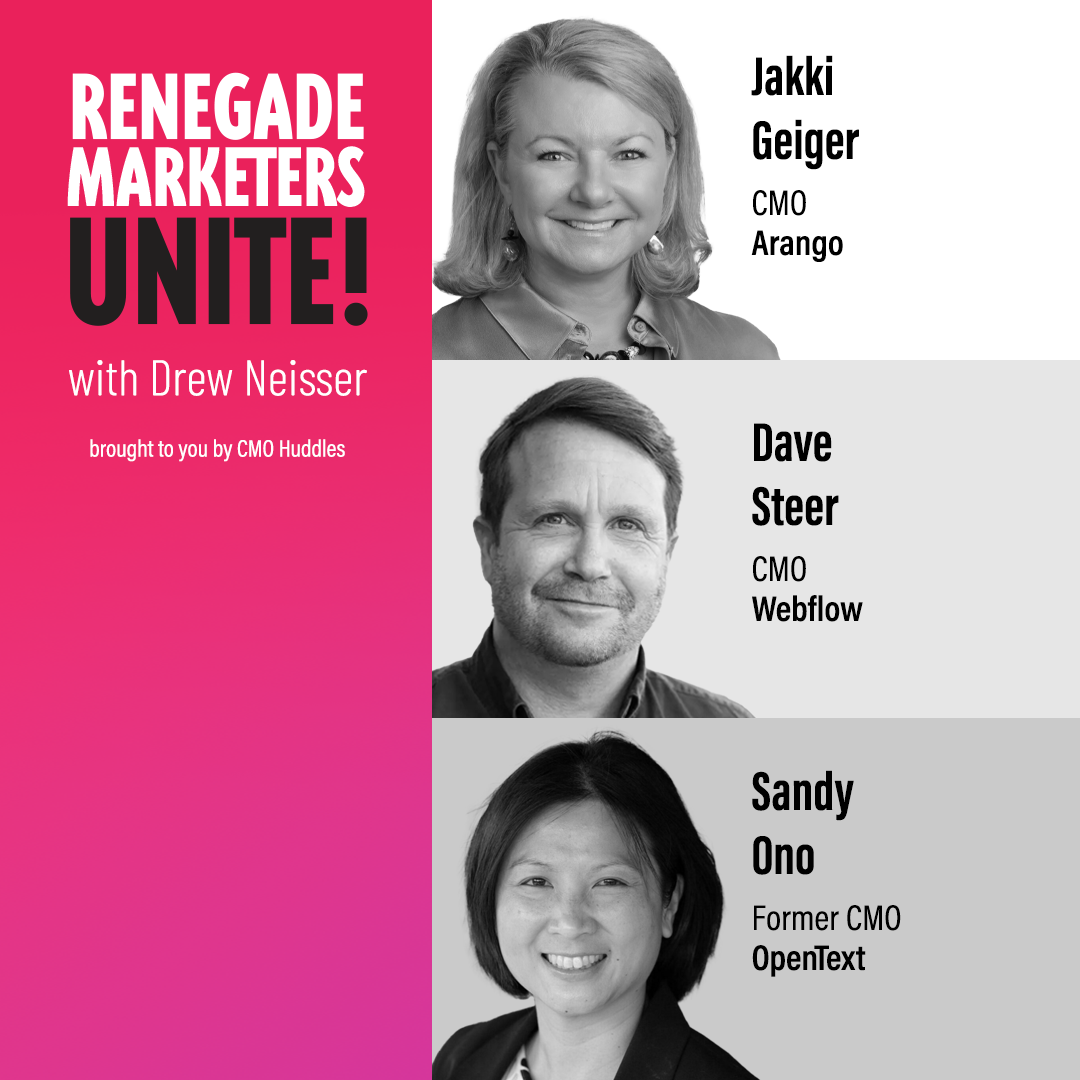
In this episode, Drew brings together Jakki Geiger (Arango), Dave Steer (Webflow), and Sandy Ono to sort out one of marketing’s trickiest new balancing acts: What automation can handle and what still needs a human brain, a trained eye, and a little creative nerve. They keep coming back to one principle. Automation should clear the path from insight to action, while marketers set the standards for quality, protect buyer trust, and know which moments still demand original thinking.
In this episode:
- Jakki shares how she used AI, customer validation, and agency expertise to reposition Arango in 60 days and turn “Frankenstack” into a distinctive market story
- Dave explains why volume is the wrong goal and how Webflow moves expert insight into market-ready content without giving up subject-matter review
- Sandy breaks down how decision levels and fidelity separate work AI can handle from work that still needs expert review
Plus:
- How to scale pillar content without diluting the message
- Why AI-ready brand systems need more than a style guide
- Where AI speeds localization and where human nuance still matters
- How process redesign and clear human roles prepare teams for AI agents
Listen in for how to put AI’s speed to work, protect expert judgment, and give your strongest ideas more reach.
Renegade Marketers Unite, Episode 526 on YouTube
Resources Mentioned
- CMO Huddles
- CMO Super Huddle
- Webflow AEO Assessment
- Sequel.io
- Trust Matters by David Horsager
- Past episodes mentioned
- RMU Episode | Samantha Stark & Steve Mudd
- Jakki Geiger
- Ali McCarthy
Highlights
- [2:32] Jakki Geiger: The human-AI rebrand sprint
- [4:26] Digital twins + human craft
- [6:52] How Frankenstack became a campaign
- [11:37] Dave Steer: Fast website builds hit a wall
- [14:27] Use AI for velocity, not volume
- [17:14] Human expertise keeps AI honest
- [21:32] Sandy Ono: Where AI ends and humans begin
- [23:33] Clarity for bots, creativity for humans
- [29:51] Match fidelity to the mission
- [31:58] CMO Huddles: Support for every CMO journey
- [35:30] Build pillars, then scale with AI
- [37:44] Positioning that moves with the market
- [38:57] Brand GPTs, global scale, human touch
- [42:20] Where AI creativity still falls short
- [48:08] Tips for balancing automation and creativity
Highlighted Quotes
"For me, the human in the loop is still very important, because in the world of AI, the currency is trust, and I don't one hundred percent trust it yet."— Jakki Geiger, Arango
“Speed alone has stopped being much of an advantage. The bigger opportunity is using automation to shorten the distance between insight and action while human judgment protects the trust, quality, and creative spark that make the work worth noticing."— Dave Steer, Webflow
"Once you break down your decision levels, know where you need high fidelity, low fidelity, it helps you answer these questions around what should be automated and what still needs a human-in-the-loop."— Sandy Ono
Full Transcript: Drew Neisser in conversation with Jakki Geiger, Dave Steer, & Sandy Ono
Drew: Hello, Renegade Marketers. If this is your first time listening, welcome. If you're a regular listener, welcome back. You're about to listen to a recording from CMO Huddles Studio, our live show featuring the flocking awesome B2B marketing leaders of CMO Huddles.
In this episode, Jakki Geiger, Dave Steer, and Sandy Ono get into the balancing act between AI-powered automation and human creativity. They talk about why speed isn't the same as volume, how automation works best when it shortens the distance between insight and action, and why marketers still need to bring judgment, originality, and creative spark that the machines cannot fake.
If you like what you hear, please subscribe to the podcast and leave a review. You'll be supporting our quest to be the number one B2B marketing podcast. All right, let's dive in.
Narrator: Welcome to Renegade Marketers Unite, possibly the best weekly podcast for CMOs and everyone else looking for innovative ways to transform their brand, drive demand, and just plain cut through, proving that B2B does not mean boring-to-business. Here's your host and chief marketing renegade, Drew Neisser.
Drew: Welcome to CMO Huddles Studio, the live streaming show dedicated to inspiring B2B awesomeness. I'm your host, Drew Neisser, live from my home studio on a beautiful day in New York City.
Today we are tackling one of the great balancing acts of modern marketing, which is: How do you blend automation and human ingenuity without losing the magic that makes brands memorable? Because while AI is making everything faster and we're focused on efficiency, the question in my mind is, is there an opportunity for CMOs and their teams to turn that speed into speedy creativity? In the old days, we'd say, well, you can have good and fast, or cheap, and you had to pick two. Right now, we're trying to figure out, can we work with machines to scale, and have humans deliver the spark, or will speedy creativity remain an oxymoron? So, lots to cover with that.
Let's bring on Jakki Geiger, CMO of Arango, and a returning guest who has previously appeared on the show to discuss many topics, including building the marketing team's AI acumen, which is relevant for today, category creation, and moving up market. Hello, Jakki. How are you? And where are you this fine day?
Jakki: Hi, Drew. I'm doing great. I'm actually at home in my home office in the San Francisco Bay Area, and fresh off of the Nvidia conference, where Jensen Huang talked about crossing the threshold. Everyone's going to have AI teammates, so I think this topic is really timely.
Drew: Yeah, let's talk about that. That must have been very cool. Let's talk a little bit about AI and your marketing workflow, and I think there's a lot of folks talking about, yeah, you got to keep a human in the loop. But what does this look like right now?
Jakki: Yeah, so I'll give you an example. I joined Arango six months ago with a charter, right? We were a very well-established, ten-year-old company known for a technology called multi-model, or graph database technology, and we got a new Chief Product Officer who came in and said, "I came from JPMorgan Chase, I see a vision here that this could be the foundation, the contextual data layer for all AI agents. We need to really ramp up our messaging, our positioning, rebrand, and launch a preview of our product at the Nvidia conference in October."
So that gave me 60 days to figure it out with no team, I had a couple of people borrowed from other parts of the organization. So how was I going to make that happen? Drew, you and I know in my previous role that took nine months, right? So I had 60 days to think through how do we differentiate ourselves in this market where everyone's talking about an AI data platform. How do we create a unique brand identity that stands out in a sea of sameness? And how do we launch a functional website that aligns with the buyer journey in 60 days, so we're ready to go at this big event?
And I would not have been able to do it without AI and a trusted agency partner. For me, that was the killer combination. There was a lot I could do with AI, but the creativity, the brand identity, the really solid taglines, and the key words that we associate ourselves with, like Frankenstack, that human creativity, not from AI.
Drew: And I love that story, because that is a reality for lots and lots of folks. I'm imagining that from a strategic standpoint, you can do a lot of the background work to look for the white space, if you will, so that kind of thing you can accelerate. Often, though, with positioning, because you're talking about repositioning your product, there's some research involved, and you must have had to skip some steps or use synthetic data to help you feel confident that your new positioning and brand ID were creative and on target.
Jakki: Yes, so I believe in creating a customer advisory board that is AI-driven, right? So one of the first things I did was start creating digital twins, a digital twin for our chief product officer, a digital twin for our CEO, so I could quickly start putting out thought leadership content and start driving SEO and AEO, right, AI engine optimization, by having relevant content that people are searching for. But I think also having customer personas as digital twins is useful. That said, Drew, I didn't want to take that alone, right? I made sure that we spoke with existing customers, validated our messaging and positioning to ensure that we also had a real human perspective, and I wasn't betting everything on AI, because I don't 100% feel confident yet to be able to say that was sufficient, that was enough.
Drew: I love it. So we had the digital twins, and then you could verify, trust but verify, and having those digital twins, I'm imagining, is incredibly important. Let's talk about the creative spark. You talked about using an agency to help you do it. Talk a little bit about specifically what they did versus the development work that you did using AI.
Jakki: Yeah, so I truly believe that if you have a certain skill set and experience base, you're going to get better outcomes from AI than someone who doesn't, right? I am not a natural-born graphic designer with years of experience behind me. My agency does have that, so they were able to accelerate their work with the use of AI because they were experts at what they do. I would probably have had a more mediocre outcome if I tried to do it on my own, and I didn't want a mediocre outcome. I needed to stand out in a sea of sameness. We wanted differentiation, so it's a real balancing act. I think every member of my team, whether agency or not, uses AI to augment themselves, to make themselves more productive, as a thought partner as well, to validate things. For me, right now, because this is such a new space moving so fast, I'm absolutely keeping humans in the loop on every process today.
Drew: And you talk about the serious importance of expertise here, and this is an existential issue that we're going to get into a little bit, these are senior people with senior experience that you trust, that you know are going to bring it. It's like, how are those people going to get to be senior when others don't get to... but that's a different topic. So, is there a specific creative outcome that you're really proud of, this combination of AI plus humans that resulted in something that feels creative and distinctive and differentiated?
Jakki: Yeah, so for me it's Frankenstack. As you know, when you're an AI leader and developer at any enterprise company, whether you're a bank or the US Air Force, or you're working for HPE, it doesn't matter, you have to hand-craft multiple databases together with pipelines, and they started thinking about it like they're building a Frankenstack, it was just a word that came into my head, and then my agency helped create it, and we built an entire explainer video, that powerful day-in-the-life, "we understand the pain you're going through," and we both used a combination of AI and human creativity to bring that explainer video to life.
Drew: Yeah, I love that idea, and I can see how many different places you could go with that. What does your Frankenstack look like, and research on Frankenstack, definitely wonderful. What you've done is you've named the problem, which is so important, and you've named it in a very easy-to-understand way, and of course now you need to show that you solve that problem, and the creative spark there is amazing. Before we move on, I wanted to make sure you talked about needing a new website. I'm curious whether you actually built that using any of the tools like Lovable, or some of the things that are fast builds but maybe problematic. Or how did you get your website done quickly?
Jakki: Yeah, so when I started, my CPO said, "Hey, I already built something on Lovable, so it's great for prototyping, right? But if you actually want to bring it into production and scale it, that is not a good path forward." So we wanted to make sure we built it properly on a strong foundation, so we could continue, I mean, it's a product, right? Version one came out in October. We're already on version four of the website that I launched, right? So we want to make sure we have scalability and best practices and templates and everything you need, so it's easy to manage.
Drew: Yeah. And I just want to put a pin in that. If you're a solo entrepreneur and you want to build a website on Lovable, knock yourself out. It's great, you could do it in a quick minute, and you'll probably create something that'll blow you away. But if you're a business with various needs, including websites that load quickly, you're going to need something a little more substantial that has more security, potentially, particularly if data is going through it. So the notion that you can build a website in a day, probably not real today. So Frankenstack was the idea. Is there any other creative thing that you took that idea and brought to life?
Jakki: So in our campaigns, right, now it's like, well, how do we bring this to companies that are in the cybersecurity market? How do we bring Frankenstack to the customer support teams who are struggling with this? So taking that and bringing it to more tailored, industry-specific language that would resonate with those target prospects is how we're using AI.
Drew: Interesting. And I'm imagining that if, and I'm just making up an industry, if you're in the travel industry, your Frankenstack is very different from, say, a commercial bank. Am I interpreting that correctly?
Jakki: Absolutely. So everyone's got their own version of Frankenstack, and so we can have that conversation. As you mentioned, it's a great launching-off point, not just as a marketing asset, but for sales, right? Like, "Let's show you what the Frankenstack, what does yours look like? Oh, you're using this technology here, and that technology there", like it's a discovery tool as well.
Drew: And I sort of love, maybe by design or accidentally, I mean, you are certainly tapping into the zeitgeist. Frankenstein is having a moment, the Bride is coming out, so it's fun, it's hip, and I'm guessing, but the tech community kind of embraced the whole Frankenstein thing. So anyway, very cool, thank you for sharing that. Now it is time to bring on Dave Steer, CMO of Webflow. And Dave, your ears must have been ringing, we were just talking about websites that are sustainable. You must have been going, "Yeah."
Dave: I was gonna say, what a great segue, Drew. That couldn't have been a better plan, segue.
Drew: You know what, I try to tee things up for you, Dave. Just really make this really easy. So, Dave is CMO of Webflow, and he's joining the show for the first time. So, Dave, hello, welcome. How are you? And where are you?
Dave: I'm in San Francisco. I'm doing quite well, and you know the whole expression of "first-time caller, long-time listener", I've been watching this for a long time. I'm super thrilled to be here, and for all of you tuning in, Drew and I have known each other for years, so it's an honor to be invited.
Drew: Thanks, I love it. Well, let's put a nice bow on the Webflow thing. We're actually working with Webflow right now, the tool, because our community website, Wild Apricot, just doesn't have any AEO or SEO capabilities at all, so we're putting a shell using Webflow, and that's been a great experience. But why is it that these, at least in your experience, these sort of in-house websites just can't compete right now?
Dave: Well, I think first of all, Jakki was speaking my language, and what she said about the Frankenstack, we see as well. And the problem statement behind that is, you know, we speak to lots of different people who are involved in the marketing mix, from the CMO and VP of marketing to the teams that support them and their agencies, and what we see with the Frankenstack is that when they're spending more time trying to manage the stack versus actually doing the job, that becomes the problem. So what Jakki said lands really, really well.
And then second, speed is important, and vibe coding, or using LLMs to get a prototype up, or even to get version one of your website experience up, is pretty cool. The problem is that speed isn't an actual differentiator anymore, because everyone has access to these tools. And so a lot of the conversation that's happening right now is about speed, but the problem is few people are talking about what day two looks like, if you're actually building a website and a web experience that is aimed at growth, where you need a context layer in place and a system in place, you're not going to get there by prototyping your way to that.
So the whole conversation about speed, yes, it's important, but not a differentiator anymore. And I like to think about it, it's interesting, because you said Frankenstein is having its time in the limelight right now, Formula One is also having its time in the limelight, and I think about the distinction: this argument is the difference between Formula One and drag racing. Anyone can do one fast lap, but when you're actually having to build a system for the long haul, and that's what Formula One is, over 50 laps, that's where you actually need an agentic web marketing platform that's not just the website experience, but has all of the infrastructure in place.
Drew: I love it. Okay, well, great little message, go to webflow.com, check it out. And by the way, they also have, I can't help it, I'm just plugging you all the way, if you go to webflow.com/aeo you can get a great AEO report on your website. All right, but let's talk about the topic at hand, which is AI. Your content teams are using it more and more. I am so worried about slop, and I'm seeing so much slop. I'm just wondering how you are managing this balance of, yeah, we can create an infinite number of blog posts and white papers and research reports, but it's not really great stuff. So how are you balancing that speed versus creativity when it comes to content creation?
Dave: I think my message broadly is, volume is not the win, velocity is. I said a little bit earlier that speed to publish the website isn't the differentiator anymore, but speed and being able to create content and adapt content becomes extraordinarily important. The distinction for all of us to keep in mind is it's not about the volume, it's about the velocity. Most teams use AI to make just more stuff, so the question is whether that stuff is actually doing anything. For us, what we've seen with our team, and we like to think of our team as customer zero for the agentic web marketing platform, because we're using it every day, and we're thinking about the content that we create and how it syncs back into our CMS, so we're experimenting a lot with this, the advantage really comes with the automation that compresses the loop between insight and action.
So to get to the question of what's the role of AI and automation versus the role of people: once you've compressed insight and action, you free people up to be the creative strategists that they are. As an example, apropos to what we're doing right now, we have found that webinars are extraordinarily effective.
First of all, people love this type of format, where you can go deeper with subject experts to really understand the context of what's happening and get insights. But we've also found that that content can then be used over and over and over again in different kinds of formats. So for us, every webinar that we do has unique expert insights in it.
We built an agentic workflow that takes the transcript, identifies topics and key insights from it, extracts quotes and keywords, and then generates new content assets that we can put out there. So it's a really simple workflow, and what we've seen, and the data has proven, is that we see 330-plus new citations from FAQ automation that comes from webinar-driven content, and a 24% increase in impressions. So it's not only the philosophy behind it, but the data is now proving out that if we take this one form of content and spread it out with automation, we're going to see real business impact.
Drew: And there's so much to unpack there, and I want to make sure folks understand what was happening. So the first level here is you need original, high-quality content, as a result, we'll call it your webinar, right, so you have the video asset there. Now you've created a workflow that takes that transcript, analyzes it, and says, "Oh, we can have a YouTube video here, or we can extract blog posts, or we can extract FAQs," and all of that happens automatically. Or is there a human in the loop checking it still?
Dave: There's a human in the loop before we hit publish, to make sure the content is right, that it didn't hallucinate. And it's interesting, because if you look at the different types of people that we have on our team, what we're increasingly seeing are strong generalists, a person in demand generation who can also be in product marketing, but there's also what I've heard in the industry, and I really like this, based on the T-shaped marketer, which is the deep-T, the really deep subject expert in an area. For an automation like this, you really want your deep-T to look at the content before we hit publish to make sure that it's right. And the cool thing about this whole model is, if you do it right, and I think our team is, you have this distinction between what the people on the team do and how they work with AI and automation together to free them up.
As the example we're talking about, the last thing in the world I would want is Drew-the-agent and Dave-the-agent having a conversation with each other that has no insight, and then just regurgitating that. So here you have two subject matter experts having an in-depth conversation that's very nuanced, from which we're going to be able to create, or hopefully you'll be able to create, a lot of great content.
Drew: Well, it's funny, because one of the reasons we're migrating to Sequel is so that we can enhance that and be able to do this a lot more effectively, because the newer tools are making these things a lot easier, which is, you know, another conversation of build versus buy, but it's interesting how that is going to enable us to do that faster. It's funny, I know at least one person named Deep T, and I'm just thinking that would be a fun T-shirt, "Deep T," but it makes a lot of sense. And this is the thing I've been worried about a lot with AI-generated writing. If you're a mediocre writer and you don't know much about the subject, whatever it comes up with, it's going to look good.
Dave: Yeah, and it's got full conviction, so you're going to believe it really quickly, because the AI makes it seem as if it's infallible. And that's why I think it's super important, as we build the prototypical AI-native marketing team, what does that team really look like?
I think the deep-T is important, the generalist is important. And you brought up earlier, and it's worth going deeper, maybe not right now, but what do you do with early-career entrants, and how do you make sure there's an on-ramp for these people to build the skills and get the 10,000 hours to gain expertise? We at Webflow have been thinking a lot about that as we build out our team.
Drew: Yeah, I hope more companies are, it's funny, I wrote one of my Saturday rants on LinkedIn about this, and I cited one of my early bosses at JWT, Marty Seuss, who, when he edited my document, whatever I wrote, it could have been a call report or a presentation, it came back and looked like a redacted CIA file. It was just red, red, red, red. But after three months, I got better, there was a lot less red, and it was very gratifying. But I learned business writing as a result of that. And look, the first article you write is not going to be very good, but if you practice and you have an editor, you can get there. So that's a whole other thing we can talk about, but we do need to move on, maybe to our next guest, and then we'll come back to this, and maybe she'll have an opinion on it.
So let's welcome Sandy Ono, who is joining the show for the very first time as well. Hello, Sandy. Thank you for your patience.
Sandy: Hey, Drew, how's it going?
Drew: All good. But so how are you? And where are you? You look like you're at a magnificent, fancy house somewhere.
Sandy: I'm in a magnificent, fake, fancy house behind me, but I am in the Bay Area in California as well, with Dave and Jakki.
Drew: Interesting. Well, you heard both Dave and Jakki talk about their thinking on this. I'm wondering if there were any notes that you took that sparked a "oh yeah, that makes sense," or anything that you heard so far.
Sandy: Yeah, absolutely. Definitely resonate with what Jakki and Dave said. And I was thinking about this, how you really balance automation and human creativity, and one of the things they reminded me of is, I worked at OpenText as the CMO there, a rather large organization, and if you work at any large tech organization, you suffer from highly matrixed organizations. One of the things my team was doing was really breaking down our decision levels, just like you have campaign levels one, two, and three, what are your decision levels one, two, and three? And that was both to decentralize the decision-making in our organization, so you can go faster, but also to get us ready for AI, what would you be ready for somebody else to make a decision on, and a machine to make a decision on? So I found that to be kind of foundational in how you actually take your organization through change. And then you layer on: well, where do you need low fidelity, and where do you need high fidelity? So in our brainstorming, our creative campaign ideation, low fidelity, right, really fast ideas that just spew out. I had an in-house agency that could just come up with graphics, and it was low fidelity, and it was okay. But when we got to competitive marketing, where we had to say "our technology versus somebody else's technology," we had to be high fidelity and factual. So once you break down your decision levels and know where you need high fidelity, low fidelity, it helps you answer these questions around what should be automated and what still needs a human in the loop.
Drew: And it's interesting, because we're using the word "creativity," but what we're really getting at, I think, is: is your brand distinct, are your stories distinctive, are you telling them in a way that is distinctive, and we're calling that creativity. Do you anticipate that we're going to be able to very quickly just say, "Hey, the bot can make the decision, because it's a low-fidelity thing," for anything to do with creativity that a human is going to consume?
Sandy: I don't think so, but I think we have to open our minds and say it's possible. I was thinking about how we really think about test-and-learn differently. If you've been in marketing for your career, you're like, "Okay, you come up with a campaign idea, and then you test and learn, you spread out five ideas, see what works, and measure it." Well, test-and-learn is so much more at the front of the cycle now. And how do you really need to flip it on its head and say, well, where do I get, as Jakki mentioned, the agent, the machine feedback? How do I get human feedback, and what does that look like? And I think it's going to press us all to act differently, because some stuff that we as humans wouldn't think works might actually work. So we need different mechanisms to capture the reaction of our customers, our partners, and our employees, and be able to bring that back in a different way, I think.
Drew: Well, and you bring up a really interesting point, I'm going down a rabbit hole here, but it's funny, when you talk to people who are A/B testers or doing email outbound, they'll often tell you the straightforward offer, or email, or heading, or landing page works better, right? And if you think about AI and what it reads, if an agent goes to your website, takes Jakki's, they're not going to know what a Frankenstack is, right?
That's a big idea that will immediately resonate with humans. So in some ways we have to design parallel universes, where the clarity is essential for the machine, but the creativity and the memorableness of an idea is for the human, and that's going to be a very tricky thing to balance.
Sandy: Yeah, well, it's been talked about quite a bit in the last couple of months, how we design marketing now for humans versus machines, and it's a parallel world. I was also thinking, as Dave was talking, how speed is the name of the game, but marketers, our job is to balance speed versus consistency, because when you think about SEO, GEO, what the machines need is consistency, not just in three places, but 3,000 places, consistency in the words you use.
So often that's really the trade-off, right, how many times am I reinforcing an idea so it actually takes hold in the market, versus how much am I just trying to tell the story differently, but it's the same thing at the core. And I think when you know the difference between what you're doing, reinforcing the past for consistency, or introducing something new, it allows you to answer some of those decision points.
Drew: Yeah, I could get very depressed very quickly in this conversation, for one reason: if decisions or search increasingly happen in LLMs, the LLM is going to go to the website, clarity is going to matter, how many FAQs you have, all your schema, and all that other good stuff, and the creative notion of a brand actually having some mind share that sticks is irrelevant at that moment, until a human has to make the decision. But there are going to be a lot of people who say, "Well, we've got discovery covered, so let's just move it all to this very straightforward, pragmatic thing," and you could see creativity kind of fading away.
Sandy: Yeah, so don't get depressed, Drew, because we're so human, right? And I think we've chatted about this before, but it's really interesting how quickly the human eye can detect machine-generated content. I'll use my favorite example: press releases, right? First we all used LLMs to "generate me a press release," and I know in my team that, as I review every press release before it goes out, I can tell that it sounds like a machine.
So I think humans will be able to discern, and I think if you consider all great B2B marketing, it really appeals to a person, and visually, at the end of the day, that relevance factor is going to take creativity. And we all know we live in a digital and physical world. So I think creativity is going to come in the experience, in how you actually engage. And if you think about all the mechanisms we have as marketers to take somebody down the path of being engaged with your brand, there's a lot of places for creativity, and hopefully, as they've said, it just happens faster now.
Drew: Yeah, I mean, it's funny, because on LinkedIn you'll be looking at the feed and you'll suddenly see a creative booth, somebody actually created an interesting experience at a booth, and I think we're going to be in this place where, if it involves humans and it's face-to-face, we might see a lot more creativity. But if it doesn't, I don't know, it all depends on what you're measuring. And if we're measuring showing up on an LLM, we may not make the same decisions as we would if we're measuring showing up in the brains of the humans in our target.
Sandy: Exactly right. How do you measure memorability, and that spark that you drive with a piece of interesting content that hooks somebody in? A lot of big brands, or growing brands, also aspire to tell a story, right? So you see a lot more brands doing documentaries, a lot more brands taking different mechanisms to express that creativity. So I hope it opens up more new doors. I'm an optimist on this one, Drew.
Drew: I love it. Well, and generally I am too, I just need to see more creativity. And when I hear things, I think this is part of it, this starts to matter, there's a famous story about the gentleman who was in charge of marketing for Absolut Vodka, when they had that whole art series that took the world by storm, and Absolut grew in record numbers. He once saw a person who did not fit the brand wearing a T-shirt, and he paid the guy $100 to give him the T-shirt right off his back, so that person wasn't wearing the brand, which I love. That speaks to every impression mattering. We've been having a conversation about "good enough", you talked about low fidelity. Are there creative things, like a press release, where good enough is good enough? How do you make those decisions?
Sandy: Yeah, I really do think it's about drawing this dial between, are you reinforcing the past, something that's already out there, or are you actually creating the future, as Jakki talked about, when you're positioning a company and trying to create that clarity? I think every detail matters, maybe I'm just an old-school marketer like that, but every word matters, everything around that matters, for a consistent amount of time, until it takes hold. So I think reinforcing something that already exists, you can allow for more low fidelity, because you get speed, and you're open to the notions that have existed forever about user-created content, right? You don't control the community in which they hold on to your brand. So I think drawing those lines between what's forward-looking versus what's past-looking is helpful.
Drew: Yeah, and I think in Dave's example, where we've got the webinar, which we put a lot of energy into making sure is high-value, now you can pull the other stuff out, because you know it was already high-value to begin with. All right, thank you for bringing optimism back into the creative marketing world, we're trying it here all on our own.
So, with that, it's time for me to talk about CMO Huddles. We launched in 2020. CMO Huddles is the only community of flocking-awesome B2B marketing leaders, and it has a logo featuring penguins. Wait, what? Yes, well, a group of these curious, adaptable, and problem-solving birds is called a huddle, and the leaders in CMO Huddles are all that and more, huddling together to conquer the toughest job in the C-suite. We have three incredibly busy, talented marketing leaders with us today who are members of our community, and I'm wondering if any of you, Jakki, Dave, Sandy, have anything you can share about how CMO Huddles has recently helped you. Jakki, you've been with us the longest, I'll let you answer first.
Jakki: Yeah, so for me, in times of transformation, you need a tribe, you need a community of people to lean on, so you can learn faster than trying everything on your own. So I'll say the most impactful experience I've had with CMO Huddles was actually meeting Sandy at the Super Huddle in Palo Alto, and just really hearing from the leaders in the space, what are other marketing leaders doing, what are they testing, what are they learning, what's working, what's not working. Having Lisa talk about how she's using AI, building teammates for others, and sharing that knowledge, I was able to set up a lot of one-on-one monthly check-ins with people. We talk about our teams, managing our marketing teams and how we overcome challenges, interviewing for new roles, that kind of thing. So I've found this community to be incredibly valuable, and it's been a good investment of time and effort.
Drew: Thank you, Jakki. I can't help but note that we have our Super Huddle 2026 coming up in October this year, October 22nd and 23rd. It's a day-and-a-half-long event. Sandy, you've been with us for the better part of a year, anything helpful for you?
Sandy: Yeah, absolutely. And echoing Jakki's shout-out on the Super Huddle, it just opened my mind. Vendors, you meet technologies you hadn't heard of, really peers behind closed doors, sharing and caring and daring together. So I'm going to steal that framework, but it was great. I'd also say I'm in transition, right, going from one job to another, and I found the Transition Labs to be quite helpful, because tech is volatile, and it's always good to be in good spirits with others who are always very practical. So I've personally found that quite helpful over the last couple of months.
Drew: Well, thank you, we appreciate your kind words. And Dave, back to you.
Dave: Thank you. I like, again, Drew, I'm going to say some stuff, Drew, you're going to blush, but Drew is nothing short of inspirational. I'm a first-time CMO, and on my pathway into this seat, Drew was very helpful to me in understanding what it takes to be a CMO in this day and age, and the things I need to be thinking about, and the community that is created. So I have a little story: at the Super Huddle we've been talking about, Drew told the origin story of the huddle, and it goes something like this, Drew, you'd probably tell it better, but the temperature difference on the inside of a huddle of penguins versus the outside of a huddle is many, many degrees in Arctic temperature, and it was a perfect metaphor for thinking about how marketing leaders and marketers come together in a safe environment to share stories about what's working and what's not, and really build community. It was so inspirational to me that I had an all-team offsite two weeks later, and I used that as the theme for all of us. So, Drew, that's my story about Huddles.
Drew: I appreciate all three of you. Dave, thank you for that story, by the way, the differential temperature is 70 degrees. It's pretty amazing, 70 degrees. If you're a B2B marketing leader who wants to build a stronger peer network, gain recognition as a thought leader, and get your very own stress penguin, I've got one over here, please join us at cmohuddles.com.
Okay, we have a lot to cover in a short period of time, but hey, we're in the internet AI age, so just put on your AI hat to answer these questions really fast. So let's talk about what is working to scale output. Dave, you already mentioned this, the part about distinctiveness of brand, right, we're in the business of differentiation. Jakki, maybe talk a little bit about scaling that output.
Jakki: Yeah, that's a challenge for me. I take the same approach as Sandy does. I'm very meticulous about the message, right, if it's for AI SEO, I want the chat answer that comes up for us to be spot-on aligned with our messaging. I truly believe that consistency of message builds trust, if you have inconsistent messaging across different channels, do they even know what they're talking about? Is that their old company or new company?
So for me, the message really matters. What we do is create pillar content, you used a different word, I think, but original, high-quality content. I call that a pillar piece. That one is meticulously crafted using AI absolutely as a thought partner, but it must be completely approved, even at my level. And then what we can do is take that and use AI to spin off blogs that are reviewed by product marketing, just for sanity-checking, making sure everything's accurate, complete, nothing's missing, that type of thing. So we do the spin-off content, I call it snackable content, using AI, largely with just a human review. But the pillar piece, to me, is, someone's providing their contact information, it's really got to be delivering value to that persona, or they're not going to trust you the next time you put a form in front of them, right?
Drew: Yeah, I'd like to see all forms go away, if we can vote on it, because I don't think that name is really worth that much to you, and if they really want to contact you, they will do it, because of the quality economy, but that's a different issue here. I love this notion of consistency and trust. I just finished Trust Matters More Than Ever by David Horsager. Consistency is one of those things, and yet we're at this moment where, particularly if you have a founder-CEO who will jump in and have a big idea and say, "I think we should change our positioning," and then suddenly, "oh, you're not this, you're not this, you're now this", and that creates some challenges. So I'm wondering, how are you dealing with the market feeling like it's moving fast, things are changing, and this rush to change, like, we're going this way, nope, we're going this way. Dave, how do you manage it?
Dave: Well, I think Jakki and Sandy are right, consistency is important, and yet we also operate in a world where categories are changing so frequently that you'll be in a company that has product-market fit one day, and then two weeks later is out of product-market fit. So for me, the really important thing is to make sure the positioning strategy, the messaging strategy, and the strategic narrative are on point and aligned across the company, that's where consistency has to happen. Then, from there, you can have different ways of telling that story, but it all has to ladder back to the positioning strategy and what you're trying to say. Number two: there will be times when companies have to revisit the positioning strategy, given what's happening in the market. So having a system in place internally that enables cross-functional stakeholders to come together and really think through how you're positioned, I think that really matters a lot too.
Drew: Yeah. Do you have a brand GPT that you use? I know a number of folks in our community do. Do you, Jakki or Dave? You're nodding your head, you have a brand GPT.
Dave: Yeah, I'll be super quick, and I'm super interested to hear what Jakki and Sandy think about this, but the important part of that is to make sure the right people are creating it, and that it's officially sanctioned, right? Because anybody can create a skill and put the word "brand" on it, but it actually has to be done by the people who have subject-matter expertise and domain expertise in creating brand systems. So the guidance I'd give is that a brand has to exist in a system, not a style guide, it has to be a system in place.
Drew: Interesting. And Sandy, I'm curious, because OpenText was a big company and did a lot of different things. How did you manage consistency, yet still pivot at times when markets changed?
Sandy: Yeah, well, let's use our favorite example on positioning, right, I think we're 24 months into this AI journey, everybody is rushing to it, and most of us need to push our peers to be clear and simple about who we are. I think the technology stack is much clearer now to everybody, are you at the infrastructure layer, the software layer, somewhere in between?
So, fewer words, more about the problems we solve, those simple concepts come right back around AI, and we can't forget about it. We got stuck in the technology for a little bit, and now clarity has to break through. And back to the point around scale, I think a lot about the global nature of it, right? When the corpus and the core are right, you can get localized and regionalized faster now, and that's where you can embrace this technology. We can do webinars in ten different languages and have that syndicated out to local teams, so it resonates with customers a lot better. You can do customer advisory boards and different mechanisms now. So I think the global nature of how you can take your company and brand faster to different regions is a huge upside for a lot of us.
Drew: And what's interesting, I suspect in this globalization, the translation, yeah, it's amazing, it can do it really fast and so forth, but there's probably still a human in the loop, because translation software isn't perfect, and it may miss a dialect, it may use a word wrong, so you still can't just put that out there. Or if you do...
Sandy: Well, for us, we've thought that brands have freedom within a framework, right, I remember learning that 20 years ago, freedom within a framework. As you go to all the local markets, yeah, you use technology to help you, but it allows the humans to focus on the actual regionalization and make it special. But you get 80% of the work done, which is pretty cool.
Drew: Yes, you get 80% of the work done, extraordinary, because you can get it that far that fast. And obviously that speeds everything up. And in theory, if there's a translator on the other end, they're able to spend their time adding a higher level of value, right, which is again sort of what we all hope, that these machines are augmenting us and getting us to focus on more of the high-value things. So, a subject matter expert, as Dave talked about, can deliver that. All right, where is it falling short? It can't all be working. I keep working on certain projects, and Claude says it's going to do something, and we go an hour into it, and at the end it's like, "Oh, sorry, I can't actually go scrape the web for you the way I said I would." So this app we were working on, that looked so good, that I had a prototype of, doesn't work. So where are you seeing some areas, particularly in creative, where this stuff isn't working as well as you'd like?
Jakki: Yeah, I'll give an example. Coming back to the Frankenstack and the explainer video, AI was definitely helpful, but it would produce things in eight-second increments, right? Here's the script, here's the design, here's the style, here's the voice, it's all AI-generated, but it was eight-second clips, so it was very painstaking work. It was helpful, it'll become better over time, but it still hallucinates. Even with these digital twins, it'll come up with something like, "Where did you get that?" or "You forgot this," or "We don't spell it like that, this is the right order", so it's still not 100% reliable, which is why I say I'm not ready to just say I have an AI teammate that operates on its own.
For me, the human in the loop is still very important, because in the world of AI, the currency is trust, and I don't 100% trust it yet. So until I get to that point, there's always going to be some human in the loop. But yeah, it's definitely not perfect, it's like the beginning stages of any technology, I think it's at a toddler stage, right, since it launched in '23. So it's a toddler, but it's going to get better and better, and I'm really optimistic, like Sandy and Dave are, about how it's going to get better and help us be more productive and do things we couldn't even imagine before.
Drew: Well, and as almost everybody in technology with AI says, whatever you're using today is as bad as it will ever be. And I'm so glad you mentioned the AI video, because last year I went through this whole process of creating a 60-second promo video for our Super Huddle, and we ended up doing an Expert Huddle on it with a couple of coaches and folks who helped me, and it was so primitive. So I'm really interested to see how far it's advanced. I suspect there will still be lots of challenges for someone like me to create what I'd consider a highly professional video using these tools without pros in the loop. Sandy, any thoughts on where you'd like to see AI improve from a creativity standpoint?
Sandy: You know, here's a challenge I've run into. I knew that the promise of agents is to actually automate workflows, but I didn't have documented process flows. You've just got to dig into the work. So how do you actually reimagine processes to be able to get maximum productivity, right, and that's really re-imagining things. I'm sure there are different ways, and I can learn more about how to do it, but I think that's where it's going to go, because workflows and agents, especially cross-functional ones, how do you use it for that type of creativity, not just visual creativity and marketing creativity, but process creativity? Can you push yourself into those domains?
Drew: Yeah, I think that's going to be a big subject at our Strategy Labs. Dave, how long before we have your team's agent as your creative director?
Dave: Very long. And I like the way Jakki put it, in an age of AI, trust is the currency. I think that's a really important thing for all of us to internalize. There's a phrase I think about a lot: the technology changes, but the principles stay the same. The notion of trust was important decades ago in our profession, and it will be important decades from now. I think we're also entering a golden age of creativity, and my sense of what's happening, and why I was so quick to answer, is that the mundane work, the road work, is going away, and that's freeing up time for my creative director and his team, and the teams that surround him, to do the truly human work of creativity.
I remember the first time I went to AWS re:Invent, this was before AI, and I went onto the floor, and Jakki, I think you said this, or Sandy, it was like a sea of sameness across all the booths. And I think we're entering a golden age of creativity, because now it's going to be about who stands out, where the creative spark is. We're going through an exercise right now, I won't scoop myself, we've got a big campaign coming up in the next two to three weeks, and it wasn't agents coming in to help us figure out what the campaign was going to be, it was about 25 people working together, brainstorming in real time, to come up with programming that I think is going to be really breakthrough.
Drew: That story warms my heart, Dave. As someone who spent a lot of their career coming up with some of these ideas for many wonderful companies, and knowing the experience of creating something that humans actually enjoyed experiencing, there's a lot of joy in that process, and I'd hate to see it go away. However, there will be agents on your team though, right, Dave?
Dave: There will be, yes, of course, there are going to be agents on the team. Actually, we just rolled out, not today, but in the past couple of weeks, everyone has a Chief of Staff, so just like there's the digital twin of the Chief Product Officer, we've actually given everyone a Claude Chief of Staff, so they have somebody to work with. And from there, we're going to build skills on top of it, and then workflows with teams. So there will be a huge part of the team that is the non-human part of the team, it's just that we're going to keep sacred the roles that we think people need to play.
Drew: Okay, well, my key takeaway, before I ask for yours, is that, at least for the moment, AI creativity is not an oxymoron, but to be determined as we move forward. So I'd love it if each of you could provide one lesson from today's discussion that can help marketing leaders strike this balance between automation and creativity. Sandy, you were last, so you get first shot at this.
Sandy: Well, I love what Dave said, let it free us up to do real creativity, and find a lot of joy in that. I think that's going to be what raises the bar on what the CMOs, and how you strike it, look like.
Drew: I love it. Okay, and now, Dave, your takeaway from what you heard today.
Dave: You know, as somebody who's been thinking about the concept of trust for decades, I'm inspired by this conversation. My key takeaway is: it's about trust, it's not volume of content. The teams that will win aren't the ones who just create volumes and volumes of content, they're the ones who are thinking about buyer trust, brand trust, and in a world in which AI can produce anything, keeping that as the highest-order bit.
Drew: I love it. Okay, Jakki, final takeaway.
Jakki: Yeah, so for me it's all about learning, testing, and learning, and I think what AI has given us is this new laboratory to experiment with. If you look at technology trends in the past, humans have always figured out how to leverage them. There's always fear at the beginning, oh gosh, is this going to replace us, displace us, but then it's like, wait a minute, how do we use this to become better?
So I'm really inspired hearing things like "the golden age of creativity is coming", how can we do things at a global level, a local level, that we could never do before without a ton of hard, labor-intensive, time-consuming effort? So I think for me, I'm walking away more inspired to try some of the things that Sandy and Dave are doing as well, and implement them on my team.
Drew: I love it. All right, well, thank you, Jakki, Dave, Sandy, you're all amazing sports. Thank you, audience, for staying with us
To hear more conversations like this one and submit your questions while we're live, join us on the next CMO Huddle Studio. We stream to my LinkedIn profile. That's Drew Neisser, every other week.
Show Credits
Renegade Marketers Unite is written and directed by Drew Neisser. Hey, that's me! This show is produced by Melissa Caffrey, Laura Parkyn, and Ishar Cuevas. The music is by the amazing Burns Twins and the intro Voice Over is Linda Cornelius. To find the transcripts of all episodes, suggest future guests, or learn more about B2B branding, CMO Huddles, or my CMO coaching service, check out renegade.com. I'm your host, Drew Neisser. And until next time, keep those Renegade thinking caps on and strong!