A CMO’s Strategic Edge in the C-Suite
CMOs see a lot of signals. The real value is knowing which ones should change the business.
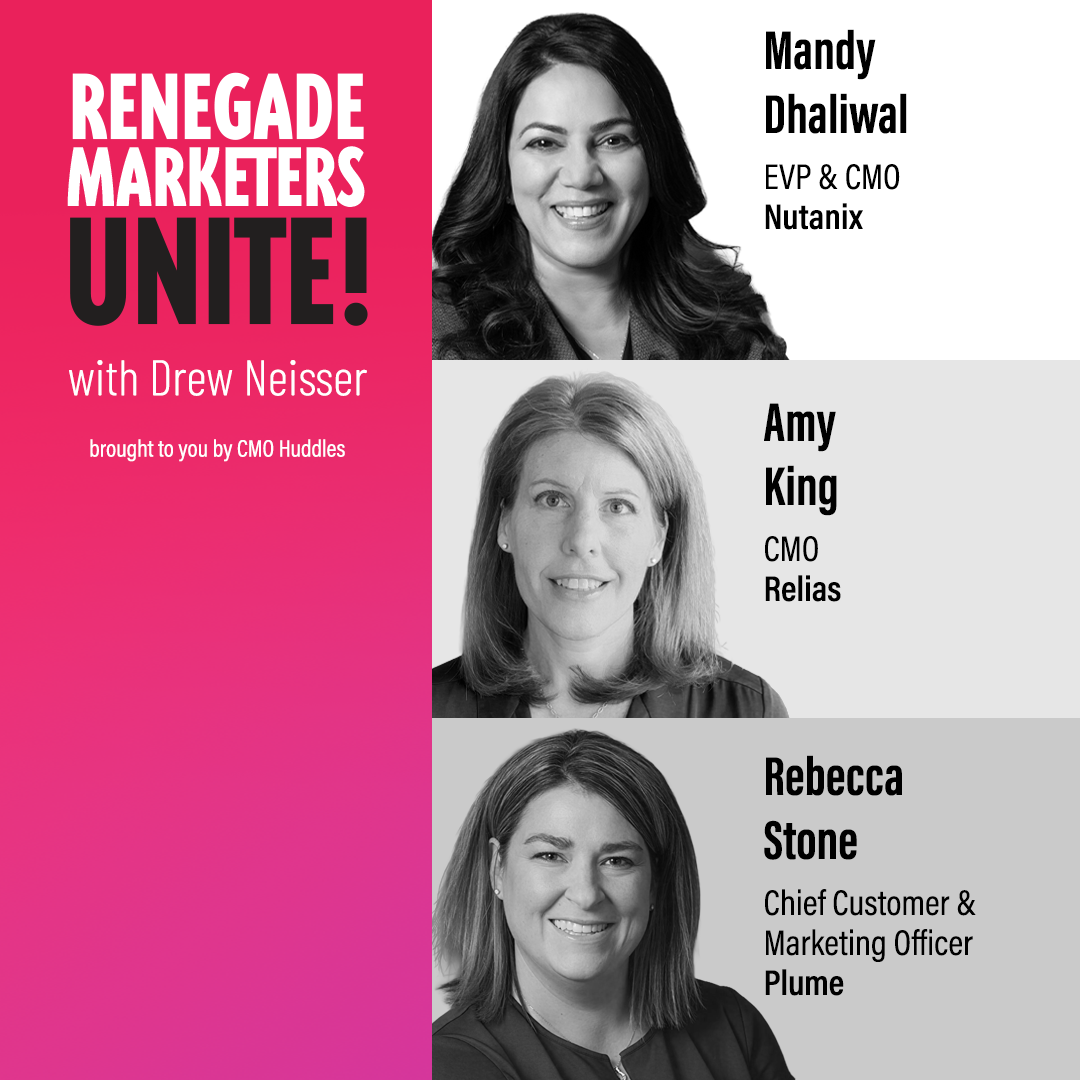
In this episode, Drew talks with Mandy Dhaliwal (Nutanix), Amy King (Relias), and Rebecca Stone (Plume) about how customer and market insight can shape decisions well beyond marketing. They get into ICP, pricing, product strategy, investment, and go-to-market, plus what it takes for a CMO to earn the credibility to influence those conversations in the first place. And if strategy is part of the mandate, they make a strong case that the team underneath the CMO has to be built to help carry it.
In This Episode
- Mandy explains how to spot the market signals worth acting on and turn them into a strategy the business can rally around
- Amy shows how customer data can sharpen ICP, pricing, bundling, and product investment in ways that show up in growth
- Rebecca walks through how customer listening helped reshape Plume’s platform strategy, product roadmap, and go-to-market
Plus
- Why executive sponsorship gives CMOs a closer read on customers
- How CABs, discovery calls, and client care fill in the customer picture
- Where AI can synthesize customer conversations without replacing direct listening
- Why one good customer story can carry weight in the executive room
Tune in to hear how strategy-driving CMOs turn market signals into better business bets and turn those bets into decisions the organization can actually execute.
Renegade Marketers Unite, Episode 546 on YouTube
Resources Mentioned
- CMO Huddles
- Gong
- Past episodes mentioned
- Amy King
- Rebecca Stone
Highlights
- [2:36] Mandy Dhaliwal: Decode market signals & own your position
- [3:43] AI noise demands stronger marketing judgment
- [5:45] Connecting product, sales, and customers
- [8:52] Amy King: Customer insights shape growth decisions
- [11:15] How ICP scoring drives business growth
- [15:02] AI delivers on ICPs, outcomes TBD
- [17:21] Rebecca Stone: One ICP, three teams, zero silos
- [18:54] From feature frenzy to platform strategy
- [23:26] New product strategy shows early results
- [24:53] CMO Huddles: Where connections drive change
- [27:54] Customer conversations fuel CMO strategy
- [35:35] Pricing, pivots, and the CFO
- [40:25] Pick the right CEO
- [43:45] Final words of wisdom: Think, act, invest
Highlighted Quotes
"We're the meat in the sandwich between sales and product. And so you have to go translate that into what's sellable for the market. So we bring that outside-in perspective, but also bring that inside-out perspective and meld the two."— Mandy Dhaliwal, Nutanix
"We're really trying to stop measuring customer insight by how much it improves our marketing, but thinking more about how it drives strategic growth decisions across the business."— Amy King, Relias
"You have to understand all aspects of the business just the same way that any other leader in the organization would, and be able and willing to challenge and debate and have conversations with your peers."— Rebecca Stone, Plume
Full Transcript: Drew Neisser in conversation with Mandy Dhaliwal, Amy King, & Rebecca Stone
Mandy: You have to be very careful and not just live in strategy land. You have to tie it to execution. It's really easy to get caught up in, well, I'm a strategic CMO and I'm going to do strategy. But if you have nothing to show for it, you're out in a year.
Amy: We're really trying ourselves to stop measuring customer insight by how much it improves our marketing, but thinking more about how it drives strategic growth decisions across the business.
Rebecca: Being able to change the dynamic of who we're selling to also changes who the sales team has to sell to, who customer success has to talk to, how the product is being built, how the executives are talking about it.
Drew: Hello, Renegade Marketers! If this is your first time listening, welcome. If you're a regular listener, welcome back. You're about to listen to a recording from CMO Huddles Studio, our live show featuring the flocking awesome B2B marketing leaders of CMO Huddles. In this episode, Mandy Dhaliwal, Amy King, and Rebecca Stone talk about what it takes for CMOs to become true strategy drivers. They get into separating signal from noise, bringing customer and marketing insights into bigger business decisions, and building the credibility to have a voice in what happens next. If you like what you hear, please subscribe to the podcast and leave a review. You'll be supporting our quest to be the number one B2B marketing podcast. All right, let's dive in.
Narrator: Welcome to Renegade Marketers Unite, possibly the best weekly podcast for CMOs and everyone else looking for innovative ways to transform their brand, drive demand, and just plain cut through, proving that B2B does not mean boring to business. Here's your host and chief marketing renegade, Drew Neisser.
Drew: I'm your host, Drew Neisser, live from my home studio in New York City. Every company wants to make smarter strategic decisions, like duh. But the challenge is knowing where those decisions should begin. Marketing sits uniquely at the intersection of customers, competitors, partners, and the market itself, giving CMOs a perspective few executives can match. Customer insight isn't valuable because it's interesting. It's valuable because it changes decisions. So today we're exploring what it means to be a CMO as strategy driver. How exceptional marketing leaders turn what they see in the market into choices that shape the business. Fortunately, we've assembled veteran CMOs who do exactly that. With that, let's bring on Mandy Dhaliwal, CMO of Nutanix, who is joining this show amazingly for the very first time. Hello, Mandy, and welcome.
Mandy: Hi, Drew. Great to be here. Thank you.
Drew: Yeah, I can't believe it's just. I mean, we've known each other so long. So, how are you, and where are you this fine day?
Mandy: I am doing great. Sunny Northern California morning.
Drew: I love it. Well, it's a sunny New York City morning here, afternoon here, so all is good. So let's, let's go big picture on this thing. In a market as complex as cloud infrastructure and AI, how do you turn what marketing sees in the market into strategic choices for the business? Nice, easy question for you to start with.
Mandy: Yeah, yeah. Get that veteran brain roaring here. Yes, you know it. There's, there's a lot of noise, obviously, in the markets that we play in, in B2B tech, and we all sound the same. So it's really distilling the signals from the noise is, is job number one. Understanding what the customer conversations are, where the analysts are playing, how competitors, how partners are positioning, and so that's critically important to be able to understand kind of where to pinpoint, and then also figuring out the gathering holes, like where are these conversations happening, and what's our defensible strategy and position within this market that we're operating in, and how do we uniquely share that point of view within those forums, if you will, events, whatever it is, digital forums to be able to get out there. So distill the story, understand, kind of pinpoint where we're going to play, and figure out how to route that story into the market to drive resonance.
Drew: So, the signal from the noise part really resonates with me right now, and I'm wondering: is AI making this easier, or just giving us more information? And I think it's a fundamental question right now.
Mandy: Yeah, yeah, we, we've all heard the slop story, right? It is more complex, and there's a lot of not so great content out there that the buyers have to sift through. We're showing up differently in LLM search, but right, the referring content has to be accurate, has to be on point. So quality matters more, and frequency also matters. So it's, it's a fundamental shift to how we've marketed in the past.
Drew: Yeah, I mean, I get that part. I'm just thinking about, as we have our GPT out there, we had a huddle today. It was all about listening more and sales enablement, and it was, you know, we have all these Gong calls, and we're using that information to synthesize it and have better battle cards. And I just sort of paused for a moment and wondered, at what point are we really achieving business impact with AI from a signal versus noise standpoint?
Mandy: Yeah, so I'm speaking about signal and noise outside in the market, right? I think on the inbound, if you know what to listen for, and you've got some really sharp marketers that are acutely aware of our business and our value prop, I think we can pinpoint better. So it is a barbell.
Drew: And, and so that, the humans in the loop here, because we're all starting to rely on the AI to synthesize this stuff for us, right? And there is that risk because we're saying, "Oh, AI, you can read all this stuff and synthesize for us." But you would mention humans listening.
Mandy: Absolutely, the sharp humans are looking for pressure points in the data and going deeper and validating before blindly leading with what we're getting from the AI at the surface level, so I think more important now than ever is, is that critical human eye and that judgment that we bring.
Drew: Music to my ears, humanity. Man, we're, we're, we're gonna think our way through this. So I'm curious, as you sort of, what marketing is bringing to the strategy table when you're, like, moving into new and emerging areas.
Mandy: Yeah, we're right in there in the mix with the technical teams, with the builders, the engineering and product teams, really trying to understand what the signals are that they saw and the product strategy that we're driving towards. So we have to come to the table with an understanding of that. We're the meat in the sandwich, if you will, between sales and product, and so you also have to go translate that into what's sellable for the market. So we bring that outside-in perspective, but also bring that inside-out perspective and meld the two to make sure that we preserve the integrity of the technology that we're building, but also route it into a market where there's resonance with the customer need.
Drew: Yeah. And in an ideal world, you're sort of baking the marketing idea or thing into whatever next iteration of a product, and that's supposed to be the job of the product marketer. I am curious, CMO can't do everything.
Mandy: No.
Drew: Do you have someone on your team that sort of is thinking strategically this way? Is, you know, where does that sit?
Mandy: So there's a core team of us that, that partner. So my senior leadership team, right? We call them the MLT, super creative, right? Leadership team. And so that forum is where a lot of these conversations happen because we bring our respective functional knowledge to make sure that we can, a, build the right strategy and also execute on it. But really, if you were to break it down to answer your question more precisely, it's the product and solutions marketing leads in addition to the go-to-market strategy folks that I've got. So office of the CMO and PSM are the other two groups that play in that.
Drew: PSM, product and solutions marketing, and just to make sure that we've provided some concrete guidance, what makes a team like that, when you're, you know, they're working well, win? What happens?
Mandy: They self-organize and they bring me stuff, and we have really compelling conversations. And we have to, again, pull in some of my peers, right? So if we're bringing in our head of product management, if we're bringing in our sales leaders appropriately, depending on what we're building, all of a sudden it's a great unifying force across the business, and that's when we know we've, we've got something that will resonate, and also the customer voice, right? I'm relieving that out, but that, that goes without saying. It's always customer first.
Drew: Right? And that has been the secret to CMO success forever. Is the better you know the customer, the more likely your seat at the table is that much more valuable. All right, well, I have lots more to explore with you, but let's, let's bring on Amy King, CMO of Relias. Hello, Amy. Amy is an industry expert who has graced our stage before to discuss growing high-performing teams. Hello, Amy. Wonderful to see you again.
Amy: Hi, Drew. It's great to be here.
Drew: So, how are you, and where are you this fine day?
Amy: Doing great in slightly steamy North Carolina today, but it's a beautiful day and enjoying some warm temps.
Drew: Yeah. So let's talk a little bit about strategy. And so Relias has evolved its portfolio and go-to-market approach. How do you use customer insight to shape growth strategy? And, you know, I guess not just sharpen messaging.
Amy: Yeah, I love talking about marketers as growth leaders. We've really taken a lot of rich customer data, which we had to build a foundation to collect. And instead of just using it for marketing, you know, better messaging or campaigns or personas, we've been focused on using it much earlier in the decision chain to drive our product strategy and our outcomes. So, for example, I have a few examples. One is our ICP framework. We focused a lot on ideal customer profile, moving beyond kind of traditional demographics and into questions like which customers have built our highest retention rates, where's the strongest expansion potential, the best unit economics, and these insights have then been put into sales coverage models, investment decisions, market prioritization, not just our traditional campaign targeting. We took a similar approach with pricing, rather than just asking customers what kind of messaging would justify a higher price. We're much more focused on willingness to pay research early in product development, looking at packaging and validation for different kinds of bundles, value perception across our segments. All that work is ultimately shaped not only our pricing architecture, but our bundle strategy and future monetization models for our portfolio. And I think the last thing that I'd say, where customer insight has really been a key strategy driver, has been when we're evaluating which products to build in the first place. So really working with product early on, on what customer problem are we solving, and is it important enough to change behavior and drive adoption? So, I think what I just mostly say there is we're really trying ourselves to stop measuring customer insight by how much it improves our marketing, but thinking more about how it drives strategic growth decisions across the business.
Drew: Right. So for me to try to summarize that, we're finding insights that impact the business. So that's whether it's pricing or product or even who we target. And I just want to, I want to break those down a little bit. ICP is something that everybody talks about in terms of sort of demographics and firmographics, but I, it always feels a little vague to me relative to that other human sitting across the desk or, or the Zoom call. So, what kinds of, you know, insights or things are you able to sort of deliver that you couldn't deliver before in this area of ICP?
Amy: Yeah. So we've had, you know, probably the most challenging was developing the scoring framework itself. So looking at, you know, how much is CAC going to matter versus renewal rate versus, and so we've really taken a lot of time to gather the data that we need to break it down by the various areas that we feel like are really driving value within the business and then applying those across. We have about 28 customer segments that we serve, so then scoring them across all of these, and, and then seeing where the value really comes out. It's been a really great exercise. Both it's required us to tighten up some of our data across a variety of metrics within Salesforce, largely. Then also make sure that as we're doing the scoring, that that really then plays out in terms of business outcomes, so obviously the focus here is not only on product development, but then also on our all of our sales. It influences everything from territorying to how we do sales plays to how we enable teams. So it's been a pretty broad ranged effort, but I think getting that scoring right for your organization is probably the trickiest part.
Drew: Whatever initiative that we're talking about moving forward, whether it's AI powered or not, obviously we all need better data, and better data will deliver a lot of good things. But if the, the source data is bad, which often is the case in Salesforce, I constantly hear that, and, you know, data hygiene is a thing. I, I got the part, so I think we've tightened up the ICP. And are you far enough along where you've actually validated that the scoring system is, in fact, where someone is a high score, their propensity to buy or upsell or cross-sell, whatever, has in fact proved to be true?
Amy: Yes, especially, I'd say, for the top three, I think those have been very well validated. We've actually used some external resources to help support us in that validation, so that's come out pretty clearly. I think then where the challenge remains is how do we stack rank the rest, and then what, you know, where are the lines that we draw between how much resourcing we give to beyond that top three, and what does that need to look like? How do we, we can't serve everybody the same? So how do we then determine where we continue to draw those lines? But the top three have definitely shown in things like win rate improvement, pipeline growth, then also obviously on the product side as well. So when we're figuring out which products would be, you know, and features are bubbling to the top of the roadmap. How well do they fit those segments? It's made it much better on the willingness to pay and customer validation side to have that kind of focus, because then we can really call on and reach out to customers in those segments, and we know when we're getting really good feedback that we're on the right track.
Drew: Yeah, fascinating. And I think if you were a holy grail moment as a CMO, and you can walk into your CEO's office and say, "Yeah, we improve the win rate with this process," that's got to be music to the ears. That, that is not a "Oh, by the way, we rebrand. And we have some new messaging out there." This is material impact on the business.
Amy: Yes, and that is the goal, especially when we're looking at things like the bundles. We've done really well with the bundle strategy, pricing strategy, looking at high and low ends of those segments. It's really paid off for us in terms of a lot of the efforts that we've done around increasing revenue, but then also, again, with focusing product efforts on areas where we know we're going to see more of a propensity to buy.
Drew: And before I let you go on this particular thing, what role, if any, is AI playing in either one, helping you refine the scoring mechanism or scoring faster so that you can then say, okay, they're top three. Go get them, and, and giving alerts or other things like that.
Amy: That's a great question. I think so far a lot of the ways that we've used AI in this is as we've identified our core ICPs, it then does help us with the marketing part. So when it's campaign automation, content generation, sales enablement materials, using AI for all of those is, it's very much helped to focus the AI models on the specific audiences that we're going after. I also, though, do think that it's going to have a material benefit for us as we continue to measure the outcome of a lot of the pricing strategies, the bundle strategies, and those things. So I think jury's a little bit out on how AI is still going to help us from a business perspective in proving out the effectiveness of not only the scoring but also the outcomes. So I'll have to get back to you on that.
Drew: All right. Well, we'll do another show on that in six months. That'll be perfect. All right. With that, well, let's welcome Rebecca Stone, CMO of Plume, who has previously joined us on this show, discussing many topics, including CEO-CMO alignment, customer advocacy, and sales enablement. Hello, Rebecca. Welcome back.
Rebecca: Hi, Drew. It's great to see you.
Drew: It's so great to see you. Oh my God, it's been a little too long, my friend. But how are you, and where are you?
Rebecca: I am doing great. I'm actually sitting in a hotel room on Long Beach Island in New Jersey. I am supposed to be on vacation today, but I am here with you for an hour before I head to the beach. So you caught me before I got to the beach. So,
Drew: By the way, it's a perfect set. It looks great, and I don't know if you mind sharing, but way back in the early days of CMO Huddles, when you were at home, you were not necessarily in such a nice place.
Rebecca: No, I was not. For those of you who have, who have joined a few of these, I was in my laundry room on an ironing board for six months early in the pandemic, so yeah, I've, I've definitely upgraded from then.
Drew: Yes, that's, that's funny. Well, fond memories of that, and here we are. You heard the conversations with Amy and with Mandy. I'm curious what you heard that resonated with you.
Rebecca: Yeah, I mean, I think the idea of infusing customer data into all parts of the business is one of those things that I have been advocating for for a very long time. Making sure that we are aligning what the product is doing, how sales is, who sales is selling to, and who marketing is marketing to, as like a, a cohesive, you know, triad, all tied to an ideal customer profile that is built on firm demographic data is probably one of the most important things that you can do from a strategy perspective. Because if you're building products that the customer doesn't want, then it becomes very, very hard for the go-to-market teams to sell those things. You know, and, and vice versa. If the product team and the marketing team are aligned on who the ideal customer profile is, but sales has gone off and, and is just trying to sell whatever they can to whomever they can, it equally becomes very, very complicated. So I think all of those things aligning is probably one of the most powerful things that you can do from a, from a strategy perspective. I also think that what Mandy said about the importance of tying your messaging and tying that to how your, the rest of your organization speaks is, is obviously a key component of what any core marketing can, can and should be doing.
Drew: So, well, I'm curious. You've been at Plume less than a year. It's
Rebecca: Been about six months.
Drew: You know, again, thinking about shaping your go-to-market strategy, I'm just curious. You know, what you've been able to do in six months, and, you know, in this strategic, you know, drivers world, if you will.
Rebecca: Yeah, I think that there's been a number of things. One, when I joined, Plume was selling a series of features that really were part of a broader platform story. So, and, and this is something that I did when, when I joined Meraki too. Was, I think it's a trap that most startups fall into, is they start with one product or, or one thing that they are selling, and then they just start tacking on the additional things and, and selling each of them individually rather than talking about the benefit of having all of those, of those components together. So we worked very closely with the product team to reshape the messaging around the product. I was in an offsite with our executive team the month before I started officially at Plume, and we were, we were all together in Arizona, and we started to talk about, hey, here's all the list of things that we're selling. And I said we should be selling it as one platform that is solving a challenge for ISPs. We sell to communications providers who are providing broadband to individuals like you or me at, at home. And those tools were solving individual problems for Wi-Fi, for security, for, to make sure that children have the right levels of access to things, and each of those things was being sold individually. When you combine it all together and say, no, we actually solve a whole host of challenges that a consumer has and struggles with against a buying cycle with an ISP, and we solve, we help to solve the challenges of communicating with them around that. It becomes a much more powerful story that elevates from an individual product leader within one of those companies to the, the C-suite at those companies. And so, being able to change the dynamic of who we're selling to then also changes who the sales team has to sell to, who customer success has to talk to, how the product is being built, how the executives are talking about it, and so that strategy change is, is has been really helping to shape the, the rest of the organization.
Drew: And that's fascinating, and I could see, absolutely see this happening, and I've seen it happen a number of times where it's feature, feature, feature, and then suddenly, someone wakes up and goes, "Wait, we need to be thinking a little higher here." In theory, there was data that backed up that, in fact, your target ISPs, as in internet service providers, were eager to have this bundle combination of features for a
Rebecca: Part of, part of what was happening was we went to a bunch of trade shows, we went to a bunch of customer QBRs, and you hear, you just listen to customers. They almost tell you the answer sometimes. It becomes so obvious once you, once you really listen to customers, and, and I think that that's, that is that customer centricity is such a key to, to business strategy, in my opinion, and really helping to shape, based on what we heard, what the needs are for those customers, and, and how we address them. It also is shaped.
Drew: Wait, I just have to, I have to say this. The quote of the day: "It becomes so obvious if you just listen to your customers." Thank you for saying that.
Rebecca: It really does. I mean, the other thing that you have to think about, another dynamic that you feed into it, is what are your competitors saying? You listen to your customers, you listen to what your competitors are saying, and where is the gap, you know, between those two things. That helps you to really position, you know, based on the needs of what your customers are asking for and, and what makes you unique in, in the industry.
Drew: So it feels like in that case, if we sort of go back to this overall theme about marketing as business driver, by doing that, you changed the go-to-market for the business in the last six months.
Rebecca: I mean, we changed the go-to-market, but we also changed the product strategy. The, the product strategy completely transformed to be much more driven towards, towards a platform strategy that meant overhauling how our product was being built. So it changed how engineering was thinking about it. It changed how the product was being developed, and which features we actually deprecated some features and, and prioritized some net new features based on, based on those changes. And then, yes, we, we changed who our target customer was, and then how, obviously, our messaging, the marketing message, sort of followed all of that change to address the, the marketing need and, and to tell the story of what that strategy was now going to be.
Drew: And is it too early to see the business impact?
Rebecca: I think that the business impact is clearly happening. The sales that we are making, the, we're in early beta testing with our first two customers of the new sort of product vision, and Operator Suite is, is what we're calling it. Those things are getting incredibly positive feedback from existing customers. They're obviously in beta. They're not really ready for public consumption yet. We are actively talking to our customers and getting the right answers from them in terms of, of what we're hearing. So,
Drew: I love it. And just in case there are any CEOs listening to this, I just want to make sure that you never use the term "Oh, they're just the marketer" again, because these three power leaders are transforming their business, they are not just doing marketing. So I wanted to get that on the record there. Okay, so now it is time for me to talk about CMO Huddles. CMO Huddles was launched in 2020. It is the only community of flocking awesome B2B marketing leaders. And that has a logo featuring penguins. Wait, what? Yes. Well, this group of curious, adaptable, and problem-solving birds is called a huddle. CMO Huddles, huddles, penguins. Get it? Okay. And the leaders in CMO Huddles are all that and more, huddling together to conquer what might be the coldest job in the C-suite. So, Mandy, Amy, Rebecca, you're all incredibly busy marketing leaders. I wonder if you could share a specific example of how CMO Huddles has helped you. And maybe I'll start with Amy because I just saw you in a huddle today.
Amy: The huddles are a great example. I think there are so many ways that CMO Huddles allows busy CMOs to interact with the group, whether that's through Slack, whether that's through a huddle, whether that's through engagements like this, and I have so much valued the perspectives of the CMOs that I work with pretty much in every interaction. Actually, what Rebecca was just saying, our company has expanded really from a point solution to more of a portfolio one. I very much resonated with what she was saying, and, and I'm already taking notes on my own guest appearance here.
Drew: So, so it's happening in real time, right?
Amy: Exactly. I love it.
Drew: All right. Well, thank you. We so value your, you being part of the community. Okay, Mandy.
Mandy: Yeah, it's honestly, it's the inspiration, Drew. Like, listening to Amy and Rebecca even now, it's just, it's phenomenal. I always learn something new, and there's this feeling of catharsis that we're not alone. I have to say that as well, knowing that we're all in it together. Because you're right; it is, it can be isolating in the, in an organization because you are just the marketer, and being able to speak up and have validation on, well, other CMOs have said this or experienced this. That really adds to our gravitas in the boardroom and in the C-suite. So lots of pluses.
Drew: Thank you for, for sharing that, Rebecca. You're, you know, an OG in the, in this CMO Huddles thing, and I'm curious if, if there's anything of late that has been a value.
Rebecca: Yeah, I mean, I think, I think I would add to and echo just what Amy and Mandy said, and also, Mandy did not call out, but we actually had a, and a real-life work problem that we had to work out that we were able to connect because of CMO, CMO Huddles a little bit more closely because we knew each other through, through the group, and that I think has been one of the things that, that I think the, the two women before me has not quite mentioned as, as much is just the, I have made some genuine real friends from, from some of the, the contacts that I have made at CMO Huddles, and I've, and people who have helped me, introduce me to, get potential roles, who have helped me connecting in, you know, like I said, in real-life work challenges that, that we were trying to work through together, and just the information that is shared is, is, is an ongoing gift that you have given us, Drew.
Drew: Oh, well, we're so grateful that, that you're participating. You're part of the community. If you're a B2B marketing leader who wants to build a stronger peer network, gain recognition as a thought leader, make some powerful friends who can help really, you know, change the way your business is running, and get your very own stress penguin, because everybody needs one of those. Please join us at cmohuddles.com. I have to admit, I love that part of the show. Thank you for those kind, kind things. I'm very, very appreciative of that. So, what does the CMO understand about customers or the market that other executives may not see as clearly? It's a tricky question, but I'm curious what you are seeing.
Mandy: Yeah, I think before we dive in, as you were talking, Drew, the word "huddle hood" came to mind. Just, just putting it out there, given that we're a group of marketers.
Drew: Yes, there's a, there might be, there, there for you.
Mandy: Okay, thank you. I'll leave that aside. I think, you know, we have a unique vantage point in an organization, right? We're out there interacting with customers when we're at industry events. You know, you just have to be in a booth and listen or walk through partner conversations, etc. But all of those patterns and all that data gives us unique insight. And I think sharing that, I also am fortunate. I get to be the exec sponsor of some of our key accounts as well, and that's been really important for me as I really deeply understand the customer. So I think that makes me a better marketer because I understand from their vantage point, again, and where their challenges are, and then you bring the pattern recognition together. So all of those data points, and then when you're, you're just sharper when you're interacting with your sales teams and with your product teams. So all in all, it's, you know, you can share the stories first and foremost, kind of the real live human stories, because as humans, right? Again, not, not agents. We have that ability to connect viscerally on the story front, so all of those things are additive, and it's more just the sponging, if you will, of the data.
Drew: I'm so glad you mentioned executive sponsor program. It's one of those things, I wrote about it in, in my book. Included it to be a customer-centric CMO. You really, that is such, huge blessing. Is there anything about the, the executive sponsor program that you're doing that has been particularly helpful? I mean, some, like, are you literally responsible for accounts that you're the sort of, I, you know, I hate the term "neck to choke" in, in the event of an issue, but is that the way it's structured?
Mandy: Yeah, I get, I get the "phone a friend," right, the text from our key stakeholders at these accounts that have been longtime customers, also the ability to pull these customers into events that we're doing, like our annual user conference. I can make a phone call, not have to wait for an introduction from a rep, and just say, "Hey, would you like to join our CEO on stage and tell your story?" I'm just more plugged in. Yeah. So that, you know, is a massive benefit, and also understanding what they really want out of the relationship. Sometimes the, you know, the salespeople aren't listening for that. I think that's the intrinsic value of being able to have those relationships, and it makes my job even more fun. I have to say it.
Drew: Well, it's interesting because we started the show really focusing in on data and the quality of the data, making sure your Salesforce instances are so. But what we're sort of getting back to is the power of qualitative and, you know, anecdote, and nothing like a good anecdote to, to sell something. And I have said this many times on the show, but I love saying, and I will repeat it: the most powerful thing a CMO can ever say is, "I was talking to a customer the other day," and then, you know, continue, because all heads will go, "Whoa, okay, let's talk." So it is interesting that even though we started with data, it comes down to that anecdote. And I'm curious, Rebecca or Amy, if you have any sort of qualitative input from customers that you find particularly valuable.
Amy: Our customer advisory boards are key. We have CABs across our verticals, and those members and what they're able to help us figure out is critically important. And then I think on the, you know, product side, we do a lot of customer discovery, and so I think those calls are also extremely important. Where we're talking with customers about how would you, would you like this? How would you use it? Where do you get it? Otherwise, all of those kinds of exploratory product discovery and willingness to pay help a lot. And then I think, lastly, you know, I think, not to, it's always super important that we're listening in on not just the sales calls, but all of our client care. So on the customer success side, whether that's things around renewal, but more on the product expansion, how our customers are feeling about current use, and making sure that we're just as plugged in on how our current customers are feeling as the growth opportunities as well.
Drew: So I'm thinking about all this, Rebecca, and it's making me sweat a little bit because I'm just thinking about, there's all these data sources and all this qual, and, you know, you could listen to customer calls and you could listen to customer success calls and you could be, you know, how do you make sure that you're spending enough time on that and still getting your, you know, from a time management standpoint it becomes, we know that customers are the source of all good information, how do you manage that?
Rebecca: I think, honestly, I love talking to the, and I, I bet Mandy and Amy would say this so much. Like, the talking to the customers is my most favorite part of the job. So it comes very easily to me to find the time to fit it in. I think not just the talking to customers, but talking to customers from different, different verticals, from different parts of the world, the, the experience is so different depending on size of customer, on, on where that customer is located, that it becomes the most important thing. It, it really does drive the entire rest of the strategy that, that I start to think about, and so I, I think I would be lost if I didn't prioritize that. To be quite honest with you, I think it becomes a matter of how do I fit in the rest of the stuff on top of the talking to customers rather than vice versa.
Drew: Yeah, I mean, I remember many years ago interviewing Beth Comstock when she was CMO at GE. She talked about spending 25% of her time out of the office with customers. I thought that was a big amount of time, and, you know, she had a great run there. So I thought that was an interesting and perhaps a correlation. I also, while you're saying that, can't help but wonder if we're gonna, because AI can do all this synthesizing, that we're gonna sort of rely on that a little bit to squeeze, just take some time off the table that you might have been actually,
Rebecca: Yeah, we, we are about to, I don't know if I'm allowed to say, but a customer recording tool, I'll, I'll say that, notifications recording tool that uses AI to synthesize a lot of the themes that are talked about across our customer conversations, our, you know, it combines email, Slack messages, and phone calls that our sales and CS teams are having. It's a tool that I have used in every other organization that I've worked in. Everybody would know the name, but yes,
Drew: I'm, I'm thinking about ringing a bell right now.
Rebecca: Exactly, that's exactly, yeah.
Speaker 1: Yeah, yeah.
Rebecca: And, and so, I mean, that becomes an incredible part because you do have the recordings that you can listen to, any call that you want to, but you also have the summaries that you are able to, to review, so that you kind of combine, to your point, the anecdotal and, and the quantitative components because you're, because you're able to use those tools to, to do things like that.
Drew: Yeah, I absolutely, I mean, there's no doubt. We talked about this in our sales enablement huddle today. I mean, having tools like Gong, which are listening across things and synthesizing and gathering this information to help you stay up on what customers are saying, what they're saying about competitors, and creating, you know, using that instead of, is, is just a critical part of, of what we're doing. So no, no doubt. I'm just, again, I'm just sort of so interested in the time management aspect of this because you have no shortage of things to do on your plate. And the whole point of this conversation is about the big stuff, right? The big impact that you can have. So I'm curious. Maybe we would talk about now about maybe overlooked areas where you think CMOs have an opportunity to influence company strategy, and, and as you think about other CMOs and what they might be thinking about doing. Go for it, Mandy.
Mandy: I have a slightly different take on this. I think overlooked areas, not so much, but it's where you apply your focus when. For example, we're, we're in planning season right now because our fiscal starts August 1, right? We're at the tail end of it. We're basically vending dollars now for, for plays to be developed. But I think your mode changes based on the quarter and the thematics of where you are in the fiscal year and the business. So I think you have to have that toolkit on the ready to be able to be agile. And so, you know, you need discipline across every functional area and also, you know, great relationships across the organization. So if a business problem comes up or an industry dynamic, i.e., AI, where things are shifting so rapidly, if you're not able to front-foot pivot, there's a problem. I think it's the readiness piece of it.
Drew: Amy, do we see any sort of overlooked areas?
Amy: I think for me, you know, we, we talk as marketers a lot about working really closely with our revenue partners and our product partners, and often we see each other as, like, three legs of a stool. I think sometimes what gets overlooked in there is our relationship with the CFO and the finance side of the business, not just being marketing as the cost center, but marketing as the strategy driver, right? And I talked a little bit earlier about pricing. I think pricing is a huge area where we have a lot of ability to drive big strategic decisions. I think product opportunity sizing and market sizing, I think, are also big areas. And then I think customer segmentation and how that works from a financial perspective are all areas where we have a lot to offer and should probably have sometimes a stronger voice at that table than we sometimes do.
Drew: Well, I know that if you ask a CFO and a CEO and a board, they want the CMO to be a business person first and a marketer second. And what you just described, I guess the question would be: if I was the CEO, where from, where does your credibility come when it comes to being able to provide input on pricing and segmentation, for example, and, and I'm sure you can, but just where's that?
Amy: Yeah,
Drew: Where's it come from?
Amy: For us, it means having a very strong market intelligence department. So we have to make sure that we are working internally and externally on making sure we know our market sizing, our segmentation, being really great about TAM, SAM, and keeping all of those things updated. We also have to have good pricing staff. I'm lucky to have some amazing pricing people on the team who are real experts in that. And then we need to be able to do the analysis to demonstrate that various changes will both be accepted by the customer and move the needle. So we need buy-in from our executive leaders, and we need close relationships with those leaders across the business. So it's both the intelligence and the analysis that you're getting from market and customer, but then also the relationships that you have with your colleagues to really help demonstrate that the insights that you're bringing are going to move the needle and that they can trust in that.
Drew: Well, it's just so, again, it's so interesting. I mean, I remember asking a CMO who had partnerships and, and marketing, and which the CEO would want to talk to them about. It was always partnership. Now, if you have pricing underneath you and you have pricing experts, I imagine that a CFO would be very happy to have a conversation with you because, in theory, that's going to drive both margin and adoption. If you price it too aggressively, you may lose some deals. But I don't know that it's typical. I mean, Rebecca, Mandy, do you have any pricing people on your team?
Rebecca: I, yeah, we're working on pricing right now. We, we're working with the, the CFO's team on, on pricing. So that is definitely one of the things. And, and I think it depends on size of company. It's not something that we were heavily involved in when I was at CSO because we had a whole pricing team that was really focused on that. But now that I'm in a smaller company, it is something that the, the product and, and solutions team have, have picked up and need to help drive, quite honestly, because we do have the market intelligence that Amy was talking about. So,
Drew: And, and you would know, just like the head of sales would know, you lost because of a pricing thing, right? You would know that information if you're somehow or other your pricing isn't right. So fascinating, and, and again, this comes back to this is a call with three CMOs, and we just moved from data into pricing because these things matter. And, you know, we've spent a lot of time talking about customers. I'm curious if, you know, and maybe this is first 90 days, but how do you sort of set yourself up as a CMO to be perceived as a strategy driver, to have that seat at the table. In theory, you always get a seat at the table, but to build that credibility that you can advise on things other than the marketing thing. And I'm just curious that because there's got to be some walls typically when you run into it.
Mandy: I think it starts before your first 90 days. You have to suss that out during the interview process. Are they coming in to have you go run comms or demand gen, or do they really want you to bring your experience to bear? Because I'm guessing, you know, on the screen we've got, you know, decades of experience, and so that's something that you have to think through as you're accepting the role. And you should not be selling within your first 90 days. You should be listening and activating, and have a hypothesis that you're testing.
Drew: Right. I mean, I think there's always, you still have to prove yourself to somebody. You have to build a relationship. But if you don't have permission, if you will, an agreement with the CEO that your mandate is broader than just, you know, fix the campaign or the messaging,
Mandy: Exactly, exactly. Pressure test that hard. Yes, my advice.
Drew: So yeah, once again, when it comes down to it, is, did you pick the right CEO that you can partner with as a strategy person? And it's funny, and I'm imagining that the best jobs that you've had have been with a CEO who sees you as a strategic driver.
Amy: Yeah, of the
Rebecca: Not only sees you as a strategic driver, but puts you directly in the middle of the strategic conversations and backs you and supports you in those conversations to ensure that everybody else sees you as a strategic driver as well.
Drew: Interesting. Amy, do you want to jump on that?
Amy: 100%. I'm very lucky to have a CEO that, from the beginning, was clear that he had a lot of trust in me and a lot of responsibility on my end to be a strategic driver, as he does with all of our executive team. And he has us spend a lot of time together and make sure that we are investing in our relationships with each other. And his expectation is then that that pays off through all of us working on strategy together, with everyone having a strong voice. So I think that dynamic can be hard to create, and it's one thing that's kept me here at Relias for five years, and hopefully another five.
Drew: I love it. Okay, so just to recap, it's so fascinating. We talked about, with three CMOs who have become or were hired to be strategic drivers, they did the groundwork, so they got a CEO, so they had permission, if you will, to take on some of the business's bigger challenges. We then sort of moved into this area of customer, customer data. We talked about the quantification of that and making sure your Salesforce instance, and being able to mine that. We talked about being able to mine Gong and equivalent listening calls, and then we talked about the power of customer stories and anecdotes as giving you the ultimate insight that you can use to persuade your peers to move something forward. And then we sort of moved into these other areas of pricing and so forth. So the bottom line for, for, for CMOs who want to be strategic drivers is you kind of need to know that if this is part of the job and your mandate, you've got to know where to start and how to do this. And I hope by listening to this call, you got some sense of that. Anyway, let's go with a final takeaway for CMOs looking to become stronger strategy drivers for the business. You know, one or two key tips. Rebecca, maybe you could start with that.
Rebecca: Yeah, I think one of the things that we did not mention, Drew, is we talked about customer centricity, understanding the needs and depth of understanding of what the customer is asking for. You need to equally understand that from the product side. You are working at a, in a B2B company. It is tech focused. You need to have an understanding of the technology, and not just the technology at a surface level, but how does the technology work? What are the best ways that the engineering team puts together? And so that's the thing that I would add on to everything that we've already said: is you have to understand all aspects of the business, just the same way that any other leader in the organization would, and be able and willing to challenge and debate and, and have conversations with your peers about what they are doing and the strategy, and be able to back that up with data that you have that is unique to your marketing team.
Drew: Yeah, I love it. Okay, Mandy. A final takeaway for CMOs looking to become stronger strategy drivers.
Mandy: Yeah, I think you have to be very careful and not just live in strategy land. You have to tie it to execution. So the thing, another thing, thank you, Rebecca, for the inspiration, that we haven't talked about is how to choose the folks on your team, your contributors that are going to help drive this with you, and what does good look like, and how do we shape this? Because these are transformations, and, you know, it's really easy to get caught up in, well, I'm a strategic CMO, and I'm going to do strategy. But if you have nothing to show for it, you're out in a year. So, like, let's brass tacks. Like, make sure once you align and have all those hard conversations, you have a mechanism and a blueprint to be able to take a narrative, take a strategy, test quickly, iterate, and be able to go run an organization that can put this into the market quickly. It's not for the faint of heart.
Drew: Yeah. No. And I love that, and thank you for bringing it back to the team because, you know, in my mind, I brought up this issue of, of time management and where you spend the time, but if you want to have a seat at the table in pricing and be able to do that, having someone on your team who spends a lot of time, so your priorities are defined by the direct reports that you have.
Mandy: Absolutely.
Drew: And so, if you have a pricing or if you have a strategy person that is dedicated to that, you will be prepared. So thank you for that. And Amy, bring it home. Final takeaway.
Amy: I think my final takeaway is when it comes to growth, it is about investment and really thinking about how is your marketing team helping provide the information, the insights, the things that are needed to help the business make better investments. So we all like creating strategic narratives and storytelling, and all the things that marketers went into marketing to do. I think it's also really important that as your organization grows, you think a lot about how are you feeding the investment decisions of the business, and where can, what information does your team have that could better inform those in ways that will be valued across your executive suite.
Drew: Yeah, so much gold dust in that statement. Thank you for that, about thinking about marketing and the things that you do as an investment that will pay off in the business. All right. Well, thank you, Mandy, Amy, Rebecca. You're all amazing marketers and great sports to go with this rambling interviewer. Thank you, audience, for staying with us.
To hear more conversations like this one and submit your questions while we're live, join us on the next CMO Huddle Studio. We stream to my LinkedIn profile. That's Drew Neisser, every other week.
Show Credits
Renegade Marketers Unite is written and directed by Drew Neisser. Hey, that's me! This show is produced by Melissa Caffrey, Laura Parkyn, and Ishar Cuevas. The music is by the amazing Burns Twins and the intro Voice Over is Linda Cornelius. To find the transcripts of all episodes, suggest future guests, or learn more about B2B branding, CMO Huddles, or my CMO coaching service, check out renegade.com. I'm your host, Drew Neisser. And until next time, keep those Renegade thinking caps on and strong!