Differentiate or Die: Winning in a Sea of Sameness
If your brand sounds like everyone else’s, you’re not competing. You’re interchangeable.
Claims like “customer-centric,” “trusted partner,” and “AI-powered” don’t do much when buyers hear them everywhere. True differentiation is bold, precise, and hard to confuse with the rest of the category.
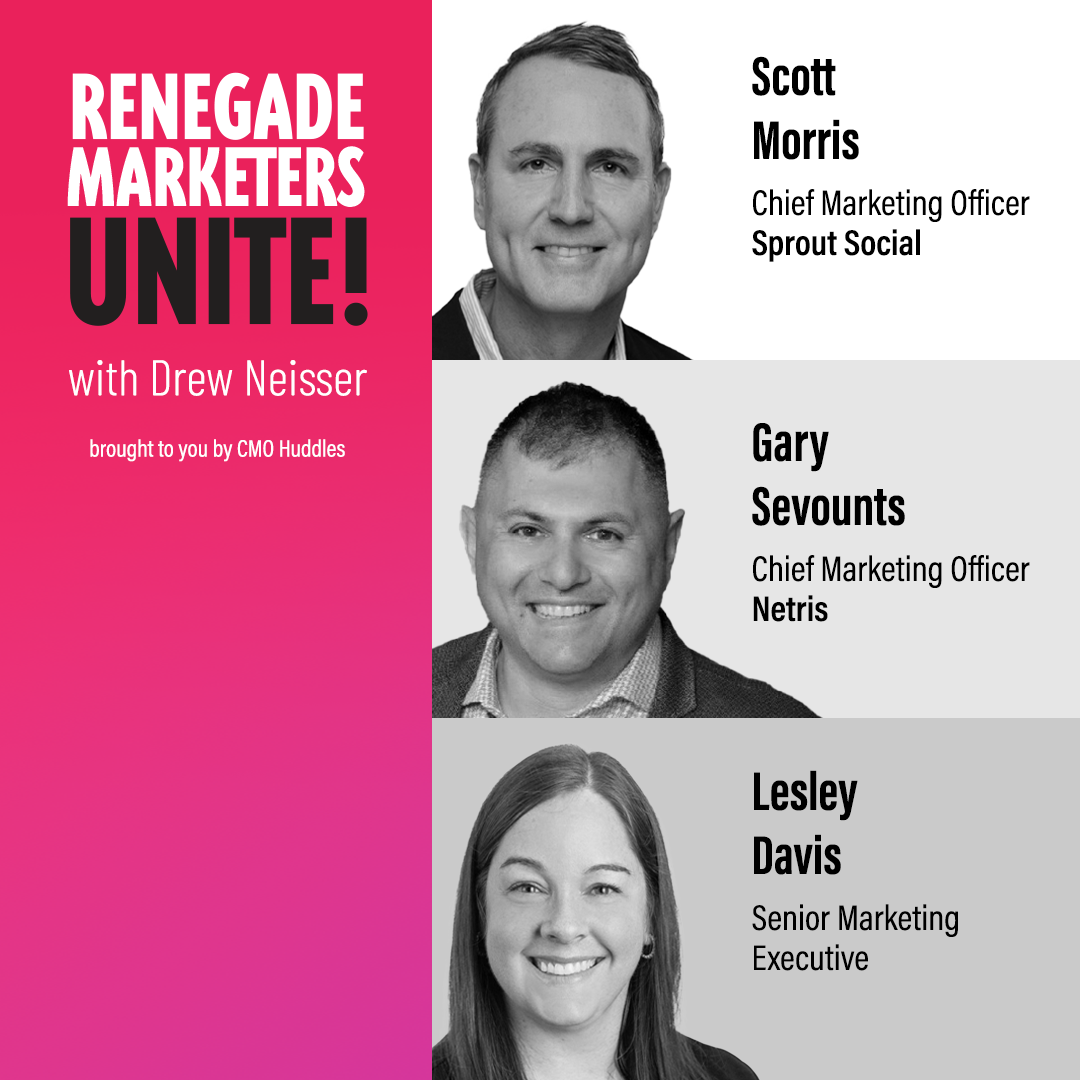
In this episode, Drew Neisser brings together Scott Morris (Sprout Social), Gary Sevounts (Netris), and Lesley Davis to explore what real differentiation requires in B2B. They get into how companies clarify their story, align internally, and carry that differentiation from product to pitch to customer experience.
In this episode:
- Scott explains why strong positioning only works when the product actually delivers on the promise, and how Sprout is building its brand around “social intelligence for breakthrough brands”
- Gary shares how a shift from selling “just another fraud tool” to an “identity trust network” transformed growth, increased deal size, and helped drive a major acquisition
- Lesley breaks down how differentiation shows up in a services business, especially in RFP-driven categories, where the real win comes from understanding the problem behind the problem
Plus:
- Why pipeline without differentiation leads to smaller deals
- How strong positioning starts with customer frustrations
- The difference between bold positioning and empty promises
- Why differentiation only works when the whole company reinforces it
If you're a B2B CMO trying to differentiate your business and make your brand impossible to ignore, this one’s worth your time!
Renegade Marketers Unite, Episode 515 on YouTube
Resources Mentioned
- CMO Huddles
- CMO Huddles Strategy Labs
- Past episodes mentioned
- Scott Morris
- Gary Sevounts
- Lesley Davis
Highlights
- [3:01] Scott Morris: In SaaS, product is positioning
- [6:07] Social intelligence drives strategy
- [7:43] Social listening into product roadmap
- [11:20] Gary Sevounts: Repositioning to an identity trust network
- [15:35] Growth stalls without differentiation
- [16:22] Pipeline funds differentiation
- [19:15] Lesley Davis: Differentiation that survives an RFP
- [21:35] Sell the problem behind the scope
- [24:03] Align the whole company on differentiation
- [27:56] CMO Huddles: Perspectives that change your playbook
- [32:10] Bold differentiation, not risky positioning
- [34:58] Build a differentiation north star
- [43:23] AI-powered differentiation radar
- [46:18] Final words for CMOs on differentiation
Highlighted Quotes
“You don't find differentiation by looking in the rear-view mirror at what your competitors are doing. You find it by looking at your customer's biggest unvoiced frustrations and then having the courage to build a brand that says: we see you, we agree with you, and we're doing it differently."— Scott Morris, Sprout Social
“Differentiation is truly happening in the mind of your perspective buyers. It's really critical to first align with ICP — to truly understand what you want to differentiate and does it really matter to them? Is it credible, or is it just my opinion, or it's just the company's opinion?"— Gary Sevounts, Netris
"Once you figured out your differentiation, take the time to really educate everyone and ensure it's continuous. We get busy sometimes and things fall through the cracks, but never let that happen for your own employees so that everyone can carry that brand forward."— Lesley Davis, Senior Marketing Executive
Full Transcript: Drew Neisser in conversation with Scott Morris, Gary Sevounts, & Lesley Davis
Drew: Hello, Renegade Marketers! If this is your first time, welcome, and if you're a regular listener, welcome back.
You're about to listen to a recording from CMO Huddles Studio, our live show featuring the flocking awesome B2B marketing leaders of CMO Huddles. In this episode, Scott Morris, Gary Sevounts, and Lesley Davis dig into what real differentiation looks like in B2B. They explore the tension between generating pipeline and building a position that can win bigger deals. They also discuss why the best differentiation often starts with customer frustrations, and just as important, they explain why the work is not done until the whole organization can carry that differentiation forward.
If you like what you hear, please subscribe to the podcast and leave a review. You'll be supporting our quest to be the number one B2B marketing podcast. All right, let's dive in.
Narrator: Welcome to Renegade Marketers Unite, possibly the best weekly podcast for CMOs and everyone else looking for innovative ways to transform their brand, drive demand, and just plain cut through, proving that B2B does not mean boring to business. Here's your host and Chief Marketing Renegade, Drew Neisser.
Drew: Welcome to CMO Huddles Studio, the live streaming show dedicated to inspiring B2B awesomeness. I'm your host, Drew Neisser, live from my home studio in New York City, and today we're diving into the holy grail of B2B marketing differentiation, or, as one of our guests said, differentiate or die. Because if your brand sounds like everybody else, congratulations, you've entered the commodity zone. So just saying you're customer-centric or a trusted partner or AI-powered, breaking news, isn't differentiation. It's basically wallpaper, and wallpaper doesn't win deals. True differentiation is bold, precise, and it goes beyond messaging, and often it's a little bit risky, but when done right, it's the reason that prospects lean in, your customers stick around, and your CFO finally cracks a smile. So how do you stand out in a sea of sameness? That's exactly what we're impacting today with real-world strategies, common pitfalls and some spicy takes, I hope, from the sharpest CMOs in the business. With that, let's bring in Scott Morris, CMO of Sprout Social and a returning guest who has previously appeared on the show to discuss integrated campaign strategies and landing a CMO job. Hello, Scott. How are you and where are you this fine day?
Scott: Hey, Drew, so good to see you again, and great to be on your show again. I am doing great. I am joining you from my home in Sonoma County, California today, and I know you're in New York, so with the snow and freezing temperatures in so much of the country right now, I will not talk about the California weather.
Drew: Yeah. I'm just, you know, there should be just a nice bottle of wine right next to you. It's all I can say.
Scott: Later today, maybe.
Drew: Yeah. Oh my gosh. Well, there is some jealousy, but hey, we like our seasons here. That's all I can tell you. All right, so Sprout is known for brand affinity and loyalty. Let's talk about how much of that comes from the product versus positioning.
Scott: Ooh, product versus positioning. I feel like that's sort of the classic chicken and egg question, right? I think though, in 2026, it kind of feels like the product is the positioning, especially with SaaS companies. I mean, positioning is basically a promise that the product has to keep every single day when your users are using the product. So if I think about what that means at Sprout, you know, loyalty doesn't just come from having a strong brand, or, frankly, even just having a great product. It really comes from the fact that the product solves the problems of the modern, modern marketer. You know, our positioning has always been, at some level—it changes over time, of course—but it's kind of been about the power of social, and if the product didn't actually make social media easier to manage, easier to do, the positioning would feel like a lie, right? Because if the product experience is frustrating, no amount of clever positioning is going to save you from that.
Drew: Interesting. So you describe “power of social.” I mean, that's a category notion. And so if social is important, Sprout is important, I guess is my takeaway on that, right? So you guys are making sure that social remains relevant. And if you believe that social is relevant to your marketing challenges, then Sprout's your choice.
Scott: Yeah, well, it's actually even more than that, right? It's making sure that people understand why social is so important, and also making social important beyond the comms silo, marketing silo, right? Really having social and social data, and the insights that you get from that, be relevant to the CMO and even to the C-suite. That's something that we're spending a lot of time on, is, how do you make that more relevant to the rest of the C-suite, to a board? And that's why we're really sort of anchoring on what we're calling social intelligence, and really trying to redefine that. And that's our big, you know, big differentiator, is really redefining that as being, you know, all of the data that you get from social and how that can actually give you insights that will let you make real-time decisions on your business. So it's not just about someone liking your post, or even the virality of maybe a social post. It's not about that. It's really about the data and the insights that you get and how those can be relevant to business decision making in the C-suite. So that's really how we're trying to differentiate, and social intelligence is sort of the thing that we're really rallying around there.
Drew: I have to share a story that's just so painful as you were talking about social intelligence, and this happened when I was running the agency, and we had two clients who had national campaigns that launched, and they were very excited about big agencies doing these things, and we knew they were dead on arrival through social media.
Scott: Yeah.
Drew: And it was actually a very painful place, because at that time we were the social agency. It was like, what are they gonna do? But the notion that this social intelligence that you can provide, it feels very powerful. What's that actually look like, and are you finding that CMOs are waking up to the importance of social intelligence?
Scott: I think it varies pretty widley. I think you have CMOs who totally get it, and they really understand the power of social, and they're really building a lot of the things in their marketing work around that and leveraging those insights, and leveraging those beyond just social and really across their campaigns, their positioning, product portfolio. That's another area that we certainly use social intelligence for, and we're seeing a lot more companies do that as well, actually using it to inform their product roadmap. And so again, I think it varies. I think you've got—you know, it's part of our sort of vision statement—we like to talk about that we are social intelligence for breakthrough brands. And breakthrough brands doesn't necessarily just mean a really big brand. It doesn't even necessarily just mean, you know, digital-native, modern, maybe AI-native brand. It really can be an SMB, it can be a large company, a brand that really has embraced social intelligence as something that they believe can fuel their business. That's also why our, you know, our tagline doesn't say the future of business is social. It says all business is social, because that's a reality today.
Drew: So it's fascinating, so many different things going through my mind. But obviously, if you don't want to be a breakthrough brand, knock yourself out. So social intelligence for breakthrough brands is certainly saying, “Oh, I want to be a breakthrough brand.” I love the notion that social intelligence is really product intelligence, and that you can do that and that you're doing that yourself, and, of course, drinking your own champagne. What's that really look like? And connect the dots a little bit, because I'm imagining that if you get some learning in social intelligence and you make the product better, that's real. Then you're sort of, in a way, differentiating along the way as a result of using these tools.
Scott: That's absolutely true. I think that what you want to be doing is you want to be leveraging all of the social data that's out there, right, which you get through lots of things. You get it through what you see on your own channels, you get it through social listening, you get it through real-time media monitoring. There's so many different angles to that, and then you bring all of that together. And this is the hard part, and this is where I think people tend to trip up a little bit, is, how do you take all of those signals and, from all of that data, all of those signals, synthesize that into real insights that you can then take action on, because otherwise it's just noise, right? And so the ability—and that's where, even if people aspirationally, or brands or CMOs aspirationally, see the value in social intelligence and how it can impact their business—what they're looking for from a company like Sprout, and again, it's another way we try to differentiate, is really showing up as the partner who can help lead the way for them. And you know, you mentioned drinking your own champagne. We have a big focus on that, not just literally drinking the champagne, but being customer zero is what I like to say, right, literally being the best possible example of how a brand can lead and do this. And so a lot of the work that we do is actually focused on that storytelling and sharing what worked for us in terms of social intelligence and how it did impact our business, where we failed, where we screwed up things, where the product didn't deliver the way we needed it to or that we wanted it to, and workarounds that we used that then feed into our product roadmap and how the product can be better at helping you do these things. We give templates to marketers to help them bring all of this data together to do great storytelling to their CMO or to their board. That's all a really big piece of it.
Drew: What I like about this conversation so far is it feels like the differentiation that we're talking about is not a moment in time based on features, but it's aspirational—that, in theory, your description of your differentiating components is not something you're gonna change every week based on product input, right?
Scott: Oh, that's right, yeah, I don't think it's something that should change every week, right? This is something that you want to be really aspirational. You want to be really forward-looking. If you want to lead the market, that's sort of the approach that you have to take. And a whole other thing, by the way, if you want to actually create a new category, which is a whole other level of differentiation, I think. But there's, you know, there's trying to dominate a category that already exists, and then there's trying to create a new category and lead it and define it.
Drew: Awesome. All right, we'll be back with that. But now let's bring on Gary Sevounts, who is the CMO of Netris and an industry expert who's graced our stage before, to delve into many topics, like AI's impact on marketing, building marketing teams and pipeline playbooks. Hello, Gary, wonderful to see you again.
Gary: Hi, Drew. Great to see you as well.
Drew: And so how are you and where are you this fine day?
Gary: I'm doing amazing, and I'm in beautiful Los Gatos, California, enjoying sunny, beautiful weather.
Drew: You West Coast people. Okay, all right, just rub it in. Fine, fine. I'm gonna take it out on you, though. I just want you to know I remember these things. So you're marketing a highly technical product. What's differentiation? And how are you crafting differentiation that resonates with both the sort of business and technical buyers?
Gary: Differentiation is really core for technical products, especially nowadays, where the markets are overcrowded and there are a lot of companies trying to say the same thing. So creating true differentiation is critical. Let me give you an example of a differentiation we created, what the impact it had, and then I'll talk a little bit about how we did that, right? Sure. When I was at a company called Kount, which was a phenomenal company in Boise, Idaho, we were struggling in a very crowded market where it was a fraud product. We were stopping fraudulent identities and fraudulent transactions for many very large companies, and a lot of retailers and other industries relied on the product. However, the way we positioned was as a fraud tool. A lot of other companies were out-marketing us, and the growth was stalled. We had a fantastic CEO founder who was a true visionary, and overall the product was fantastic. And in my conversations with him, he was talking about how it's not just a fraud tool — it's so much more than that. It's, you know, identity. It's more about network. So that was the first component: speaking with technical people, with founders, truly understanding what their passion is, how do they see the differentiation? The second part was speaking with customers. I had like 10–15 conversations with customers, and our customers kept telling us, "Hey, guys, yeah, your fraud tools are really good. But the real value is that you have a big network of companies that know these identities, these credit cards — you know, fraudsters or good people — you actually have that. So when we buy your product, we sort of join a network, and we see that as a huge value." The third part of the equation is really passion and technical storytelling. So we started thinking and doing a lot of experiments, and we landed on this thing that we call the Identity Trust Network. Instead of talking about, you know, buying a fraud product, we came up with this term that you're joining a network. You're joining a network of identity trust. It's powered by the biggest companies out there — like Staples and Barclays and Chase — and now your fraud decisions are amplified by knowledge across all these companies. So when we launched that, I mean, it was a major launch. It was a repositioning of the company, and we'll talk more about it later — how we worked with the sales department and others — but we really changed the way we talk about things, how we position, what our narrative is, our website, how we talk to customers, partners, analysts, right? And that made a huge difference. We started talking in a different way, attracting different customers, much larger customers. Our deal size increased. Our velocity increased. Our growth went from negative to over 100% in like a year and a half. And then another year or so later, we got acquired by Equifax, where the value of the company went from, I don't know, like $80–$200 million to an acquisition for $640 million, which was a great story. And I would say that differentiation was one of the main culprits of that success.
Drew: I love that story, and it's really helpful in context, because you went from just another fraud product to redefining what it is that you are offering — an Identity Trust Network — essentially kind of creating a category of one, if you will. And again, it's like, yeah, do you want to go solo, or do you want to be part of this thing? It's a very easy idea to grasp, but the fact that you were able to adopt that, and that that ultimately led to a big exit, is impressive. And I think that's often an under... there's also something incredibly simple about that positioning, right? I mean, it was very clear. Like, you could have gone into technically why it was, because it's technical buyers, but you didn't need to, right?
Gary: Yeah, absolutely. And it was a lesson learned for me, because in my first VP of Marketing opportunity, you know, I did everything but that, right? We did this phenomenal demand generation engine. It was state-of-the-art, and we went from zero — not zero, like $1 million — to like $15 million in like a year and a half or two, but we missed the big story, the big differentiation, sort of like either dominating or creating the category, and the growth at some point stalled. So that was a lesson learned, right?
Drew: The point that you were just making is so interesting, because I do think that there are a lot of demand gen marketers out there who feel like, if they get their demand gen engine running, in theory, that they've done their job. And yeah, in some ways they've done some of the job, but truly helping a company differentiate is a game-changer.
Gary: Absolutely, yeah, 100%. It's always a combination, right — like, hey, we need to generate demand now and we need to get things going, and then also differentiating — and that's a very tough balance at times, because the demand on CMOs for pipeline, for revenue, is now. And that's the way it actually worked at Kount too. I remember my first board meeting was like two or three weeks into the company, and the board was, you know, pointing the finger at the CSO and CRO saying that we needed to bring in these kinds of salespeople. And I raised my hand and said, "Hey, the problem is not with the CRO. The problem is pipeline. We don't have the coverage." And then all eyes turned on me like, "So when are you going to create a pipeline?" So the pipeline is sort of like an allowance — like a permission to create more strategic types of things. So that was one of the first things we did: we generated the pipeline. But again, if we had not strategically differentiated and built that, we would have never accomplished the exit we wanted and the leap that we accomplished.
Drew: Well, and I think there's a really, really important thing to sort of summarize here, because when you had a differentiated approach to the market, your deal size got bigger, your close rate improved. So if you don't have that, you have pipeline, but you're not getting the big deals, you're not closing. And so the notion that you can build a pipeline without differentiation — yeah, in theory you can get some swings in there — but your win rate's not going to be very good, because now suddenly you're the same as everybody else, and you're competing on price. And that's where we started this conversation, which is: Differentiate or die.
Gary: 100% Drew.
Drew: Love it. All right. Well, Gary, thank you for that. I love that case history. We're going to keep going and bring on Lesley Davis, who's been patiently waiting to join this conversation. Lesley is a senior marketing executive who has previously joined us to shed light on building and nurturing marketing teams. Hello, Lesley, welcome back.
Lesley: Hey, Drew, thank you so much for having me. I really enjoy doing these with you.
Drew: How are you and where are you this fine day?
Lesley: I am well. I am not enjoying California weather, but I am in New Orleans, and we have 12 Days of Mardi Gras going strong.
Drew: No beads on you?
Lesley: No, not yet.
Drew: Come on.
Lesley: I know — tonight's the first big parade night.
Drew: Got it. Well, next show I want beads. All right, just for the record. So let's talk about differentiation in a commoditized industry like engineering, for example.
Lesley: Yeah, hugely important. It's really funny, because a lot of engineers will feel that saying they can do it the best, or "we can do it all," is a differentiator. In my previous role, it was a real learning curve to teach them that's not a differentiator at all. So we did go through the entire branding process and came up with a USP, a persona, all of that. But to translate it to the land of RFPs — which is imperative in services spaces, right? There are always things written in the RFP and things that are unwritten in that RFP, always. There's more to the story than "here's the scope we need." So ensuring that we've done our work to meet with these people and learn the problems behind what's written in the scopes is imperative. And then from that point, assuming you've got your brand recognition and brand penetration and they know you as a brand, it's really about taking every single project in the RFP, every project on every resume in the RFP, every part of your executive summary in the RFP, and marrying your brand USP and promise to their problem with that value prop. And if you can do that, you've won them over every time.
Drew: Interesting. And so this is kind of like where differentiation meets the rubber meets the road. Because in theory, an RFP means I'm competing with three, four, or five different companies who have all been called engineering firms, right? You're all in the same bucket, so you're toothpaste for a moment.
Lesley: And not only that, because of this industry, all the projects are public knowledge, because all the budgets are public knowledge. So you're really competing with sometimes 50, 60, 70 engineering firms. But a lot of them, again, say they can do it better, and they can do it all in one place, all in-house. And that's not going to stand out when you've got somebody reviewing 50, 60, 70 of these.
Drew: Wow. And so I would imagine that, yes, as you described it, the differentiation needs to run through it. But at some point you're giving them a price and a schedule and all the other things that everybody else is going to look very similar on. And it's interesting, because that is the moment — right, you got on the list, which obviously... but at this point you really — so talk a little bit more about the things that you could do in this moment of truth, right? They're reading an RFP. It's like, how do you stand out? How do you differentiate? And you talked about learning and getting the problem behind the problem. But I'm just curious how that showed up.
Lesley: What does that look like?
Drew: Yeah.
Lesley: So, you know, prior to the RFP coming out, we've been providing the materials, the landing pages, the LinkedIn, the thought leadership — all of the things that boost the story we're going to tell — and we're making sure the clients are seeing what they need to see prior to. But along the way, we're listening. So my example would be: right-of-way in the RFP is going to be right-of-way scopes. But what we've learned along the way, while we're showing how we're great at right-of-way with our USP — our very specific USP — and our people living that USP, etc., we've also learned the property owner for some of this right-of-way is extremely difficult to work with, for whatever the reasons could be. We've also learned there's a ton of infrastructure already under the ground there, but not well documented — we don't really know what's there. All of those are massive problems when you're trying to perform whatever service it might be, be it a new roadway, a new water treatment plant, a new wastewater facility, what have you. So the scope is going to say design, engineering, construction management, including right-of-way, as-built, blah, blah, blah — just those three words. But we know our client is losing sleep because of this right-of-way and some other things, always. But this is their biggest challenge. We know this. So as we've learned this further, we've continued growing our marketing materials to them, ABM style — right? Here's where we've experienced unknown infrastructure with right-of-way. We've had that discussion. We've had them meet with the subject matter experts. And when the RFP comes out, the entire story might revolve around: "We're transforming communities, assisting and finding funding to ensure projects get done and eliminating right-of-way challenges via XYZ." And the approach speaks to that. Our data speaks to that. Maybe more — maybe most people would show more water treatment plant experience — we're going to show two or three specific right-of-way experiences.
Drew: So you had the relevant cases that they're going to go, "Oh, I see myself. You solved this problem for me.” That's the key thing here. And I'm just — because you and marketing may or may not be writing these RFPs, you may or may not be weighing in on it, and it's easy to imagine. And this often happens in B2B: you have rogue salespeople who sell what they think is going to work, and they're not necessarily even selling against the differentiation. So now we get to culture and values and making sure that everybody gets — this is why we exist, this is what makes us special. And I'm just — talk a little bit about that, how that played into the last few years for you?
Lesley: Yes, I think part one is there was no brand. Like Wagner, where I was, did not have any branding written out. I mean, they had their color palette, but they had never gone through a true "Who are we?" exercise. And so the first thing was going through that process with the primary, the secondary, the committee, etc., coming up with it. But then from there, it was educating everyone, saying, "Hey, this is our brand. This is our persona, this is our tone and voice. This is our brand promise. These are the things we believe in." And most importantly, in any science-backed world, here's how we got there. I didn't wake up and say, "You know what? I'm going to make up a brand promise today," because that's imperative. And everybody bought in. And they did believe it, because it was true for them, because we had an internal committee, and we had our primary research in front of them to say, "This is who we are." Every new hire was trained on that. It's on our intranet. You can look at it anytime you wish. And it's just setting up and, of course, presenting it like, "This is why we're excited." As far as from there, people were sort of living our brand because they already believed in it. From day one, they were already the brand. And there's a psychology between people reading what it is and experiencing what it is, and our people are how they were experiencing the brand. And I think our repeat business, our upsales, and our massive contracts in totally new geographies and/or with new services really proved that the people with their feet on the ground were living the brand that we were promising the clients to begin with.
Drew: I love it. And what's interesting about the conversation so far is that we've gone from SaaS, and then we got into cybersecurity, and then we're talking about services, which are obviously very different businesses, but there is a commonality in that when you are clear about your differentiation, you have a chance of winning more often. And ideally, if your differentiation is better, you not only win more often, but you get more opportunities to win. Because people understand, "Oh yeah, well, these guys — this is what they're about." And did you find at any point in time that this was bigger than engineering?
Lesley: Oh, yes, always, always. And part of it again — these are public projects. They're affecting the general public. They're making their lives better. Sometimes we have to remind the public why their lives will be better as a result. But yes, it was far beyond engineering, where you know you're giving people drinking water, you're making sure they have enough drinking water, you're making sure the wastewater is okay. You're giving them roadways that will ensure buses of children and ambulances, etc., can get to and from as they need to. It's way bigger than just selling some engineering.
Drew: I love it. All right, well, now it's time for me to talk about CMO Huddles, one of my favorite topics. Launched in 2020, CMO Huddles is the only community of flocking, awesome B2B marketing leaders — and one that has a logo featuring penguins. Wait, what? Well, a group of these curious, adaptable, and problem-solving birds is called a huddle. And the leaders in CMO Huddles are all that and more, huddling together to conquer the toughest job in the C-Suite. There's a pun in there, if you paid attention. Anyway, Scott, Gary, Lesley — you are all incredibly busy marketing leaders. I'm wondering if you could share a specific, maybe recent, example of how CMO Huddles has helped you. Anybody want to volunteer?
Scott: You know, there are a lot of CMO communities out there, and for me, one of the biggest values I get out of CMO Huddles is the peer-to-peer connection. But I don't mean that in a generic way. What I mean is having the opportunity to meet and build relationships with other CMOs and marketing leaders who have solved a problem that I am struggling with, and who can help me find my way, and are willing to help me find my way. And most recently, this happened as we were struggling with implementing AI SDRs. Very hot topic with a lot of marketing teams right now. We had been using the technology for a little while with very mediocre results. So I actually threw together a combination of contacts that I made at the Super Huddle in November — which is an awesome event; it was my first time attending that last year — as well as some of the insightful posts I've seen in the Slack channel and some other guests you've had on your show. I was able to basically connect with, I think, maybe a half dozen Huddles, and I did 30-minute Zooms with each of them. They were so willing to share all of their experience, and it ultimately ended up influencing the decision that we made, and we went with a totally different vendor and a completely different strategy with our AI tech stack for pre-sales.
Drew: I love it. I also have a sidebar — why don't I talk to you about where you ended up? But that's something different. That's really cool. I appreciate that. And it is funny — you have to ask us to — but the fact that you did and you had all these meetings is fantastic. So thank you. We really appreciate that. Gary, you're up.
Gary: Yeah, absolutely — huge difference in getting the best minds, thoughts, and best practices. This is what I mean by that: listen, at the end of the day, we're just one CMO driving one company. And yeah, we've done this many times before, but the market is changing so fast and the technology is changing so fast that there are a lot of new best practices, especially in the AI, AIO, GEO — you know, tool space — that it's very hard to keep up. You know, even if you're really focused on that a lot, the fact that we have this mastermind of people that are trying things and recommending and sharing things is huge. Because now, when I talk to my team members and a question comes up — "Hey, how about this type of technique?" — I may not have that experience, but the fellow CMOs on Huddles have talked about it. And let's say it didn't work for them, right? Like, for example, a certain type of LinkedIn advertising — primary demand, right? Instead of going into that experiment and wasting months of time trying to find answers on ChatGPT that are coming from questionable sources or hallucinations, you have actual people who've tried things and know what worked or didn't work, and that's a huge value.
Drew: Yeah, well, we really appreciate you. You've been with us for a long, long time as a member. And Lesley, anything you want to add in here?
Lesley: Just echoing what I've heard. And I will say, I think one of the best parts for me personally is we're all in different industries, different spaces, different company sizes. And so when we get in the small group meetings, and you get to hear five or ten perspectives — even though we always have a lot on our plates — it gives you some ideas that maybe aren't hot for you right now, but could be, so you can start working towards them. The different perspectives have been incredible.
Drew: I love it, and so appreciate the three of you sharing those comments. I did want to mention — most of what Huddles has been doing in the past has been virtual, except for our Super Huddle. But we are going on the road with our Strategy Labs in May. We're doing the Midwest, Chicago, Dallas, and Austin. So if you happen to be listening and you're in one of those markets, check it out. We also — speaking of AI SDRs — Amanda Kahlow from 1Mind is doing a keynote in all of those. So super excited. Check those out. You can find out more at cmohuddles.com. And if you're a B2B marketing leader who wants to grow a stronger network, gain recognition as a thought leader, and get your very own stress penguin, do yourself a favor and join us at cmohuddles.com. Okay, that was a lot. Thank you. So it feels like there's a line here between differentiation and risk positioning. I don't know. I mean, I'm just gonna go back and pick on you, Scott, for a second. I mean, "social intelligence for breakthrough brands" — there doesn't feel that risky. It just feels really smart. So I don't know — have I answered my own question here?
Scott: Well, what is your question? Is it really like — gain differentiation and sort of risky positioning?
Drew: Yeah. I mean, I guess the question — we always talk about marketers needing courage and so forth, but when we talk about a clear differentiation and your positioning, they don't necessarily have to be — they have to be different, they have to be clear.
Scott: Yeah.
Drew: But I don't know if they have to be risky.
Scott: They don't have to be risky necessarily, right? I mean, I think you can have really bold differentiation where you sort of take a stand for how work should be done. And I'll give the example — you know, Sprout, we're sort of about that bold idea that social data should be at the center of the enterprise. We talked about that a little bit, and not just in a marketing silo, right? So that is bold from our perspective. That's a bold bet that we're willing to make because we really, really believe that it's the future. Whereas risky positioning is different to me — that's when you're making a promise that maybe your product can't keep. What would be a good example of risky positioning? I think maybe — and we talked about this a little bit with AI — when you chase a hype cycle, right? Like Gen AI, without a really, really clear benefit to the user, right? And if you pivot your entire brand identity all around a trend that might be gone in 18 months, you're not being bold, you're being reckless. I think in that case, one thing that I use a lot in terms of a filter — in terms of whether something makes sense, whether it's positioning or differentiation — the filter that I use is: does this amplify our customer's voice, or does it only amplify our own voice? Because if the positioning makes us the hero and doesn't make the customer the hero, I think that's when it becomes kind of risky.
Drew: It's interesting — that "taking a stand" part. And I guess this is where — I think it was Andy Crestodina who talked about: if no one's arguing with your thought leadership, it's not thought leadership. And so that's about taking a stand. Somebody has to disagree with it — otherwise, if everybody nods and goes, "Yeah, that's right," then you haven't moved the conversation forward. So I guess that's where "taking a stand" is a great way to think about this versus risky. Because there are people who are going to disagree that social should be the center of the enterprise, right? And they should, because otherwise the greater risk is always trying to be all things to all people, right? I guess we can agree there. Okay, let's move on from that line of thinking, and let's talk about aligning. So what does it really take, assuming you've found this differentiation, to get everybody to sing off the same sheet of music? Gary, you want to weigh in on that?
Gary: Yeah, absolutely. The way I'm thinking about it, there are two stages of aligning. The one stage is when you're creating the message, and the second one is when you're getting internal buy-in and then launching. For aligning, I think it's really important to remember what differentiation is, right? If you remember the old classic book — "The Battle for Differentiation," the battle for your mind — differentiation is truly happening in the mind of your prospective buyers. And it's really critical to first align with your ICP to truly understand what it is you want to differentiate, and does it really matter to them, and what are the emotions? And you know, what does it really trigger in their minds? And is it credible, or is it just my opinion, or just the company's opinion, right? That's really important to understand. And with that knowledge, you work with the people who created that differentiation — and more importantly, who will continue to create that differentiation, right? Because the differentiation becomes kind of like a company strategy moving forward. And then once you create that, you test it. The second part is really making sure that everybody's aligned, right. Because at the end of the day, salespeople are going to sell that differentiation, and technical support people are going to support it. Industry analysts are going to be talking and amplifying it. So there is a huge part of working with all these different parties to make sure that everything is aligned. And I'll give you an interesting anecdote: when one of the companies I was at — we created "identity trust network," everybody was aligned, everything was great. And we had a board meeting where I was presenting that, and a couple of board members said, "Huh, network — what are you talking about? We're not Cisco. Why 'network'?" And I said, "Well —" and I showed the data that this is what our customers want. And there was, you know, a pretty chilly reception to that. Interestingly enough, we had a very big executive customer summit the next morning — the same next morning, actually — where the board members were present. And I had one of the industry analysts opening that, and he showed the research data confirming the direction we were going, and our customers were talking about how much they loved this messaging. And in the first break, the most vocal board member who was against this messaging stopped by and said, "Gary, you know what? I'm really sorry. I can now clearly see where you're going with this positioning. This makes so much sense. I'm such a big supporter." And that was a huge relief. And the rest was fantastic. So yeah, the alignment is critical in all these stages.
Drew: Yeah, I love that story. And inevitably, as a CMO, you are going to run into somebody who doesn't get that.
Gary: Yes.
Drew: And I think that's an important part of the role. And you know, I'm curious, Scott, how you — now you're marketing to marketers, and it's Sprout, so most likely you have a savvy group of folks in the boardroom who appreciate the power of being differentiated. But you've worked at other places that may not have, and I'm just curious what you have found in terms of helping people understand the notion of differentiation in that specific idea, or place that you're going with a differentiated idea, like "social intelligence is for breakthrough brands."
Scott: I think people fundamentally, you know, do understand the need to have strong differentiation. I mean, even if our board members didn't know our business very well — which they very, very much do — we have some really high-powered former CMOs, in fact, on our board who will forever know more than I do about marketing. But they definitely all appreciate the value of having a strongly differentiated brand. I mean, all of us are in intensely competitive situations, right? I mean, Lesley mentioned different-size companies, different industries entirely, but all of us are facing intense competition in our space. We've got a couple of big players who are, you know, similar in size and scope to us, and then we've got, like, a whole slew of — I'm not going to say ankle biters, but — you know, some smaller, smaller companies that want to be companies like us in the future, right? And so I think most people understand the need to have that strong differentiation. I think that in terms of getting that stakeholder alignment, for me, it's never been a struggle at the board level. I think sometimes at the product level, it can be a little bit tricky, because as the CMO, I feel like sometimes our job is to figure out how to bridge that gap between marketing and market vision — which includes your differentiation and everything else — and roadmap reality, like what the product is actually delivering. And I think one of those board members that I mentioned, who was a high-powered CMO in a past life, talked to me about how the CMO really needs to be the voice of the customer at scale, and you have to bring those insights to the board. You have to bring those insights to the broader organization, to your product team. And I think that can be really powerful. And I've learned through that too. Instead of coming to my product team saying, "Hey, maybe can we build this feature," instead I say something like, "Hey, our customers are struggling to prove ROI to their boards. How can we solve that in a way that only Sprout can?" And so that really helps with our differentiated narrative as well.
Drew: Yeah, and I think this is the moment where the product conversations and influencing that — particularly in SaaS, but it's probably true in everything — is that the words that you used: "only Sprout can."
Scott: Right.
Drew: And that permeates just about everything that you do when creating product development. And I just wonder, for the CMOs who are listening to this, how many of them can articulate and say, "you know our company," and then follow that with "only our company can X." And if you don't have that, it feels like you don't have a North Star, and therefore those product people can just say, "Well, I think this is a cool feature. Let's do it.
Scott: Also, other companies will do a really good job of copying you if you're doing it really well, right? We had that at Zendesk, where we had a very differentiated brand and a very differentiated product. And then it was like a couple of years later, and we realized all those competitors had literally copied our look and feel — even the colors of our website and a lot of the usability of the product. And that's when we decided it was time to do a complete refresh on how we talked about the company, because we thought we were differentiated. But then we took all of our messaging and we would swap out our competitors' names, and it felt just as true.
Drew: So this is the double-edged sword. If you have a great positioning and you get it out to the market, then chances are someone — your competitors — are going to copy it. So that's got to be very gratifying. But it also means, "Oh, sugar, we've got to do it again."
Scott: But if they copy you, then it means you were doing the right thing, right? That's what you would want. But yeah, it makes your job harder.
Drew: Yeah, I'm curious, Lesley, as you're hearing about this — I mean this permeating differentiation. So finding it is the hard part, permeating it is probably another, and then doing it on a continuous basis feels like a big challenge.
Lesley: It is. I say you always have to start with an inventory of what you even have, such that you can add what you've just discovered as your USP and differentiator that's most important. And then to be a leader, you have to be a dreamer. What else do we need that we don't have to weave this into? And how do we prioritize that to get the most ROI in the most impactful way to help our customers? It is not easy. You have to have that roadmap and that vision, that marketing plan. If you want to bore it down a little, you've got to have that to sort of know where you're going.
Drew: I love it. So "as a leader, you have to be a dreamer." I love that — just a headline there. But also, that made me think: okay, well, as a leader and a dreamer, it feels like — and we haven't mentioned the word AI, other than AI washing, so far — it feels like there's a moment right now where you can empower your teams and so forth to help them constantly be thinking about differentiation in very fresh ways, in new ways of doing it thanks to AI. Is that playing out at all, Gary, at your company? Can you link AI activities with furthering your differentiation?
Gary: Yeah, absolutely. I mean, I want to start with a point that attracted me to my current company — what was very interesting and fresh, right? So what we're seeing is the product-market fit shifting quite a bit with AI, and you've seen lately with Anthropic's new features, a lot of companies are losing a lot of value, and a lot of things can be changed and replicated. So I really believe differentiation starts with the founder, you know, in a core belief of technology. In the company I work in right now, NetRisk — it's a network automation for AI — you know, the founders' core belief is like, "Hey, I'm going to start with differentiation," and such a differentiated product-market fit that, you know, once we build the message, it really carries. But I think there are two areas of continuous differentiation. One is, again, from the technology and founders' perspective — strategically, keep on innovating, keep on building on that leadership, because the change cycles are so fast right now that if you don't do that, no matter how you position and how you message, you may lose your differentiation like within two or three months, right? So it's really critical to have that DNA in the company. And then, to answer your question, it's really important on the marketing side to have the DNA of being very tightly coupled with the differentiation on the product side, and turn that into messaging and go-to-market motion — to keep ahead and continue tweaking differentiation without disrupting things and sounding like you're going left and right all the time. And AI is one of those tools that helps you do that, right — like creating agents and training your teams to constantly be on the lookout for what's changing and what the sentiment of your buyers and your partners and the news is, and constantly being that voice that keeps that differentiation ahead of competitors.
Drew: Yeah, it's interesting. As you're talking, I was sort of thinking — God, if we're doing this every three months, God forbid — we're not really at a high enough level. I gotta believe that if you're building a long-term brand, a company, I just struggle with this notion that every three months you're going to — yeah, you may have to upgrade your features, but if your positioning has to change that often, wow, that's going to be a problem long term. But anyway, let's get to final words of wisdom. Lesley, you're up first, for CMOs when it comes to differentiating your business.
Lesley: I think once you've figured out your differentiation, take the time to really educate everyone and ensure it's continuous. We get busy sometimes and things fall through the cracks, but never let that happen for your own employees, so that everyone can carry that brand forward.
Drew: I love it. All right, we're gonna just make sure that it sinks deep into the organization. Okay, Scott, final word of wisdom.
Scott: My final word would be that you don't find differentiation by looking in the rearview mirror at what your competitors are doing. In my opinion, you find it by looking at your customers' biggest unvoiced frustrations, and then having the courage to build a brand that says, "We see you, we agree with you, and we're doing it differently." You know, aim to be the only one who does it the way that you can do it, like we talked about earlier. And speaking of AI — that's a moat that AI can't cross.
Drew: That is a moat. Yes, I love it. All right, Gary, final words of wisdom.
Gary: Amplify your differentiation — meaning that you really find the true ways to speak about differentiation and be paranoid about going out there and amplifying, and making sure it's everywhere and your target market truly knows why and how you differentiate and what it matters to them.
Drew: Love it. All right, well, thank you all — Scott, Gary, Lesley — you're all great sports. Thank you, audience, for staying with us.
To hear more conversations like this one and submit your questions while we're live, join us on the next CMO Huddle Studio. We stream to my LinkedIn profile. That's Drew Neisser, every other week.
Show Credits
Renegade Marketers Unite is written and directed by Drew Neisser. Hey, that's me! This show is produced by Melissa Caffrey, Laura Parkyn, and Ishar Cuevas. The music is by the amazing Burns Twins and the intro Voice Over is Linda Cornelius. To find the transcripts of all episodes, suggest future guests, or learn more about B2B branding, CMO Huddles, or my CMO coaching service, check out renegade.com. I'm your host, Drew Neisser. And until next time, keep those Renegade thinking caps on and strong!