Intentional AI Adoption
AI is now a standing agenda item. It shows up in QBRs, board packets, and 2026 budget plans with a big expectation stamp on it. CMOs are being asked to operationalize it fast, prove value in workflows, and keep risk, governance, and tool sprawl under control.
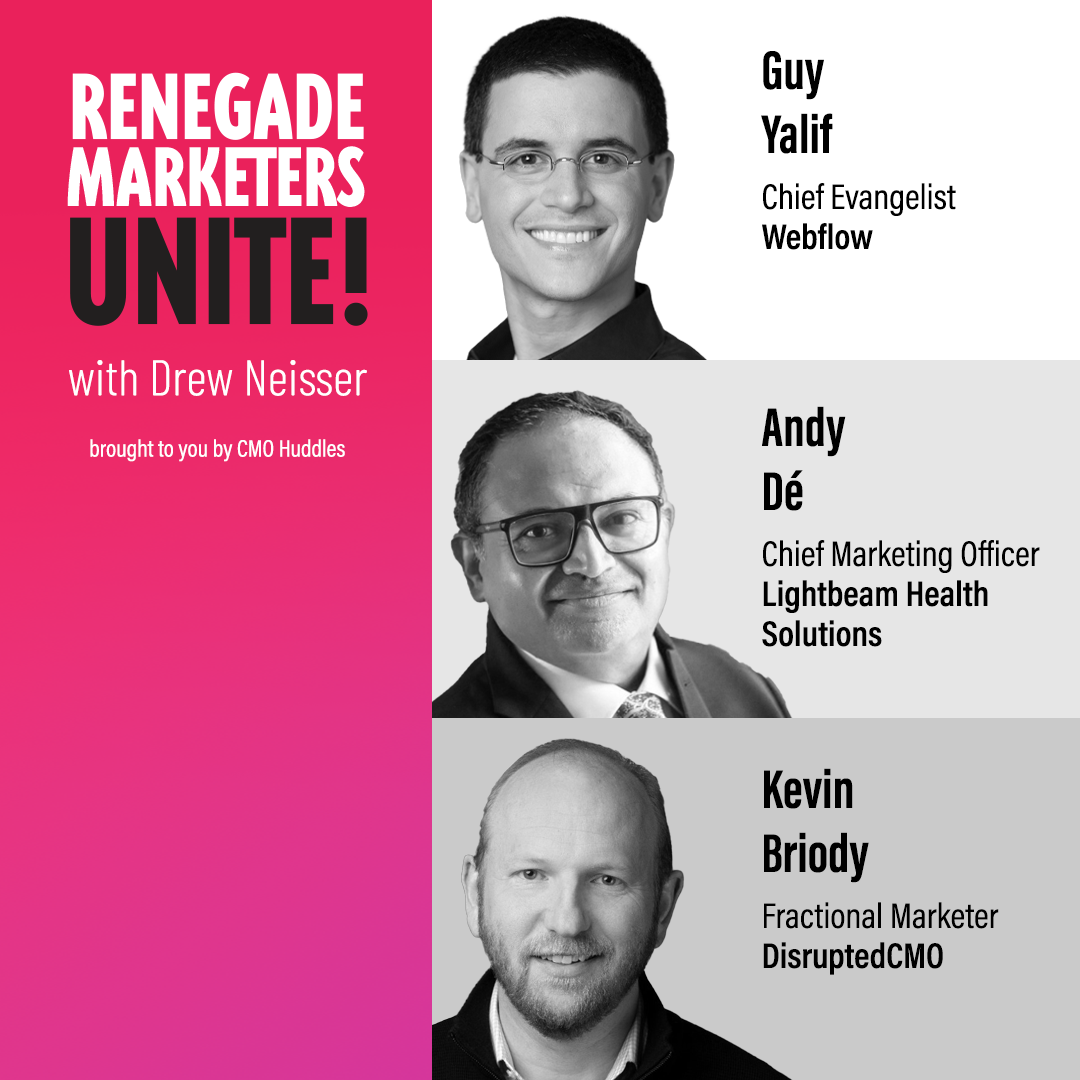
To get specific about what to prioritize next, Drew brings together Guy Yalif (Webflow), Andy Dé (Lightbeam Health Solutions), and Kevin Briody (DisruptedCMO). Together, they focus on how CMOs can move from scattered experiments to intentional AI adoption across people, process, and technology, and what it takes to make AI a trusted part of how marketing runs.
In this episode:
- Guy shares an AI fluency maturity model and explains why the shift to operational excellence is a change management challenge.
- Andy breaks down agentic AI and workflow automation with examples from CI, outbound, RFPs, content, and AEO, using “why, what, how, so what.”
- Kevin focuses on the people and platform side, from job anxiety and culture to vendor shakeouts and MarTech-level discipline.
Plus:
- Centering AI plans on people and fluency so it feels additive, not threatening.
- Using councils, fast-track approvals, and guardrails to scale safely.
- Balancing efficiency with human experience and customer acceptance.
- Treating AI tools like core MarTech, with scrutiny around contracts, integrations, and vendor longevity.
If you want your 2026 AI plan to feel like a strategic advantage instead of a collection of pilots, this conversation will help you decide what to run, what to scale, and what to skip.
Renegade Marketers Unite, Episode 504 on YouTube
Resources Mentioned
- Tools mentioned
- Past episodes mentioned
-
- Guy Yalif
-
- Kevin Briody
Highlights
- [3:10] Guy Yalif: 2026 roadmap for AI adoption
- [5:28] AI councils, 101s, and rubrics
- [8:28] Fast-track approvals, then enforce
- [13:43] Andy Dé: The shift to process-first agent AI
- [17:12] Agents for intel and outreach
- [19:59] Making AI personal at scale
- [24:48 Kevin Briody: Balance efficiency with buyer experience
- [32:16] Choose platforms with staying power
- [34:46] Agentic AI automates the marketing grind
- [36:19] CMO Huddles: Market read & peer power
- [39:01] Start with why, end with so what
- [42:23 AI is the new UI
- [43:56] Scale metadata and content with AI
- [46:41] AI Readiness tips for 2026
Highlighted Quotes
"Our successful peers will stop treating AI adoption as tech and start treating it as a major change management effort and guide their teams through at least what I've seen as six stages of AI fluency."— Guy Yalif, Webflow
"AI is the new UI. Your buyers are looking for you via prompt. The question is, do you have the content? Are you going to be rank-ordered by ChatGPT, Claude, Perplexity to ensure that your buyers come looking for you?"— Andy Dé, Lightbeam Health Solutions
"2025 has been a big year of disruption and experimentation. 2026 is really about operationalizing AI and ingraining it into your marketing team. It’s a culture and people challenge as much as anything else."— Kevin Briody, DisruptedCMO
Full Transcript: Drew Neisser in conversation with Guy Yalif, Andy Dé, & Kevin Briody
Drew: Hello, Renegade Marketers! If this is your first time, welcome, and if you're a regular listener, welcome back. Before I present today's episode, I wanted to give a quick shout-out to one of our flocking awesome sponsors, Firebrick Consulting. Firebrick CEO Bob Wright recently led the positioning workshops at our CMO Super Huddle, and it was a huge success, so much so that we're taking it on the road in February at our Strategy Labs. If you're in need of positioning help, I can't recommend Bob and his team at Firebrick enough. For more details on our Strategy Lab or links to Firebrick, check out cmohuddles.com or follow the link in the description.
You're about to listen to a recording from CMO Huddle Studio, our live show featuring the flocking awesome B2B marketing leaders of CMO Huddles. In this episode, Guy Yalif, Andy Dé, and Kevin Brody talk through how CMOs should be approaching AI as 2026 gets underway. They focus on moving beyond scattered experiments, building fluency across teams, and leading AI adoption as a people and process challenge. This conversation centers on what to prioritize now and how to scale with intention. If you like what you hear, please subscribe to the podcast and leave a review. You'll be supporting our quest to be the number one B2B marketing podcast. All right, let's dive in.
Narrator: Welcome to Renegade Marketers Unite, possibly the best weekly podcast for CMOs and everyone else looking for innovative ways to transform their brand, drive demand, and just plain cut through, proving that B2B does not mean boring to business. Here's your host and Chief Marketing Renegade, Drew Neisser.
Drew: Welcome to CMO Huddle Studio, the live streaming show dedicated to inspiring B2B flocking awesomeness. I'm your host, Drew Neisser, live from my home studio in New York City. Today, we're diving into a topic that's not just on everyone's radar and every CMO's radar—it's on every QBR, every board report, every budget plan for 2026. And of course, I'm talking about generative AI. Now, let's be clear, this isn't another hand-wavy "AI will change everything" episode. We're not here to marvel at ChatGPT's latest poetry ability or banana infographics—although they are pretty cool. We're here to answer the big practical questions: How should CMOs prioritize Gen AI across people, process, and tech right now to win in 2026? Such an easy question! There's going to be a piece of cake for the guests. This episode will ground you in what's working, what's worth piloting, and what to avoid, because let's face it, Gen AI is no longer optional. But it doesn't mean throwing spaghetti at the proverbial tech stack to see what sticks. With that, let's bring on Guy Yalif, Chief Evangelist of Webflow and a returning guest who has previously appeared on the show to discuss product launches. Hello, Guy. How are you, and where are you this fine day?
Guy: Hey, Drew. I am flocking awesome, and I am in San Francisco Bay Area, in Burlingame.
Drew: All right. Well, you know, I set this up with some pretty high, lofty goals, but you know, you're embedded in martech. You're deep in the space. Where should CMOs focus their energy around AI in 2026? I know that's a hard question, but bring some clarity to this big old world.
Guy: To your joke earlier, you could take this in a million directions. I think 2026 is the year where CMOs widely move from random acts of AI to operational excellence. How? Well, I think by now, most teams already have access to AI tools. Far fewer know how to use the tools well and safely. And in 2026, I think that gap is going to matter a lot and create a unique opportunity for us as CMOs to lead real AI adoption across our companies. I think our successful peers will stop treating AI adoption—you mentioned people, process, and tech—they'll stop treating it as tech and start treating it as a major change management effort and guide their teams through at least what I've seen as six stages of AI fluency. One: approval, where you get sort of legal, security, privacy guardrails in place, like it's required. Two: people start playing. Everyone's encouraged to get hands-on and experience experiments, doing things with LLMs and marvel, as you said. Three: organization, where you get some AI councils, training, and you point the LLM work at business goals. Then I've seen people go to four, where AI is used to automate existing tasks, saving time. Five, where AI now automates those same tasks but at superhuman scale, enabling you to do things you just couldn't do before because they weren't scalable enough. And the last is genuinely new workflows that emerge that AI wasn't possible before. And I think a lot of words are being written about number six, but I think there's a journey to take our teams through to get there.
Drew: Yeah. Well, wow. Okay, that was a lot to cover, and I want to sort of build on some of these things and skip over others. But so clearly the training part of this—there's lots of access to the tools, but the training part is shortcoming. So at least specifically, what are you doing with your team and so forth to make sure that people know how to use these tools so you can keep moving up this ladder, if you will?
Guy: We keep experimenting. We're doing a lot. So we do have AI councils that first work through the approvals and now are trying to shine a spotlight on things that are working for dual purpose. One is, "Oh hey, Joe or Jane created this custom GPT that does X. You may want to use it." That's purpose one. And purpose two: to help inspire everybody's thinking to see, "Hey, what could I do and go create that would be useful that this inspired me to do?" So that's one. Two, we're doing AI 101, Prompting 101 internally. And three, we've added it to our reviews—like the rubric for reviews, the rubric for hiring. And next year, it will be tied directly, sort of as we all do, to 100% investment. Excuse me—what investment are you making and what are you getting out of it? Because it is such a big, big effort.
Drew: And you mentioned that the CMO is in position not just to lead their departments in this transformation but the organizations. We've talked a little bit about this over the year. I want to believe that CMOs are doing that. I don't know if, in fact, that's happening. I know, like at KPMG, Lauren Boyman is doing that and has been for, like—she's—they actually created an AI Task Force two years ago, and she is leading it as the CMO. So, and that's a big company, but I don't know that many other examples. Are you seeing CMOs who are stepping over and then helping the company with their adoption plans?
Guy: Some. Sydney Sloan has done a great job at G2. I've seen others where they've first, in general, sort of gotten our own house in order, where they've gotten the marketing team up to a higher level. And rather than saying, "I'm going to now foist this on everybody else," waited for the pull, waited for other orgs to say, "Ooh, that looks good. Can you help us?" Which, in my humble opinion, is probably the right strategy in most organizations. I also think the reframing of this away from a technical problem—there are real technical things to solve, but for us as leaders, I think there's just as much, if not more, around the change management and people and how they feel and how they think about these things, and raising everybody's AI fluency. I think that makes it applicable across the entire org, because we know as marketers, our org is affected as much or more than any other org in the company.
Drew: And there's certainly an expectation, for better or worse, that this is suddenly going to make marketing 25 to 50% more efficient. And those conversations, those conversations are having, whether or not CMOs actually know how to do that—that's a whole different issue. And option: you talked at the very beginning about approvals and mention privacy, training, safety, that kind of thing. And with a lot of the technology being adopted on an individual level, as opposed to a corporate level, as happened like with laptops and cell phones and all those other things, that was really good because you got people to do it. The minute you bring in IT and say, "Wait, you can only use this one, and you can only use that one," it's somehow—like, you have a Microsoft shop, they can only use Copilot. There's constraints that come in here. I guess the question that I'm trying to get at is balancing that out with forward progress.
Guy: We experienced that very directly at Webflow. There very much was a push and pull. So early on—and I know early and late is measured in months in this space—IT and the corporate AI Council—we have a go-to-market one separately—but approved a handful of tools, very small list. People eventually did exactly what you said. They adopted from the bottom up. They went off the reservation. The central team, to their credit, said, "We need to enable this. We need to move faster rather than constraining everybody else all the time." And so there has to be some balance because we are not putting any customer data, any financial data, any sensitive data in any of these places where something else might be trained. So after some time, they introduced a fast-track approval specifically for Gen AI-related tools or features of existing tools that reduced what can be a pretty long procurement process to a few days to get a preliminary green light. They dramatically improved and lengthened that list and keep doing so all the time. Huge credit to them. They also then said, "Hey, there is a grace period that's going to end. And after this grace period, you need to be using the approved tools," to the point where they centrally enforced it literally. I happen to use Granola. Granola I enjoy as a product. Turns out that's not one they've approved yet. And at some point, my computer said to me, "You can't do anything until you take this off. Here are some other ones you can use, and maybe one day they'll approve Granola." Nothing good or bad about Granola. It's just—so they shifted from "here's some rules," everybody did their own thing. "Okay, we're going to move faster. Grace period is over." Now, a rapidly iterating, improving list, but you need to stick on the list.
Drew: Now I'm going to skip ahead to this. This sort of the biggest thing that you brought up, which is so clear, is the change management aspect of this. There were early adopters. There were obviously people who resisted. There's still people at lots of companies they're saying, "But wait, what about all the water usage or the electrical usage of all the AI?" And, you know, it's using some—and it's funny. I've been listening to some podcasts that, as a person who works with green building and understands a fair amount of this, it's not as simple as folks might want to believe it. This is going to be a hard technology stop, but there are individuals and companies that don't want to use it because of that. And I guess that is a—that's a personal choice, but a company is going to struggle if their employees don't adopt it pretty quickly. So I'm curious, in that part of change management, if you've run into that, had you know and seen that out there, and how folks are dealing with that. Because it's like, suddenly someone's saying, "Yeah, I'm sorry. We're not going to use a car because I love my horses."
Guy: I think the metaphors are apt. I have not seen this. Webflow has not as a business had delved into this as an individual. I've heard other people talk about it externally. And I think the metaphors you're drawing are apt. This is so transformational. It is, on the one hand, few times in a career where you get a change this big, and on the other hand, this one's actually bigger than all the other ones we've experienced. And so I am with you. I think there are few roles where people will be able to—again, this is not a Webflow thing, this is a Guy opinion—but be able to be effective at the level their peers are in other companies without embracing some form of this. And as an individual who cares about the planet, I'm happy that there are other versions of models coming out there and other ways to tackle this, which, to your point, it's not as simple. It's not as straightforward. There are a lot of people thinking very hard about that part of the problem.
Drew: Okay, well, with that, thank you for that. I have lots more questions, but we now will bring on Andy Dé, who is the CMO of Lightbeam Health Solutions, who is joining the show for the very first time. Hello, Andy, and welcome.
Andy: Hey, Drew, thank you for the invitation. Very excited to be here. Exciting times.
Drew: Where are you and how are you?
Andy: I'm doing well, looking forward to the holiday season and an impending pilgrimage to Sevilla, Spain in mid-January. I'm in Dallas, Texas.
Drew: Got it. Oh, well, very exciting. Haven't been to Sevilla. So okay, you heard a lot about what Guy had to say. What's your overall outlook on how AI will reshape marketing next year? And already, you know, is probably a continuation of how you're seeing it being reshaped right now.
Andy: Yeah, if I may start with a bit of controversy. So Gen AI is dead, dying, or being subsumed by agentic AI and AI agents, right? Which is all about process, workflow, automation, which is where we are starting to—we are actually going to see lower human intervention. We're going to see efficiency, productivity, especially for repetitive tasks, and that's where the action is moving to, right? So I think from an overarching perspective, as Guy alluded to, you're going to see this haves versus have-nots from an AI perspective. You're going to see a five-stage lifecycle, right, of AI adoption. It'll start with augmentation. It'll start with prescriptive analysis, where there was descriptive analysis in the previous generation, if you will. We're going to see the emergence of copilots, right, or assistants, which are still going to be in the Gen AI realm, right, for self-service. But that's where we've seen this exciting transition to agentic AI, where in terms of exception management of processes, right, then total automation, which will potentially demand very little human intervention, right, just for governance and oversight. And the Holy Grail where the arms race is being waged is this notion of artificial general intelligence, or, you know, AI singularity, where AI pretty much senses its ecosystem, can adapt, and run on autopilot. So the healthcare industry, we're not going to see much of that. But again, the self-driving cars is the only example we can talk about. But that's kind of the transition. From a marketing perspective, while we have obviously Gen AI for research and authoring content, white papers, blog posts, social media posts—that's fairly ubiquitous. Personalizing web experiences, buyer personas at scale is something I'm excited about. We are already using Gen AI for responding to RFPs, RFQs, and then this exciting note of, you know, kind of bringing in no-code/low-code in a marketing context, from ideation to publication in hours with tools like Lovable. Agentic AI is opening up whole new possibilities, right? Conversational AI agents and chatbots for prospect engagement, de-anonymizing website visitors, right, with tools like Qualified and Warmly. Salesforce just announced it is going to be acquiring Qualified. The notion of conversational AI agents actually supplanting SDRs or BDRs, right, is one we are looking at. We have human BDRs today, external BDRs. AI agents for personalization of cold-call emails at scale is something we are literally on the brink of adopting. AIO or GEO, right, using AI to craft your AIO or GEO from SEO—I think is a huge area that a lot of marketers are going to be focused on.
Drew: Okay, wait. You gotta—you gotta just throw way too much at us. You got—I gotta, I gotta stop you because it's way too much. I think fundamentally, the problem that CMOs are facing is there's too much. There's so many things. And one of the things that we're trying to do on the show is get them to focus. And you can't do all of those things, right? You just can't do all of them all at once, and nor should you. That's not the definition of strategy—what do you say no to? So we got to focus. And so I want your help, because I know you know a lot about this, and you're—so let's talk about specifically what you're doing and where you see—you mentioned agentic. So are you—do you have agents working for you right now? And if so, what do those look like? So let's be as specific as we can relative to what you are doing, not the universe, because we can't boil that ocean on this show.
Andy: Surprisingly, we're doing a little bit of everything I mentioned. But I think core use cases today: I can't afford to hire a competitive intelligence analyst, so I literally have an agent that does competitive intelligence for us already in place, right? Using AI agents for cold-call email personalization at scale, I think, is a huge application. So that's something we are deploying, you know, based on intent insights as we speak.
Drew: Okay, let's stop on that one for a second. Are you doing that in-house? Are you working—like, so Amanda Kayla from One Mind is, you know, creating the superhuman SDRs. In fact, she's going to be doing the road show with us in the Strategy Lab that we're doing in February. But are you looking at this, these sort of robotic SDRs—are you building them yourself?
Andy: No, there are platform-as-a-service tools, right? So the right stack is a combination of Salesforce, ZoomInfo, and this tool called Lavender.ai, right? So it's that stack that we are literally putting into place. We are integrating it ourselves with help from—with the help of our IT. In fact, our VP of Demand Gen is doing that. So we are literally doing that. We also have access—have a friend who's turned into a kind of a Gen AI, agentic AI consultant who can literally help us create custom solutions at will, at very competitive prices. So it's that combination of buy and then, you know, adapt and customize.
Drew: So okay, so we've—we've got—you mentioned you've got agents for competitive intelligence. I think that's one that folks sort of see as—that says, sort of GPT on steroids, right? And we're talking about cold calling and personalized cold calling. Yes, that is certainly personalizing at scale is something that we have all as marketers been wanting to do so that we would stop getting emails that said, "Hello, name."
Andy: Exactly, exactly.
Drew: It's interesting to me that I can't say I have seen dramatic improvement in personalization yet, and part of the problem seems to be the data that you—like, you really, to do it well, you kind of need first-party data, or you need something that is able to sort through some of the nuances of being a human and what you're connected with. So I'm curious: Have you—have you been able to implement the personalization at scale, or is this the promise of it that you're hoping to test in 2026?
Andy: Yeah, we have literally integrated it. We are waiting to deploy it, right? Okay, here, the notion is this platform—if we are targeting Drew, it'll look up your LinkedIn profile. Look at what do you do for a living? What are you passionate about? What do you write about? What do you respond to? And based on that, craft a subject line and email that will intuitively resonate with you because it's about you. It's not one size fits all. And tie that part of the AI, you know, enablement is tie that to the value proposition of the solution we are presenting with the potential ROI. Think about how much that's a game changer, right, related to the "Hey, hello, name" nonsense.
Drew: It is. And here's—I'm getting—so I have a podcast, and you know, it's called Renegade Marketers Unite. The show, in fact, actually goes out on that podcast. Guest PR people will use a bot to research the show and say, "Hey, I loved what you said on this show about this thing." It's so obviously generative AI that they've never read it, and they don't. And then they pitch a CFO who's working in B2C. So clearly they didn't quite get, "Oh, we're only CMOs and we're only B2B," but they got some other nuances, and they pretended like they had listened to the show. And so it felt—and I know they're using generative AI because I know the tools out there do this. So there's still a disconnect because I'm not persuaded this person didn't—really, this bot didn't really understand, but they did put words together that seemed like they made sense. So it'll be really interesting. We'll have to come back in six months to see that this level of personalization actually worked.
Andy: I'll give you an example. So I moonlight as a Bollywood DJ for friends, right? I love it. So I got this email from this platform called Qualified, which does this. It said, "Hey, DJ Fever, where's your next gig?" right in my business email inbox. So guess what? I opened it up, and then it went into—again, it clearly had done its research, connected my Bollywood DJing with my thought leadership on AI, and then said, "Hey, imagine if you could do this with every other prospect you're looking at. Wouldn't that be worthwhile? So should we talk?" So I think it's getting to that level of intelligence, intuitiveness, and resonance is the key.
Drew: That's so interesting. I want to share—it's not intelligence. It's just putting words together, but it somehow looks like intelligence.
Andy: Exactly.
Drew: So we'll see. There is a difference. So we'll see. I'm holding out for humans somewhere in this thing. And, you know, I again—I'm not being a Luddite here. I just do think that the personalization at scale implies that there isn't a human in the loop. And if there's a human in the loop, then that human is—and they're not reading every email, then we're at this place where someone's getting an email that is not relevant to them.
Andy: The human in the loop is training the agents. There's a lot of upfront training and learning that needs to be done, and that's where, again, having product marketers provide the positioning, messaging—here are the key differentiators, here's what resonates with your prospects. I think that's what the human element comes in and a process of oversight, right? "Hey, is this actually working?" Put in a feedback loop. And how do you refine and learn from every experience?
Drew: Yeah, I love it. And again, I think what you're implying is that you don't necessarily deploy this to 100,000 people day one. You work your way up and validate and so forth. Okay, got it. All so much more to cover. This is an impossibly large task, but I appreciate you focusing on those two things. We're now going to bring in the very patient Kevin Briody, who is a fractional marketer at DisruptedCMO, and an industry expert who's graced our stage before to delve into many topics, including ed tech, strategic focus, and funnel strategy. Hello, Kevin, wonderful to see you again.
Kevin: Likewise, Drew. Thanks for having me on.
Drew: Hey man, thank you for your patience. How are you and where are you this fine day?
Kevin: I'm doing great. I actually, looking at your background, I feel bad I don't have my little penguin display from CMO Huddles. I do have my World's Greatest CMO coffee mug that you guys sent me back there. So I am in kind of chilly North Carolina right now, and I'm doing well.
Drew: All right. Well, hopefully maybe we'll see you on the road show. So let's talk about the category you've spent a lot of time in. What's AI integration look like now? And where do you think it's headed in 2026?
Kevin: Well, it's interesting listening. Coming in third on this is always fun, because you get to just furiously take notes from what Andy and Guy were saying, I think, and they made some great points. And I think they covered a lot of, you know, my background in ed tech, and then broadly, what we're all seeing in the industry. I think that it has really gone from AI adoption as being kind of a science project or innovation around the edges. A lot of people personally getting familiar with ChatGPT or Claude, or some of the other individual platform tools, and then pulling that into, you know, isolated projects within a lot of companies. And I think what we're starting to see, I think Guy, you know, covered it well, which was, we're starting to see more of the operationalization of AI in a lot of marketing teams. I do think the last conversation that Andy brought up, really, when you talk about 2026 is, I think it's something that is not being covered enough, and I'm glad you all brought it up, which is, I think it's the human element here is the wild card. And I think it's not just how it's viewed, like Guy said, as a change management issue, and how it's received. I do think AI, for many parts of the marketing profession, is still viewed by employees as something of an existential job threat, and that's a huge challenge that we as a profession, as marketing leaders, still very much need to focus on. But I also do think the customer is a big wild card here for exactly the points you brought up. I think this idea of insincere or even invasive personalization that could come up. I think this idea of brand voices getting essentially smoothed out because everyone's using the same algorithms and the same platforms. This idea of, you know, you could get so—I call it the efficiency temptation. This idea of we could do so much more for so much less. Let's use AI, turn out more content, churn out more emails, do all this great personalization. I think that could easily get run amok, and you're running into an issue where I think that all that great personalization could actually result in our core buyers further tuning us out or pushing us back because of the potential of AI. And I think it's, I think that is the central challenge as we look to 2026, for marketing leaders, is this idea of finding that balance, keeping the human in mind and not getting so focused on the potential of the technology that things go a little bit out of control.
Drew: Yeah, it is a moment, and there's so many competing forces on this, and you know where CEOs and CFOs are as it's all about efficiency, and it's about this quarter. So is there a world in which a CMO is not embracing this technology to its fullest extent in their departments and in their companies?
Kevin: I think it's fair to say that if you're not, as a CMO, embracing it, you're going to face a hard road. I think in most, in pretty much every company I've been in, every CMO I've spoken to, and every leader in pretty much any department, the pressure is on, you know, from the board, the CEO, the CFO, to, you know, it's a, it is a transformative technology. I think, as maybe Andy said, it's, we're at this inflection point now. It's a massive transformation in our profession. And so I don't think there's a thing where a CMO is going to get away very long with not actively embracing AI, or at least, you know, committing to fully exploring its potential within their organization. I think my point is you can do that, but at the same point, it has to go back to some leadership fundamentals, and also just good old marketing fundamentals of really paying attention to customer reaction, how customers are connecting with this kind of technology that we're putting out, and not just getting too enamored with the raw potential of it.
Drew: Yeah, you know, it's interesting. I was talking to a tech person last night at an event, and often folks will say, "Gee, I don't want to deal with a bot. I want to talk to a human." But there are circumstances. It's two in the morning and you want to go into detail, and a human may not be available because they're not outsourcing it to India or something, and you can get a bot that's very useful. And if it's really good at conversation, you know that it's like a godsend at that moment. It's quite useful. So I do think that there are going to be incredible opportunities for some of the particularly repetitive tasks to turn it over to the bots and embrace all of that. The leadership part is really interesting to me, because we're talking about change management, we're talking about adoption and training. We're talking about how much skills do the CMOs themselves have to upskill. Like, does every CMO need to learn to vibe code?
Kevin: I think it's funny. To your original point about that idea of automating certain experiences. My favorite example is actually, weirdly enough, here in North Carolina, the DMV. To renew your driver's license, to renew your car registration, a couple of years ago, they put out a chatbot, which is very smooth, works perfectly every time, and it saves you from having to do any sort of human interaction. But that's a welcome experience, and that, I think it's a super simple but a great example of, yeah, there are some of those interactions where automating it with AI or even simple chatbots, I think is incredibly valuable. But no, I think to the larger point, yeah, it is a fundamentally human issue about training. I do think it's thinking about your employees, how they're reacting to this, how they're embracing it, supporting them. I do think it is, you know, from a customer level too. I do think it's in the back of my mind that I rattle around this idea that "made by humans" will be something of a premium brand differentiator going forward. I do think as we start to see some of that pushback, and more importantly, brands who will take it too far. You know, I think you see brands testing the waters like Coca-Cola with their famous AI-generated Christmas ad, and just trying to see what the reaction was. I do think you're going to see this idea of a little bit of a flip backwards, where some of the under-the-covers automation will be heavily involved with AI, but a lot of the customer interactions, there's going to be a bit of a push and pull going on, where this idea of, "I can actually speak to a human," or "I know that content was crafted by humans," that is going to be a differentiator, or something that will be, at least be valued in some cases.
Drew: It's funny, I, every week I write my Saturday editorial or rant, if you will, on LinkedIn, and 99% of those have been, you know, every single word I wrote. And then every once in a while, I get a little lazy, and I'll, you know, and I'll say 70% human-made or something, and I've been using whatever the percentage roughly is. It hasn't mattered, yeah, like, I haven't gotten dinged when it was 50% versus 90% versus—it was, it's really about the strength of the arguments and the ideas that are put forth. So again, there's a human editor, and that's ultimately what determines that. But let's get pragmatic for a second. What are you seeing? What are you working on right now with these tools that you think every CMO is going to have to do in 2026 if they're not doing it already?
Kevin: Well, I do think looking to 2026, I think for every CMO, it's being very, very careful about your tool and platform selection. I think in 2025 there's just been this massive level of experimentation. I mean, during this podcast, I was jotting down some of the apps that some of the other speakers were talking about, things I got to go play around with. I think we're going to, we're going to, that has been incredible over the last year. I think we're going to continue to see that. However, I think there's also going to be a pretty good vendor shakeout. So that is something that I think is going to be really important for CMOs to focus on. As AI starts moving from the edges into the core martech stack, it becomes more and more mission critical, and at that point, we have to be a little bit more discerning about the strength, the staying power, the longevity, the financial health of some of these apps and platforms that we're betting on. You know, I do think there's a lot of debate on some of these pure AI wrappers that have gotten some good traction, you know, but do they have long-term staying power? And I think that is if I was, you know, I'm on the consulting side now, but if I was in a CMO role right now, I think it would be embracing AI, you know, keeping that human balance I talked about, but also as you're pulling it into the tech stack, really being discerning, and really kind of looking at some of these cool AI applications and tools with a little bit more of the discerning eye that you would otherwise look at some of your enterprise solutions.
Drew: Yeah, and that is a good point. And I think the one way that the CMOs can protect themselves is, you know, no long-term contracts, monthly deals, if you can, because you may throw some things away. It's tricky, though, from a training standpoint and so forth. Because, you know, there are a lot of the standardization things. The people who have Copilot and are like a Microsoft shop and are stuck, or the people who are Google, and "we're all Google," and, you know, finally Gemini came along and made it. These are hard choices, because you could be left behind. You're safe with Microsoft, but you know, right now, you're struggling to do a lot of the things that Guy and Andy were talking about. All right? Well, is there another specific thing that we should just sort of say, "I'm excited about this, this one thing"?
Kevin: I think it was Andy who really just hammered on agentic AI. I do think that is the real big potential. We've seen a lot with regards to the creative side, content production, and using AI as a strategy brainstorming tool or a planning tool. I do think this automation, and real automation through agentic AI, that is going to be very powerful this year. So I think where my head is is really trying to get up to speed on that, see where the potentials are, see who's experimenting the most. But I do think there's so much of just the turn of the work that happens in any marketing organization, on the production side, on the planning, on the media side, that really could be handled through intelligent agents. And I do think that is a massive opportunity. So it's that core automation challenge, as the tools become more mature, that I think we're going to see a lot of the real benefit this year.
Drew: Got it. Okay, perfect. With that, it is time for me to talk about CMO Huddles. We launched in 2020 and it's the only community of flocking awesome B2B marketing leaders that has a logo featuring a penguin. You may have heard, well, a group of these curious, adaptable and problem-solving birds is called a huddle. And the leaders in CMO Huddles are all that and more, huddling together to conquer the toughest job in the C-suite. So Guy, Kevin, Andy, you're all incredibly busy marketing leaders. I'm wondering if you could share a specific example of how CMO Huddles has helped you.
Andy: I mean, this is a privilege. Being on the same conversation with Guy and Kevin, and the fact that we all approach it, we're seeing the big picture, but yet approaching it with very different, complementary yet different approaches, I think is so very valuable. So learning from each other is the reason I'm with CMO Huddles. And Drew, thank you for bringing this community together.
Drew: Oh, my pleasure. So happy you're here with us. Okay, Guy, your turn.
Guy: I think we are in this period of, like, okay, not once in a career, but like, just a few times at a career level of massive change where our playbooks, like, they either don't apply or they need a lot of reframing and updating. CMO Huddles, this incredible community you've built, has helped me get a read on the market, has helped me learn, especially on AI fluency and AEO, both of which affect all of us, to understand what other people are doing, to have like the real candid conversations and compare notes. You've not just brought people together. You've also been, candidly, a great connector between the individuals wrestling in that particular moment with similar things.
Drew: Well, thank you for that. I appreciate your thought leadership in the AEO area. And it is so interesting because it's this exciting moment, and we really need to hear from the CMOs who are at the forefront making interesting things happen. And Kevin, feel free to chime in if you want to share something.
Kevin: Yeah. I mean, I think, as others have said, but it's really this idea of what I found very valuable is a lot of the conversations that happen within the CMO Huddles community, through some of the different Huddles and through the Slack channel and things like that. This idea of essentially helping us as marketing leaders cut through some of the vendor speak to really understand what other people are experiencing, how they're solving some of these problems, and really just get right to the core of, you know, what's helpful and what's not. So I think that's been a tremendous value to me for the number of years that I've been involved in the community.
Drew: And we so appreciate having you and Andy and Guy. If you're a B2B marketing leader who wants to build a stronger peer network, gain recognition as a thought leader and get your very own stress penguin, please join us at cmohuddles.com. Okay, we don't have a lot of time left, and we need to be geniusly focused somehow to get some takeaways here for our fellow CMOs in this world. So we talked about change management. What is one thing that a CMO could do right now that would help the company move forward? And maybe that's too broad a thing, so I'm going to go back to you, Andy, and talk about agentic for a second. You've mentioned a couple examples. Is there—wrapping your mind around agentic—it's not just, "Oh, I'm going to go build this," you and I necessarily, because there might be APIs. It's complicated stuff. It's tech support stuff. What do we need to know, and how do we focus our resources to make sure in Q1 and Q2, if we go down the agentic route, that we're going to build something that's going to come out the other side and be worth the time?
Andy: I have a very simple framework, right, that gets you away from being enamored with the technology and really focus and prioritize your attention. It's why, what, how, and then the so what? What is the ROI and the value that you'll see from this use case, from this deliverable, or what you are doing? And that's true for AI or any new technology in innovation across any industry. Don't be enamored with the technology. Have a clear path in terms of, why are you doing it? What? What is the problem you're solving? How are you going to do it? That's where, again, not just gen AI or agentic AI. Treat it like a portfolio. It's a portfolio of technologies, and always be guided by the so what? What is the value that people who are using it, the buyer persona, user persona, is going to derive from this?
Drew: I love it. That makes total sense. It's a nice little framework. And the thing that's interesting about the what, and this is where, in order to ask smart whats, you have to be pretty knowledgeable about, at least somewhat about the art of the possible. And that's tricky right now, because there's a lot of things. And part of the excitement here is that we want to do what isn't possible or what we couldn't do before. So I'm curious, Guy, as you're thinking about that framework, how do we sort of, we can identify a problem, but we can't always identify the potential solution. We can sort of imagine. "Wouldn't it be cool if..." I'm curious how you're grappling with that.
Guy: I feel like this is the ultimate curiosity moment, where, you know, the learning curve for everyone from kindergartner to CMO and CEO is like this. And I think you nailed it. It is what is possible. There are a set of constraints we've all grown to accept. Sometimes people are like, "Oh, AI will get rid of all of those." That's just not true. And so to have a point of view, to see examples from elsewhere around your org, to have that then spark ideas on the team where they're like, "Well, gosh, if that constraint's broken, I can go do this that much better." I feel like that's the iterative, nonlinear, harder to predict place we are in. And to have that work well, you got to focus on the people so that they feel safe, emotionally safe, and see this is going to be a superpower for them, rather than some existential threat. Then they will make those connections and produce great things.
Drew: Yeah, and the safety part is hard. I mean, you can foster it as much as you want. That's what leaders do, right? You have to create this safe space for people to experiment and fail to get to some of these things. Okay, let's see. We've talked about the framework. Andy, practical example. We've talked a little bit about mass personalization. Is there another agentic application that you're excited about that we haven't talked about, that you plan to experiment on in 2026?
Andy: I think the AIO/GEO one is big, right? Because you've all been in that SEO sandbox, if you will, right? And the rules of the game are just being changed, right? How do you ensure, I mean, 70% of your buyers, that this is a big, big aha. AI is the new UI, so your buyers are actually looking for you via prompt. And the question is, do you have the content? Are you going to be found? Are you going to be rank-ordered by ChatGPT, Claude, Perplexity, to ensure that your buyers come looking for you versus, you know, the legacy SEO rules just don't hold anymore. So AI is the new UI, right, is a big mantra to wrap your mind around.
Drew: So, and funny, Guy and I can go at length on this one. We've talked about it at length, and I can't agree with you on the "SEO is dead." I can't agree with you on the fact that the SEO rules don't matter, because they still do matter. And that often there is an intersection between AEO and SEO. The question I have, and maybe Guy is, are you saying that we're going to use AI to get us to perform better with AEO, or we're just being aware of AEO and we're going to do all the things that we need to do, whatever the people think at this moment are the best practices to improve your site visibility in LLMs? I wasn't sure, Andy, if you were saying use AI to solve the AEO problem, or just be aware of AEO?
Andy: Use AI to understand what your gaps are, and how can you still be—obviously, SEO is not going away—but how do you embrace the world of AIO/GEO?
Drew: Interesting. Do you want to build on that, Guy?
Guy: Sure thing. I agree with you, Drew, Tom, that AEO is close to SEO for a whole variety of reasons. And I agree with Andy that AI can be very helpful there with the human in the loop. I actually think one of the ways to raise AI fluency is directly relevant here, where you can lower the bar for your team by not having them need to learn a bunch of new things. Ask them questions they're used to answering all the time. Do it in context for what they're familiar with. Bring to the point we were hearing earlier from Kevin their brand essence, so that you don't lose that in this sea of sameness. That then can do just what Andy said. Should I be creating some content? Can you help me start creating that content more effectively? Can you auto-generate a bunch of stuff I used to need to go to an engineer to auto-generate, like the metadata? LLMs are so valuable to understand structure and meaning of content. So I think there is a play here that is very helpful and elevates the org without relinquishing control.
Drew: Interesting, and it's funny, because as many times as we've talked about AEO, we haven't actually connected the dots that AI is going to also help you with AEO. It's obvious that it could, because it can do gap analysis. So you can find spaces that just as you would with SEO, right? But you could do that probably faster, and you can educate your GPT on brand, and then you can auto-generate these Q&As using the information from your employees. It's all in here and just getting it out there. So all of that makes sense. And then, of course, we've talked a little bit about the technical aspects of AEO, and I do want to say that I'm a firm believer you would be silly not to put a certain amount of energy into AEO next year. If you haven't already, that would be a big mistake, because we're all using LLMs more for all sorts of things, whether or not you should spend a lot of time getting employees actively involved in Reddit and some of the other things that are the rabbit holes that you could go down to try to build your AEO is a subject for debate. I think at the moment, I got a thumbs up from Guy on that one. All right. Again, such a broad topic. We've done this. I want to sort of, let's get to some final words of wisdom for other CMOs when it comes to—and we'll call it AI readiness 2026. There is not going to be an aspect of your job and your world that will not be impacted by AI. I believe that to be true. Let's give folks some final words of wisdom. And Kevin, you get to go first on this one.
Kevin: Yeah, I think final words of wisdom. I would say 2025 has been a big year of disruption and experimentation. 2026, as you've heard on here, is, I think really, and we all agree, is really about essentially operationalizing AI and really ingraining it into your marketing team. But I do think it is really, I would recommend that CMOs look at it as a cultural and people challenge as much as anything else. For 2026, I think it is really helping people understand how AI is additive and supports them and is not something they need to fear as it's going to replace them. That's a huge challenge, because obviously CMOs are under pressure for cost reduction and things like that. But I do think it's fundamentally, as Guy said at the very beginning, a change management challenge. I think it's a cultural challenge. I think really focus on your people and really that idea of, let's ingrain this as part of our production processes, as part of our core automation, and at the same time, still keep some of that spirit of the art of the possible, that wild innovation and experimentation that we've seen so much of this year. And that's, it's a cultural thing more than anything else. So, you know, keep your eye on the ball. And that's just classic leadership challenge.
Drew: It is. It's leading the humans to think of these as augmentation opportunities, as opposed to replacements. Okay? Cool. Andy, you're up.
Andy: Absolutely. So I think never before, and this is never before, have CMOs been asked to do so much with so little. And I think that's true for every industry. It's true for healthcare, which is where we work in with physician and nursing shortage. So I think having, you know, digital tools and AI augment, right, where you don't have people, is the way we have to move forward, but do it with balance, which was, I love those comments from both Kevin and Guy and Drew, you know, ensure the human is in the loop. Train the agents, have governance and oversight, and ensure that people embrace it in terms of how it can improve their lives, their productivity, versus be wary of it as a job killer. I think that's, you know, for me as a CMO, that's top of mind, and I hope that'll be valuable for other CMOs as well.
Drew: Okay, Guy, bring us home.
Guy: We're going to build on a theme here. I agree with everything that was said. I especially like how Kevin framed it. In 2026, focus on the people more than the details of the tech. Let this be a superpower for everybody on your team, rather than an existential threat. In talking to hundreds of CMOs, I hear it impacting hiring. I'm hearing a lot less about letting people go, and if folks aren't thinking about that quite as much, that enables psychological safety, which engenders curiosity. And if you then ground the team as they get curious in the fact that core job hasn't changed, we need to go build brands and drive revenue. That hasn't changed. They will then point their energies in the right direction. And if you can lower the bar for that AI fluency by finding tech that fits easily into your workflows and brings the AI to bear by asking folks questions they are already used to answering.
Drew: I love it. All right. Well, there you have it. Easy peasy. 2026, nothing to it. Just get on and build a couple agents, and off you go. Keep those great people, get them trained, make them feel loved, set some vision, be a leader, all that stuff. Piece of cake anyway. Thank you, Guy, Kevin, Andy, you're all great sports. Thank you audience for staying with us.
To hear more conversations like this one and submit your questions while we're live, join us on the next CMO Huddle Studio. We stream to my LinkedIn profile. That's Drew Neisser, every other week.
Show Credits
Renegade Marketers Unite is written and directed by Drew Neisser. Hey, that's me! This show is produced by Melissa Caffrey, Laura Parkyn, and Ishar Cuevas. The music is by the amazing Burns Twins and the intro Voice Over is Linda Cornelius. To find the transcripts of all episodes, suggest future guests, or learn more about B2B branding, CMO Huddles, or my CMO coaching service, check out renegade.com. I'm your host, Drew Neisser. And until next time, keep those Renegade thinking caps on and strong!