When Marketing Leads the AI Migration
Company-wide AI adoption needs a flock leader. Marketing may already have the job.
Marketing has a few advantages here. It hears customer friction early, touches nearly every corner of the business, and has gotten pretty good at doing more with less. That makes it a natural proving ground for new ways of working, with a chance to test what works, prove the value, and give the rest of the company something worth scaling.
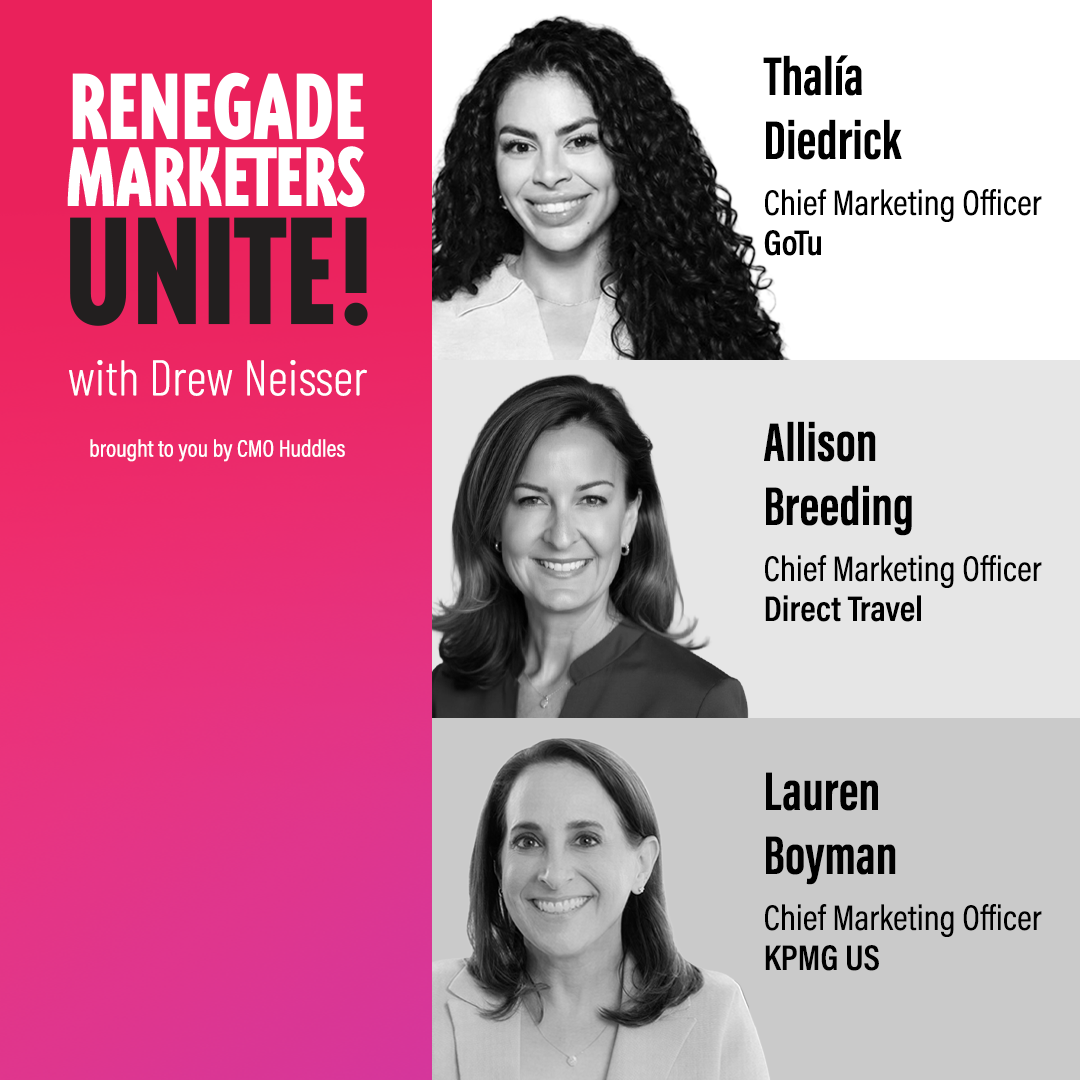
In this episode, Drew talks with Thalía Diedrick (GoTu), Allison Breeding (Direct Travel), and Lauren Boyman (KPMG US) about how marketing can lead company-wide AI adoption. Across three differently sized companies, they compare what sophisticated AI use looks like, how workflows start to change, and where build-versus-buy, governance, and training enter the picture. AI moves fast. Companies have people, processes, budgets, systems, and guardrails that take a little longer to turn. These marketers are figuring out how to bring the whole company along.
In this episode:
- Thalía shows how GoTu built a bespoke AI project manager into the team’s daily workflow, helping marketing model a more AI-native way of working
- Allison shares how Direct Travel drives adoption through business-problem hackathons, a central owner for new ideas, and regular wins shared with leadership
- Lauren on how KPMG uses marketing as “client zero,” pushing beyond basic adoption to test AI approaches the wider business can learn from
Plus:
- How to make smarter AI build-versus-buy decisions
- How to scale AI experimentation without creating agent sprawl
- Why organic traffic can fall while buying intent rises in the AEO/GEO era
Listen in for how CMOs can lead company-wide AI adoption and turn experimentation into new ways of working.
Renegade Marketers Unite, Episode 537 on YouTube
Resources Mentioned
- CMO Huddles
- CMO Super Huddle
- CMO Huddles Strategy Labs
- Index26 Conference
- Tools mentioned
- Past episodes mentioned
- Lauren Boyman
Highlights
- [2:48] Thalía Diedrick: Marketing leads the AI charge
- [5:58] GoTu’s AI project manager
- [9:05] Building an AI teammate
- [11:18] Allison Breeding: AI with built-in guardrails
- [13:16] Get your team excited about AI
- [18:33] Sharing wins changes everything
- [20:30] Lauren Boyman: Client zero advantage
- [24:06] The shift to sophisticated use
- [27:23] Build on-brand content faster
- [29:20] CMO Huddles: Peer connections that deliver
- [32:24] Build, buy, or both?
- [40:49] When AI breaks down silos
- [43:52] Winning in AI search
- [48:28] Tips for scaling AI across the company
Highlighted Quotes
"Marketing naturally became the example for the rest of the company because we sit so close to both the customer and the market. We hear friction first. We see behavior shifts first. We feel the competitive pressure first."— Thalía Diedrick, GoTu
"The discovery that we're getting out of just listening and engaging with the LLMs, I bring back to product. It's informing a lot of how we're positioning for the future."— Allison Breeding, Direct Travel
"AI is making marketers collaborate together a little bit less, and marketers collaborate with the business a little bit more."— Lauren Boyman, KPMG US
Full Transcript: Drew Neisser in conversation with Thalía Diedrick, Allison Breeding, & Lauren Boyman
Thalía: We weren't sitting around trying to build a giant AI strategy deck at first. We were shipping and learning in real time because we had to.
Allison: The discovery we're getting out of listening and engaging with the LLMs, I bring back to products. It's informing a lot of how we're positioning for the future.
Lauren: Marketers tend to be that connector between different business groups. We are often on the cutting edge of transformation when it comes to technology.
Drew: Hello, Renegade Marketers! If this is your first time listening, welcome. If you're a regular listener, welcome back. You're about to listen to a recording from CMO Huddles Studio, our live show featuring the flocking awesome B2B marketing leaders of CMO Huddles. In this episode, Thalía Diedrick, Allison Breeding, and Lauren Boyman talk about how marketing can lead the AI charge across the business. They get into moving from scattered experiments to more AI-native ways of working, where to build versus buy, and how marketers can help turn all that AI activity into real momentum. Because as AI shapes or reshapes the way the company works, marketing has a real chance to lead the flock. I love the fact that in this show you can see that in action. If you like what you hear, please subscribe to the podcast and leave a review. You'll be supporting our quest to be the number one B2B marketing podcast. All right, let's dive in.
Narrator: Welcome to Renegade Marketers Unite, possibly the best weekly podcast for CMOs and everyone else looking for innovative ways to transform their brand, drive demand, and just plain cut through, proving that B2B does not mean boring to business. Here's your host and chief marketing renegade, Drew Neisser.
Drew: I'm your host, Drew Neisser, live from my home studio in New York City, and today we're following the great AI migration when marketing leads the flock. So, what makes this conversation especially fascinating is that we've got marketing leaders from startups to sort of large PE-backed to jumbo public companies, all comparing notes on AI adoption, and all three are CMOs who are really driving the change in their organization. So it's going to be interesting to see the level of change, what that looks like, and whether or not, you know, one of my theories is that the AI magic is happening at smaller companies, but you know, we'll find out in just a second. So with that, let's bring on Thalía Diedrick, VP of Marketing at GoTu, who's joining us for the very first time. Is that possible?
Thalía: Yes.
Drew: Oh my gosh. Well, hello, Thalía, and welcome. How are you? And where are you this fine day?
Thalía: Hey, Drew. Thrilled to be here. I'm doing really well. I hope you are as well. I'm actually coming to you from Miami. Thank you so much for having me. I'm really excited.
Drew: Awesome. All right. Well, let's let's get into it now. So let's just talk about, look, AI is reshaping everything we know, but how? What role is marketing playing in helping to drive this sort of broader organizational change at GoTu? So, sort of set the stage for us. So, what what you're up to?
Thalía: Yeah. So, at GoTu, we're a dental talent marketplace. Marketing ended up being one of the biggest drivers of organizational change because we were already operating like a scrappy guerrilla team inside of a high-growth startup. We were a lean team, extremely ambitious, very close to the customer, and honestly, very used to figuring things out without waiting for perfect systems or permission. Our first real AI workflow actually started back in 2023. It was simple by today's standards, just Zapier connected to ChatGPT, automating pieces of our workflows. But it changed how we thought about our work. So from there, we kept layering in more use cases. There was an understanding on our team that there was no shame in leaning on AI, and the expectation was to use it if it could speed up our output because we were a lean team. So every month it was another experiment: content generation, lifecycle marketing, campaign ops, SEO workflows. We weren't sitting around trying to build a giant AI strategy deck at first. We were shipping and learning in real time because we had to. And I even remember one moment where our co-founder genuinely thought our community lead was operating at some superhuman level because of how quickly Google reviews were being responded to. But what he didn't realize at first is we had quietly built AI into our workflows behind the scenes. So he actually asked me to present to our executive leadership team over a year ago on how dramatically AI was already impacting marketing specifically. And I think marketing naturally became the example for the rest of the company because we sit so close to both the customer and the market, and for our marketplace model, the user, and we hear friction first, we see behavior shifts first, we feel competitive pressure first. So when new technology appears or new opportunities to optimize our processes, we don't really have the luxury of waiting around to study it for a year. But I also think part of it came from frustration in a productive way. Marketing teams are often told no, deprioritized, or asked to do more with less. So we developed this culture of being extremely resourceful and creative, and I don't think that's unique to the marketing team at GoTu. So AI amplified that mentality.
Drew: So, and I love that framing of it. Now that you've had time to work with this, if you were sort of to look at, you know, sort of stage one, level one of AI adoption, feels like it's just operational. You're finding efficiencies. You're making stuff happen faster with, and then there's sort of another level, and then you finally get to sort of where agents are doing everything. Yeah. But so talk a little bit about strategically how you are thinking about AI now versus your sort of two years of experimenting: well, this worked, let's build that. You know, strategically, where are you? And obviously this stuff is evolving and changing so fast. But,
Thalía: yeah, no, for sure, it's interesting, right? Like the first phase of it probably for us looked like daisy-chaining different use cases using ChatGPT or any LLM, and using our own process that was AI-enabled. But now we've really become a lot more AI-native. I would say it actually makes me think of, we built something called Sprint. It's an agentic AI project manager, so it's cc'd on important emails, added to vital meetings where it can review transcripts. It reviews multiple key Slack channels internally, and from there, it's like actively pinging members of my team on due dates, status updates, proactively updating our project management system if flags still work before deadlines slip, chases owners. It's funny, one of my team members yesterday was saying, "I really like Sprint, but I want to punch him today because he just sent her like a bunch of reminders that morning," but it honestly holds us accountable like a traditional project manager would. But the tool is cool, right? It isn't even exactly the most interesting part to me. The interesting part is what changed socially once it was running. You know, we've almost humanized it to a weird extent. My team interacts with Sprint as if it was a real team member, gives it context on why we're missing a deadline and what blockers are in our way, works with it to properly document everything going on with, like, a key strategic partner, asks if it remembers key details from a meeting. So for me, it's been the most sci-fi-like experience, and this isn't a tool we bought that has this one-size-fits-all use case style. It's a bespoke agent that we built for how we operate, and it's equipped with the same context we give a new team member, which creates a very personalized experience. And that's a characteristic of AI that I think really makes it transformative. So the real shift wasn't even the tool, it was changing how we interact with technology. That's never been the case before, and I think that's really made us evolve to this more AI-native way of working.
Drew: Yeah, it's so interesting. And so I heard the pronoun "he." Have you all decided that Sprint is a he?
Thalía: Yes, we have.
Drew: And it's funny, because Amanda Kolo, we were on the road for our strategy labs, and all of their agents are clearly gendered. You know, there's Mindy as a she, and there's Nigel as a he, and they all refer to them in that way, which I just think is hilarious. But it speaks to how comfortable folks are with these bots, if you will, and getting to the point where they're really a teammate. I have to ask, just sort of, how long did it take you to build that tool, and what did you build it in?
Thalía: So it took a couple of weeks, and it's funny, it kind of becomes a little bit meta, right? Because we used Claude Code to build it. It's built on Anthropic's SDK, and then Claude Code helped us build the tool. We informed it with what we wanted. We wanted it to have its own email inbox that we could forward emails to, and cc it on different emails that were important. We wanted it to have a Google Drive where it could review meeting notes, and then we wanted it to have access to our project management system and to be able to interact with us in Slack. So we kind of dumped all of our requirements into Claude Code, and it gave us the instructions on how we needed to build it. We put in some parameters in there, like, these are the security requirements that we're looking for from our team, and we just followed the steps. We're using Railway and Supabase, and we were even able to kind of control for the cost using Supabase by giving it almost a brain, so it's not getting super bloated on the context side. Which, I'm a tinkerer, I love tinkering at work and outside of work. So outside of work, I've played around a lot with the OpenClaw bots, and I don't know if they're pronouncing it "Hermes" or "Hermes," not quite sure, but that new framework as well. And one of the things that I've noticed that's like a pain point for those bots is how bloated they get and how that impacts cost. So it's just interesting that by giving a specific use case with very distinct instructions, and almost, not necessarily deterministic, but exactly what our outcomes were, we were able to create the perfect solution for us without it being astronomical in cost.
Drew: Perfect. I love this. Well, there's lots to come back to, and we will, but now let's bring on Allison Breeding, CMO of Direct Travel, who is joining the show for the first time as well. Hello, Allison, and welcome.
Allison: Hi. Thank you. Glad to be here.
Drew: Where do we find you this fine day?
Allison: I am actually located in Raleigh, North Carolina.
Drew: Been there, love that. Nice. Okay, so let's sort of talk about where you are in terms of AI adoption. What role is marketing playing in sort of driving AI? Thalía used the term "AI-native." So, you know, what sort of, where are you generally? Give us an overview.
Allison: I would say my team, I think every single person on the team at this point is utilizing AI in some way, shape, or form. We are the power users of the company, so our CIO just gave me those stats. So, you know, we are leaning in heavily. We did just recently get some guardrails in place, which has been challenging, but I get it. You know, we're a larger enterprise, but at the end of the day, AI at Direct Travel is a huge part of our business strategy. So, you know, I think that helps us not only enable our team but also lean in more to the tools, building our own versus buying, you know, from some of the credible sources out there. So we're doing a lot. I think every person is, you know, using it to make their lives easier, be more responsive and more innovative. And I do feel like we're learning more about our customers and prospects as well, utilizing a lot of the AEO tools.
Drew: So just quickly on the guardrails, Allison, is that more about burning through tokens, or is it more about security and governance?
Allison: Security and governance. Okay, so we've had our own instance. So we have our Direct DT Assist, which is our AI assistant that we use for the company. So everybody in the company has access to this for whatever they need it for in their jobs, and so we've basically taken that and built our own in partnership with our AI product team, and we've got Claude instances, both Haiku and Sonnet. We have ChatGPT built into that, so that we do have some protection for uploading, you know, decks, sensitive information, all of that. You know, I do think that's needed, and we've worked well within those constraints.
Drew: Step one in all of this, particularly as your team gets larger, is adoption, right? And I'm curious if there were any lessons learned as you worked to get to 100% adoption. That must have meant you went through training, and usually there are some laggards.
Allison: Yeah, absolutely, there still are. But I think everybody is getting more comfortable with it. I think the biggest thing for me that's changed is, you know, from a leadership perspective, I've been doing marketing for a long time, leading marketing for a long time. I don't have the answers in this AI world, and so I really have to lean on the team to help find the right solutions and the right tools. And I think that's really helped me. I empower them. I also empower them to test and fail. It's okay, let's just find the right solutions that work for us. And honestly, just get started. So I came most recently from IBM. Every year, the past couple of years, they've run a hackathon across the company on different ways that AI can help various parts of the organization, and someone always wins. The CEO, you know, grants the award, and it gets implemented across that large company. So when I came over here, we did our own within the marketing team. Look, I get it, we are a small team, we have huge goals, we've got to figure out how to work smarter, not harder. AI is a great way to get us there. Bring to the table, you know, in our meetings, different ideas you have. Let's test them. And everybody really got into that. We've gotten a lot of great ideas that have come out of it, and not everything has to be bought. A lot of it can be built, which is great.
Drew: It's interesting with the hackathons, and I want to just sort of zero in on that for a second. In service of a strategic challenge, I mean, is it open, like, "Hey, what can you do," or is it, "Hey, we want to improve X, Y, Z as a business goal"? And so, I'm curious because it aligns to,
Allison: it has to align to a business problem that you're solving for. So it's not just, "Hey, I need to get blogs out faster." Right, it's, you know, we have challenges with managing our brand globally. You know, how can we make sure that every marketer around the globe has access to the right content to be able to market better? You know, AI bots have been built out of that. The biggest one and most well known at IBM was the HR bot, which can, you know, answer a ton of questions. That came out of that hackathon, which is really cool.
Drew: And then the other part of this is you have a lot of smart people on your team who may or may not know technically, you know, sort of what's possible, and may not know necessarily how to even use the tools in order to build, like Thalía was describing with their Sprint. You know, that was a complicated thing to imagine, right? And it's hard. So how are you approaching these kinds of things? Do you couple a tech person with a non-tech person in order to sort of help these teams come up with these ideas?
Allison: Yeah, that's a great question. So my head of revenue operations is kind of the go-to for all the ideas. We just needed one central person to kind of help guide what we're trying to accomplish, and he also works with the team, vets their ideas. Obviously, he manages our budget as well, so he's looking at the cost of different things, and he's also pulling IT in, he's pulling legal in, he's acting as that kind of go-to safeguard. He is not, he will tell you he is not the expert in AI by any means, but he does do the vetting for us. Otherwise, I feel like we would all be just kind of out of control. Everybody, I've empowered everybody so much that there's so many ideas, and you just don't want everybody going off and implementing their own thing without having, you know, a process in place to manage it.
Drew: Well, yeah, I was talking to a CMO, as I often do, and we just had another conversation, and this CMO described that when they had left their last job, they had 52 different agents, and I thought, "That's cool," or is it? Because I'm just thinking, if they were 52 independent agents that weren't actually communicating, all built with possibilities, if they were built by individuals, could break, and, you know, depending on that, could lead to trouble down the road. So yeah, there has to be some kind of planning here.
Allison: Yeah, yeah, and honestly, also what I've been really, what I've loved to see, I mean, I have a great team, but people are kind of coming out of the woodwork to volunteer to run certain, you know, parts of certain pools. Like I have one person, he's taken over, he was leading SEO. SEO is now partnered very tightly with AEO. He had to learn that, and he has probably made the most progress out of anyone with what he's doing with SEMrush and AEO, and really understanding the prompts that are out there related to Direct Travel. He probably has the most points on the board, and really has leaned in and taken the reins, and really progressed us. Our website, you know, we've got schema, we've got, you know, we've had an assessment done to make sure, I think it was with Eyesight Agent Ready, to really assess where we are, where we were when he started, and where we are today.
Drew: Yeah, and that's a whole other conversation. I was at a conference yesterday called Index 26, and we managed to fill up five hours of content, pretty much all on AEO, and it continues to evolve. I want to make sure, before we sort of wrap up this section, do you feel like marketing is helping drive the whole organization towards this AI-native workforce? And if so, talk a little bit about that.
Allison: Yeah, I talk about it a lot, both at our board meetings as well as our leadership meetings. I often, on a weekly basis, showcase different wins that we've had with the team, and I do feel like the discovery that we're getting out of, we're bringing a brand new solution to market, the discovery we're getting out of just listening and engaging with the LLMs, I bring back to product. You know, it's informing a lot of, you know, just how we're positioning for the future, and I think it's helpful. Our CEO is also incredibly innovative, and she loves to hear what the team is doing.
Drew: Amazing! All right, well, great stuff. We will be back to you when we all regroup. But now let's welcome Lauren Boyman, who's patiently been waiting for us. Lauren is the CMO of KPMG Americas and is an industry expert who has graced a stage before to discuss getting organizational buy-in for strategic initiatives, and of course, strategic initiative number one is AI. So anyway, Lauren, wonderful to see you again.
Lauren: Good to see you.
Drew: And where are we finding you this fine day?
Lauren: I am in New York City at our new U.S. headquarters in Two Manhattan West.
Drew: Wow! Oh gosh, that's amazing. That building is amazing. Very cool. Full disclosure: Lauren and I were on a panel yesterday and had a conversation about this, so it's all very fresh in my mind. But I think we can recreate some of what we talked about yesterday. And I think the first notion is really helpful here, because the whole concept of this show is, you know, how marketing is helping lead AI, and you've been part of this AI transformation journey since the beginning. Talk a little bit about how you, as the CMO, ended up coming to lead there, and how this has sort of changed your role, and all the good stuff.
Lauren: Sure. So KPMG is a really interesting organization to be at right now, and to think about how AI impacts, because we are a professional services firm, so there is a lot of transformation and disruption happening in that space related to AI, and we are helping our clients with that transformation. We help clients with strategy and technology transformation. So this is, you know, right up our alley, but we are also obviously experiencing this ourselves. And so we have set up our own end-to-end AI transformation at KPMG globally that we call AIQ, and it's little "a" and big "IQ," in order to demonstrate intentionally that the technology and humans have to work together. So I got involved, like you said, a couple of years ago, on request to help with the sales and marketing, or go-to-market, aspects of how we're using AI, and it's been really exciting. And I think the reason that I was asked to do that is because we were doing a lot of transformation and marketing technology work within marketing before, and so it felt like there were a lot of things that we could build on, and a spirit of embracing change. And just listening to what Thalía and Allison have to say, it sounds like that is, and, knowing CMOs in general, it sounds like that is a very common trait that marketers have, and so it's awesome to see that marketing as a function is really playing that change agent role. I think marketers tend to be that connector between different business groups at companies, and we are often on the cutting edge of transformation when it comes to technology. So I think there's a lot of different reasons why marketing is the place where AI is, you know, getting a lot of energy from. I think there's also a lot of potential within the marketing function for how AI can transform, and, of course, always a lot of focus from the boardroom and the CFO on how can we cut costs and how can we be more efficient and how can we get more ROI from our marketing dollars? And so AI is really a blessing, for not just small companies but for us as well, because, you know, it doesn't matter how big you are, there's just never enough people or budget to do all of the marketing programs and activities that you want to do. And just one last point, this "client zero" effort has also made me more commercial, right? Because we consider ourselves client zero, and so the activities and the AI transformation that we're doing for our own marketing department, we are trying to stay one, if not two or three, steps ahead of the market, so that we're able to learn and then translate that into, you know, best practices and advice for our clients. So it has definitely made us think about how we are, as a department, being more commercial, and that's, I think, a great thing for marketers who, you know, may not tend to think of themselves as salespeople.
Drew: Yeah, I mean, because if it works for you, you're a case history, and if it doesn't, you can sort of learn before you go and sell this. But you also sort of need to chronicle what you're doing, right? So we have to show: we were here, we were doing this, now we're doing that. And you've talked about sort of three pillars: unifying the brand, improving productivity and agility, and transforming content. Let's pick one of those that you think has created the biggest change inside the organization, and any of the challenges that you ran into.
Lauren: Yeah, well, I will say one of the things that we've really, like, the mantras and guiding principles that we have been following is that adoption isn't the goal, sophisticated use is. Because with marketing, you could, like with many other functions as well, but you can use AI for pretty small tasks, like, especially in the content development space, or content generation. You can use an LLM to create a social post, or to create a blog, or to create a web page copy, and that may save you a little bit of time here or there, and that, of course, adds up over time and with lots of people. However, when you think about using AI for more sophisticated use when it comes to social, I'll give you an example of how we're using it in our social media space with our influencer program. So we have many smart people at KPMG that are thought leaders in their specific subject matter, and we want to help support them in their effort to be visible and to participate in conversations online. And so we do that now through an influencer agent, where it's trained on different people's voice, tone, and personality. And now I even heard the other day that LinkedIn has a way to tell when content is used and created by AI, so, you know, that's something we're going to have to monitor because all of these things are changing so quickly. But we now have a program that has about 50 or so people in it, and they are actively engaging, and we're able to do that faster, and we're able to do that on more platforms. Just one other quick example is in the PR space, so you can train an agent on journalists' specific style, on the articles that they write, on, you know, what they tend to ask or push back on, and, you know, prepare better for pitches with journalists. So, lots of different ways we're using it. To your point, in the brand space and creative, I don't want to monopolize time here, but the one I think that's been the biggest impact is the creative, because it allows us to skip a step and not have to put in a request to go to creative services, and it enables and puts the tools and the power in the hands of the actual marketer, who potentially is on-site at an event doing a webcast, to get something out really quickly. So it enables that speed to market, which is what I think the power of gen AI really does unlock for marketing.
Drew: I just have to make a little note. I'm going to have to double check this LinkedIn new thing, because all of the AI assessment tools are so inaccurate. I mean, what counts as AI? Is it 100% AI, 50% AI? You know, just spell check. It would be really helpful if you use
Lauren: the LinkedIn AI generator, right? Like, how does it know, especially if it's based on someone's personality? And
Drew: that'll be something that we'll need to investigate. What you were talking about, and I just want to put a nice ribbon around it — so, from a creative standpoint, you've given folks access to a couple of tools that have all the brand guidelines on them. So I recall from yesterday, Canva and Writer. So talk a little bit just about how you've been able to sort of embed your brand so that, again, at an event somebody could do this.
Lauren: Yes, so I mean there are different tools and they produce different output. So Canva, to focus on that, is something that allows us to take away the requirement, or the need, or burden, to go to creative services for things that are easy to produce — you know, high volume, low complexity. It certainly does not replace the need for our very talented designers in creative services. In fact, it actually frees them up to work on, and have the time to focus on, those more creative campaigns. But those very transactional, small requests that come through that are able to be put within brand guardrails — we're able to now enable people to do that faster. And so, I think, for specifically the field marketers, it does change their role and give them much more empowerment in their jobs,
Drew: which they must appreciate because it just speeds up their ability to do what it is that they want to do and are tasked to do. So, all right, we will come back to you, but now it is time for me to talk about CMO Huddles, launched in 2020. CMO Huddles is the only community of flocking awesome B2B marketing leaders, and that has a logo featuring penguins. Wait, what?
Speaker 1: Yes.
Drew: Well, a group of these curious, adaptable, and problem-solving birds is called a huddle, and the leaders in CMO Huddles are all that and more: huddle together to conquer the toughest job, maybe even the coldest job in the C-Suite. So, Talia, Alice, and Lauren, you're all incredibly busy marketing leaders. I'm wondering if you could share a specific example of how CMO Huddles has helped you.
Lauren: There was one example I can remember, a couple of years ago, when we were implementing a new lead management process, and there were a couple of questions that you have, and you think to yourself, like, I cannot be the first person to have these questions. And I recall reaching out to your team, and within a matter of hours, I had a call set up for the next day with someone in a very different industry, very different company, but just a super helpful person and very open to having a conversation and sharing best practices and their experience. So it was really helpful, and I remember specifying a specific technology that went down to somebody who used that technology.
Drew: Yeah, no, it's so — one-on-ones are such an important part of what we do. We're actually trying to build a brain right now that helps us do that even better and faster. So thank you for that example, Ellyn. How are you? Any thoughts?
Allison: I loved the strategy lab that you all did in Raleigh, and I also loved that today I got surprised with a bunch of really great documentation and write-ups from the experts that you brought in for that strategy lab. So I thought that was really great. You know, I know it's counter to what most people are these days, but I'm very much an in-person person. I get a lot of energy from being in-person. So it was invaluable to have that in-person time with you, your experts, and your team. So
Drew: well, thank you. I'm so glad you were able to make it. We did 10 strategy labs this year. We'll do more next year, but of course we have our CMO Super Huddle coming up. No,
Allison: I'm in.
Drew: I love it, Talia.
Thalía: Yeah, I can actually echo Lauren. One of the things I've appreciated most about CMO Huddles is the caliber of conversation it creates. Actually, recently I had the opportunity to connect with another marketing leader and ask specific questions about how they handled going through periods of rapid change and navigating that growth and building teams through that. So for me, those kinds of conversations are incredibly valuable, because they push your thinking beyond your own company and expose you to different ways of operating and leading, which is really just priceless.
Drew: I love it. And you know what I've really come to appreciate in this, and we can see it in this conversation, is that while you would think that big companies can only learn from big companies, it's interesting — now, because AI innovation is happening in all sorts of corners, it's really a great equalizer. And I think that's been a fun part of CMO Huddles right now — helping to bring those conversations together. Anyway, if you're a B2B marketing leader who wants to build a powerful peer network, gain recognition as a thought leader, and get your very own stress penguin, please join us at cmohuddles.com. It's a little bit warmer — I mean, it's warmer in the Huddles. Yes, trust me on that one. Okay, so a lot of CMOs are struggling with two things. This is for everybody: build versus buy. And I know we all leaned into build in the last two years, but that's build versus buy — that's one thing, and let's just focus on that for a moment. I'm curious how you are thinking about those decisions. I'm going to start with Lauren, because I know you've done a fair amount of buying, so — why, for example? I mean, you mentioned Canva, and I mentioned Writer. I mean, you could have tried to build something.
Lauren: Well, we've also done a fair amount of building. I'd say KPMG is a unique organization because we have a lot of alliance technology partners, and so we have a lot of technology to play with. So there's a lot of experimentation to my point about being client zero. I will just say a couple of things. It's not one or the other. The technology is moving so incredibly fast that it is really difficult to lock yourself into long contracts. So, whether you're buying, make sure that you're not signing anything that is too difficult to get yourself out of. And I would say start with your current Martech stack, because there's so much AI functionality and features that are being built into the technology that you already use. So, rather than add on new tools and create extra tech debt, potentially have some of those strategic conversations first with your, hopefully already strategic, partners. And then one last piece of advice: the technology is moving so fast, but people don't move as quickly as the technology. And so, for every dollar that you're spending on technology, I would make sure to spend a dollar on people, learning, and development training. I mean, Allison, you talked about being in person — those are, you know, hard to do for large organizations, but really valuable and just so needed to make the most of this technology.
Drew: You know, it's so funny, because it's always been the problem with Martech — that the staffing has never kept up with the expenditure, and it's no different in AI, even though we want it to be. So that's a good point. Ellyn, are you having any build-versus-buy anxiety in your place? Yeah,
Allison: I mean, we're trying to build as much as we can with the budget that we have, but yeah, there are certain things that I'm just more comfortable buying. As you know, I love our SDR bot that we have — we couldn't build that. There are certain things that we just couldn't build, and there are certain tools that we felt were justified to spend the money on. But I love the point that Lauren made around not signing long-term contracts. I think that is super important with renewals — you know, that are coming up with our existing tech stack. The rate of change is so fast that we try to build those clauses into everything, so that if, after a year, we're not getting what we need versus the competition, we're able to get out. And we've done a ton of analysis around our existing stack, just to see, as they're enabling AI within their own tools — most of them are free of charge, they're just enhancements — that we're leaning into those as well before introducing yet another technology.
Drew: I tell you, I'm going to guess on this one. I mean, look, you're a smaller company. It felt probably really, really right to build this thing, because it's much, much cheaper. I wonder, with Sprint, for example, if it had some quirks in it, would you all be able to fix it? And, you know, what would happen — let's just say, for example, next year tokens are ten times what they are now, because the investors are no longer subsidizing the actual cost of using these tools. If suddenly Sprint was ten times more expensive, would it still be worth building?
Thalía: Yeah, no, I mean, that's a really fair point. It's actually one of the reasons why we're pursuing this thing that we're calling modular infrastructure when it comes to AI. And what that means is that, basically, we're not trying to create our AI infrastructure dedicated to one LLM, or one product, or one tool, right? Because, ideally, you have this perfect system that works great, and it's doing exactly what you want it to do — it's driving all of these business outcomes. But, for one reason or another, if that one tool decides to drive up the cost of it — whether it's an LLM, or whether it is, you know, like we use HubSpot, for example, so Breeze credits in HubSpot, right — that puts you in a really bad spot. And there's something about AI pricing that is very different from SaaS pricing, because it is so utilization- and usage-based, compared to — okay, maybe it was more seat-oriented with a utilization part — but it's just a lot riskier. And, to be honest, when I think about Sprint, right, I think that just reinforces the need that we're trying to pursue of making our solutions, our agents, our workflows, more plug-and-play, so that way we're not at the mercy of any single company — whether it's Anthropic, whether it's OpenAI. But, for us, that question of buy versus build is becoming a big strategic risk. Just because you can doesn't mean you should, right? And I'm really pulling on that with my team right now — like, "Oh well, I could build this in Lovable," or "I think I could do that in Claude Code," and I'm like, yeah, but should you? How deterministic is the outcome? Is it commoditized enough that actually purchasing the tool is better, to your point of the maintenance and the managing of it? So it's definitely a calculated trade-off that needs to be made and discussed in every situation and every use case.
Drew: It's interesting — I was talking to a CMO yesterday, and the CFO had actually called him and said, "By the way, you are the highest token user in the organization — you, as an individual." And, as it turned out, he'd been building something that was of extraordinary and tremendous value. But he also realized that it was running five days straight, and there were a couple of things he could stop it from doing — again, I wouldn't know how to do this — but he could stop doing this in order to reduce the cost by 90%, which is crazy. But the problem with it is you don't find out until afterwards. It's like your electric bill — you get it once you've used it. So, I think token management is going to be a new thing; it's probably going to have to sit on top of this. But I will say that there are some things, and I also appreciate this notion of multiple LLMs — like, you know, Claude will have an advantage, and then ChatGPT. And I'm finding Codex a game changer, absolutely, just blowing my mind in terms of how easy it is now for anybody, because of the connections, to do some amazing things. So, yeah, I do think you just have to — you can't put all your eggs in one basket. Claude's more expensive too. I mean, it's just — it is, at every level, it just is. So maybe it's worth it, maybe it isn't. Okay, the
Lauren: term "tokenomics."
Drew: I hadn't heard that. Nice, thank you for sharing. Yes, it is a thing, and we're all going to be talking about it more. And, you know, the one thing I keep thinking about, and again, I'm going to go back to the Sprint example — I'm not picking on Thalía — but now that everybody's used to it and it's built, if it broke, you know, could you fix it?
Thalía: Yeah, right now I could. In a year, is that the case? You know, that's a question that I don't have a great answer for. I think that is part of the unknown of this. I think the beauty of it is that the tech is evolving faster than I am. And every time I run up against a pain point where I'm like, "Hey, this tool is doing this, and I really don't like it," by the time that I come up with a solution or a way to work around it, the tech has already kind of figured it out. I think Lovable is a really good example of that. By the time that I had set up something that was presentable for our IT team in Lovable, the pain points that I had solved manually — they had already released a fix. So I think there's an interesting question there for sure: right now I could, but in the future — still to be unknown — and definitely a risk that I have to absorb.
Drew: So let's talk really quickly just about this: it feels like there is an opportunity for a different kind of collaboration than there might have existed pre-AI, and I'm wondering how that might manifest itself in your organizations. Ellyn, are you seeing teams collaborate differently because of AI becoming embedded?
Allison: Yeah, I mean, I feel like our team's having fun too. Like, we did some really fun chat mashes for a birthday yesterday. We definitely don't know
Drew: what a chat mash is, so you have to tell me — what is that?
Allison: Basically, you put a bunch of information about the person into ChatGPT, and then got a birthday card, and it's got animation, and it's really fun. And everybody did their own — some people did a poem. Anyway, it was fun to celebrate a person on our team. But no, I do feel like it's helped. You know, Lauren mentioned that marketing has always kind of served as the bridge between so many different functions — it's definitely helped there. I think our relationship with sales, as far as how they're doing their discovery, what we're finding, and how quickly we can get responsive campaigns to market — we can get social outreach done. I think it's really helped, and I really feel like this whole change from SEO to AEO — both need to coexist together — has helped people build muscles they didn't have before. But that discovery piece has been really helpful in how we're trying to position our company and our solutions.
Drew: Interesting. Lauren, are you seeing different levels of people working together that weren't working together in the past, as a result of this?
Lauren: Yeah, I think, just to give a — I don't know, maybe a different perspective — I think actually AI is making marketers collaborate together a little bit less, and marketers collaborate with the business more, which I think is a really good thing. Because where marketers were running into issues was just focusing more on marketing process and collaborating more in a low-value way to get something out the door. But the collaboration that we're now able to have with business stakeholders, and talk about business strategy and insights and campaign analytics and what's working and what's not, is even better. So I think it's allowing more collaboration in a good way.
Drew: Interesting. So clearly, buying processes are changing, and CMOs are feeling this sooner than anybody else, and maybe sales is noticing it too. But given that — I don't know what was the latest study — 80 to 85% of the buyer's journey, as an enterprise buyer's journey, is done in the dark. That number keeps creeping up to where it's going to be 100%. But there's no doubt that brands are being discovered, or not discovered, on LLMs. So, what are you all doing, first of all, to make sure that it gets to a board level, that people understand and appreciate it, and then what are you seeing that's really been an unlock for your organization to be discovered? Talia, have you found anything that's sort of killing it for you in AEO/GEO land?
Thalía: Yeah, so for us, we've been using a tool called Profound, and that has been really powerful for us. One, in the context of actually utilizing the results that it produces — it simulates the prompts and then shows us how we rank on those simulated prompts. So we're not actually getting insight into what is being asked, or what those questions actually look like, but it is still creating a simulated experience, and Profound's been really powerful for us in ranking higher on those simulated prompts. We've also used reverse engineering of the vector context, which has been really cool. We've also looked at double-E-A-T — you know, just more traditional SEO mechanisms — as a way to reinforce our AEO presence. And I will say that, while we haven't been able to attribute the work that we're doing to actual results, what we have been able to see was an increase in traffic from LLM referral sources. So we're able to tie the results that way with these mechanisms and tools that we're using. But it is definitely really underexplored — it's not like going into SEMrush, or into Google Search Console, right? So
Drew: double-E-A-T? What is that? Sorry,
Thalía: E-E-A-T — it's an acronym, I don't want to butcher it — it's experience, expertise, authoritativeness, and trustworthiness. It's the core framework that Google uses to evaluate content quality. So it's one of the things that we've been using prior to AEO and GEO. But, given our understanding and some of the moves that Google's making — especially when you look at their relationship with Reddit, right, they have this three-year contract with Reddit; I'm sure not everyone's super happy about that, I'm a Reddit end user, but Google does get a little bit of flak on Reddit — but when you see how they're moving, and the evolution of no-click searches, there's something to be said about the authenticity of content in the age of AI.
Drew: Yeah, I love it. All right, just for the record, there were three words used in the show that I didn't know before. One is "tokenomics," two is "chat mashes," and now we have "E-E-A-T." Hey, we each taught
Lauren: you something today. I know.
Drew: I'm loving this — this is why I have the best job in the world. So, anything, Ellyn or Lauren, in terms of feeling some success with AEO? Yeah,
Lauren: I mean, I'm happy to jump in for a sec. I think the interesting aspect of GEO is what to focus on from a digital measurement perspective, because there are a lot of marketers that focus on the clicks and the vanity metrics, and that obviously is in great decline. What, instead, I'm encouraging my team to focus on is the buying intent behaviors, and those have actually gone up. So, despite the fact that organic traffic is going down, we have direct traffic going up significantly, and that means that when people are coming to the site, they are taking higher-value actions to show that they are interested — like signing up for a webinar or subscribing to a newsletter. Those are really interesting metrics to highlight with business partners. But it also, from an education standpoint for the board or senior management, helps us demonstrate just how much AI is changing people's buying behaviors, because we can show, okay, they're not taking the same action, and we can see how that online behavior and browsing behavior is changing — and it's changing so quickly with all of the tools and capabilities that people are now becoming more accustomed to.
Drew: Yeah, it's really an interesting moment, and also a leveling moment for marketers and CMOs. I will say, for anybody listening, we've been — as part of the strategy lab, we've had three different experts, or actually four, bringing their wisdom — and have compiled a list of, I think, nine easy wins that you can either find on cmohuddles.com, or just ping me on LinkedIn, and we'll get you that information. There's some really easy things that you can do, and then there's a lot of things that are going to take a little bit more time that seem to move the needle. All right, final question for all of you, and we'll start with Ellyn: one lesson from today's conversation that can help marketing leaders turn AI use into a company-wide opportunity or adoption.
Allison: All kinds of notes — I love these. I mean, more than anything, I captured some ideas around some of the tools that my peers here on the call are using that I think I'm going to look into: Canva AI, Lovable, and also just this idea of really paying attention to the cost of what we're doing and this whole tokenomics thing. I mean, it's not a thing now, but it's going to be a thing. It is
Drew: going to be a thing, and it's such a — the reality is, chances are, this is a good thing. If you are not going over budget and running out of tokens, your team is probably not using it enough. But that's sort of an interesting little metric. Okay, a key takeaway for you, Talia, today.
Thalía: For me, I think it really is that buy-versus-build conversation, and what it looks like to formalize a formal framework of how deterministic, how much simulated human discernment you need, and where your solution falls on that. Because I think that, just from this conversation we were going through, there's a lot to think about in terms of the longevity of some of the initiatives that are going on right now.
Drew: Yeah, I mean, if this is mission-critical stuff for your organization, and you're building it on tools that you don't know if you're going to be able to rely on, that's a little scary. But, on the other hand, it's amazing what you can build. So these are hard things. Okay, final takeaway, Lauren.
Lauren: Mine, and maybe this is not surprising, working at the largest company of the three, is around governance. It was something that I think, Allison, you were talking about, and then, Drew, you mentioned 52 agents, and that feels very familiar to me. So, from my perspective, it's so important to make sure that there is not just marketing-wide governance, but enterprise-wide governance that we're tapping into, because so many of these tools should be connected across departments. So, if you're just working in a marketing silo, we're really missing a lot of the opportunity to make the most of it for an enterprise.
Drew: I love it. All right, well, thank you, Thalía, Allison, and Lauren. You're all wonderful Huddles — great sport. Thank you, audience, for staying with us.
To hear more conversations like this one and submit your questions while we're live, join us on the next CMO Huddle Studio. We stream to my LinkedIn profile. That's Drew Neisser, every other week.
Show Credits
Renegade Marketers Unite is written and directed by Drew Neisser. Hey, that's me! This show is produced by Melissa Caffrey, Laura Parkyn, and Ishar Cuevas. The music is by the amazing Burns Twins and the intro Voice Over is Linda Cornelius. To find the transcripts of all episodes, suggest future guests, or learn more about B2B branding, CMO Huddles, or my CMO coaching service, check out renegade.com. I'm your host, Drew Neisser. And until next time, keep those Renegade thinking caps on and strong!