PE-Backed CMOs
PE-backed CMOs have to make marketing make sense at board speed.
The questions come faster. The comparisons come from portfolio companies that look nothing like yours. And no budget line stays “just marketing” for long.
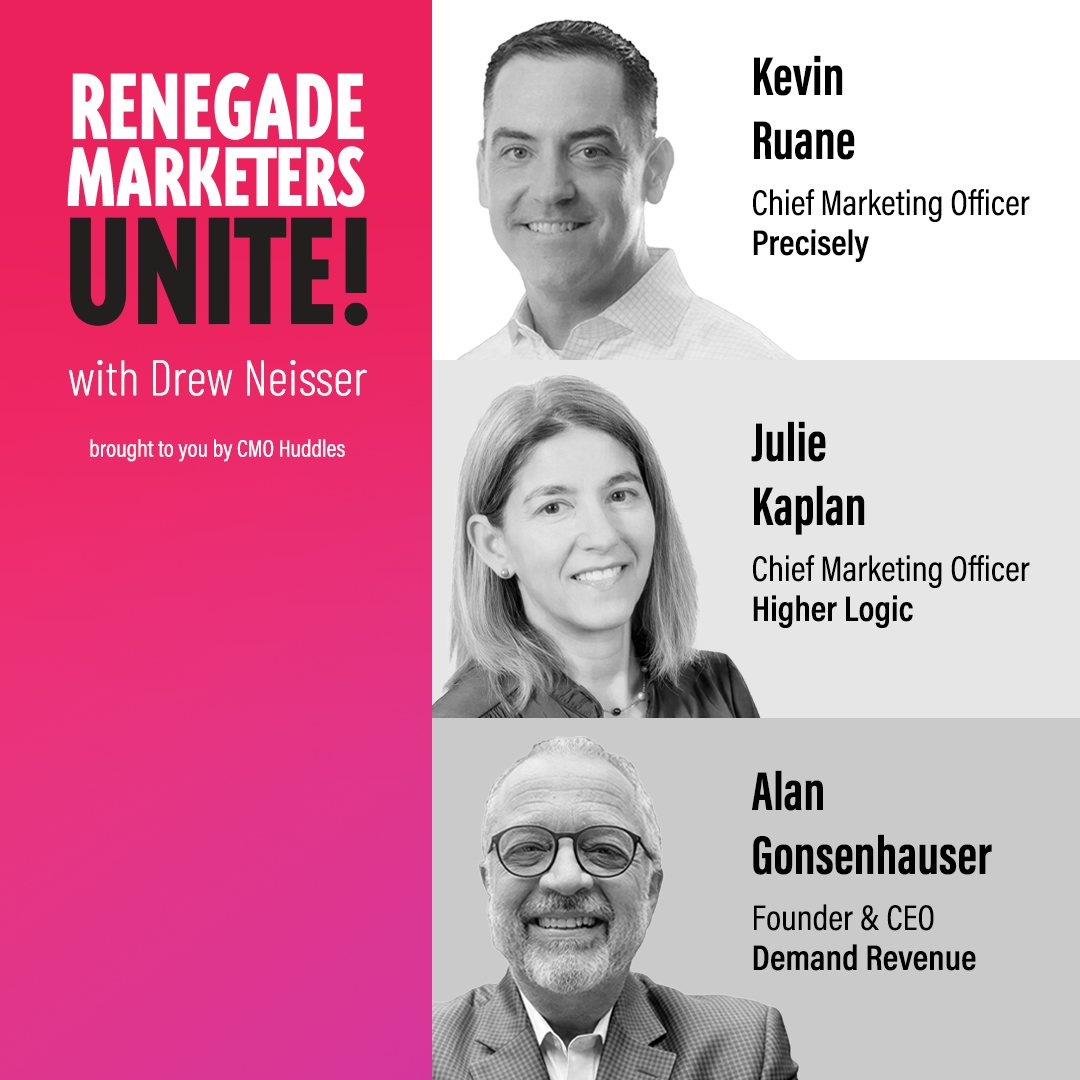
In this episode, Drew talks with Kevin Ruane (Precisely), Julie Kaplan (Higher Logic), and Alan Gonsenhauser (Demand Revenue) about what it takes to succeed as a PE-backed CMO. They explain how to learn the investment thesis, build CFO trust early, use customer success as a signal source, and make growth more predictable, explainable, and easier for the business to back.
In this episode:
- Kevin shows how to make brand and demand credible with PE sponsors by tying every investment to a clear business story
- Julie explains why CMOs need to understand the PE firm’s thesis, exit story, and pressure points before adapting the marketing plan
- Alan shows how PE-backed CMOs make growth more predictable by owning outcomes and translating marketing into financial language
Plus:
- Why PE-backed CMOs need a business point of view fast
- How marketing becomes the glue across the business
- Why CFOs need to see customers, not just line items
- How to use board meetings to sharpen priorities
Listen in for how PE-backed CMOs can turn the investment thesis into a stronger marketing agenda, make every bet easier to defend, and show the business exactly how marketing creates value.
Renegade Marketers Unite, Episode 533 on YouTube
Resources Mentioned
- CMO Huddles
- Firebrick
- Past episodes mentioned
- Kevin Ruane
- Julie Kaplan
- Alan Gonsenhauser
Highlights
- [2:51] Kevin Ruane: Every dollar needs a story
- [4:50] Teach investors why brand matters
- [8:35] Talk like the CEO
- [11:18] Julie Kaplan: Think like your PE firm
- [13:31] Understand every executive's goals
- [15:20] Stop scaling broken marketing
- [19:29] Alan Gonsenhauser: Own the pipeline
- [21:28] Act more like a P&L leader
- [23:50] Don't buy churn
- [28:27] CMO Huddles: The power of shared experience
- [31:06] First-time PE CMO surprises
- [37:42] Build your PE dream team
- [46:47] How PE-backed CMOs win
- [48:27] Key lessons for first-time PE-backed CMOs
Highlighted Quotes
"In private equity in particular, you always have to be in line with your CFO. If they don't understand what marketing is producing, you're going to end up in that first conversation — the one you don't want to be a part of."— Kevin Ruane, Precisely
"It's important to understand what your PE firm is trying to accomplish with their portfolio. What story are they trying to tell with their portfolio? What does an exit look like for them?"— Julie Kaplan, Higher Logic
"The best CMOs I've worked with at PE portfolio companies have made growth more predictable and more explainable, and they take the mystery out of marketing for the PE sponsors to see what the value is of marketing."— Alan Gonsenhauser, Demand Revenue
Full Transcript: Drew Neisser in conversation with Kevin Ruane, Julie Kaplan, & Alan Gonsenhauser
Kevin: If they're hearing about things from other portfolio companies and trying to apply that to your business, and it doesn't make sense, those can be some of the most difficult conversations to have. If you're kind of setting that agenda, leading that conversation, you're just going to be in a much better place.
Julie: You need to understand where the business is trying to go, and you need to make the adaptations that adjust to everyone around you.
Alan: The best CMOs I've worked with at PE portfolio companies have made growth more predictable and more explainable.
Drew: Hello, Renegade Marketers! If this is your first time listening, welcome. If you're a regular listener, welcome back. You're about to listen to a recording from CMO Huddles Studio, our live show featuring the flocking awesome B2B marketing leaders of CMO Huddles. In this episode, Kevin Ruane, Julie Kaplan, and Alan Gonsenhauser unpack what it takes to succeed as a CMO at a PE-backed company. They talk about understanding the investment thesis, making sure that marketing can prove its place in the plan, and when the pressure's on, they get real about staying close to the numbers, leading the conversation with investors, and knowing where to place your bets. If you like what you hear, please subscribe to the podcast and leave a review. You'll be supporting our quest to be the number one B2B marketing podcast. All right, let's dive in.
Narrator: Welcome to Renegade Marketers Unite, possibly the best weekly podcast for CMOs and everyone else looking for innovative ways to transform their brand, drive demand, and just plain cut through, proving that B2B does not mean boring to business. Here's your host and chief marketing renegade, Drew Neisser.
Drew: Welcome to CMO Huddles Studio, the live streaming show dedicated to inspiring B2B awesomeness. I'm your host, Drew Neisser, live from my home studio in New York City. Today we're discussing the challenges and opportunities of being a CMO at a PE-backed company. Now, if you've read any of my Saturday LinkedIn rants, you know that I'm not exactly a cheerleader for private equity, kind of based on what I hear from CMOs about some of the directives they receive. But today, I promise to bite my tongue, and really, because it's important that, to be fair to our guests, that we not ask them to critique the very firms that are signing their paychecks. So let's be clear about that. And the point of this show is to help B2B CMOs who are at PE-backed companies be more successful. Okay, those are the ground rules. Here we go. With that, let's bring on Kevin Ruane, CMO of Precisely, and a returning guest who previously appeared on the show to discuss many topics, including AI's impact on marketing, event strategy, and driving big change. Hello, Kevin.
Kevin: Hey, Drew. Good to see you.
Drew: Nice to see you. How are you, and where are you this fine day?
Kevin: I am outstanding. I am in my home office in Massachusetts, about 20 miles due west of Boston.
Drew: All right. Very cool. Let's get into this. I mean, how has a PE-backed environment shaped the way you know, helped you shape your priorities, and you know, when it becomes demand gen versus other marketing activities? You know, give us a ground, us here, if you will, on the impact of PE.
Kevin: Sure. Well, I'll start by saying I'm going to be a little bit of your counterbalance, hopefully, Drew, to some of your perspectives on PE. Now, granted, I have grown up as a CMO in PE-backed environments, so you know, a little bit biased by that experience. But you know, really, what my experience has taught me is it really has helped sharpen the focus and really requires you to make sure that every dollar of investment has a story. And so, you know, I think what that means from a demand gen perspective is it really is front and center. It needs to be the connective tissue running through everything that you do. And that's not to say — don't misread me here — that brand building or other marketing activities aren't important. They are absolutely critical. They just need to be disciplined. And if you take brand, for example, which, you know, isn't a dirty word at Precisely — we talk about it, we talk about it with the investors and the board all the time — you know, you just got to cast it a little bit as a demand gen lever in the PE environment. And I assure you, I don't know everything that my PE sponsors think, but I know that they care a great deal about pipeline velocity. And the ones that I work with certainly understand that brand helps to accelerate.
Drew: No, there's one thing that I love the way you said it. You have to, one, sharpen the focus — always a good thing. And every investment has to have a story. And what I like about that is I'm assuming you use that language instead of "every investment has to have an ROI."
Kevin: That's correct. I think we know, as you know, marketers and CMOs, that that's probably an impossible task. But you know, if you have that story, that can kind of help cover, you know, the fact that some of what we will do will work, and some of it will be lessons that we can learn and apply going forward.
Drew: And let's break this down. So, what you're saying is that the PE firm that you're working with understands brand and demand and the role they play together. Maybe you could help tell the story of how brand does impact demand, and how you've told that story.
Kevin: Yeah, I, you know, and I don't think it's earth-shattering, and probably, you know, something that many of my peers at the CMO level are doing, is, you know, just helping them understand, you know, especially in the changing world in which we're living, your buyer's journey has been upended, and you've got people who are coming into you much further into their journey than they may have been in the past. So, you know, how you're showing up, and you know, where they come in, and how you're on the short list before, you know, they ever engage with even marketing, let alone sales. You know, it's just very different. And so, you know, I do think you need to have a strong, you know, a strong brand. I think investors understand that you need to be, you know, positioned and aligned to the major themes and where the market is going. And I think it's really important, you know, to make that connection between that work that you're doing and how that impacts the ability to improve conversion rates and sort of get the value out of the investments, you know, that you're making.
Drew: All that made sense, and we are in this rapidly transforming environment where brands are being discovered on LLMs. And what's interesting about that, at least the conversations that we've been having, is things that may have been harder to rationalize before — whether it's PR, or just, gee, do we have awareness or not — those things matter, perhaps maybe more than they did before. It's kind of ironic, right? That some of the old-school things are sort of coming back, because if they don't recognize your brand and you don't show up in the LLM, you were never in the conversation.
Kevin: And what a great opportunity to go invite that conversation with your investors and kind of lead with that insight and explain to them why you're doing the things you're doing, versus, you know, waiting for the question to come in, and then you find yourself in a conversation about how organic traffic on your site is cratering, and you know, it just goes down some different paths. So, you know, what we ended up doing, you know, very early on, was, you know, knowing that our PE sponsors are working across a wide variety of portfolio companies, they're triangulating what they're hearing. We want to actually lean in and lead and kind of shape that conversation that we want to have, and explain what we're doing and why we're doing it, versus waiting for the question, where you're kind of automatically on your heels and playing defense.
Drew: Right. So if they learn from seven other companies that they're investing heavily over here and they're seeing results, and you haven't raised that as an issue — yeah, so a little proactivity, and it's sort of just really good management, I would say.
Kevin: And that's where you can sometimes, with PE sponsors, get in trouble — is that they're hearing about things from other portfolio companies and trying to apply that to your business, and it doesn't make sense. Those can be some of the most difficult conversations to have. So if you're kind of setting that agenda, leading that conversation, you're just going to be in a much better place. And you know, I think the ultimate compliment, you know, that I've had — and this has happened, believe it or not, several times in the course of being a CMO with, you know, private equity-backed sponsors — is when they're asking you to go talk to their other portfolio companies and help share what you're doing and why that makes sense for you. You know, that's where you know you're onto something, and you're kind of heading in the right direction and in a good space.
Drew: Yeah, and I suspect that credit — so here's the question then: where does the credibility come from? One, you can bring up this initiative and say, "Hey, LLMs are really important, and let's talk about here are some of the strategies that we're doing to do it." But I wonder if, like you mentioned earlier, pipeline velocity as a critical metric — if you can show pipeline velocity, and you can show that you're making headway there, then they might respect you more, perhaps. And so I wonder if it always comes back down to: if you have a healthy pipeline and a healthy close rate, you are credible.
Kevin: Well, I mean, I think, you know, usually that's where it starts, right? And once you can kind of build some credibility and put some wins under your belt there, then you earn the right, I think, to kind of broaden the conversation. But you should be challenging yourself where you can to tie yourself back to those levers wherever you can, because that's sort of speaking the language of the sponsors and who you're working with. And you know, sometimes it works better than others, but the reality is, I just have experienced the focus and accountability that that drives is a much better place to operate. You know, there are certain things you control and you don't control, and you're probably not going to be able to change some of the focus on that. So play the game instead of beating your head and trying to kind of take things in a direction they're unlikely to go.
Drew: Yeah, I mean, these are the rules, right? And it's important to understand the rules, and it's important to play by the rules, to the extent that playing by the rules also means that you're doing effective marketing. I guess that's where the big issue arises, right? Okay, love this. I mean, every investment — the headline for me: every investment has a story, and I love that. With that, let's bring on Julie Kaplan, CMO of Higher Logic, an industry expert who has graced our stage to delve into many topics, including quick wins, marketing metrics, and ABM. Hello, Julie! Wonderful to see you again.
Julie: Nice to see you.
Drew: So, Julie, how are you, and where are you?
Julie: Well, I'm in Maryland, and I'm doing well. And I'm gonna echo Kevin's comments in that I've had a very positive experience with PE-backed firms. So my answers here today may be biased, but there are definitely very good players in the marketplace that can be helpful, and you can learn and grow from.
Drew: They're getting schooled here, which is really good, because you know, I have to admit, I do get a lot of sad stories as well. So this is wonderful, and I just assume that if you agreed to be on this show, you would have positive things to say, because you're not going to come on and rant necessarily — this would not be the forum for that. So talk about, then, sort of, when you say a positive experience, what are the sort of aspects of the PE involvement that help you, say, be a more effective marketer?
Julie: Okay. Well, first I should note that not all PE firms are alike, and companies within a portfolio are not all alike. So it's important — and again, I'm going to echo more words you've already heard in the show today — it's important to understand what your PE firm is trying to accomplish with their portfolio. What story are they trying to tell with their portfolio? What does an exit look like for them? Depending on your position or the time that you land in their investment, you may or may not have access to the people who can tell you that directly, but you can infer it from conversations that you have with people in your own company. And understanding what that story is, and your company's role in that story, helps you make really good, smart marketing decisions. Now, it's not uncommon that you will hear things like "we need pipeline," you know, because it's often part of the story that you need to work on, you know, the revenue side of the equation that they're, you know, looking at.
Drew: Yeah, I mean, I don't think there's anybody who would buy a company and hope that it wouldn't grow and expect that it wouldn't grow. The language that I have heard often is: understand the thesis. What is it? Why did they buy the company and think they could grow it? That's part one. And number two: understand where you are in the exit cycle. Maybe you could — so, what do you think are some of the — I don't know — we have capabilities, and so knowing what they want from you is one thing; delivering is another, right? And so, look, every company wants pipeline, but it's not like just saying, "Okay, we want more pipeline, and we're going to focus on pipeline," that you get pipeline. It's a lot of pieces that need to go together. Talk about some of the capabilities you think matter most to succeed.
Julie: So I think a CMO needs to really, again, understand the part of the story that they're in, and they need to understand the pressures that are on their own colleagues. You know, what is the CEO and the CFO being pressured on? Are they being pressured for scale? Are they being pressured for cost reduction? Are they being pressured for increasing speed of product development? Understanding and really being curious about the business, and what value marketing can bring to other parts of the organization, is super important, because you can make the adaptations in marketing that will support that without having to have deep discussions with everyone. Now, you should be developing those relationships, but you know marketing, and you know what the levers are. What you don't know is what the pressures are in the other parts of the business. What you might not know is, you know, where do they need help? Your colleagues might not know that there's something marketing can do, you know, to help in those areas. You are part of a company, and it's a company story you're telling, not just a marketing story.
Drew: Got it. I guess, you know, if we broke it down and we said, look, if it's EBITDA, that's always problematic, because that simply gets down to efficiency of use. I would say cost per acquisition — that's a much more difficult environment for the marketer. I'm curious, if you are lucky enough to be working for a company that is saying, "We want you to scale" —
Julie: By the way, that usually happens at the beginning of the investment.
Drew: Yes, exactly.
Julie: Yeah.
Drew: So they say scale. So what does that mean to the CMO in terms of how they approach budgeting, how they approach spending, how they approach leaders? I'm just curious, for example, on that one.
Julie: Well, you have to understand first — is your machinery built for scale? So many marketing teams grew out of scrappy, you know, put-together startups, and it's a lot of manual work. That kind of machinery is not going to scale. If you're trying to make that old machinery just work 10% better, you're not going to get to scale — you failed from the start. If you're going for scale, then you need to rebuild. If you have a good machine in place, well, what are the pieces and parts of that machine that aren't working? You know, it's often found in conversion, or maybe not — people aren't coming fast enough into the top of the pipeline. These are all things all marketers know, and Drew, you've been talking about it for years and years, over and over and over again. So it's not new. It's how you adapt to the rest of the organization, and nobody can give you a formula for that.
Drew: Right? No, because every company, every situation, competitive pressures — all of that starts to matter. And obviously, at that moment, there's no difference between you sitting in a PE-backed firm versus public or private. You know, you're trying to grow the company in the most efficient way. I wonder how the language that you use, and if you think about that differently in the context, as you are explaining and defending your marketing — and you know, one of the things I hear about is that sometimes they're in the weeds, they're looking at, you know, a lot of detail. How do you sort of keep them focused on the big picture?
Julie: I personally haven't had that experience. We're super in the weeds about marketing. So right now we have a PE firm that's excellent, right? They're sitting side by side with us. We're having conversations about what the right thing to do is. That's unusual, and I'm privileged to have that experience. If I think about other experiences with PE firms, the more commonplace, at least in my experience, has been marketing is just not the thing they're talking about. It comes through levels, and you kind of have to figure it out. They're not in the weeds in marketing. I would consider it a great compliment if they want to talk about marketing, because I need their help in getting investment. I need their help in helping the company understand that marketing is an important and integral part of the business that cannot just go off and do PowerPoint decks on our own — that it is an engine within the business that needs to work with other engines in the business. So if I rewind time and go back to some of the other experiences I've had, I would have loved to have been having conversations with the PE firm, because then I know that my colleagues care. Again, I'm in a very fortunate situation where that's not the case right now, and we're just talking about how to make the business better, faster. You know, how do we rethink things so that we experience growth that no one thought we could?
Drew: It's funny, you make a great point, which is: if they're ignoring you, then marketing doesn't matter to them, which I think is a really interesting sign. So for all of you CMOs that are at a PE-backed firm, if they're not having regular conversations with you, chances are they don't think marketing is a growth engine. So thank you for that — that's fascinating and important to recognize. All right, let's now welcome Alan Gonsenhauser, founder and CEO of Demand Revenue, who's previously joined us to talk about budgeting, fractional CMOing, and customer-led growth, and also happens to focus his practice on PE firms. So, hello, Alan. Welcome back. How are you? And where are you this fine day?
Alan: Hi, Drew. Great to be back. And I'm wonderful. I'm in the Boston area, doing great.
Drew: So you heard from Kevin and Julie — I imagine much of what they said resonated. But you also had some thoughts that you wanted to add, to build on some of the thoughts that they had.
Alan: Well, I, you know, say that, like them, I have had very positive experiences with private equity investors that I've worked with and their portfolio companies. So I don't think there's going to be a lot of disagreement there. And I totally agree with what Kevin said about brand speeding demand, and also, it's really important — the best CMOs I've worked with at PE portfolio companies, like Kevin, is a great example, have made growth more predictable and more explainable. You know, not just "we ran campaigns," but they understand pipeline coverage and understand where it's coming from and how to make the order. And they take the mystery out of marketing for the board to see and the PE sponsors to see what the value is of marketing.
Drew: Take the mystery out of marketing — I want to go deeper there, and I know you talk and write a lot about this, taking the mystery out. So let's break that down a little bit. So, an effective CMO at a PE-backed company, you know, creating predictable pipeline feels like a really good thing to do. It's kind of hard, isn't it?
Alan: It's not the easiest thing you do, but you have to take the risk, and you have to take ownership over the pipeline with sales. And you know, you have to make the CEO's side easier by owning outcomes, not just activity, and being very tightly aligned with your peers. The head of sales, the CFO, is a really important internal ally to have — that's your ticket, you know, to the board and the PE sponsor. And you know, CMOs — the best CMOs are embedded in the business. They understand the investment thesis. They know the growth targets, and they align marketing to everything that the business is trying to do on an ongoing basis.
Drew: So it sounds wonderful, it sounds beautiful that, you know, I mean, we own outcomes, not — you know — marketing is there to impact the company in any number of ways, including driving pipeline and helping close faster and helping win big deals. Where does the problem begin, then, in these things? Because these are great things — why wouldn't you want to own outcomes instead of things? What are some of the things that sometimes prevent CMOs from being successful in doing the things that you're describing? Is it know-how, or is it some other structural thing?
Alan: Well, I've met a lot of great marketing people that are wonderful at marketing, but they act more like leaders of the marketing department rather than a P&L general manager. So you have to know how to translate the things in marketing to what the board cares about, and what the CFO and the CEO and the C-suite cares about. Let me give you an example: you can't just talk about "we need to make more investments in brand or brand reputation." You have to translate that into what the financial implications of that would be. More of that, because you're going to be on those short lists that Kevin was talking about earlier. You're going to have a better win-loss ratio. You're going to have more pricing power. These are all things CFOs and boards care about. And so you have to look at marketing as a series of investments. And you can't track everything — we all know that — but you have to speak in a different language, not in marketing speak, but in business and financial terms, to explain to people why we're making the investments we're making and what we think the impacts are going to be. And you have to commit yourself to some of those impacts and take some risk, so you'll be a real partner. It's acting more like a P&L general manager and the leader of a fund, if that makes sense.
Drew: I mean, it totally makes sense to me. It's funny, because we've been having these conversations for six years in CMO Huddles, and I feel like every CMO that we talk to — and you know, I joked in one of your posts, I hope that we — because you made a comment about a CMO, I joked, "I sure hope they aren't in Huddles."
Alan: I hope there aren't many.
Drew: Yeah, I mean, we've been talking about this. The one of the issues that I bring up a lot is short-termism versus long-termism. When we used to think about marketing, you would say the marketer has their eye 18 months out, the sales team has their eyes out a quarter, right? Right — they're getting paid by quotas. And so when I hear where — when the conflict of PE firms, in my mind, comes to pipeline, pipeline, close, close, close, right, revenue, revenue — when, in fact, you know, the things the marketer's doing today will impact things not necessarily in the next three months —
Alan: Right. It goes back to what Kevin was saying: brand feeds demand. And if you look at some of the research that's come out from Ehrenberg-Bass and 6sense, you know, 95% of companies are not in the market to buy something today. They will be in the next 6, 12, 18, 24 months, but not today. But they are consuming content and developing short lists of vendors they will consider when they do go in-market. And when they do go in-market, 95% of the time, one of the vendors on that short list of four to five companies will win. So brand absolutely feeds demand — it helps win-loss ratio, pricing power, and even go financial metrics. So it's really balancing the short- and long-term objectives. And the other thing I'll say: if you've got a long — I've seen companies that have brought on business they couldn't renew or grow, and so you're just buying debt — you're not buying long-term growth. So that's another example where short-term wins may be good for the current quarter, but if you can't retain those customers and grow them, you're buying churn, you're buying debt, and you're not buying your long-term financial success. So with those kinds of conversations, I've had a lot of those with CFOs, talking about balancing short- and long-term investments.
Drew: That one feels like it comes completely down to what you incentivize, right, and what you measure. And if you tell salespeople "close, close, close," they're just looking at revenue — they don't care, they're going to close whatever they can close. But your point about getting the right ICP and getting the customer that's going to stay with you a year, or two, or three, means that you have a lot of good data on not only "this is the right ICP," but "this is the ICP that will stick." And this is the question that sort of gets really tricky: is it an assumption that your next best customer is going to look like your last customer, which used to be true? You know, this is a tricky one.
Alan: A couple of days ago, I did a LinkedIn post just on that topic — the eight traps in how people consider their ICP. And the first thing I recommend is to do a customer cohort analysis of those segments of customers. Look at the win-loss ratio, look at the gross revenue retention, and look at the net revenue retention, and triangulate between them. So look at segments of customers that you can more easily get, keep, and grow, and then look at the external positive market headwinds and tailwinds, and your internal capabilities to be successful — that you're actually ready — and balance those two, and you'll know where to promote your investments.
Drew: I love it. All right. Well, so far, just to recap folks, you've got to be able to — every investment has a story. That's part one of this thing. Focus and accountability is part two. Part three: understand where the firm, the PE firm, is coming from. Act like you own the P&L and that you own outcomes. All right, with that, it's time for me to talk about CMO Huddles. Launched in 2020, CMO Huddles is the only community of flocking awesome B2B marketing leaders, and that has a logo featuring penguins. Wait, what? Yes, well, a group of these curious, adaptable, and problem-solving birds is called a huddle, and the leaders in CMO Huddles are all that and more, huddling together to conquer the toughest — I might argue the coldest — job in the C-Suite. Little pun there. Kevin, Julie, Alan, you're all incredibly busy marketing leaders. I'm wondering if you'd be so kind as to share a specific example of how CMO Huddles has helped you.
Julie: So one of the beauties of CMO Huddles is that you have access to other people who have experimented with use cases you're trying to solve for for your company. I have a small team, less than 12 people, and amongst us, we haven't encountered every situation that we need to solve for on our marketing team, but I can tap into dozens of smart people and their smart teams and learn from their experiences. That helps me come up, and my team come up, the learning curve much faster.
Drew: So amazing, and it just means you're not quite alone in there as a solo marketer. I love that. Thank you for sharing that. Kevin, any thoughts?
Kevin: Yeah, no, and Drew, I have to give you some credit here, and I mean that sincerely. So, in the context of today's discussion, when our investors started pushing us to really sharpen and accelerate our AI strategy and make sure that our positioning reflected where the market was going, I turned to you and CMO Huddles for help, and you connected me with what I would say are probably three or four of the top experts on building AI-forward positioning in the market that's substantive and defensible, and that led to an engagement that we did last year with Bob Wright and the Firebrick team, and honestly, it was one of the best strategic investments we made last year. We were able to, as part of our kickoff to 2026, be in market with the new positioning, and so far it's resonating really well. So, kind of a good example where a push from a PE sponsor and the help of CMO Huddles really, you know, turned into a great win for the team and the business.
Drew: Oh, I love that case history, and I'm so happy — and boy, I'm such a believer in repositioning and getting that right, and how important that is to everything else you do. So it's great to hear that's working. Alan?
Alan: Yes, well, I would say the conversations are specific, and all the folks are really generous. And to give you a specific example, in the last couple of weeks, someone I met at Super Huddle reached out to me for CMO coaching, who works for a company that's a portfolio company of a private equity firm, and I love helping CMOs. It's part of what I do in my portfolio career, and this looks like a great fit. So thank you, Drew.
Drew: I love it. All right, well, if you're a B2B marketing leader who wants to build a powerful peer network, gain recognition as a thought leader, and get your very own stress penguin, please join us at cmohuddles.com. Okay, so let's — this is — let's all hear, what do you think the surprises are for CMOs when they step into a PE-backed company for the first time? And maybe they shouldn't be surprises, but I feel like there are some. Anybody want to jump in on that one?
Kevin: Drew, I've got a thought on that. I think for me, it's really just the speed at which you're expected to have an opinion, and that's not even an opinion about marketing — it's about the business as a whole, the market you're in, where things are heading. You know, I think what I've found is my PE sponsors, they certainly like to be — they see me as being an expert in marketing and bringing that capability to the business, but you know, they really want overall business leaders who can think more broadly. And as Julie was kind of talking about earlier, make that connection between what marketing does and what the investment thesis is, and what we're here to do.
Drew: Talk a little bit more about the speed, because I'm feeling like there's — I'm almost thinking of this as this velocity gap or crisis where there's so much information coming at you, there's so much change happening. Is part of that the speed of opinion, Kevin, is that just the breadth of it, or the fact that we're talking — like, they ask you a question about the business and you got to answer in real time. I mean, what's it?
Kevin: It's the world in which they operate, Drew. You know, these are incredibly intelligent people who are working across all of these businesses, in many cases jumping from board meeting to board meeting, evaluating the next company for the investment, and it can be — at least initially — very direct and to the point. And time is important to them, and so they're going to ask you a question, they want a direct answer, and there's really — you know, you've got to be prepared and know your numbers and have a perspective that you can offer if you want to be able to participate and build that credibility and trust that we talked about earlier.
Drew: Right. If you want to sit at the table, you got to be prepared. Interesting. Okay, Julie, any surprises you want to address?
Julie: Well, I would just echo what Kevin had to say. The intensity often catches you off guard, but it's usually a good thing and helps inspire a lot of creativity and quick reworking. So, keeps you on your game. But I think the most surprising thing to me is how interested our partners — like we work with JMI — how interested they are in the health of the company, not just to take us to exit, but beyond that. We don't have conversations about like, "This is just our short-term investment, and we only care what happens in the next 12 months." We are really having conversations about how we're building a lasting, durable business, and they're willing to put in investment and resources to help us accomplish that. And sometimes, I mean, that was a surprise to me.
Drew: That, by the way, huge surprise to me and joy to my heart, because that means then culture starts to matter, employee satisfaction starts to matter, building something, customer centricity — you know — all of those things play into the measurement spectrum of looking at a healthy company. Because if you just look at the bottom line, you can get the bottom line, but you won't necessarily have a healthy —
Julie: Yeah, it's important to remember their reputation is on the line also, right? When they sell a company, they don't want to sell something that was just sort of put together with toothpicks, you know, that falls apart the second another PE firm takes over. That isn't what everybody wants to build, necessarily. So sometimes this is just a matter of partnering with the right people, so that you can have that lovely combination of: we have a great sense of urgency, we have something to accomplish, we have this limited amount of time to do it, and we want to build a business that's going to last well beyond an exit.
Drew: Fascinating. Alan, is that your experience too?
Alan: Yeah, I totally agree with what they both said. And you know, speed of execution setting is really important. You know, a sponsor is going to want to know what your priorities are and your thesis in the first few weeks. If it's a much larger company, you may have a lot more time to develop that, but then, you know, PE firms go very quickly, as Kevin said, and speed matters. The second surprise is how financially fluent you need to be. You really need to begin to understand the P&L, even as a marketing person. And as I said earlier, you know, talk that talk so the board can appreciate what you're communicating to them in the language they're used to. I mean, most CEOs and CFOs, that's the language they speak. So CMOs — the most successful ones — learn to speak that language and communicate properly.
Drew: Yeah, and you know, it's funny, I don't think there's any excuse here, given access to GPTs, because you could then do analysis on your own and learn the language and actually role-play with a CFO GPT. You could do all those things to prepare. So it's a little harder to claim ignorance. Not that you ever would have wanted to, but it's easier to get up to speed fast.
Alan: To your point, Drew, I was going to say, with one client, I set up a virtual board where you put in everybody's LinkedIn profiles of all the board members, and this person can actually communicate, and the board members talk to each other, and you can put PowerPoints in, and they can opine on what you're going to talk about — your talk track, your story, your presentation — before the board meeting, which is really helpful to prepare.
Drew: Yeah, no doubt. And I imagine that same process, you can put in whatever you're planning to present through that, and anticipate what they're going to say, what questions they're going to ask.
Alan: That's what it's for, exactly.
Drew: Yeah, and that has got to be helpful. All right, so we've dealt with some of the surprises. Are there places that you're finding that marketing needs to work most closely with the rest of the business? I mean, sales is kind of obvious, so I'm wondering if there's some other area — Kevin, in terms of whether it's the CFO or product — where you're finding, in order to... and again, this may be true for all companies, but I'm just curious, where outside of marketing do you need to invest more time in order to sort of work well with your PE-backed company?
Kevin: Yeah, no, I mean the obvious answer is we've got to work with everyone. And I've been working over the last couple of months with a new CEO, and he calls marketing "the glue of the business," and I love that. I think that's absolutely true. But just to answer your question directly, I think there are two things happening. One is, in private equity in particular, you always have to be in line with your CFO. If he or she is not understanding what marketing is producing, you're going to be part of that first conversation that you don't want to be a part of. So that's a critical relationship that always needs to be running in the background. I do think, especially with what's happening in the market with AI today, though, there has been a shift. And I will never say my sales colleagues are not critical — they are — but what I would tell you is, we are living in product and engineering's world right now. This is their moment, and if we aren't doing their product and their innovations justice from a marketing perspective and showcasing our value, they have more ways than they've ever had before to go around us and do it themselves. And so there's a lot of focus right now that I'm placing on making sure to be aligned and really tight, adding value with those product and engineering leaders and their teams.
Drew: You know, it's interesting, I have to go a little bit deeper on that. What I think I heard you say is the possibility exists: they develop the product, and then they just say, go into their GPT or Claude, and say, "Hey, do a marketing campaign for me," and not knowing any better, they're going to say, "This looks great." I mean, is that where we are?
Kevin: Or, "Here's your new website — I made it for you today in [tool]." I mean, and these are real conversations you have, and so you've got to have a growth mindset and say, "Great, take me through what you're thinking and what you think's missing from today, and then let me and my team apply our expertise that we have, so that we can preserve the value of what we've created, the foundation we have, and make it better, and make sure it's aligned to your product strategy and where we're going and where we see our customers going."
Drew: Yeah, and again, this gets back to this speed thing, because there is suddenly this expectation that you can build a website in half an hour. You know, forget about whether it's secure, or whether it integrates with anything else, whether it loads really quickly, or whether it's AEO or GEO enabled — "but I built it." And I've actually heard stories now of CEOs going home and building — you know, particularly at Series B companies — where the CEO, because they started as a coder, will build a new website over the weekend, and show up in March and say, "Hey, I like this. What do you think?"
Kevin: Just because he can do it doesn't mean it's a good idea, Drew.
Drew: Well, there you go. Yes, but I think that's a really interesting — if you've got eyes behind your back — that is one of the places to be thinking about that I don't think you necessarily had to worry about before. But I'd also want to say, I wonder how many CMOs or CEOs would say — and I love this language — "marketing is the glue of the business." That feels like a really wonderful aspiration, right? That is really — and I want to come back to that in a second. Okay, so Alan, what's your perspective on this? We talked about finance, we talked about sales.
Alan: Well, you know that, Drew, I'm always big on the CMO-CFO relationship. You know, I think if you have the ear of, and a partnership with, the CFO, and if you work problems together, and if you talk way before budget time — way before — I just did a blog on this yesterday on the CMO-CFO relationship. I think that's a really important one. Obviously the CSO, and also customer success, and your CHRO — I think they're all really important, but the CFO is a really critical one, especially in a private equity environment, because they're always involved with the board and the investors.
Drew: And I'm curious, and this is for the whole group: not every CFO understands or appreciates marketing's ability as a growth lever. They may have been at a company where it wasn't, and they come in and look at it as a cost. And I'm curious, in your experience, have you ever been able to get a CFO who looked at marketing as a cost to understand it, to the point where it's actually an investment lever? And what does that education process look like?
Kevin: I just think you hit the right word, Drew — it's just constant education, and I think it's slowing down to take the time to explain it in a way that they can understand. And I've got a really great example. I'm excited for next week. So I was out at a board meeting in California last week and had a chance, at dinner, with our CFO — we were talking about our customer advisory board meeting that's happening next week — and, you know, it finally just dawned on me. I invited him, and he looked at his schedule, and he can make it work. So he's just going to come and experience it, be a fly on the wall, get to meet our customers. And you know, the beauty of it is, instead of being a line item in my budget that he's got to question, he's going to get to go experience it himself. So just be inclusive, and you might be surprised in terms of how you can open eyes and educate in kind of powerful ways.
Drew: You know, it seems, when you say that, it feels so obvious, yet I don't know how many CMOs have that on their playbook — invite your CFO to your customer advisory board meetings. It is a lightbulb moment. I'm kind of shocked that I don't have it on a list somewhere. So thank you, Kevin, for that. It also occurred to me that, just like a marketer, they ought to go on a sales call. They ought to be invited. The same thing — they should be invited to a big trade show.
Alan: CFOs should be part of a customer-centric culture. You know, you want your culture to be customer centric, you want all functions to be customer centric — that's included in CFO. They have a lot bigger influence.
Drew: Yeah, I mean, several CMOs in our community are big fans of executive sponsor programs, where every executive in the company owns a big client, a big customer, and I feel that's one of the ways that you can help everybody sort of understand. So literally, the CFO or the CMO or the CRO are all responsible for specific large accounts. It's another way of getting there. But yeah, get the CFO in front of your customers so they understand — so they're not numbers, but they're people. Really a good point. I know you all prepared for this call, and I feel like I bounced around a lot. So, Julie, was there something that you had prepared that you thought would be really helpful for others as they're stepping into their first PE-backed company job?
Julie: Well, I'm actually going to go back to the last question. You — oh, go ahead.
Drew: No, go ahead. That's fine.
Julie: Again, I will echo what Kevin and Alan said about the CFO, and aligning with sales, and aligning with product. I'm also going to add to that list your besties in the company: customer success, right? You want to be close to the customer — they're the closest to the customer. They're the ones who have to live with the downstream impact of the promises you make, of the customers you bring into the company. They're your partners in identifying who is a champion of your business, who needs some nurture and some help, and they're the people who hang on to customers for dear life. So, also another critical relationship to have in the business. And I think, tying your last question into that, your relationships in the business and your understanding of how the business works is super critical. So, if you're at a PE-backed firm, know your business, know your company.
Drew: Yeah, you know, I'm just thinking about the customer success folks. In an ideal world, those calls are being recorded — that's probably the most valuable database that you have, because it's the language that they use, it's the issues, it's probably competitive information faster than you've ever been able to get it before. That's both sales calls and customer calls. But also, back to Alan's point about ICP — you can start to see patterns in the customer success people; if there's a consistent group of "whiners," you know, maybe they look like the same group of people, then maybe that's not the ICP. But your customer success people can really play a role in helping you understand that. And what we're talking about is a very complex ecosystem — customer in the middle, customer success, sales, marketing, and then you've got finance on the outside of this. I'm just curious, as you figure out how to invest your time — do you think, being at a PE-backed company, you are investing your time a little bit differently than you might at another company? I just wonder about that. And Alan, you've worked with a lot of PE-backed companies — are you approaching it slightly differently?
Alan: You know, I think there are a few things that are really important — maybe three things. You know, one is prioritization. You can't do everything. So I think — and I push a lot of CMOs on this — pick three things you're going to do really well. Yes, we're going to work on some things, but at the end of the year, you want to make sure you hit the ball out of the park on the three most important things that are going to move the needle. So don't try to do everything. Prioritize. Number two, talent and structure of your organization — it's critically important to have the right team. If you bring on folks that are not the right fit, that can really hurt you for a long time. And number three, be careful what goes into your board dashboard. You know, have a really aligned definition of what "good" looks like for the organization. Make sure you're totally in line with the CFO and the board, and don't just report to the board — use the board for a conversation, to get their input, to get their advice. I mean, you know, Kevin mentioned you're working with many portfolio companies — some of the things they bring from other companies may be very useful. Not everything will apply, obviously, but use the board meeting as a conversation to develop a relationship and get their input as well.
Drew: I love it. Okay, those are awesome takeaways. As we wrap up the show — Kevin, a couple of takeaways for CMOs who are about to go to work for a PE-backed company, a little bit of advice for them?
Kevin: You know, just surrender to it and go all in. You know, we were just talking about, enlist the help of your PE backers to help with your marketing agenda, driving that forward. Lean into the relationship with the CEO, the CFO, be inclusive. The more they understand marketing and how it can help support that investment thesis that Julie talked about, the better off you're going to be. And it's not for the faint of heart, but enlist the help of the team.
Drew: Yes, and I think it's worth just sort of saying that in a very calm way — it's not for the faint of heart. I'm going to just double down on that, because there might be some crazy in there. I'm just saying — not with the three of you, no, none of that — but there might be some crazy, just a little bit. So, all right, Julie, your chance — one or two key lessons for CMOs who are first-time PE-backed CMOs.
Julie: Other than "body armor on"? Yeah, it's — you know, the intensity is an opportunity for growth. If you're viewing this as, you know, embrace — just go ahead and embrace the twists and turns. Learn a lot, learn as much as you can, be as good as you can. I know this is sort of like a "be all you can be" kind of call here, but it's true. You are going to have twists and turns, you are not going to be able to predict them all. You need to understand where the business is trying to go, and you need to make adaptations in marketing that adjust to everyone around you. And if you're not doing that, you're probably going to get whiplash from all these twists and turns.
Drew: I love that. Well, the only thing I might add is that while you're getting all this thrown at you, you are going to need one of these — I'm just saying, there's going to be moments where you're gonna feel like you need to squeeze a stress ball, and just want you to know that there are say 700 other CMOs right behind you, ready to help you when that wacky curveball comes your way. All right, well, thank you Kevin, Julie, Alan — you're all great sports. Thank you, audience, for staying with us.
To hear more conversations like this one and submit your questions while we're live, join us on the next CMO Huddle Studio. We stream to my LinkedIn profile. That's Drew Neisser, every other week.
Show Credits
Renegade Marketers Unite is written and directed by Drew Neisser. Hey, that's me! This show is produced by Melissa Caffrey, Laura Parkyn, and Ishar Cuevas. The music is by the amazing Burns Twins and the intro Voice Over is Linda Cornelius. To find the transcripts of all episodes, suggest future guests, or learn more about B2B branding, CMO Huddles, or my CMO coaching service, check out renegade.com. I'm your host, Drew Neisser. And until next time, keep those Renegade thinking caps on and strong!