Repositioning Nutanix
When everybody has a favorite version of the company story, repositioning becomes an exercise in choosing what survives.
Sometimes the company has already changed before the story catches up. At Nutanix, the business was evolving beyond its on-prem roots, so the story had to keep pace without giving up the credibility the company had already earned. Sales, product, and leadership all had good reasons to care about different parts of the answer, so the new story had to do more than please the room. It had to be simple enough to remember, credible enough to hold up, and useful enough for the company to keep carrying forward.
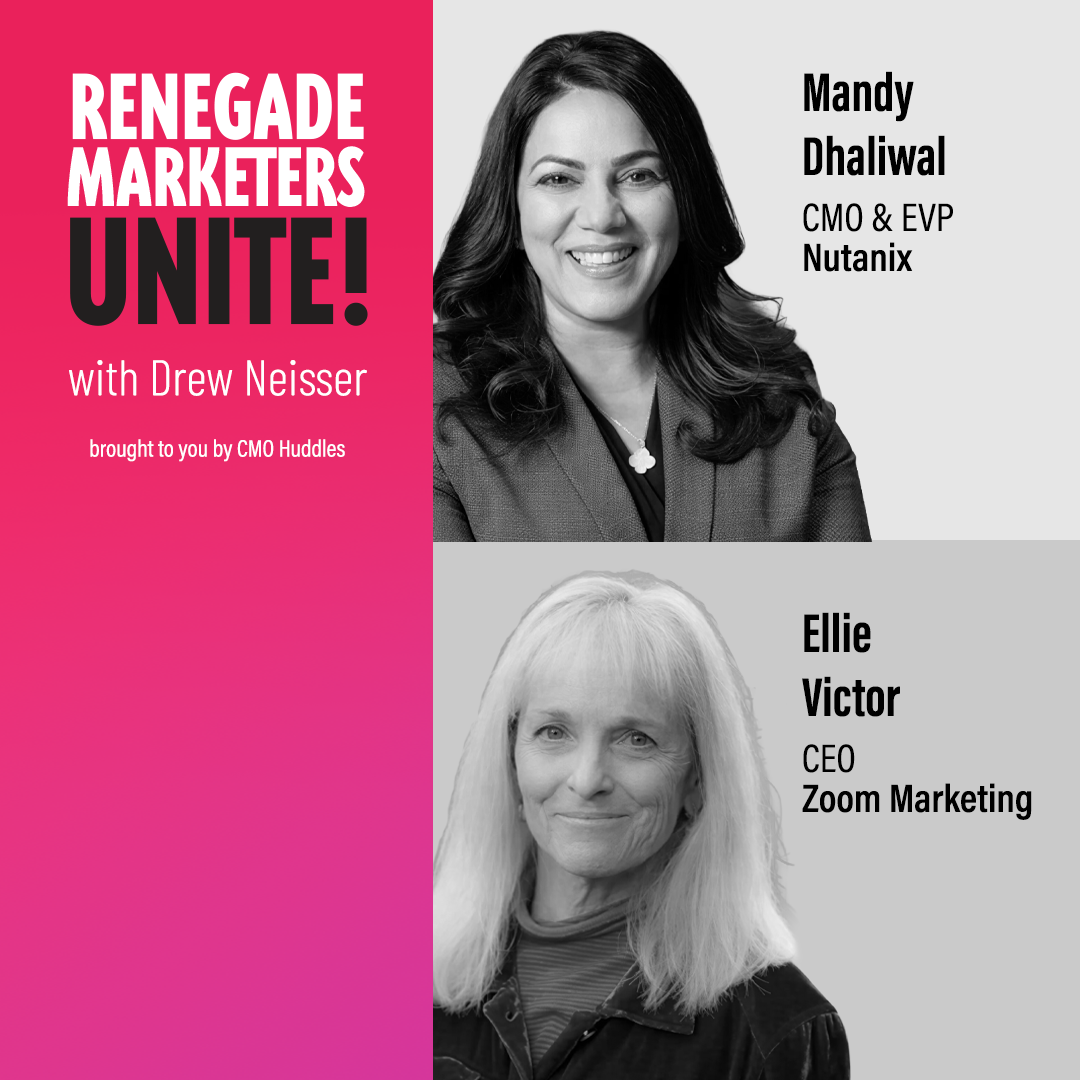
In this episode, Mandy Dhaliwal gives Drew the inside story on how Nutanix turned a major business shift into a company-wide repositioning effort. Ellie Victor of Zoom Marketing brings the outside eye that helped test assumptions, challenge the favorites, and keep the work grounded in what customers were actually saying. They share how the research shaped the positioning, how the company brought that story to life across the business, and how “Run Anything Anywhere” gave that broader shift a simple expression.
What You’ll Learn
- Why repositioning has to become a company decision first
- How to align strong internal voices without watering down the answer
- Where customer research can challenge assumptions and break ties
- What makes a new position stick across the company and in the market
Tune in for how Nutanix and Zoom Marketing worked through a multi-year repositioning. You’ll come away with a clearer way to align opinions, use customer research, and make the new story land.
Renegade Marketers Unite, Episode 544 on YouTube
Resources Mentioned
Highlights
- [2:30] Nutanix's cloud shift demanded a new story
- [5:30] Why repositioning needs an outside voice
- [7:11] Getting the CEO behind repositioning
- [11:40] Turning repositioning battles into buy-in
- [20:06] How customer fears reshaped AI positioning
- [24:11] Run anything anywhere
- [27:16] Bold positioning, backed by execution
- [29:44] Getting sales to embrace repositioning
- [31:15] Feel it, test it, launch it
- [34:48] Making Nutanix the VMware alternative
- [37:32] Repositioning results worth bragging about
- [38:46] Making AI claims customers can believe
- [40:37] Make positioning everyone's business
- [43:14] Embed your agency & align your stakeholders
Highlighted Quotes
"It's more than just a positioning exercise where you drop some words and leave. You have to be able to integrate it into all of your activity for it to stick, and that's where the secret sauce is."— Mandy Dhaliwal, Nutanix
"If you ask everyone on your leadership team, 'What is our most important differentiator,' how many different answers will you receive? Is what you're promising actually that thread pulling all the way through to what your customers say makes you great?"— Ellie Victor, Zoom Marketing
"If you're thinking about a positioning exercise or repositioning and your CEO is not on board, it means they think it's a messaging thing, and that's gonna fail."— Drew Neisser, CMO Huddles
Full Transcript: Drew Neisser in conversation with Mandy Dhaliwal & Ellie Victor
Mandy: We were changing religion. We were moving from on-prem to cloud. I think fundamentally we were all like, "Okay, this is where we've got to take the company. But can we actually go sell this stuff? We've never done it before."
Ellie: We think the hardest part about positioning is alignment and buy-in. How do you work through a process without just watering it down so you have everybody's little bit in there?
Drew: If you're thinking about a positioning exercise or repositioning, and your CEO is not on board, it means he thinks it's a messaging thing, or she thinks that, and that's gonna fail.
Hello, Renegade Marketers! If this is your first time listening, welcome. If you're a regular listener, welcome back. You're about to listen to an expert huddle, where experts share their insights into topics of critical importance to our flocking awesome community, CMO Huddles. In this episode, Mandy Dhaliwal of Nutanix and Ellie Victor of Zoom Marketing take us behind the scenes of a four-year repositioning journey. They talk about why positioning has to be a company-wide exercise, not just marketing, how customer research builds conviction, and what it takes to bring the organization along with you. After all that work, Nutanix landed on three simple words with plenty of staying power: run anything anywhere. If you like what you hear, please subscribe to the podcast and leave a review. You'll be supporting our quest to be the number one B2B marketing podcast. All right, let's dive in.
Narrator: Welcome to Renegade Marketers Unite, possibly the best weekly podcast for CMOs and everyone else looking for innovative ways to transform their brand, drive demand, and just plain cut through. Proving that B2B does not mean boring to business. Here's your host and chief marketing renegade, Drew Neisser.
Drew: Every CMO knows positioning matters, but far fewer have led a successful repositioning effort across an entire company. Today, we're going behind the scenes of Nutanix's repositioning journey with Huddle Mandy Dhaliwal and Ellie Victor of Zoom Marketing, exploring not just where they landed, but also how they aligned executives, validated assumptions, and brought the organization along for the ride. So, really excited about this. Hello, Mandy and Ellie. How are you, and where are you this fine day? We start with Mandy.
Mandy: Hi, everybody. Hey, Drew. I'm, I'm in Northern California this morning and doing great.
Drew: All right, and Ellie?
Ellie: Hey, Drew, I'm also in the Bay Area, and as a fellow tennis player, it's my favorite time of year. So I'm also doing great.
Drew: There you go. All right. So, Mandy, let's start at the beginning. What was happening inside Nutanix that convinced you that you needed a repositioning?
Mandy: Yeah, well, they hired a new CMO, and I came in, and the mandate was to take us out of the world we'd been living in very successfully and transform the business. So the business had been going from a hardware company transformation into software and into subscription. So when I got there, the, the mandate was, "Let's get us into the hybrid cloud era," and so that precipitated the need to align everybody in the organization, because nobody was telling the story the same way.
Drew: I'm curious. So was there sort of research? Was this a founder visionary? I mean, what? Who was it who decided hybrid cloud was where we wanted to go?
Mandy: It was the market need. It was what customers were demanding at the moment.
Drew: And so the existing positioning, I'm fairly certain, you were, was not going to get you there, because you were completely changing the offering of the company.
Mandy: Yeah, and now that infrastructure is so hot in 2026, right? Just to give you a little bit of the tech behind it, we were an on-prem company, so all the workloads ran on-premises and in data centers. We were making an effort to go become hybrid multi-cloud, because we're a platform that helps people run anywhere, so core, edge, or cloud. And so that was the beginning of the transition. Transition, and Ellie and team worked very closely with us, and it's been a multi-step journey to get us to where we are today over the last four years.
Drew: I guess it would help people to understand sort of what Nutanix is. I mean, and you know, you were and you are, and I know you've used some terms like hybrid cloud, but are we talking storage? What are we talking about in terms of actually what you do for customers?
Mandy: So our claim to fame was we invented hyperconverged infrastructure. So it's a combination of storage, networking, and compute in a box, basically. And we built software on top of it to help you manage your business. So the world's largest organizations run us, run us in mission-critical environments. We like. Say so. Think about your banks. Think about government entities. Think about universities, colleges. Everything that we rely on. I like to say in plain English, we're the underpinning of how these businesses run. So we, we power that core infrastructure. We sit on top of the hardware, and we're the software layer that manages all of the operations.
Drew: Okay, and it was, and it used to be on-prem, and now we're sort of, we need to get to cloud, and you need to bring your customers along with you, and you need to let them know that you're doing this.
Mandy: Well, customers have cloud mandates because Amazon, AWS, Microsoft, Google, everybody is putting workloads in the cloud, and that's expensive. And so you can have an infrastructure where you can run in the cloud, but you also have some workloads running on-prem or wherever. If you're a retailer or a manufacturer, you can have your workloads running at your manufacturing sites. That's what we call the edge. So you've got to manage all of those points in a very cohesive way, because that's the way to optimize and run your business efficiently and provide the service uptime that your customers need.
Drew: Okay, so you know, you're a new CMO. It's time for a new positioning. What was it that made you decide you needed outside help, rather than, because you knew sort of structurally you were going to be this hybrid cloud thing, that you needed an outside firm to help?
Mandy: We are deeply technical, and we're incredibly smart people and highly opinionated across every function in our business. And so, to bring everyone together and unify us internally, that was absolutely critical for us. So that was more of a CMO kind of intuition on if we bring somebody in to really listen deeply to what we want to be in our aspiration, but also marry that with what the customers and prospects and our partners need right now, and the dynamics in the industry, that would be the win.
Drew: Yeah, it's so interesting, because it is, it's so hard to do this when you don't have that outside expert to referee, to get sort of people to see, because then it just becomes this sort of internal battle. So, which I've seen happen many times. So, Ellie, now you're coming into this. What attracted you to this opportunity?
Ellie: Well, the short answer is two things: Mandy and the technology. So we look for two things. We look for, is there substance there? Is there a real technology advantage that we can position, and is there a leader who sees this as a business alignment assignment rather than a messaging assignment? And Mandy and Nutanix check both of those boxes.
Drew: And that's a really critical thing, because, like, the CMO can bring this to the table, but if the CEO is not, like, really owning it, it's a problem. And, and I know, Ellie, you've seen this across things, but, Mandy, how did that work from your CEO's standpoint?
Mandy: It was a lot of conversation, but also I had the mandate, which I had pressure tested prior to joining the company, because I had in my mind, I'm like, "Here's the playbook that I think we need," and there were a couple of key elements that were strategic pillars of the mission. And so when I got inside, did my first, you know, listening tour, in parallel, I called Zoom Marketing, and I'm like, "I think I'm gonna need you folks." So I know they're super busy. So you've got to reserve your space, if you will. And so you have these conversations. You have signals. I'm looking at LinkedIn as a part of the interview process, and I'm like, "Okay, in Asia Pacific we speak of ourselves differently, and in AMEA we do. Different sales reps are saying various things. There's no cohesive story." So I pointed out the symptoms and then started to talk about the root cause with our CEO, and then we had an agreement where he would sponsor the project, I would run it, and so we had full alignment from the office of the CEO to be able to go take this to the market, because positioning is a very strategic exercise. And I just want to repeat that notion: the CEO is the sponsor. The CMO is sort of the driver. You used a different word, but a shepherd that helps move it along.
Drew: But I, I cannot emphasize enough. And any of you have ever gone through a positioning project that didn't succeed, I can guarantee you that the CEO did not take ownership of that, right? And, and that's the number one cause of when positioning doesn't. So if you're thinking about a positioning exercise or repositioning, and your CEO is not on board, it means he thinks it's a messaging thing, or she thinks that, and that's gonna fail. Yeah,
Mandy: and just to pull the thread on that, Drew, it's, "Uh-oh, here's another campaign that marketing is running," so it's another flash in the pan. And this wasn't. This was fundamental to who we were as a business.
Drew: Yeah, and I, I think it's a tricky, it's funny, because I don't know how many CEOs sort of grow up thinking about positioning and actually understand what the word is, what it means. And I don't want to put you on the spot and say, "Did your CEO know?" But I think what, it sounds like you did is you showed them that we're saying different things in different markets. So clearly, there are some issues, and, and introduce them, perhaps, to the concept of. And I should know: is your CEO a male or female? So I can use the right pronoun.
Mandy: Reggie, he's male.
Drew: Okay,
Mandy: yeah, but, but here's the thing, right? They don't need to know if they've got a CMO that will partner with them. We're the experts, right? And so you've got to build that relationship where you can provide your professional opinion and guide, you know, substantiation, substantiation as to why we need to do this. And there was a massive desire on the, you know, on the board and the management team's side to be able to take us into the next generation of the company. So there was already pent-up demand. I didn't have to sell too hard. I basically went, "Here's how we're going to do this. Let's talk about, talk about it."
Drew: So as you're, I think one thing that would help for the CMOs listening right now is understanding what is sort of the key steps to selling in the notion of, and we may be repetitive here, but I think it's worth just putting that down in super clear words.
Mandy: Yeah, I think, I think it's, it's a conversation around future state. Where do we want to be as an organization, and where are we today? And let's thread the needle to get us there. Right? It's that simple. The tactics matter less. It's, here. Here's what. Here's where I'm going to take us.
Drew: Right.
Ellie: If I could add to that, Drew, one of the things that we say is think about the companies you admire. They stand for something. They deliver on their promise. So whatever their promise is to the market about what sets them apart, they deliver on it with their technology, with their services, with everything they do. How do you get there? So one way to do it is to point to success and then compare it to where we are today. You know, and it could be as simple as, is everyone saying the same thing, or it could be, what is the north star that guides every decision? So those are a couple of things that we'll typically say to help the CEO understand why this is important.
Drew: So we have C-suite buy-in. Everybody wants to move the company from here to here. Let's talk about sort of the initial key steps that help you sort of launch successfully when you get this program, not that you have it, but the process of repositioning. And, Ellie, feel free to talk about sort of just a little bit more about the process that you go through at the beginning stages of repositioning.
Ellie: Well, we think the hardest part about positioning is alignment and buy-in, and so if you've got, like, Mandy and Nutanix, and most of the clients we see, a series and a leadership team that's extremely smart and opinionated, how do you work through a process that it makes tough decisions and without just watering it down, so you have everybody's little bit in there? We think it's a couple of things. One is listening to that leadership team and understanding the technology at its core. My co-CEO, Nick, is on the call, and he's a physicist, so we've yet to come across any technology that he can't understand. So that's part one: is to listen to the leadership team, and then part two is data. You know, I have yet to meet a technology leader who is not data driven, and so we use data from both customers and prospects, qualitative and quantitative, to drive decisions by saying, you know, this idea that you loved, or we all loved, performed at 50%, whereas this idea performed at 90%. Let's listen to why that was and use that to help drive decisions.
Mandy: And even before that, Ellie, you know that 100%. That was the core of how we got there. But I think having the right voices in the room when you're doing that initial intake is critical. This is not just an ELT exercise. We had leaders across our business, product leaders, we had sales leadership, technical sales leadership, members of the executive team. Not all of us, by the way, and so we had the folks who had skin in the game, and so that's the other thing, and that's your job as the person that's leading the project, to make sure that you bring the right, right voices to the table, because it takes one person to say, "Well, I don't agree, I don't know what you guys did there," right? So it's a bit of a, you know, bringing folks along, but it's also having their voices heard. I can't emphasize that enough. People need to have a chance to voice what they think they are and get their fingerprints on the, the storytelling, because then they're implicitly bought in as you take them through the journey.
Drew: Well, and I guess, is it fair to say that if you can anticipate who are the senior people who are most likely to kill this or make it hard, there it is, they need to be in the room. Yeah. Yeah. Right. It's not just the people who can contribute the most, but it's also maybe there's a, a super negative person somewhere that you just need to make sure someone has heard their thing. But okay, so that's part one. So make sure this is part of this is reading the room of the organization, which is tricky and not necessarily just a straight line. Oh well, we need these three people, but if there's a salesperson who has a very strong point of view, then that may be different. You've got to get that person in the room too, yeah.
Mandy: And also, again, just to give you guys a little more color, we were changing religion. We were moving from on-prem to cloud, right? And so there was, there was a lot of internal consternation. I think fundamentally we were all like, "Okay, this is where we've got to take the company, but can we actually go sell this stuff? We've never done it before," right? Right. So a lot of things come to bear as a part of this positioning exercise.
Drew: You know, one of the things I like about the story, at least so far, is that this is a big change. This is a fundamental, like, we were going over here, we're something completely different, and I think that's really important. Like, sometimes you'll hear about repositioning exercises where, like, the product isn't changing, the service isn't changing, and that's really kind of not what this is about. This is a big shift in, in when you're doing it. So, I wonder, one nuanced thing I just want to get at. We've got everybody in the room. We're listening to them. Some, you know, in 1984, you know, all pigs are equal, but some pigs are more equal than others. There are going to be voices, like, God forbid, a CEO says something and you say, "Nah, that's wrong." I mean, but that happens. So, how do you manage the politics of the input based on seniority or how invested they are with the sharing of their point of view to make sure, and I guess probably part of the answer is testing, Ellie. But
Mandy: it's, I'll let Ellie speak in just a sec. But it's the intake, it's the blueprint, and how they gathered the information. Everybody had an opportunity to share, and there was no voice that was louder than the other in the room. That, by design,
Drew: by design,
Ellie: by design.
Drew: Okay, that's an important thing, and then you're in some ways taking the opinion out of it, Ellie, by having your data, the qual and the quant, right?
Ellie: Yeah, exactly. And one of the things, you know, you could take an extreme example where the data is pointing to one answer, and the CEO or someone says, "I don't like that, and we've, you know, we've had that." And there's two directions at that point. One is we say, "Okay, understood. Let's, let's unpack why, but let's also explore what if the data is right. Let's just pause and, and listen to what the data is telling us and consider that." Now, there are some cases where the CEO, like we worked with Ali Ghodsi at Databricks, is so convincing and charismatic and opinionated that if you have a CEO like that, he can force something, whether the, you know, whether the market feedback is there or not. So there are some cases where you cannot ignore the data, but understand it, but still move forward. But for most cases, the way we handle that is we have the leader, the CEO, or whoever is against it, or just "I don't like that," just pause for a moment and consider, "What if the data is right, and why is the market telling us this?"
Drew: Maybe, if possible, can you share some? Because we're eventually going to get to the answer here that you went to market with. But were some of the disagreements or tensions during the process, Mandy, that, that you can share?
Mandy: I think it was a, especially because we have a fairly broad portfolio, it was the vying for the top-level message. Like, my piece of the portfolio is more important, and, and, and it was, it was more the sequencing of the why, what,
Drew: right,
Mandy: how, that really, you know, we had to spend some extra time on to get folks aligned,
Drew: right? Because these are territory battles, and, yeah, right. And, and inherently, if you are focusing on one aspect of the business and you're not in that aspect of the business, you're gonna, I won't say lose, but so at some point in time, you have to convince them that this rising tide will lift everybody.
Mandy: Absolutely, and also, you know, everybody knows marketing, right? Like, our jobs.
Drew: Of course they do,
Mandy: and so there's, and I mean that in the best possible way. But everybody has an opinion, and it's like, "Well, you know, the sidebar conversation is, well, here's what I think." I'm like, "Okay, great. Like, we will include this," so it becomes this exercise of diplomatic relations to kind of, you know, get to the north star that you're trying to, and I, I keep going back to the process, the point that matters, the hill, like that methodology helps protect, and that's the Zoom methodology, obviously, but that helps protect and mitigate some of these misfires,
Drew: right? And also because they're a third party, they're not biased to any one way or another. So again, their goal is going to be to sort of get you to the promised land. It's not even about fair; it's just about closer to right than, or, or better. Ellie, were there some tiebreakers, where, you know, ideas that seemed brilliant internally didn't survive market validation?
Ellie: Yeah, that's a great question. We, we worked with Mandy on three different projects since she began in 2022, and so the one that stands out is, I believe, was the second project, was around their AI positioning. We thought, all of us thought, that the message was going to be around speed to outcomes, and they did help companies get to an AI solution faster. I mean, even some of their customers, I remember, one was a construction company, one was a mining company, and they were using sensors to deliver AI data, and they were moving quickly. So we, we thought it was going to be around speed to outcomes, but we found really quickly in the customer interviews that it was about security and governance, and that was what was stressing their customers out. That was where their emotional angst was, because they were afraid that with AI things were going to go haywire with hallucinations, and they wanted the governance and security that Nutanix is known for to include AI. So it was a bit of a pivot in where we were testing different ways to say speed to outcome, and we had to pivot and focus more on the governance and security.
Drew: It's such a fascinating psychological thing for the moment, because in some ways it sort of, it does express a little bit of AI too, right? There's the optimist that it's going to change the world, and there's the boomers on this other side. It's going to ruin every business and every job. But that's also interesting, just on a simpler level, that fear was more powerful than upside, right? Yeah. And, but, but I think the thing that connected the dots for me was that's where Nutanix was known for, anyway. So for you to attach that outcome to AI made you know that's, you have some heritage there.
Mandy: Yeah. Well, and here's the thing: as technologists, we're like, "Okay, we've got this amazing product. It's going to go help people be AI proficient quickly. That's the value prop. Let's go sell the story." And had we not engaged in the, on the research side with Zoom, we would have gone out with that message, and it would have fallen flat. Since then, we've been evolving the story, and we now have the story still relies heavily on trust and security and safety. But now we're talking governance of operations, of data, of cost management, and those are the biggest pillars. Again, like, we all read the headlines, token maxing has become part of our vocabulary, and we're, we're sitting on that technology that helps enable the, the efficient use of those tokens. So there's a lot there to unpack, but that was very formative for us in our AI story as we've evolved it. That has not changed for us.
Drew: Was there a moment? So before we, because we are going to reveal, you know, where you landed, but, in, I think that's an important part of this conversation. But was there a moment, Mandy, where you thought, "This is going to be a lot harder than we expected"?
Mandy: No, no, it gave me conviction. Honest to God, you know me. I like hard things. Anyway, that's, that's where the magic happens in our careers. But that's a separate huddle. Really, for me, it was, "Okay, I now have conviction that this is going to work," because it's resonated with the people that are spending their, their dollars and their opex on us. And I have, you know, limited funds as well to go deploy. So if I've got conviction that this story is the right story, I can go out there and guide the organization to be able to go make investments to go build our name in that and align to that value prop.
Drew: So it's an insurance policy. Ellie, I had the pleasure of being in three strategy labs with you, and, and you know, you talked about making, what's the thing you're going to make a thing about? And so I'm curious, what did Nutanix ultimately decide to make a thing about?
Ellie: Three words: run anything, anywhere.
Drew: Run anything anywhere.
Ellie: Anything is apps, data, and AI, and anywhere is core, cloud, and edge.
Drew: And, Mandy, when you, this and thought about this idea, and was there general excitement about this when it first got, or what? What kinds of explanations did you get when you got there? Talk about that language for you.
Mandy: I loved it because I loved the simplicity of it, because we were throwing around words like "control plane" and, you know, all of the tech jargon, but I wanted a top-level message that you could have an elevator conversation with. My biggest trepidation, and I use that word carefully, was the ability for our deeply technical organization across the entire go-to-market and the tech organization to actually buy into it. Because then, again, you run the risk of, "Well, marketing's not technical. They don't get what we do, and it's way more serious than running anything anywhere. Like, what are you guys talking about?" right? So there was a little bit of that. So how we managed the rollout was critically important. We did a first-call deck. We ran campaigns around it. We used it as the tagline at our user conference, so it was a softer rollout to the market, and folks lit up. There was a group of folks that went, "I don't know what that means," and then there was another group that went, "Wow, that's brilliant." And so it took a little bit of time. I joke sometimes in our ELT, like, it's like when you name a baby. You learn to love it on some of these things, right? Like, you don't know, but then, like, once you, you know, and so all of a sudden now it's been hanging out with us for a couple of years, and our competitors are using the word "anywhere," "run anywhere." And so, again, right, we set a tone in the industry to talk about infrastructure software that has made the dent in the universe that I always ask new marketing for.
Ellie: Yeah, actually, that was funny. On the last project we did, when Mandy called us to say what was the assignment, she said, "I want to punch a hole in the universe." How do you not get excited about that?
Drew: Yeah, maybe you can explain that, Mandy. It's just that's a brilliant sort of challenge to throw out. That's a gauntlet. It is
Mandy: a gauntlet, and also was just as much of a gauntlet to my marketing organization. I'm like, "Let's not continue to do more of the same. Let's just disrupt ourselves," because as this market's opening up, right? There's, again, layers of the journey. We eradicated operational complexity. We talked about that initially. We started talking about running anything anywhere. Now, where do we take this thing? Right. Sorry, I missed a slide. We talked about hybrid multi-cloud as our positioning. We now dropped the "multi" because that's a given. You can run across clouds. So now it's hybrid cloud. And then when we get to run anything anywhere, that's a big idea.
Drew: So, you know, there are some folks, purists, who say that a positioning is not a tagline, and a tagline is not a positioning. Did you use, you said you used run anything anywhere internally at your launch. Did you use it in customer-facing language as well?
Mandy: We did. We have a first-call deck that speaks to it. But again, we don't. We don't just hover on that. We go deeper, right? But it's the idea. It's owning real estate in someone's mind, right? That elicits that resonance, and then you're able to go speak about, "Okay, are you looking to run your business? Are you looking to modernize? Are you looking to migrate? Are you looking to innovate?" And then you can have a strategic conversation with a customer, but you kind of plant a, a flag.
Drew: So let's talk about how you put some meat on that bone, because it's a big, broad, bold statement: run anything, anywhere. And at some point in time, people are buying something that's fitting underneath that promise. Talk a little bit about the way you sort of explain this internally and why this was so powerful, and then maybe how it manifested itself across the various products or solutions that you provide.
Mandy: Yeah, you know, really, it was the bow on top of the package, and that's how we positioned it. But the "anything" is apps. We run workloads on our platform anywhere, given, right? You can run it wherever, and that's, and that's the unique value proposition and differentiation, differentiation that we have. The way we handle data is our moat and our secret sauce, and that story had never been told before. So when you know, you know, kind of internally, and folks got super excited about that. And then as we got into the AI world, we tagged on the AI. And so basically, it's one of those, "Your business operations can run smoothly with a company like Nutanix." Was the, the trust that we were building in the market in order to go make that happen. There's, again, like, there's materials, there's an elevator pitch, there's the boilerplate, there's the homepage, there's all the things that you have to do as a marketer within the marketing organization to enable not only your sellers but also tell the story to the analysts in the market. So all of that had to be driven very consistently. Our brand portal has all of the information as well and the creative around it. So it's more than just a positioning exercise where you drew some words and leave. You have to be able to integrate it into all of your activity in order for it to stick, and that's where the secret sauce is in terms of how to make positioning stick and actually move the needle on market perception.
Drew: So let's dig into that, because we have a question about the sales organization, how they initially received it, and how you made sure that even if they resisted it, eventually it became part of the way they went to market.
Mandy: Yeah. So, so really, the story there was I had an agreement with our, our CRO when I first got there, and it was, "You know what, Mandy, it takes us a long time when we walk into a customer account. Our first-call meeting is explaining who we are and what we do, and so it would really help if we had more awareness." Was the, was the conversation. And I said, "Okay, assignment taken. I will make sure that my team and I work on explaining to the market who we are and what we do, so when you walk into a customer account, you can start solutioning and helping them solve their challenges." So it was a very simple conversation. But that's exactly what happened, and this positioning work was fundamental to that. Because now we, again, the folks that need to know us, we're not a household name, right? We don't need to be, because we serve a very different audience that is not mainstream for most, for all intents and purposes. CIOs and their VPs of infrastructure need to know about us, and so now there's resonance in terms of who we are and what we do. So the "anywhere" is also very important as well, because we were always, historically, we IPO'd with great fanfare as an on-prem company, as an appliance company. And so when you change your stripes, you kind of have to go tell the world. I don't think I had resistance per se from sales, because they're going to go sell what the customer needs, but they appreciated the air cover.
Drew: Fast forwarding just a little bit, when did you know that this is, like, that it landed?
Mandy: Oh, day one, opening keynote of our conference, right? The eyes lit up in the room, and folks started chatting about it.
Drew: Fascinating. So, boom, on launch, because it's not always that way, right?
Mandy: But we did it in a safe space. We did it at, you know, with 5,000 of our faithful.
Drew: And I'm just going to make a note of that. If you are thinking about repositioning, there is no better place to launch that, that, at an internal event or a customer event. And it's really good to have that. And I'm assuming that you knew that was a deadline in your process. Yes, because that is really smart. And, you know, I mean, God forbid you haven't done all your homework and that doesn't land, but you'll know at that moment too.
Mandy: And then you're like, "Oh, it's just a tagline for the event." Yeah, it's just a tagline. Yeah.
Drew: So, thinking up to Ellie, up to the launch, were there any sort of things that, again, you're thinking about this from a case history standpoint? Things that you did or during the process that are worth sharing with other CMOs in terms of what things to look for, or things that can help sort of give the confidence that when you do go to the, and share this broadly, at least internally with Salesforce or your customers, that you're going to have a higher probability of success.
Ellie: Yeah, I think the number one thing is having data from the market, and we believe in both qual and quant, because the emotion, we find, we tap into in those qualitative interviews. I mean, I still remember there was another project we did where VMware was just acquired by Broadcom, and they were strong-arming customers with pricing, and we heard how customers who had loved VMware now were looking for an alternative. And there was Nutanix right there to take that opportunity. And so part of our opportunity was to find out what is the language that we can tap into without being too mercenary, but just being there. And so we found talking about freedom. You know, the freedom to run anything anywhere was one of the ways to do it. But the, the important lesson here was if you're just doing quant, you don't hear that emotion. So we heard the emotion from the customers about how angry they were at VMware and how relieved they were to have Nutanix there to solve it. And then we also heard the emotion in the AI study about the fear with governance. So it's that combination of getting the right answer by tapping into the emotion, but then if you say to a CEO, "Well, we talked to 12 customers, and here, therefore, we're recommending this," they're going to be like, "This is based on 12 customers?" No, we say we, we talked to 12 customers or CAB members, but we also surveyed 150 prospects, and this, this story resonated, you know, 50% better than this other one, and therefore we're, that's why we're recommending this.
Drew: Okay, so, and that's really helpful from an internal sell-in and getting people comfortable and excited. So, Mandy, you go to, you share this with the sales org, your customers. Fast forward six months. What are some of the signals that you knew that this was the right place and made you feel really good about all the work that you had done beforehand?
Mandy: Yeah, on the, the Broadcom VMware compete specifically, the freedom was, that was absolutely the right tone for us to set, and also, in competitive campaigns, I don't believe in slinging mud. Like, this is about taking the high road, and that's just a fundamental belief that I have and we have as a company. And so our positioning was all around: we're here to help, and, you know, and we did a really cool campaign about navigating storms. So we had the dark side of the storm, which was meant to be them, and the brighter, you know, sparkling water with us, and kind of open seas, kind of metaphor. And when we went in right after they announced the acquisition, we weren't known as the alternative. We, and we were talking about that at the board meeting, our end-of-year board meeting, as well as when we got back after the holiday break. And all of a sudden, it's like, "Well, nobody knows that we have the capability," or the market doesn't, because they were just, you know, so much bigger than us in terms of number of customers. And the conversation became, "Well, I can help. Let's go invest in the awareness." But the awareness investment was with the analyst community as well, the industry analysts. It was with the publications that these customers were going to, and we also took the moment and all the angst around it and turned it into us being the heroes to help. And so the punchline on the ad campaign was "We're here to help." And all of a sudden, because that notion of freedom was so strong, we became the good guys and gals that help people migrate over into safer passages, and so that was the whole storytelling arc. And obviously, underneath it all, the tech and all of the piece parts of the platform that were able to help and show the market that there is another answer. You don't have to be held hostage to hundreds of X price increases.
Drew: So I was talking to a CMO last week, also at a public company, who talked about a repositioning with me, this was, and the, the proof point that this individual was able to point to was that the market, and literally the stock market, learned that they were an infrastructure company, and that had a tremendous impact on their stock. I have not been following the Nutanix stock, but I'm guessing that making a move where you become an infrastructure company probably showed up pretty well from that standpoint. The
Mandy: opportunity that we were able to align to definitely helped.
Drew: When you look at it from a, you know, I mean, we can talk about language and things like that, and storytelling, but, you know, obviously, investors and CEOs and CFOs all want to hear: Did the business grow as a result of this? Yeah, and maybe you can share a little bit of what you would point to that would help link the repositioning to the market performance.
Mandy: Yeah, certainly. I think, you know, two vectors. Short term, we weren't known as the alternative. Within 90 days, we were in conversations when we spoke to Gartner. They said 85, 90 percent of their conversations are about this, this transition in the market. It was an inflection point, and we repeatedly come up as the alternative. So we were able to watch the sentiment in the market change. That was more qualitative.
Drew: Right.
Mandy: Quantitatively, as our sales teams went in and started to have these conversations, we saw the pipe increase. That was the second leading indicator. And now this is all publicly available information. We're a publicly traded company. We're closing north of 700 new logos a quarter. It's the highest number of new logos that we've been closing, and that's attributed to these migrations. And so it's a long tail, but we set this. We, we told the story. We got the resonance, and all of a sudden now we're reaping the benefit.
Drew: Okay, so that's got to feel pretty good.
Mandy: It's great.
Drew: We, we touched a little bit about AI, and, you know, there's a lot of AI washing out there right now, and everybody is an AI native, or we were AI before AI was AI, right? And, and all of that. And I'm wondering how. And you talked a little bit about it, but I want to, because I know this is an issue that a lot of companies are facing right now. We've got to get AI in our name. We've got to get it in our story. How have you managed to make AI work for you, unbelievably so?
Mandy: Yeah, there's, again, multiple layers to that. There's AI in our portfolio, like in our product capabilities. There's the use of AI within our organizations as well, across every functional area, and then there's the development and the investment we're making in our platform to make it able to handle agentic AI, and so this year, again, our AI product development has been a journey over the last several years as well. We launched GPT-in-a-Box, which was the ability for our customers to be able to go set up AI, and then we launched an inferencing capability. Now we have an agentic orchestration plane, and I'm deliberately using those technical words, but it's basically the ability to manage the agents and having a layer across everywhere your AI is going to run. So the same story translates, translates. It's what we're known for, but we're not AI washing. We're developing AI capability and speaking the language of the customers in this AI world to be able to show them the value. So you're not going to see on our website, like, all sorts of "we've always been at AI." We're investing. We're going to help you solve the toughest challenges, and we're going to continue to be that same stable platform that you've always relied on.
Drew: We're not going to see "run AI anywhere."
Mandy: We're talking, we're talking more about pilots to production and how we help make production AI real.
Drew: Got it. Got it. Let's talk. Just sort of, Ellie, maybe two key takeaways you want every CMO listening to to remember today.
Ellie: Yeah, I think, you know, everyone wants to achieve what Mandy has achieved at Nutanix, and if you think about the brands that you admire, they stand for something. And the question is, how do you get there? So the first thing is know what you're going to make a thing about. You know, we call it the point that matters. And one test, there's a lot of tests, but if you ask everyone on your leadership team, "What is our most important differentiator?" how many different answers will you receive? And another test is whatever you think you're making a thing about, how often does that show up in your customer reviews? Because that's a test of alignment. Is what you're promising actually that thread pulling all the way through to what your customers say makes you great? So, thing number one is know what to make a thing about, and thing number two is drive alignment. Don't make it a messaging assignment. Make it an alignment assignment, a north star. This is how we make decisions.
Drew: Yeah, it's, I mean, I'm thinking back to Huddles and any number of times when we talked about positioning, and I remember one CMO going to each of the individual teams and saying, "So what's our positioning?" and getting, you know, seven different answers. But the CEO insisted that everybody knew exactly where, where we were, because in that individual's mind and the CEO's mind, it was very clear. Which is, but we're not all Vulcan mind-meld readers, right? We can't quite get in that head. I also like the point about showing up in the reviews. So, Mandy, did this positioning end up showing up in the reviews?
Mandy: Yeah, it absolutely did. It was really interesting, and we've got a very faithful customer set as well. And so, I think the passion around it was awesome. But we also had aspirations to grow net new, and so for us it was, "Okay, continue to nurture the base and do all the good things that got us there, but let's also go build credibility and leverage that." So that, again, was important. And, you know, there were many folks that were customers of ours from a very long time that only knew us for that one thing that we started our journey as a company with, and so that, you know, it's always a challenge for marketing to be known across all the elements of what we deliver. So that journey continues. You know, it's not a magic wand.
Drew: No, it takes some time, and you have to stick with it and keep pushing it. And, and this is another thing. It's like, you don't, it's not like you put this out there and then, "Okay, you're done. Great," right? So, was there anything in this project that you would, if you could do it all again, that you would do differently? I
Mandy: don't think I would do it differently, because I'm very pleased, and the business results show it. I think some of the cornerstones to our success were around making sure that the partner you bring in is an extension of your team, and that's what we have with Zoom Marketing. And so I think that's critically important across my leadership team, in particular. Right, there's a really good working relationship and rapport there. So I think that's thing one, and bring them into not just the positioning part, but we rebranded ourselves early days when we did our very first launch. So we had the agencies that were working on the creative also partnering closely with Zoom. They were embedded into the Mandy org, if you will, right? So I think that's super important, because you get great results when you align yourself in that way. And then, number two, your stakeholders: keep them close. And so, in hindsight, bringing folks together, bringing the different voices together was absolutely the right thing to do. And even now, our head of product management is working with us closely when we work with Zoom. So this is not just a marketing thing; it's a company thing. So don't be afraid to bring in other folks that are stakeholders within your org to be a part of the process, because you build credibility and you get a better product.
Ellie: Yeah, if I could just add that, Mandy, you know, we, you know, I remember we had a lot of conversations with Lee. He's the product guy, and we wanted to make sure what we were learning was aligning with how he thought of the vision of the product. So the fact that Mandy opened the door for us to have those level conversations really helped us stay aligned.
Drew: Yeah, I thought it was fascinating that you bring it. You brought in the branding agency too. I don't think many folks do that, so that was a little note that I, and, and so important, because not everybody understands the difference between branding and positioning. So that's, that's a win. I'm just gonna, first of all, I want to thank you both for spending the time with us. Incredibly, in, insightful. Just as a recap from my perspective, key things here are: don't embark on a positioning project unless your, your CEO is fully embedded in the process and, and is there and prepared to both provide input and listen. Number two, yeah, when you get a chance, if you can do some research that also validates it, or, well, you might end up with a surprise. You could end up in a position that you didn't expect. Three, launch it internally in a very big and important way across the thing. We didn't even talk about, you know, there's sometimes people do a reposition. They talk about they teach people what it means and how to use it, but it sounds like the key thing I heard was sales was very involved in the process and participated in the used it. That's another sign that you're successful. And then, finally, the fact that product is continuing to be involved is so important, because if you don't change, if your product isn't changing, don't bother repositioning. So, with that, thank you both. It's an amazing conversation.
Ellie: Thank you. So fun. Great to see both of you. And thanks, everyone, for listening. You can reach out to me on LinkedIn or Ellie at Zoom Marketing if you have questions.
Drew: If you're a B2B CMO and you want to hear more conversations like this one, find out if you qualify to join our community of sharing, caring, and daring CMOs at cmohuddles.com.
Show Credits
Renegade Marketers Unite is written and directed by Drew Neisser. Hey, that's me! This show is produced by Melissa Caffrey, Laura Parkyn, and Ishar Cuevas. The music is by the amazing Burns Twins and the intro Voice Over is Linda Cornelius. To find the transcripts of all episodes, suggest future guests, or learn more about B2B branding, CMO Huddles, or my CMO coaching service, check out renegade.com. I'm your host, Drew Neisser. And until next time, keep those Renegade thinking caps on and strong!