Pick Your Battles: Strategic Trade-offs in B2B Marketing
Marketing has no shortage of good ideas. The trouble is, they’re all competing for the same budget, people, and attention.
When everything looks important, something has to give. A big growth bet may deserve the full weight of the team. A proven motion might be better off with a template and a handoff. And a perfectly good idea might need to sit in the parking lot for a while. Somebody has to decide what gets the team’s energy before every good idea starts claiming it.
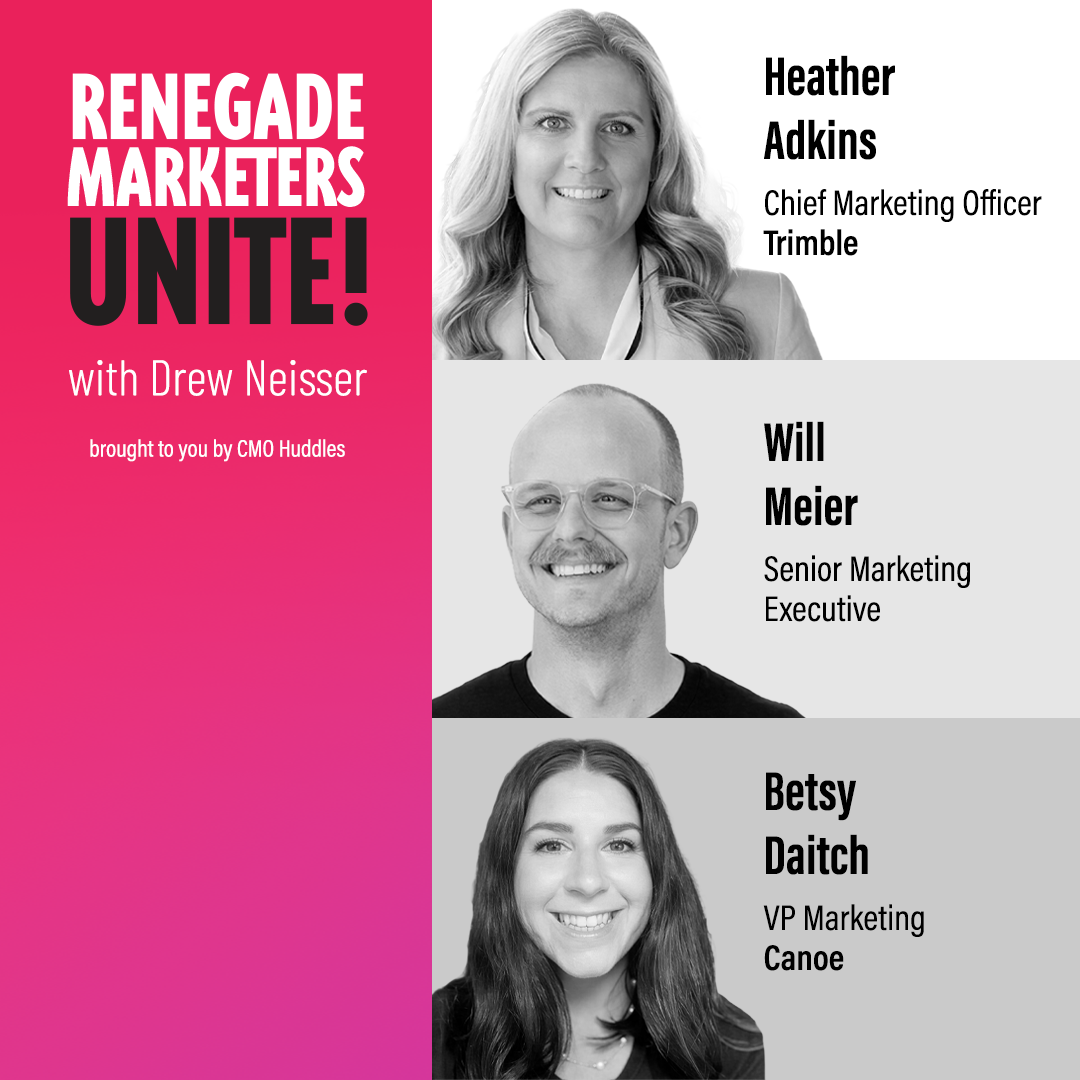
In this episode, Drew is joined by Heather Adkins (Trimble), Will Meier, and Betsy Daitch (Canoe), three marketing leaders navigating the trade-offs between business impact, time, budget, and team capacity. Together, they wrestle with the judgment calls behind those trade-offs.
How long do you let a new idea season? When has a strategy earned its retirement? And if AI gives you more capacity, where should it actually go?
In This Episode
- Heather explains how velocity, leverage, and time-to-value help decide what deserves marketing horsepower
- Will shows how tighter constraints across three brands can force better choices, including one low-lift fix that helped opportunities jump 10X
- Betsy shares how force-multiplier thinking and faster event follow-up helped move MQL-to-opportunity conversion from 30% to 55%
Plus
- How to park good ideas without losing them
- Who needs a seat at the table when priorities shift
- How to push back when conviction is low
- Whether AI belongs on the org chart
Listen in to learn how B2B marketing leaders can make smarter strategic trade-offs, prioritize marketing budget and team capacity, and use AI to create room for higher-impact work.
Renegade Marketers Unite, Episode 539 on YouTube
Resources Mentioned
- CMO Huddles
- CMO Super Huddle
- Virtual Super Huddle
- Liza Adams
- Renegade Marketing by Drew Neisser
- Tools mentioned
- Past episodes mentioned
- Heather Adkins
- Will Meier
- Betsy Daitch
Highlights
- [3:10] Heather Adkins: Support, step back, or go big
- [7:00] Tier one gets the horsepower
- [7:56] Faster value wins the day
- [11:49] Will Meier: Focus the family of brands
- [16:00] AI adds hidden capacity
- [17:35] Let small fires burn
- [21:04] Betsy Daitch: Find the multiplier moments
- [24:15] Stop chasing every request
- [25:54] Speed turns leads into opportunities
- [28:53] CMO Huddles: The power of connection
- [32:45] Test ideas without flying blind
- [38:25] Building the human plus AI team
- [44:05] Do not romance stale strategy
- [45:53] Push back without blowing up
- [47:56] How to make smarter trade-offs
Highlighted Quotes
"If you only bet on what's proven, you're managing a depreciating asset. We have to innovate, but you can't innovate blindly."— Heather Adkins, Trimble
"Sometimes you have to let fires burn, and it can be a little scary when there's smoke coming out from the door. You have to wait until the flames come out, and don't rush to put every fire out as soon as you see it."— Will Meier
"Look for opportunities where you can be a multiplier within your organization. Focus on those initiatives that not only support one goal, but perhaps two, three, four goals within the organization all at once."— Betsy Daitch, Canoe
Full Transcript: Drew Neisser in conversation with Heather Adkins, Will Meier, & Betsy Daitch
Heather: If you only bet on what's proven, you're managing a depreciating asset. We have to innovate, but you can't innovate blindly.
Will: If we have all the time and money and resources, it can be easy when a small fire comes up or you start seeing smoke to say, "Go quick, put out the fire." But in reality, sometimes we have to let those burn.
Betsy: Look for those opportunities where you can be a multiplier within your organization. Focus on those initiatives that not only support one goal, but perhaps 2, 3, 4 goals within the organization all at once.
Drew: Hello, Renegade Marketers! If this is your first time listening, welcome. If you're a regular listener, welcome back. You're about to listen to a recording from CMO Huddles Studio, our live show featuring the flocking awesome B2B marketing leaders of CMO Huddles. In this episode, Heather Adkins, Will Meier, and Betsy Daitch talk about a familiar CMO challenge: deciding what not to do. They get into tying trade-offs back to business priorities, protecting team capacity, and finding the moves where marketing can be a true force multiplier. And sometimes, as Will puts it, that means letting a few fires burn. And this just in: in addition to our in-person CMO Super Huddle on October 22nd and 23rd in Palo Alto, we do have a couple seats left, which is just for CMOs. I'm excited to announce here for the first time that we're hosting our first virtual Super Huddle on November 6 from 12 to 5 p.m. Eastern. That happens to be open to marketers of all levels, and is brought to you in part by our friends at Demand Science, who can guide you to get more pipeline now. Visit cmohuddles.com for more details. All right, let's dive into the episode.
Narrator: Welcome to Renegade Marketers Unite, possibly the best weekly podcast for CMOs and everyone else looking for innovative ways to transform their brand, drive demand, and just plain cut through. Proving that B2B does not mean boring to business. Here's your host and chief marketing renegade, Drew Neisser.
Drew: I'm your host, Drew Neisser, live from my home studio in New York City. Today, we're talking about strategic trade-offs, or what happens when your wish list is twice the size of your budget. Famous strategist and Harvard professor Michael Porter said that the essence of strategy is choosing what not to do. And what's interesting right now is AI is giving CMOs even more choices to make. So we're going to go beyond tactics to explore how marketing leaders decide what to fund, what to pause, and where they believe the next dollar, hire, or AI investment will have the greatest impact. We want to get into the thinking behind all of this. So, with that, let's bring on Heather Adkins, CMO of Trimble, and a returning guest who previously appeared on the show to discuss marketing org design. Hello, Heather. How are you, and where are you this fine day?
Heather: Hello, Drew. I am doing just fantastic. Thank you so much for having me on again. Always a pleasure to chat with you and other amazing marketing leaders. So I am coming to you from Trimble headquarters in Westminster, which is right outside of Denver, Colorado.
Drew: Awesome. All right, a little Rocky Mountain high, so to speak. Cool. Yeah. So let's talk about the signals, if you will, that tell you that marketing should lean in fully versus support from the side, or maybe step back, and just how you think about trade-offs.
Heather: You know, definitely interesting question. It doesn't always have a clear answer. In the sheer volume, I think, of good ideas, great ideas, can be very overwhelming. So we all know that if everything is important, nothing is important. So I think we all have to have a system in place to really filter the noise and find the true priorities for the business. So I start, Drew, with just strategic alignment. Right, we anchor every marketing opportunity to the company's overarching business strategy. So for example, if we're focused on penetrating a new geographic market, then marketing's priorities must directly map to those goals. The challenge here, of course, is there is more than one strategic priority. But the rule is, if an opportunity is brilliant but does not move the needle on our top corporate initiatives, then it's an automatic "not right now." Right? It could happen sometime in the future, but for now, it's just distractions and it gets deprioritized. So there's good ideas that perhaps belong in a backlog, but they're not on our current roadmap.
Drew: Interesting, and I realize I thank you for, for framing this so well. I mean, I think part of the challenge is it's conceivable that a company could have too many strategic priorities, right? You suddenly, sometimes you see it, we've got 10 priorities. Well, that's not prioritized, and so it takes a lot of discipline in the C-suite, if you will, to make sure that from a marketing standpoint, you can do what you described and support the key initiatives. So I suspect sometimes there's more initiatives than marketing can support, and there's some arbitrage that you have to do.
Heather: Yeah, that's exactly right. I look at a couple of things when that happens, because there could be a ton of corporate initiatives that the, that the C-suite has deemed worthy of supporting. But I look at non-negotiables, right? So these are like proven programs that keep the engine running that directly tie to current revenue. Certainly look at big bets. So these are the high-upside things, like a major new product launch or maybe it's a critical account-based marketing pivot. And then even then, you might still have too many marketing priorities. So, you know, another filter that I like to look at is time to value and then how scalable something is, right? So, when deciding between two highly aligned opportunities, we look at velocity and leverage. So, how quickly can this thing deliver measurable impact to the sales pipeline or brand equity, for example? Or can this asset, campaign, playbook be scaled across multiple divisions, regions, or is it a one-off bespoke request, right? And we always prioritize the repeatable ones over the episodic ones. And then also, with all of that in mind, we need space for innovation, right? So we, we definitely try to protect, you know, a certain amount of capacity for experimentation. I would say about, you know, 10% to 15% of our capacity and our budget is reserved for that, which right now heavily involves testing AI efficiencies and new ways to, you know, transform our go-to-market team.
Drew: And I'm going to start at the end with this one, because going back to my book and other things, I really do encourage every CMO to have 10 to 20 percent of their budget in that undefined experimental, and this is a perfect time if you've done that, because you're right, you could just take it and go there, but a lot of folks don't have that in their budget, worried that it'll get cut or whatever. But so let's go back to, I love the way you framed your answer, and so proven programs. Obviously, there you have to have defined outcomes and a system in place that you can show that it's, hey, this is working to achieve that objective, whatever that is. Big bets. I'm interested in big bets and, and what that looks like, and maybe you could be more specific.
Heather: Definitely. Again, like, if, if it has really high upside, if it drives revenue, it drives pipeline for the business, and the business has prioritized it. So we recently have launched a kind of tiered product launch process where we say, okay, tier one, this is going to drive the highest amount of revenue, or it's something that is going to be the most innovative. Then those are the things that marketing, from a horsepower perspective, puts marketing budget and time behind, right? So really aligning with the business on what those things are and what is going to drive the, the needle in the most impactful way.
Drew: So that was one thing that really caught me. That's helpful. The other one is the time to value, or speed to value, which I think is such a great framework, because often companies put their brand, their story, behind this notion: we can help you if you hire us, we'll help you get value out of it. But I don't often hear marketers... talking about their programs as this one is going to work faster than that one, and therefore it's worthy. Talk a little bit about how you actually can sort of know that.
Heather: Yeah, and we, we definitely look at our marketing activities short term. Marketing stop does not end at a marketing qualified account or a marketing qualified lead, right? We are there in the trenches. We have regional marketers in the trenches with sellers to look at those and, and to really come up with pipeline acceleration plays jointly across sales and marketing. So time to value for that, we have to reserve capacity for that, is pretty quick, right? But we're also looking out 3, 4, 5 quarters in the future. So we balance that short-term time to value versus the long term. Long term is going to set us up for future success, but what is that balance of delivering for the sales organization now and in the future?
Drew: Yeah, and it's so interesting, because I mean, sales, let's face it, is living quarter to quarter, and marketing often lives a year later. However, if marketing can solve the problem of either win more, like a higher close rate, or win faster, you're a hero, and, and most likely that will buy you the time to do some of the longer term. Because when we're talking about longer term, we're really talking about market development, doing things that are not necessarily going to show up in pipeline right away. It's just because not everybody's in the market.
Heather: That's right, and, and you, you opened this up by, by talking also about when marketing should lean in fully versus support from the side, or make decisions where you step back entirely, and I do think that that is where the rubber meets the road, and how we protect the capacity of our teams to balance, to be able to balance the short term with the long term, right? Knowing when to put your full weight behind something, and I think that is, could really be the difference between an efficient marketing engine and a totally burnt-out team. So, in my opinion, that's something that is, is very important to get right. So, you know, I talked about prioritizing big bets we're making as a company. So, of course, we're all in if something is mission critical to our growth plans, both short and long term. Another signal that, that we use for when we should be leaning in fully is that we are uniquely positioned in marketing. So, right, we possess a unique capability that no other department has to solve that problem. Maybe we have deep customer insights, or we have the chops to tell that better brand story, or maybe it's just a very complex problem that only marketing can solve. Right, so the target audience doesn't know who we are yet. The buyer journey is highly complex. And then there are certainly a lot of scenarios where we can easily support from the side, or where our highest and best use is really focused on enablement and giving the teams the tools and the resources that they need to self-serve. So, you know, if, if we've already built a playbook, we've successfully run a program maybe five times already, then the sixth time could be a time that it would be more of a templated motion, right? Right. So we definitely look for opportunities to hand over those, like, high-quality self-service tools, brand templates, curated emails that sellers can send one to one. They've got it right because marketing has enabled them. There's less risk of them going rogue, and also more chance that it's brand compliant and on point with the messages that we're actually trying to put out in the market.
Drew: Protect the capacity of your team is such a leadership notion, and I'm just, I just wanted to get that out there and repeat it. All right, now let's bring on Will Meier, VP of Marketing at FM, and an industry expert who graced our stage before to discuss business transformation. Hello, Will. Wonderful to see you again.
Will: Likewise, Drew. Great to be here. Thanks for having me again.
Drew: How are you, and where are you this fine day?
Will: Doing wonderful so far this week. I am in Fort Worth, Texas, where it is currently very hot. Happy fast.
Drew: And you're leading across a family of brands. So how, this, you have a complex decision process, even which products to focus on, and, and where marketing might have the greatest impact. So, talk a little bit about the strategic trade-offs and the way you think about this.
Will: Yeah, it does feel a little bit like each of our businesses is a kid, different stage of life, different needs, different wants, and so I think a lot of what Heather said is great, and a lot of what we do here as well is you have to start at the top and have alignment with leadership on, hey, for this quarter, for this month, for, for whatever period we're in, and looking at what is the focus of the business, what are the greatest business needs, what are the initiatives we're focused on, and if we don't start there, it can get pretty chaotic really quickly, especially with three brands in the mix. So starting here, not just with, hey, what are the individual priorities, but what are... the brands or businesses within this family that we're focusing on? Because we do have three brands that are in very different maturity stages, very different revenue stages, and so when we allocate resources, we're looking at, as a leadership team, okay, we can't do everything for all three brands. One of these has to take a back seat this month or this quarter or for the next six months. And so, as an example, our youngest brand, we had to set limits on it and say, across teams, time, resource, money allocations, we have to put limits on those. If it goes outside that scope, it better be worth it, or it better be very large and we better be aligned. And then it's having data points for each of those businesses to say, hey, if we have the right data points and we have clarity and we have quality data, those businesses will also reveal to us their needs. And so, with the, the smaller brand in particular, when we allocate those resources, there have only been a couple times where, whether it was me or another leader, said, hey, there is an opportunity. Let's scope this. Let's go through it. Let's find alignment. And if the, the payoff is really this big, do we agree with pulling resources off of the other businesses and brands and allocating that accordingly?
Drew: Well, and this is where it gets really tricky, because we are kind of dealing with a zero-sum game. There's a limited amount of people, time, and dollars to put. And so one of the challenges that you have is that you're going to have to say no. Some, there's going to be a, you talked about this one brand that's getting a little less, a little less love. You have to be able to communicate that to that individual, and it becomes, they're, well, wait, my job is dependent on you doing more marketing for me. So that's got to be somewhat tricky, and that's a trade-off, because you know you're trading off the potential relationship with that individual.
Will: Yeah, and so my team is fortunate where we work across all three brands. So the communication is fairly easy on my team to say, "Hey, these are the hours, the, the budget, whatever it is that we've allocated towards this brand. If we've hit the limit, I know we all love this brand, or we..." Opportunity and want to work on it, but we can't. Or you need to make a pitch as to why. When we get into the sales department or other teams, it is that conversation of, okay, well, within the constraints we have, are you getting enough leads or opportunities or pipeline from us to be able to hit your goals? And if you're not, what do we have within our resources for that brand that we can reallocate, or is there a way that we could get you more that doesn't just cost budget? That is a team reallocation, or is there something that we could take from one of the other larger brands that's working and help give you more pipeline or help you hit your opportunity goals? And it really is a conversation which I actually really enjoy, because it becomes more collaborative. Because then it actually helps us understand: okay, if you're not hitting your numbers, or you're not hitting your goals, or you don't feel like you have enough opportunities, can we dive in and can you show me? Is it that our opportunities, or what marketing brings, is a lower quality? Are we bringing enough? And maybe you're not finding some elsewhere, and we're actually the lion's share of what you get brought. Like, let's diagnose this together, and then collaboratively, we could probably come up with a better solution that we all feel great about and fits in our constraints and resources. So I think that actually forces us to collaborate at a higher level and really diagnose, like, what's actually happening here. If we have unlimited or way more budget and time, it's easy just to throw time and resources at it and hope that it goes away.
Drew: Yeah, and I imagine this is getting trickier in the AI era, because on one hand your team could be that much more productive, so they could do it. But you don't always have that luxury. Like, a lot of folks in market, they're not backfilling when someone leaves, because AI, in theory, is, is delivering this. Are you finding that with AI so far, you've been able to maybe deliver a little bit more than you could before to the brand that didn't get as much love?
Will: We're in an interesting position because our clients are agencies, brands, people at the highest level creatively that are using our product. And so, when we look at the marketing that we put out, we have a pretty high bar in terms of being able to either impress them or show them the, the level and quality we operate at. So, when it comes to deliverables for marketing, it's been very challenging for us to find ways where AI is able to deliver for us. On the backside, in terms of speed to evaluate data, being able to take larger data sets and be able to compare them or look at correlations and things like that, that has definitely made things quicker. And then, really, mostly behind the scenes for us. So it, it has had some, but I would say a lot of it is things that we weren't able to hire someone for anyways. So it's not replacing anyone yet. It's just saying, hey, you know, someone got an extra 10% capacity, or someone got an extra 15%, or it went from four hours, now they can do it in an hour and a half, and a lot of that is what we're seeing on our side internally.
Drew: Yeah, and it's interesting that so far, at least, given your, the sophistication of your target, marketing to marketers and so forth, you can't go out there with generic content. Have you been surprised at any point in time where a particular program, let's say third child, if you will, being, having been a third child, worked out fine, but you know the, you didn't always get the attention that the first two did? Have you found any ways sometimes where that necessity of, you got a smaller budget, you're getting less time, has helped you actually be more creative?
Will: Yeah, I mean, in general, it really forces us to, in a lot of cases, say, I kind of mentioned this previously, but if we have all the time and money and resources, it can be easy when a small fire comes up or you start seeing smoke to say, "Go quick, put out the fire." But in reality, sometimes we have to let those burn, and then you do realize, "Oh, that actually wasn't a huge deal. I'm glad we didn't jump on that." And in one case, it also helps you kind of zoom out a little bit and say, I can't rush into every fire. I can't rush in to fix every problem immediately. So I do have to step back and say, what are the largest ones? Maybe where's the largest area that things are being missed, or where's the largest area of opportunity where we're way over our goal and we need to lean in and push further. And one area that, over the course of a few months, I kept looking at the business and comparing it to the other two, saying, when we have SQLs that come in, we kind of have a ratio on the first two brands that we can expect for opportunities to sales, and those hold pretty true on the other two brands. And I kept looking at the small brand, saying, I know it's young, I know it's early, but that ratio is so far off. We're nowhere near the other brands, and after monitoring it and looking at it and talking to the sales team and digging into, like, you know, what does this mean? Does this mean that you're getting the same quality as the other brands and the volume is truly lower, or is the quality higher because the volume is lower? And we all ended up diagnosing it holds true for quality across the brand. We just have a lower volume, and so... over the course of a few months, realizing if we're going to do something here, it's going to require realignment and reallocation. What do we do? I started building a plan with our head of product to say, okay, are there things on the table that don't require large budgets, that don't require three- to six-month projects? Like, what do we basically have at our disposal? And what we figured out is there are some triggers on one of our other brands that exist that send opportunities to sales, and we could essentially duplicate those into the smaller brand, because they're not the same right now. And so we were able to do a very low-lift project to say, well, if we believe in what the other brands are doing, and, and all three of these are operating similarly, let's more or less... Our engineering team would probably hate me for saying this, but let's copy and paste it into the other brand. And then, lo and behold, opportunities go up by 10x. The ratio starts getting more healthy. Opportunities to the sales team are coming through, and, and they're liking what they're seeing. But it was that resource constraint of, you know, we can't go to engineering and product and say, "Dream up something amazing. How do we fix this problem?" It was, what's the lowest lift possible? Is there something that could take a few days or, or maybe a week's worth of our time that doesn't require a large effort? It would require realignment in terms of allocating resources, but we can only do something small. What do you guys have?
Drew: I love it. No, it's, it's a great example, and you know, one of the advantages of having multiple brands is you should be able to learn from one and borrow that and, and gain some efficiency. All right. Well, thanks for that, Will. Now it's time. We're going to welcome Betsy Daitch, VP of Marketing at Canoe Intelligence, who has previously joined us to talk about building your marketing team's AI acumen. Hello, Betsy. Welcome back.
Betsy: Thank you so much, Drew. Yeah, happy to be back. It's so fun to join the CMO Huddles Studio and be with you.
Drew: Well, so how are you, and where are you this fine day?
Betsy: Yeah, doing great. I'm at home in my home office in Manchester-by-the-Sea, Massachusetts.
Drew: All right. See, we are spanning the country here. So, I, you know, I'm curious. You heard, um, you heard what Heather and Will had to say. What, what resonated with you?
Betsy: So much resonated. I think, you know, as a head of marketing, everyone's dealing with some of these similar challenges. But one of the things that really resonated, I think, in Heather's response and Heather's talk around the time to value of the work that you're doing and of the initiatives that you decide to pursue as a team. And the way that I think about it at Canoe is really looking for those opportunities where marketing can be a force multiplier in initiatives that may already be percolating and brewing within other departments. So part of that is really, like, staying very in tune with the sales team, with business development, with product, with every single team to hear what's going on and, and be able to get involved and use the marketing toolkit to really elevate the work and, and drive value.
Drew: So in this trade-off thing, I mean, maybe you could think of one recently, but how do you decide where, you know, the function can make the most difference? Can be this force multiplier. What gets you there?
Betsy: Yeah. So, so always looking at things from a variety of perspectives. Looking at kind of how easy is it to do. What kind of impact do we think this will have on our brand, on our pipeline, on accelerating the pipeline that we have, and then making those, making those hard decisions, weighing up what we have on the roadmap from a marketing standpoint, and seeing how we can support other teams in order to, you know, really just check off some quick wins that have a huge impact. So I can give you an example. I was thinking of one in, in preparation for today, just in talks with, with one of our sales directors two weeks ago. He was showing me that he and his team are using Gong in order to create guides for each prospect as they move through their buying process, and I said, "Wow, that's amazing! We should make this accessible to all prospects and also get this on our website as a lead magnet and pull out the content to create a series of blog posts that LLMs can read as prospects are doing their research." So that was just a quick win. That was, the sales team was already doing this work on a bespoke basis. Marketing got involved and turned it into something that benefits the whole organization.
Drew: Yeah, I mean, I just, anybody who has Gong or a similar listening program has such an opportunity right now, because that data is real time, and, you know, I just, I feel like it's under, for folks who've had it for a while, it's so underutilized. It's, it's just a goldmine of opportunity, not just from a content standpoint, but from a strategic standpoint, from competitive alerts. I mean, it's just kind of incredible how what was supposed to be a listening tool is now sort of becoming the brain, or can be part of the brain of the organization. We've always talked about marketers getting closer to the customer. Well, there it is. So, are you, um, have you seen where marketing can create more impact, maybe by narrowing its focus? I mean, typically, you know, sales is, is the biggest, most guilty of this. To say, hey, could you create a presentation? Hey, could you do this? Hey, could you do this? And, and that list just keeps growing and growing and growing, and, you know, part of this, and, and Heather talked about this, is ability to sort of say, no, not now. Talk a little bit about perhaps how narrowing your focus, where you might have narrowed your focus.
Betsy: Yeah, sure thing. One thing that comes to mind is how, as a business, we're approaching events and the follow-up from events, and this is a bit of a, a bit of a technology play, but also narrowing the focus. So earlier this year, we implemented Qualified at Canoe. We started with the kind of the chatbot on the site, but most recently have been leveraging it, leveraging the email component. And historically, we've had almost a two-week process from completing an event or a webinar to actually having our sales team follow up, because of all of the mechanics involved after the fact. With this tool, we've really been able to narrow in and hone in on a process that allows us to deliver that, that time to value, that speed to lead or speed to pipeline acceleration from our events. You know, much faster, really narrowing the focus, focusing on, on this particular channel, and, and seeing really huge, huge results on the back of that.
Drew: Well, and so just, it used to take a couple of weeks. Now, how long does it take?
Betsy: You know, it kicks off automatically the next day.
Drew: And presumably, if someone is coming to a webinar or coming to your event, they were interested in something. And so, if you can sort of figure out what that was and get something of value back to them within 24 hours, if not an hour, you increase it. And so, when you say it's performing, what does that mean now?
Betsy: Yeah, certainly. So before we implemented this process, we were kind of sitting at about a 30% MQL to opportunity conversion rate, and now we're 55%.
Drew: Wow.
Betsy: Yeah. So, so huge, huge improvement in converting the leads that we're generating from events.
Drew: And the email didn't change. It was really just the speed at which you got the emails to them.
Betsy: Yeah, it was speed, and then through Qualified, there's context to what's going on in HubSpot and Salesforce. So yes, the messages that are sent are very relevant, and that certainly helps.
Drew: Got it. Just, I have to ask: Is there a human in the loop at this point, or are they able to? Are they good enough that they can just go straight out?
Betsy: Yeah, there's a human in the loop at the beginning, where our team creates a guide for Qualified, and we call it Finn. So if you go on the Canoe website, you can see Finn, the little whale. But yeah, we create a guide on the marketing team to support the outreach with all the context, and then Qualified pushes out the emails to the prospects.
Drew: I love it, and so you also have built-in measurement right away. So, and in theory, these are highly relevant because they have all these data points, and from HubSpot, it's just an incredible thing to see. Yeah, and I love the fact that you've already seen the business value. Now, what would be interesting is from MQL to SQO, if you will, has doubled. But now, will that, your normal conversion rate, continue through it to pipeline?
Betsy: I mean, we expect it to increase because we're, you know, we're sharing relevant information sooner. We're progressing the process, and, you know, time is of the essence.
Drew: Interesting. Well, I didn't think we would be at a conversation about how much improving the speed of email can do, but it does speak to the fact that sometimes it's just about finding the right problem to focus on, and amazing. And the fact is, right now the technology is there to help you solve things like this, and get it there faster, and get it there in a more relevant way. Okay, now it is time for me to talk about CMO Huddles. Launched in 2020, CMO Huddles is the only community of flocking awesome B2B marketing leaders that has a logo featuring penguins. Wait, what? Yes. Well, a group of these curious, adaptable, and problem-solving birds is called a huddle. That's a key fact. A group of penguins is a huddle, and the leaders in CMO Huddles are all that and more, huddling together to conquer the coldest job in the C-suite. So, Heather, Will, Betsy, you're all incredibly busy marketing leaders. I'm wondering if you can share an example. You don't have to, but you could share an example of how CMO Huddles has helped you in the last six months.
Heather: I would love to, Drew. I'm actually going to give two examples, and the theme that is there for both of them is connection to other amazing marketing leaders. So the first example, I was hired at Trimble as the CMO, and then a few months later, my scope expanded to lead corporate communications and PR. You connected me with Amy Masano, who had just gone through a very similar transition with Thomson Reuters. We had a very lovely conversation, and she gave me very tangible, actionable advice on how to merge market and comms teams. And then the second example is I attended the CMO Super Huddle last October and met Lisa Adams. So impressed with her thoughts on how AI can transform go-to-market teams that just last week, actually, we kicked off an engagement with her. And I'm going to quote her, but she's going to help us democratize building, meaning every marketer's hands-on keyboard building with AI, and then also to streamline and centralize enablement, so fully supporting marketing with the resources that they need to be successful. So I would not have met Lisa or Amy without being a part of CMO Huddles. So the biggest benefit for me is connectivity.
Drew: I love it. Well, thank you for sharing that. And Amy's a longtime huddler, even before she was at Thomson Reuters, and just a delightful human. So I'm so glad that worked out. And Lisa Adams, a longtime friend of Super Huddle and CMO Huddles, she was actually with us for a couple of her strategy labs, and we're expecting her to be back at the Super Huddle in October in Palo Alto, so thank you, Heather, for sharing that. Betsy, Will?
Will: Just to dovetail off what Heather said. I was trying to figure out how to scale. I felt like we were in a unique position with our brands, and I needed to scale our ABM across a pretty wide range of SQLs, and was trying to sort through how do we do that. Drew, you and I had a call, and I expressed this. "Hey, this is a problem or a challenge I'm trying to sort through." And you immediately said, "Oh, I know someone you should connect with." And his name escapes me at the moment, but you connected me with him. And I said, "Hey, I'm trying to scale our ABM platform. How do you do that?" He said, "Great question. Here's how we do it." And it was a huge unlock in a moment that really shifted my perspective in a very quick and easy way. But a great moment where I felt like, "Does anybody else deal with this? Am I the only one?" And immediately you're like, "You're not alone. Here's somebody." And we had a great conversation. It was a fantastic experience.
Drew: That really makes me happy. I love our one-on-ones. Encourage all the members of our leader program to do that because learning just keeps happening for me and the ability to share. Betsy?
Betsy: Sure thing. Yeah. So I think I've been part of CMO Huddles for maybe about a year and a half or so, and I think what I love most is the community. Leading marketing sometimes is a lonely job, so it's wonderful to be part of a group of people who are going through the same things, have gone through similar things, and can share advice. One of the things that we dealt with at Canoe, or that I dealt with last year, was establishing a new attribution methodology for our leads and opportunities. We were growing our business development team, and it was time to do that. And so I went to the Slack community for CMO Huddles, and a number of people responded in giving advice. And then I had a one-on-one with Kathy Johnson, who was super helpful in this process and made a really daunting project a lot easier.
Drew: I love it. Yeah, and Kathy's a longtime huddler. In fact, an OG, as is, and is a member of our advisory board. So I'm glad she took the time to do that. Well, if you're a B2B CMO who can share, care, and dare with the best of them, build a peer. You want to build a network or gain recognition as a thought leader, or maybe even own your very own stress penguin, please join us at CMOHuddles.com. Okay, let's talk about, so it's a new market initiative. Maybe someone on your team said, "I really think we ought to do this. It feels right, but you don't have proof because it's a new thing." I'm wondering how you sort of decide to test it, what success might look like, and I think I'll start with you, Heather, because you talked about having a budget for experimentation. So part of that obviously is coming up with some new initiatives.
Heather: Definitely, this is the ultimate test of a growth-minded CMO. If you only bet on what's proven, you're managing a depreciating asset, right? So we have to innovate, but you can't innovate blindly. So I think the biggest mistake that I personally have made is setting an arbitrary deadline, like, "Let's try this for 30 days," which, depending on your sales cycle, could be a massive mistake because you're not giving it long enough, you know, for the results to season and to actually know what impact it has on revenue, and that doesn't mean that you have to let it go for too long without looking at those early indicators, right? So until I can actually see that revenue proof, it's all about measuring momentum for me. So are we seeing high engagement quality, like, you know, above-average time on page or high-intent demo requests, and then looking at velocity, so are these prospects moving through the early stages of the sales funnel faster than maybe what our historical baseline is? And then, of course, there are red flags throughout all of that. But when you decide on that test window and the test window closes, then looking at that data through that ruthless lens, right? So if the results look scalable and pipeline velocity is outperforming the baseline, then maybe that's the decision where you can fund a phase two of it. Or if those leading indicators, you know, fall flat, then you pull the plug.
Drew: And interesting on that one, it just occurs to me that it may be the right idea. It just might have been executed a little wrong. So sometimes there's some subtlety in looking at this. So if we just tweak this, and again, it speaks to the idea of you've got to give these time, as you said, time to season. I love that expression. Betsy or Will, on that particular one, you know, how do you look at your new marketing initiatives?
Will: A big thing for me, I don't know if it's because I'm visual, or I need the clarity for myself, but similar to what Heather was saying, I'll actually make sure that we have on paper what is the goal. Are we trying to tackle a problem that we, or our goal that we haven't hit yet? Are we trying to get more out of a program or something that we already have? Like, what are we actually trying to accomplish? Because I think, especially if you have a team of very creative people who think about things and have ideas, it's easy to say, "Oh, look, there's four new ideas on the table this week," and being able to evaluate, okay, if we think that all four of these are going to hit a strategic initiative or a goal that we have, now we can march down evaluating them more deeply in terms of, okay, is one of them a short term? Is one of them a very low lift? Does one fit within the budget, or do half of them not actually have a goal attached to them that we feel like is meaningful, and we just really like the idea, and we can at least say it out loud in the room, "Hey, we love this. Let's hang on to it. Maybe put it in our bank, and if we have problems later, we could pull it out of the bank and see if it could work." So, as a leadership team, we've actually created an initiative evaluation doc, and I do a version of it with my team where we can say, okay, if an idea comes forward, make sure you're thinking critically. You're going through all these steps and running through these. Put it on paper. For me, it's really helpful to actually look at it on paper. Make sure I get my thoughts out of my head, and then it's easy to share that with a team member or to get others on board. But the biggest thing for me has been, when my team has ideas, making sure, "Hey, this is great. What initiative could it attach to, or does it help us hit a goal we're not hitting? What's the ultimate business goal here?"
Drew: Right, it's not just sort of floundering. You're grounding it on something. And what I like also, the thing that you said that I think is subtle but important, is it may be a great initiative, but again, because we're making trade-offs, we have to park it somewhere. It's going to sit in the runway a little bit longer, but we're not killing it necessarily, but because of the priorities that we've decided, that one's going to have to wait, and that may be frustrating for some individuals. But it's all right. So you've got, sometimes these are tough trade-offs, particularly if someone is doing this. So I'm curious, Betsy, how do you involve the right people without sort of losing focus of the decision, you know, it's like you get more people on the committee, and the harder it is to decide?
Betsy: Yeah, that's a good question. I think a lot of times it comes down to what is the goal of the initiative and who is best suited on the team to be part of the decision-making process based on the primary goal. You know, oftentimes what I'll do is, of course, like in our weekly marketing team meetings, go over everything that's going on with everyone and keep everyone informed as to where we are with launching this initiative, moving this one to Q3 or Q4 or Q1 of next year. But I think that it is focused on the goal, understanding the strengths of your team members, and just keeping everyone informed so that everyone's operating with visibility and transparency when things are changing.
Drew: Yeah. So, Heather, I want to go back to you on this question of sort of what's so interesting about AI. It could solve almost anything, right? I mean, it's just incredible, and it keeps getting better at doing things. But there are also these sort of hidden top costs with, you know, tokens sort of creeping up here, and so sometimes it's harder to eliminate an AI test than folks think. So I'm curious how you are approaching this from a strategic trade-off standpoint because there is this myth that if you're doing your AI right, you can do four times what you were doing with the same amount of team. It's, nobody has yet proven, but it sounds wonderful. How are you sort of dealing with AI tests, if you will, and, you know, perhaps looking at the way your marketing team is changing the way your team works?
Heather: Yeah, and you definitely caught us at the perfect moment for this question. So as I shared before, at Trimble, we are in the early stages of, you know, a full-scale marketing transformation. We brought in Lisa Adams to help us really as our strategic advisor to help us navigate this, and so working with Lisa, we want to completely kind of throw out the old way of evaluating tech, is the first thing, right? We aren't looking at AI as a tool to check the box, whether it is to test something or whether it is to determine how we should be restructuring our teams and the roles and the roles and responsibilities, right? So, you know, she talks about, like, building a true kind of human plus AI organization. So, again, we're at the early stages of doing that. You know, it really is that AI teammate shift. So, she has this great framework around moving from basic AI tools to actual AI teammates. You know, I anticipate that test showing enough promise to really change our workflow when the AI stops being just that kind of prompt-and-response calculator and starts really acting like a collaborative partner. That's when that human and AI new org chart will come into play for us. Definitely anticipate seeing those major efficiency gains, where then we can test and learn with that extra capacity and looking at that capacity impact. So, if an AI workflow reduces that time to delivery, let's say for a specific task, from, like, 50 to 70 percent, that's really our trigger. Then to kind of formally rewrite that team's operational playbook, right? So we don't just say, "Great, we're faster now," but we actively sort of rebaseline the marketers' goals and really leverage that extra capacity to do high-impact creative things, do more testing and learning.
Drew: One of the things that I'm trying to wrap my mind around is this is a time that means that you, the CMO, are investing here and not spending it somewhere else, right? Because you're now thinking, "Oh my God, I have to do marketing transformation, I have to redesign my organization, I'm creating essentially a new org chart." Where's that time coming from and how are you deciding that it's worth doing relative, I mean, because you could spend your time on a lot of different things?
Heather: Yeah, I mean, again, it's just really looking at those workflows and saying, okay, if a marketing campaign to get out the door used to be 10 steps, now we're going to automate it. We're going to build agents and connect agents, and so that really has freed up the capacity of that team to then think different. I think it's also about, when you think of the human and AI org chart, it's also around, you know, hiring for mindset. So we have a lot of team members that do a lot of different things. You know, we're hiring more kind of T marketers, where you might go super deep, but we do like the, the lines of roles and responsibilities are becoming more blurred because we have these super integrated workflows across all of our marketing disciplines, and then that again frees up time to say, okay, where else should we be focused on?
Drew: It's so interesting. Will, do you anticipate having bots on your org chart?
Will: It's a question that I'm actively talking through, not just with my team but our leadership team. And I think at this moment, it's still TBD. And I think part of that could be the uniqueness of how discerning our creative clients are. The areas we've seen that maybe show the most opportunity haven't shown up as full teammates yet, but it is really around data and analytics. We are a smaller team. We don't have an entire data and analytics team that's built out with multiple people, but we found a lot of ways to use AI where we can build artifacts in Claude that are interactive and are able to present the data for me and for the whole team in a way that is more actionable, is faster to understand what's really happening here. How does this work? And so that's where we've seen the most impact. It's we do have a small team and we don't have a data analytics department, but we do have the raw data, whether it's from social media or from advertising or the stuff on our website, and we're able to pull those together and say, okay, we're able to read data that we pull together faster. We're able to do it custom for us. We're not dependent on a department. We're not dependent on somebody else. That's where we've seen a lot of fruit. It would be great if we're able to get to the point where it can be a full team member for sure, and we're able to offload more or delegate more to them and say, "Hey, we're just asking you to do one little task. We're able to describe the thing that we need, and we're going to send you off on your way to go do it." But TBD for us specifically.
Drew: Yeah, and that's funny. Yes, I had a CMO I was talking to yesterday and said, "Look, AI, these are just bots or workflows. I'm not putting a workflow. I'm not putting my Salesforce workflow. I'm not putting my other things. Why am I going to put that in an org chart?" I thought it was a reasonable question because there's been so much momentum about these redesigns with bots on the chart, or somebody said, "Oh, you know, the next VP of marketing is a bot." So anyway, I think it's up for debate, and, you know, it would be probably scary for a lot of people. It'd be interesting to see bots on their, you know, as their partner. But so, all right, you know, Betsy, I didn't know if you wanted to weigh in on that, the whole conversation of how are you managing your AI test, but you already talked about the Qualified one as a killer example of a great workflow.
Betsy: Yeah, thank you. I mean, just to comment on that for a second, the use of Qualified at Canoe, like we call it Finn, our teammate, our AI SDR teammate. So I would argue we already have an AI bot on the org chart already, and so yeah, I foresee us exploring that more into the future.
Drew: Interesting. Okay, let's talk about a couple other things before we wrap up. One, what signals tell you that a longtime strategy or effort is no longer serving the business, and, you know, Heather, you talked a lot about this, that if you just do the same thing year after year, you're going to lose equity. But how do you know? How do you know that it's time that a thing isn't working the way it did?
Heather: I think there's definitely some clear signals, right? It's easy to kill a project that's failed after three weeks. It's incredibly painful to kill the strategy that you've built, you've championed, and you've run for three years. It can be a very humbling experience.
Drew: Yeah,
Heather: but, you know, as marketing leaders, we should not let that sentimentality kind of dictate strategy. And I think there's, again, clear examples when it's time to pull the plug. One of them is diminishing returns. Right, that's easy. Every great strategy sort of follows that S curve: slow adoption, explosive growth, you know, and then that eventual plateau. So if you're spending the same amount of budget or more, and putting in that same amount of team effort, but, for example, maybe your customer acquisition costs are creeping up while conversion rates are flattening or dipping, you know, that's diminishing returns. So it could be an opportunity to pull the plug. I think that's also looking at the partnership with sales, right? So if sales stops using your content, they ignore your campaign leads, they start building their own kind of rogue marketing materials or doing their own localized events, it might be time for a change. And then I think there's, you know, softer signals, looking closely at how your team talks about the strategy, so your own marketing team, right? So when they begin to look at and kind of list the laundry list of activities that you're doing instead of being focused on outcomes, they may be checked out, and it may be time. You know, that could be a signal that the strategy is stale and it's time for a change.
Drew: Yeah, that's so helpful. So, Will, if marketing is asked to take on something you don't believe is worth the effort, how are you pushing back?
Will: It's a great question. This is something I would say I'm still learning and growing in. I think the first thing is making sure I understand why I don't believe in it because it could be a range of things, from "I haven't really thought about it enough and it wasn't my idea," or "it just didn't sit well with me at first." But the more I think about it, maybe the more I do believe in it. It could also be I don't believe in it because I don't see how this is going to help us hit the goal. And so one thing I'm actively working on and growing on is how do I present that, especially if it's to our leadership team or our CEO. "Hey, this is what I'm seeing. I see this is the strategy or the goal that we're trying to hit. I'm a little fuzzy, or I'm unsure of how that is really going to help us hit that. I don't have a high level of confidence. Do you see it differently? Do you have more confidence, or is there a different perspective, or maybe angle, you see on how that is going to help us hit it?" And there have been a couple of opportunities and moments where, whether it's talking to a sales leader or a CEO, they've said, "Well, actually, there's this piece over here, maybe in sales, you didn't know about. I think this will help us hit." Or there have been moments where then our CEO and I say, "Oh," he says, "You're right. That's actually not going to. If that's the case and that's what you're seeing, I don't believe in it either." Or it gives us an opportunity to say, "I think," as I evaluate, okay, if I don't believe in something, do I know why I don't believe in something? What's my level of conviction? And then bringing that level of conviction to find out maybe for one other person that I'm working with, or if it's the whole room, what is everybody else's level of conviction? Because I might find out, "Oh, we all had a pretty low level of conviction." But if I don't bring that up and diagnose, how do I feel about this? And bring that to the room, I think everybody must have a strong conviction, and I'm the only one who doesn't believe in it. So working on evaluating why don't I believe in something, and then trying to open the conversation around, "Hey, here's my level of confidence based on what I see as the situation. Do you or others have a different perspective or a different level of confidence?" And then we have an opportunity to work through that.
Drew: Yeah, and I love the way you framed that. It's like, "Here's what I'm thinking. What am I missing?" And it's just a great way of non-threateningly opening the door to say, "Well, you can agree or you can disagree. Let's talk about this, and you can move on." Well, it's time for all of you to provide your final takeaway for CMOs who are trying to make smarter strategic trade-offs. So, Betsy, let's start with you.
Betsy: Sure thing, Drew. I think, you know, I mentioned this earlier, but I think that the most important thing to do is to look for those opportunities where you can be a multiplier within your organization, and really focus on those initiatives that not only support one goal but perhaps 2, 3, 4 goals within the organization all at once.
Drew: Two birds, one stone. I love it. All right, Will. Final takeaway.
Will: Sometimes you have to let fires burn, and it can be a little scary when there's smoke coming out from the door in the room over there. But sometimes you have to wait until the flames come out, and don't rush to put every fire out as soon as you see it.
Drew: Yeah, but we do have our fire extinguisher here just in case this one sort of blows a little hotter than you expected. Okay, Heather, final takeaway.
Heather: Yep, sure. So when facing tough trade-offs, anchor to the business goals, not just the marketing metrics. Frame every trade-off in a language of, you know, corporate growth, AR, ARR, pipeline. It really removes the emotion and forces that rational, kind of executive decision-making. Protect your future, meaning ruthlessly automate or template the routine stuff so you can protect, you know, that 15% of capacity for innovation, and then retire strategies with honor. Don't let that sentimentality get in the way.
Drew: What a great summary! Thank you. You just did all of my work for me. I love it. So thank you for that. Well, and thank you, Heather, Will, Betsy, you're all good sports, and thank you, audience, for staying with us.
To hear more conversations like this one and submit your questions while we're live, join us on the next CMO Huddle Studio. We stream to my LinkedIn profile. That's Drew Neisser, every other week.
Show Credits
Renegade Marketers Unite is written and directed by Drew Neisser. Hey, that's me! This show is produced by Melissa Caffrey, Laura Parkyn, and Ishar Cuevas. The music is by the amazing Burns Twins and the intro Voice Over is Linda Cornelius. To find the transcripts of all episodes, suggest future guests, or learn more about B2B branding, CMO Huddles, or my CMO coaching service, check out renegade.com. I'm your host, Drew Neisser. And until next time, keep those Renegade thinking caps on and strong!