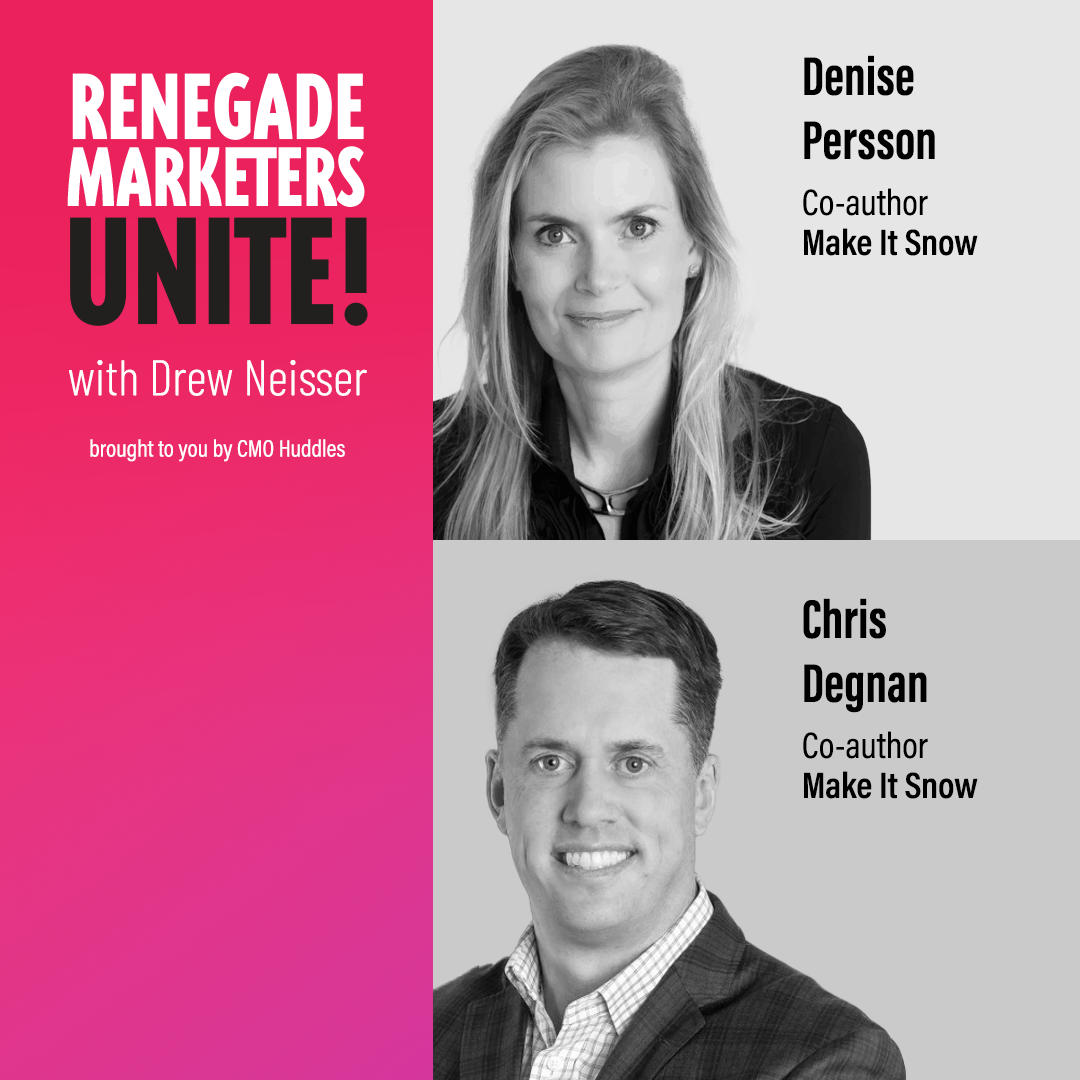
The CMO-CRO Partnership That Made It Snow
The fastest way to break trust between sales and marketing is to let each team bring its own scoreboard.
Marketing can point to MQLs. Sales can point to missed revenue. Everyone can be technically right, and the business still loses. No wonder Denise Persson and Chris Degnan have little patience for functional victory laps. At Snowflake, the question was never, “Did marketing look good?” It was, “Are reps productive, is new business moving, and are we working from the same plan?”
In this episode, Drew sits down with Denise and Chris, co-authors of Make It Snow, whose sales-marketing partnership shaped much of Snowflake’s climb from startup to billions in revenue. They get past the usual alignment talk and into the operating discipline behind it. For the pair, trust showed up in honest feedback, fast action, rep-level visibility, and a shared refusal to declare victory unless the go-to-market motion was actually working.
In this episode:
- Denise shares how she earned sales trust by listening to SDRs, AEs, and managers, then building marketing around what each territory needed
- Chris explains why sales leaders need marketing partners who roll up their sleeves, take feedback fast, and care more about the shared number than looking right
- Together, they show how a CMO-CRO partnership can hold through CEO changes, board pressure, hiring misses, and the politics of a winning company
Plus:
- How to push sales-marketing alignment beyond the C-suite
- Why “no rep left behind” became a practical GTM rallying cry
- What it took to move Snowflake from “data warehouse for the cloud” to “the data cloud”
- Where AI fits into Snowflake’s marketing team today, from change-makers to workflow automation
Listen in as Denise and Chris share what their Snowflake run taught them about CMO-CRO alignment, sales-marketing trust, and building one revenue-focused go-to-market team.
Renegade Marketers Unite, Episode 527 on YouTube
Resources Mentioned
Highlights
- [2:59] The executive alignment traps
- [7:28] No rep left behind
- [12:29] The CMO-CRO trust playbook
- [16:02] Surviving four new CEOs
- [20:31] The feedback trust loop
- [22:19] Sales-marketing alignment, Snowflake style
- [25:35] How Snowflake became data cloud
- [32:19] Data strategy before AI strategy
- [36:56] The case for human SDRs
- [41:15] AI turns marketers into builders
- [43:53] Building the CMO-CRO bond
Highlighted Quotes
"If you get feedback and you're like, ‘Nah, this one's a little bit uncomfortable for me, I'm not really going to do it.’ Then Chris isn’t going to give me any feedback again. Then I lose the most important thing, which is to get real truth and feedback. And then you're acting upon some illusion that isn’t correct."— Denise Persson, Make It Snow
"We would go into board meetings, and Denise wouldn't be like, 'Yay, look at what we did on the marketing side, but sales stinks.' She would be like, 'No, look at what we did, sales and marketing together.'"— Chris Degnan, Make It Snow
Full Transcript: Drew Neisser in conversation with Denise Persson & Chris Degnan
Drew: Hello, Renegade Marketers! If this is your first time listening, welcome. If you're a regular listener, welcome back. You're about to hear an expert huddle, where our flocking awesome community, CMO Huddles, gets exclusive access to experts, including the authors of some of the world's best-selling business books.
In this episode, Denise Persson and Chris Degnan take on one of the most important and often fragile relationships in any company: the partnership between marketing and sales. As co-authors of Make It Snow and the sales and marketing duo behind much of Snowflake's go-to-market meteoric story, they discuss why trust has to come first, why alignment has to run deeper than the C-suite, and why things start to change when leaders stop pointing to MQL scoreboards and start showing up with a shared view of success.
If you like what you hear, please subscribe to the podcast and leave a review. You'll be supporting our quest to be the number one B2B marketing podcast. All right, let's get to it.
Narrator: Welcome to Renegade Marketers Unite, possibly the best weekly podcast for CMOs and everyone else looking for innovative ways to transform their brand, drive demand, and just plain cut through, proving that B2B does not mean boring to business. Here's your host and chief marketing renegade, Drew Neisser.
Drew: Hello, huddlers! Today we are continuing a conversation that was one of the highlights of last year's CMO Super Huddle. Denise Persson, Snowflake CMO, and Chris Degnan, Snowflake's former CRO, helped lead one of the most remarkable growth stories in enterprise software, which they wrote about in Make It Snow, which I did read, and they took the company from startup to billions in revenue. I think it's currently 4.5 billion, while navigating not two, not three, four CEOs along the way.
Their 20-minute session at the Super Huddle is actually 23 minutes, sparking so much interest that we knew we had to bring them back for a deeper dive into one of the most important and often fragile relationships in the business, and that's the partnership between marketing and sales.
So, hello, Denise and Chris. How are you, and where are you on this fine day? And we'll start with Denise.
Denise: Hey, I'm doing great. I'm in Menlo Park, California.
Chris: I'm not too far from Denise in Redwood City, California. I've got my golf shirt on, ready to go golfing with my shorts on right after this call.
Denise: I have to, you know, Chris. I'm going into the sales QBRs today. Okay, I’m about ready to go into the office.
Chris: Don't miss it.
Denise: Rub it in there with the golf.
Drew: Oh my God! Well, this is just the beginning because I do want it to get a little spicy if we can because I know you guys were very close during this thing. But at the Super Huddle, we learned a few important things: no hugs, no coffee, and definitely no MQLs. And we had a little bit of a laugh about that. But for those who weren't there, the big theme was alignment.
But just in case our audience needs to leave early, or we need to convince them to stay, could you both suggest two mistakes you see leaders making in trying to achieve the executive alignment that you did? And I guess we'll start, Denise, with you. Two mistakes. Just list them, and then I'll get two from Chris, and then we'll go through them one at a time.
Denise: Okay, I do think trust is the foundation, you know, across the leadership team, right? You can talk about objectives and alignment and going in the same direction, but there's not really trust. That's an issue. Then also you need to drive that same alignment at the leadership level, right? So the alignment that Chris and I are aligned. It doesn't matter if the VPs or senior directors are not aligned, right, across the organization. We'll dive into that. But okay, to Chris.
Drew: Do you have any other? So and I, you know, you stated him as positive, Denise. I think that expresses your personality a bit. I'm actually looking for the flip side of this. So, obviously the lack of trust and lack of alignment, but Chris, are there any other sort of big mistakes you see leaders making?
Chris: I have the fortunate, you know, job now where I sit on you know other boards of other companies and marketers. A lot of times, you know, you know, have gone to business school where the salesperson pretty much hasn't, and so they'll they'll create these, you know, wonderful, you know, slides, and they'll point at these slides, and they'll point at their what I call the the scoreboard.
So marketers like to point at the scoreboard and say, look at all these wonderful MQLs that I've generated for Mr. Sales or Mr. and Mrs. Sales Leader, and your sales team stinks because they can't convert any of the MQLs. So that's like that is like pretty much what happens.
And by the way, for the record, that a little bit was happening prior to Denise's showing up at Snowflake. So that that that's real. I mean that dysfunction. And if you're a CEO and you let that dysfunction kind of exist, then it just it deteriorates the relationship. I think it's the inverse of what you know Denise said. Trust matters, right? And and so you know we would go into board meetings, and they wouldn't be like Denise wouldn't be like you know yay look at what we did like on the marketing side, but sales stink. She'd be like, no, look at what we did sales and marketing together.
So I think that's one, and then and then I think there's politics. I think politics can really ruin a company. Like as we got bigger, we would hire big company people, and they have their own agendas. They have fiefdoms they want to build. You know, people have egos. They think they're they're better than they actually are. You know, as as Denise and I, our last CEO prior to Sridhar was Frank Slootman, and Frank would always say, money makes people think they're more important than they actually are, and so when you have success, you think you can just go off what you did in the past, and really it doesn't matter what you did in the past; it matters what you're going to do going forward.
And so I think that's the thing that you just have to be self-aware that you know because you did something great yesterday doesn't mean you're going to do it great you know tomorrow.
Denise: I think imposter syndrome is a good thing. It keeps you humble. It keeps you on your toes, right? You don't want to become overly confident because then you stop learning. So I think everyone hopefully have have felt some level of imposter syndrome. I certainly do every single day, and that kind of keeps me sort of humble that I just don't know it all. So I think that's so important. Staying staying humble, right? Even when you're successful, right, as a company, you just never go. Don't know. You see that, right? You don't know which companies that's gonna drop one day, right? There, there is no no time for anyone to go and think that they're above anything else.
Drew: Yeah, it reminds me of a of a little statuette I think I had growing up, which said it's hard to be humble when you're as great as I am. Just always made me laugh. But okay, so if we think about this, though, where we've covered so far. So obviously, if the absence of trust is so problematic, I think it would be great to go into what are the key elements that build trust?
I think one of them, though, that Chris you talked about, and so one CMO that I know who's been very successful, but the first time they were a CMO, the first time presenting to a board, presented all the great scoreboard numbers, and the board member said to them, "So obviously, with all these great marketing numbers and sales must suck, right?" And that was the moment when the light bulb went off and said, "Oh my God, I just threw this guy under the bus," and it's probably wrong. And I think probably everybody has had that moment, or hopefully has.
And you guys just called it to attention. No scoreboards. And so, question for you is: were you presenting data together, looking at you know results together constantly, and is that the way to avoid the scoreboard problem?
Chris: Yeah, so I'll answer. So, I think you know, for us, like when we were building Snowflake, the kind of the measurement that the board of directors, the investors, really looked at was: should we hire more? Should we grow faster? Could we make a sales rep productive? And and productive meant a sales rep doing north of $250,000 of new ACV every quarter. And if if that was like a little bit of the magic number, and so if if we saw that we could do that, then we were hiring. And like pretty much everything, the entire company hiring plan was kind of built on new logo acquisition and productivity of the sales team.
So really, like when Denise and I would sit down and look at those numbers, she really wouldn't say I need to go buy. I mean, she did all this, but she wouldn't say, "Oh, I need to go do a billboard," or "I need to go buy a bunch of Google Ads." It might be, "I need to build an account-based marketing tool to go and you know get Chris's sales team in front of as many customers as possible, so that we can make them productive." And that's how her and I operated. We were like, okay, well, are our sales reps being successful? Where are they? Where are they failing? And how do we get everyone on the same page and stuff like that? And that's that's really the measuring that we did is looking at the productivity of the sales team.
Denise: When I joined, we had maybe 30 reps or so, three territories in the U.S. And I mean, I essentially had like I had the scoreboard. It was kind of a Google sheet, right, for every VP and their AEs. And they were like, "Are they in the green? Are they in the red?" or somewhere somewhere in between. And it could be a rep, let's say, who actually focused on a couple large deals at that moment. So maybe that rep didn't need a lot of qualified meetings, right? Because they were so busy with those, and then there were those that are really hungry, right? New territories, new reps, and then it's more okay, how do we feed these people, right? I mean, with the most you know qualified opportunity.
But it was really looking at them at an individual level, right? Because you could look at you know the West territory, and it all looks great because one or two reps, right, closed a couple of massive deals, right? There were maybe 400% of quota, and then you have eight people starving. Then we're not successful. So it was very much like that. Like okay, every territory, every rep, we had that no no rep left behind was kind of our rally cry in the early days, and it was really about how to make sure everyone gets successful. That productivity Chris talked about was again why it's so expensive.
Also to hire people, train them, get them successful, right? And if they after a year later not successful, it's such a big cost for the company. So that's how we looked at it. Also in the board meetings, it was always one integrated, and it still is at Snowflake today, right? It's one integrated sales and marketing deck. It wasn't like I worked on a deck in isolation, right? Looking at kind of the marketing component of the GTM effort, it was always very always integrated, right? And the most sort of integrated part for us is around new business, right? We have two components. Most of our revenue comes from expansion of existing accounts, but new business is a lifeblood, right? That's a future Snowflake. That's the revenue we're going to get in one, two years from now, so that new business, what we call Capacity One, is a very sort of integrated plan, right?
Looking at everything, okay, what is a new new kind of business we need to break into, and driving engagement there to to meetings in those accounts, clearly opportunities to close business. We go in and present it as one integrated plan always. And again, right? You cannot again. The thing is, right? You cannot call victory in marketing, right? If things on your side look green, right? That's like that's a no-no. That that that that creates a sour situation, right? You just can't.
Drew: Yeah. No. There is no such thing as a as a successful marketer if if sales isn't hitting his numbers. It doesn't, or isn't hitting their numbers, her numbers. Sorry.
So I want to step back though for a second because what's so funny is one, I imagine the CMOs who are listening to us either live or wondering saying, "Gee, was my last presentation to the board integrated or was I separated?"
Two, do I sound like Denise? Can I get into that kind of level and look at every single rep and know whether they're going to hit quota or not? That to me, it almost, if you didn't know, if you were listening to the podcast version of it and you heard Denise, you might've said, "Is she the head of sales or is she the head of marketing?"
And there was a connection, and that gets me back to this, the first things that you guys talked about, and I want to make sure we stay high before we get into some of the details. The trust and alignment that you two built, you know, I just opened the book again to the introduction, and one of the things in the intro, it said Denise never said a bad word about Chris, and vice versa. I'm going to ask you, Chris. You grew up with Snowflake. You grew into a CRO role, but working with a CMO was not necessarily in your skill set. How did you sort of go about building that relationship and trust with Denise?
Chris: Well, I think you know you realize even like when I started off as the director of sales, and then I was the VP of sales, and then I was the CRO. I think you know, obviously, I didn't know how to be the VP of sales. I didn't know how to be the CRO in that situation. I was fortunate to have different people advise me along the way, and the same thing. You kind of there's the general like you know, common sense type stuff that you have to like you know you rely on, but with Denise, I explained to her, and so I had a guy. We, Snowflake had a guy by the name of John McMahon, who was a legendary sales leader on our board, and the reason we brought in Denise really was because he's like, hey, dude, you're gonna get fired because we're not gonna get enough leads on sales if we don't fix the marketing situation.
That's literally like how it went down, and so that's when we started searching for Denise. I am not an expert, and I don't know marketing, so I explained to her my problem. And one of the things that I always have, I struggle with with big company people, is that they have a lot of people around them to go do jobs for them. So the fear that you have when you hire someone who is a more senior person, like Denise was, was the fear that she could come in and really not roll up her sleeves. And Denise was the polar opposite. Like she just came in and really, you know, when we talk about this, like she went and interviewed every single SDR, every single sales rep, every single sales manager to just better understand what was working and what wasn't, and and that's and that was the beauty of what she did. And so, to me, she earned my respect by doing that.
Look, the only thing I know how to do is I'm a very technical salesperson. I know how to sell a technical product, and so I just needed to show to her and the rest of the the people that I could I could hire a bunch of good people and sell the product. And I just needed her to make sure that we you know we were getting our sales teams in front of customers. So I think that that roll-up-the-sleeves mentality, like you know, I respected the crap out of that. I was like, okay, she's a great business partner because she cares about the sales team hitting the number because she knows that if we hit the number, good things are going to happen to the company, and that's really you know that's how we operate.
So I think that's like that was the beginning of this trusting relationship. And there's a whole bunch of other stuff like just being honest with each other, being direct, telling me I'm screwing up on something, I'm doing something, I'm an idiot, and vice versa. Like you know that that kind of relationship where there is no filter, that's really helpful to have that. And also like you know we're both a little bit insecure, and so there's also like this like you know at any one point like we thought we might get fired in different stages of Snowflake, and we we'd commiserate together, you know, and say, "Oh, we getting fired this week?" And like you know, it was a joke, not joke. So yeah, there's stuff like that.
Drew: I want to again, I just like to put pins in certain points that I hear. The fact that Denise went and talked to all those reps, in in got the lowdown at minimum for CMOs. Listening to every gong, you know, a bunch of Gong calls so that you understand. And you know, ideally, you're going out on on some of those calls. So, got it. You guys were hand in glove. You survived the four. And I do want to ask that question because we talked about it at the Super Huddle, but it's just so incredible to think about. Very few CMOs, frankly, survive a new CEO. The two of you survived four CEOs. Talk a little bit about that. Like, how the heck could that even happen?
Denise: Yeah, no, but again, right. I think also each CEO coming in probably also talked to the next CEO, right? And the board, of course, knew us so well too. So we never really became the problem, and we always listened and took in feedback immediately. Right? If there was no CEO like Frank Slootman, right? He had very clear kind of expectation on sales and marketing, and if we be like, "Oh no, I mean we're not going to do that," right? But I think we immediately took in kind of what it was looking for and kind of you know ran with it, right? Immediately, so we built trust with them quickly.
And again, we feared for our jobs as well. We didn't take. We never took. I still don't take the job. I had my meeting with my CEO yesterday. I walked in and thought, you know what? Maybe I'm getting fired today. The truth, 10 years, I thought I was going to get fired yesterday, right? There's a chance, right? There is always. We have a great relationship with our CEO. I think we're fully aligned on everything. Haven't heard anything different, but I thought yesterday that there's a chance that I will get fired today, so I think we continued to kind of really listen to the feedback, the direction. Understood that Frank Slootman is someone extremely experienced coming in. We had an opportunity to learn from him as well, and we turned out to not be a problem for him to focus on. That was kind of the goal, right? We're not we're not going to become the issue, right? We're going to become the people in the driver's seat that Frank Slootman always, you know, talked about. So it was really, again, they really took in the feedback, and also I think they like the fact that okay, you know what, these teams seem to be working really well. Why go in and fix something that is working essentially?
Chris: You know, I'm now on the other side, like so, I sit on boards of smaller companies. I work with Iconiq on their venture side, and and you know it's actually makes me realize like I think you know why the board in particular would say like this is this is working is if you've got an enterprise go-to-market motion that's working and you have a good sales team and a good marketing team. There's always someone maybe a little bit better. Always, there's probably many people that could be a better CRO than me, better CMO than Denise. But at the end of the day, it's like it's working, and there are so many companies that don't have that working. And it's like if it ain't broke, don't fix it. And that's the thing I think that you know you realize.
When John McMahon left Snowflake's board, I asked him. I said, "Hey, John, how the hell did I keep my job for you know through all these different CEOs?" And and and like you know, he said to me, he said, "Look, Chris, you took feedback and you acted on that feedback immediately." And and I think that's the same thing with Denise, and that's like one of the best traits that Denise has. It's like you go into a meeting with Denise, and it's like, hey, we should do this, and she's like, okay, boom, and she calls a bunch, like, okay, let's do it right this second, and that sense of urgency that she has, I share the same, and so like we were definitely on that same page. Of like, let's not like do it next week. Let's do it right now or next quarter.
And so those were the things that I think you know we shared that same paranoia, same sense of urgency, and that that worked quite well. And there are things that you know we certainly would disagree on, but we would work through those things and make sure we did that.
Drew: I'm going to make a couple more sort of summary statements. One is you had an advisor, Chris. I just so admire the fact that yeah, and you reference that in the book several times that how these folks really helped you think about the big picture and that helped frame it. Like if we're going to scale, what does scale look like from a sales standpoint? Those kinds of advice. So, both of you are clearly listeners, as much as you have ability in your respective areas. So, amen to that.
Let's talk about, okay, before we get onto a couple of other things because I think Frank is an interesting one. I want to come back to him because you repositioned when he arrived. But before that, give us a moment of tension. Come on, just one moment where you really disagreed about something.
Chris: I mean, you know what? There's not. I would say there was never like philosophical disagreements. I think where there would be moments of tension, I would think would be like, and it happened on both both ways. It would be around people. So it'd be like, hey, Denise, you hired this... I won't say what position, but she hired this person. This person isn't good, you know. Like, she's like, no, no, no, no. I'm like, no, no, no, no. It's they're not good. And by the way, same thing on my end. Like, I hired this person. No, they're great. No, no, no, no, they're not great. And and like and you're you know, look, hiring a senior person is like you work so hard, you do these references, you think they're going to be great, and then when like you know it's like calling your baby ugly, and it's like oh yeah, and so we've done that to we've done that to each other. So I think like that's if I if I can think of really the only only area, and I wouldn't even call attention, is just like it's like honesty, it's directness, it's like yeah, this person is not good for different reasons, and I think that's we both had it on on both ends, and we and we told each other that.
Denise: Yeah, and I do think if you act upon again that feedback, right? That's how you build, continue to build the trust, right? And then you get feedback again. But if you get feedback and you're like, nah, you know, this one is a little bit uncomfortable for me to to make this change or whatever, I'm not really gonna do it, I'm gonna wait and see. Then Chris is not gonna give me any feedback again because he knows, well, Denise doesn't even you know care, right? Or his organization knows that she doesn't care. And then I lose the most important thing, which is to get real truth and feedback. And then you act. If you don't get the truth, you're acting upon some illusion that is not correct, right? And then you're not effective as an organization.
Drew: I don't know, Chris, if this is an answerable question or not. But are there things that Denise did that made your job easier?
Chris: You know, look, I think that every time, like you know, you're hiring sales reps, and they're coming from other companies. And unanimously, like every time a sales rep came into Snowflake, they were blown away by the marketing team. They're like, "I've never worked with a marketing team that has done this." Whether it was field marketing events, whether it was account-based marketing tools that they gave them, whether it was the SDRs and and and getting a bunch, a bunch of leads for the teams, like that was like the thing that was like the magic, is like it kind of made me feel good because I'm hiring these people, I want to make them successful, and they're like, "Well geez, you, we have this world-class marketing team," that's really, so it's like kind of like pride of like yeah we are this great company, and I think that was like I was very proud of the the marketing organization that Denise built.
Drew: And Denise, I'm going to ask you that question. Did Chris do anything to make your job easier?
Denise: I mean, I was fully embraced into the sales organization, right? I mean, I was in you know the the sales you know leadership you know meetings, the culture that Chris built, not just across his team. It wasn't just about him driving alignment with marketing. He did the same thing with the product team and the finance team and and all teams, right? And always kind of drove that hard with the sales team about that importance to be aligned across the company. I think that was, and was, I mean, what I remember from all the early, you know, QBRs, and then the QBRs were like I don't know, maybe 10 people or something in those in the early days. And also, Chris always said, like to everyone, remember everyone, we are no-asshole sales leadership team, we're a no-asshole company. So it was more, that was the foundation of our culture. It's not the kind of hardcore sales mentality where people are kind of rude to each other or aggressive, or that kind of war mentality. It was very much that team mentality. So it was easy for us to to integrate and collaborate with this with this team.
Drew: Okay, so I have to revise my intro. It's no hugs, no dashboards, no assholes. So that's a that's a perfect triumvirate, and I think anybody would appreciate it.
Ad Break: This show is brought to you by CMO Huddles, the only marketing community dedicated to B2B greatness, and that donates 1% of revenue to the Global Penguin Society. Why? Well, it turns out that B2B CMOs and penguins have a lot in common. Both are highly curious and remarkable problem solvers. Both prevail in harsh environments by working together with peers, and both are remarkably mediagenic. And just as a group of penguins is called a huddle, our community of over 300 B2B marketing leaders huddle together to gain confidence, colleagues, and coverage. If you're a B2B CMO, why not dive into CMO Huddles by registering for our free starter program on cmohuddles.com? Hope to see you in a huddle soon.
Drew: I mentioned Frank. I know that was one of the big positioning pivots. I'm wondering if you could take us back to where you were and where you went to, and sort of how that positioning shift happened.
Denise: Should I start, Chris? Yeah, I mean that was 2019, right? When Frank Slootman came on. Before that, we've been driving this positioning around the data warehouse built for the cloud. You know, we have Nick and Laura here from Zoom Marketing who helped us and worked us through that entire positioning exercise in in 2016, and then also joined us in in 2019 to do some validation of our new positioning. And it was more the fact that we had grown out of that. The product capabilities, even when we were the data warehouse built for the cloud, our capabilities were actually, you know, broader than that.
But in the early days, if we had come out with a very broad scope, a very a bigger category, if you will, we wouldn't have got the credibility right from from the market in the early day, and it was so important for prospects to be able to kind of put us kind of in some sort of reference box in terms of what what we do essentially.
So the product has expanded, you know, tremendously over the years, and again, essentially the positioning, they did a warehouse positioning. It became like having a too-tight suit on, right? It didn't kind of give our product the justice.
And that positioning, it was actually customers also pulled us into that direction towards the data cloud because they came to us as well. Where I said, you know what, we really need this data cloud for a company that sits across the hyperscalers, essentially. So they also pulled us into that, and also Frank had kind of like bigger ambitions in terms of where the company was going.
So that's how it came about, and also then we did a validation exercise again with customers, prospects, partners, the broader kind of market, right? Together with the with the Zoom team, and it pretty much validated. Yes, this positioning is kind of also in line with how customers see you today and what they need to, right? You don't want to have a disconnect, right? So it became fairly easy to drive that more broader positioning, both with customers and also the sales team, and it was a very orchestrated effort in terms of like, okay, we got to get the partners right. We have a pretty large ecosystem of partners. They need to now describe Snowflake as the data cloud, right? Everyone had responsibilities in terms of making sure that everyone positions correctly, and it was sort of essentially a six-month process to get everyone on board on that.
Drew: So, and what's interesting, it's an evolution. You could see how you won. I love the metaphor of a tight suit. That's just a great one because it's so easy to visualize. One of the places where positioning often is slowest to stick is internally. People are used to one way, and particularly sales has been selling against this thing. So I'm curious, Chris, how you made sure that the team worked with marketing to make sure that this new positioning not only struck, but they could they could sell against it effectively.
Chris: I always believe that to be a sales leader, no matter how senior you are, you need to know how to position the product. And so, from my vantage point, I had to lead from the front, and I had to make sure that I took the positioning that we agreed upon as a company, and we talked about it.
So I do think it starts with top down. I think Frank Slootman very much was pushing us to be a platform company. I mean that's why ServiceNow became what it was, because he did transition it to a platform company, and then he wanted to do the same thing for Snowflake. And so we had to lean into that. I mean it's, it was kind of ironic that that like you know, as Denise said, our north star when she started was to be like the data warehouse for the cloud, and we did that, we became like the number one product, so you like, oh my gosh, we did that, now you have to come up with a new thing, and it's hard because then the sales team, the sales reps that that were the early sales reps, they would have slide decks that they were using from like you know three four years ago, they're like, yeah, this still works.
Well, we need to know, to expand what we're doing. It's not always easy because to your point is like sales reps don't want to screw with what they're you know what they're doing that's successful. So it very much was like me going out in the field, me going on sales calls, me talking about the data cloud, then having other people you know, promoting like the sales reps that do adopt that, and having them present to the the broader sales team around how they're doing that, but really, you know, get people excited about like how much money can you make, Mr. or Mrs. Sales Rep, on selling the data cloud, and you know, and now and then it becomes the AI Data Cloud. So there's just like this constant evolution that you have to lean into,
Denise: To add to that, it's so important to have done the process right because we had so much data, right? We could say, you know, we have talked to 25 prospects and all these customers and all these partners, and we have looked at the market overall. We had so much data backing up why we needed to do this.
But if you just go in and say, well, you know, our CEO thought we should do this, this came up last week, now we're just going to run with this, then it's hard to convince everyone. It's not just convincing the sales team. You need to convince the engineers too. So we could also present to the company the thorough kind of work that was done in terms of gathering, you know, feedback. It was very hard for anyone to argue against it, right? Because there's so much emotion around positioning, and I remember specifically the data cloud positioning.
There was one of our very very senior sales leaders who's been the longest sales rep at that company, still here, right? He was a little bit against it in the beginning, saying like, you know what, it's really it works the way we did it. But after six months, he's like, whoa! I mean, he was completely turned around, and he saw like the deals became bigger, and he was completely sold on it. So, but important to show the process behind the positioning and really why you're doing it to get really people fully on board, so you can drive that consistency really hard, right? Because if again you have a third of your sales organization still going out saying something old, or your partners, it's not gonna make a difference.
Drew: Okay, so Denise, you're still in the hot seat, and no doubt a lot of CMOs are feeling AI is making everyone sort of rethink basically how work gets done from start to finish, right? And it's almost impossible to have a conversation with a CMO without at least touching on AI and how you're using it either personally or on the team, and obviously, I know that you're now the AI Data Cloud. But let's just talk more about the integration of AI into marketing and how you see this evolving.
Denise: Yeah, I mean, Snowflake, of course, is a very unique positioning. We have all the data accessible to us, not just structured data, but we have all data accessible, documents, you know, videos, all intelligence we have accessible to us, right? And the main ingredient, right, for AI is, you know, data, right? There is no AI strategy without a data strategy.
So we're in a very unique position in that we have access to everything, and we also have access to AI tools, right? I'm not here to kind of sell Snowflake in any shape or form, but we recently launched a product called, you know, Cortex, which essentially lets you build absolutely anything, right? Any any agentic workflow you can build directly on your data, and now we're equipping, of course, everyone within the organization using Cortex, and it's a game changer. The dashboard is dead. It is. It is true.
I don't look at the dashboard anymore. The BI function is dying too, right? We're just seeing a lot of functions now disappearing when business workers have access to these, of course, data and these agentic tools themselves. So, thing we've been focused on, I think number one, you need to start building that kind of AI fluency right across your organization, right? You need to really again identify those change makers, and I identified change makers across each marketing function that I didn't think were going to be change makers, right? But you have to find those who are really curious about testing, experimenting, and have them sort of set time aside for them to do that.
So, of course, every marketing discipline, right, they're one to change makers. Their job is just to go out and learn. They go, of course, to conferences. They test new products. They, you know, they experiment. They fail. They succeed. And they come back and talk about kind of their their their key learnings. I don't think you can tell everyone, let's say Snowflake marketing, almost 500 people, I can't go tell everyone, hey, go out and be wild, right? I want you all to use AI tomorrow, right? That's crazy, to be wild west, and everyone isn't as curious, right, about it.
But that has worked, you know, quite well, you know, for us, and of course, we then use, of course, Snowflake, we use Snowflake Cortex, and we're now building. We're now automating different, you know, workflows in marketing. Nobody has been able to kind of agentify the whole thing from lead to cash, right? That's nobody there. There's some, of course, companies that are trying to build those platforms right now.
But we've been able to take pieces of marketing and the process and make that a lot effective. Simple things, like, we have, and I think most of you maybe have that here, we almost need to have a calendar for just sending out emails, right? There's so many products and industry go-to-market programs are fighting to get to the database, right?
So it was almost necessary to have a full-time person managing the calendar. We were able to build an agent for the calendar of our email campaigns to make sure that there's no conflict and that we're optimizing that, right? So that, okay, we saved actually a headcount for that. So there are small things like that, and the innovation comes from people you didn't expect.
The leading team on the Snowflake marketing team to use AI tools now is our brand team, in terms of how they are building. Right, they have so many processes they're creating, you know, videos, all of that, right? And there's two people there that are just crushing it in terms of identifying or automating a number of kind of key workflows in in their function. So now we're really again highlighting and celebrating those people. I have a leaderboard now.
Denise: Every week I show the leaderboard in terms of who are the top 20 AI users right across in marketing, and focus a lot now more of course on also training everyone to use these tools as well. So that's where we are.
Again, we have not cracked the code in terms of agentifying the entire process. I don't think anyone has done that. We were taking, you know, pieces, and again, one day would probably be more able to stitch together the whole thing.
Drew: Chris, I'm curious if you've had a chance to see the superhuman SDR that 1mind has developed, and can you imagine a sales team where half of your SDRs are actually bots? Is that a world that you could foresee?
Chris: I think you'll need fewer SDRs, but like pretty much every single company that I get involved with now, the unanimous feedback on what's working the most is the old-school thing: cold calls. Because there's all these AI bots that are spamming the world, now you need to know people to pick up the phone and actually talk to someone. So really, like when I talk to all these different startups, it is the hardcore people that are cold calling. So you know the people that want to send the LinkedIn message, the people that want to send the email, they're not hitting as much now because there's just so much noise on that front.
Denise: You know another important thing that Chris heard you say the other day, Chris, was as well: the SDR function is kind of the talent pipeline for a company. Truly, it has been, right?
Those eight SDRs that I sat with in the early days, they're successful sellers and leaders in our company today. One of our SDRs, she's the vice president of field marketing for the Americas today at Snowflake, right? So that if you don't have that talent pool coming in as well, how are you going to build your sales organization? You're only going to have to hire from other companies. Those people coming in with no experience, they're going to be expensive from the beginning, right? So it's also a very cost-effective way to build that talent, building a career.
So I think the SDR organization is super important in so many ways. So again, you cannot, if anyone says take them all away, that would be a huge mistake because the cost is going to show up also somewhere else later.
Drew: It's funny because I think that that's an issue across the board. It's not just junior SDRs. It's junior writers. It's junior art directors. It's junior editors. There's a whole, right now, notion in the way the tools are being used is a lot of junior-level, entry-level jobs are... And you're right, if you hope to build a big company, you are not going to help develop the sort of critical thinkers who understand the business if you're just going to be hiring, you know, hired guns. So it's really interesting. But this is a big question mark in business moving forward: where is the role for growing talent?
Denise: Yeah, very very important. You have to look at where's the cost is. Now, if you hire people from the outside, right, you're going to have to pay them more than they did at their previous company, right? So you're paying someone else for that, you know, training, and they're not trained on your product. They're not a part of the culture. And again, these folks, right, coming in, or I mean, they look at things in a different way. Many of those people now, they're experimenting with the AI, or many of those kind of like 25-year-olds, right? Who've got no respect for for technology, right? They're fearless using it too. So yeah, again, you have to, you know, that that talent is super important as well.
Drew: And Chris, it's funny that you mentioned the cold calls because I remember the early days. In the book you describe the situation where you don't even have a product yet, and you're making cold calls and saying, "Just talk to me, please." And before you had anything to sell, so you certainly know that world and what it takes to, you know, even when you didn't have a product, you were getting meetings.
Chris: As long as, you know, look, people are saying, "Is AI going to replace salespeople?" And I'm like, "Well, look, I'm not going to say never, but as long as we're selling to humans, I think that there's a good chance you'll need, you know, a real human on the other side." So that's my hope, at least. So
Drew: Yeah, it'll be really interesting. I mean, how this goes. I'm curious, Denise, you did mention that not everybody is as far along, and there's going to be laggards. What I've been asking a lot of the CMOs in the CMO Huddles community is how long will you tolerate that? In the sense that it was the equivalent of 10 years ago—imagine someone says, "You know what? I don't want to use a computer. I'm going to just use a typewriter." Are you okay with that? You wouldn't. You'd say no, flat out, no, that would not work. You know, so I'm just curious. You know, everybody wants to have AI-augmented employees so that they can be as productive as they want to be and can be. How long do you give the laggards?
Denise: And also, of course, the people you want to have on your team, right? You want to have those who are kind of leaning in, right, as well. And it helps if you are investing here in saying, okay, you know what, we're really gonna all go all in here and really invest here, you, of course, gonna be able to keep your talent, right?
I'm using this as a retention technique, right, for my team as well. Hey, look at the things you're gonna be able to do here. You're going to be able to be the forefront of AI marketing, right? Whoa, that that's kind of how I'm motivating to this day here, right? If you go somewhere else, you're going to go back and maybe do things the way they've been done. So I'm motivating them that way as well, essentially.
And another thing is also, our head of growth marketing, Hilary, she posted on LinkedIn yesterday. She was looking for a new person, and she said that, you know, in the past we were looking for people that will do sort of things in growth marketing. Now, this person, she's looking for someone coming in to build how things are gonna work, right? The one who has that mindset, sort of, "I'm gonna come in and see how I can, okay, I'm responsible to do this, but I'm going to go in and build and automate, you know, parts of it." So I think that was interesting, right? To look at people not doing things, but building, right?
Drew: Yeah, I mean.
Denise: Yeah, workflows.
Drew: I think that's what we are all, you know, all becoming. Either we're builders, or it's up to, of course, the leaders to drive the strategy, so they're not just off there building random things, but they're they're doing it. I also wonder, there is this moment where we're sort of doing business the way we did 10 years ago, 15 years ago, augmenting what we do, and I just wonder who's going to step back and say, you know what, we can do marketing completely differently. We can do, you know, go-to-market completely differently thanks to these tools, and you know, I think we're just a year or two away from, as you described it, reinventing marketing.
Denise: Yeah, and also, yeah, at the end of the day, also we have to meet customers also where they still are, right?
So you cannot just, I mean, you have to look at it from the outside in. So you actually, customers, you have them with you along the way, right along the way. So yeah, again, I don't think anyone can predict, you know, anything. I certainly can't at all. It's just one step at a time here. I mean, one experiment, one failure, one success at a time, essentially.
Drew: Okay. Well, as you look at the next generation of CMOs and CROs trying to build this kind of partnership, could you each provide sort of one takeaway that you want every leader listening to remember? And Chris, we'll start with you.
Chris: I mean, do your job, and I mean that, like, you know, if you expect your sales reps to go on a bunch of sales calls, have the credibility and the humility to do the same thing, and I think that's what I learned from Denise, is, you know, look, she's a roll-up-your-sleeves person, and so if you if you go and then you want to like say go do all this stuff and you won't do it yourself, then I have no respect for you.
So I really do think that it's about the people, the doers, and and I think that's what I look for. And when I'm looking at, you know, hiring people, I hire heads of marketing for all these different startups that I advise, and I'm looking for the people that can grow with the job.
But I need the people that can show up and build a marketing organization from nothing, and that's, it's hard to do, and it's effectively what Denise did, and that's that's what I did at Snowflake.
Drew: I love it, Denise. One key takeaway for you?
Denise: Yeah, I think it's also very important that, again, you might be super kind of aligned yourself, but you might have some people on your teams that make sort of mistakes out there or or piss the sales organization off for whatever reason. What I've said, I still say, you know what? I mean, it's completely okay to make mistakes here, Snowflake. But if you do piss off one of our sales people, I will take you out. That's the only time where I'm like dead serious. I say that I will, that you, I'm not gonna take you out, you will walk out the door, because you were then kind of destroying that very precious relationship we have across our entire company, and it takes one mistake and you fall down the mountain, right? And it's very very hard to climb back to build that trust again.
So it's more, that's how I kind of just state the seriousness. It's a little bit too hard, perhaps, but I do that, and I will I will take them out if they're not kind of really respecting that selling is a hard job. You need to respect that craft. These are individuals. They have quotas. They're not making money if they don't succeed. Marketing, right, we will make money anyway, right? They won't. You need to have that respect for the craft of sales every day.
Drew: I think you get a little sense of the thing we talked about there, the ice queen just sort of snuck out there for a moment, just a little tiny bit. There are lines that you do not cross. Well, Denise Persson, Chris Degnan, co-authors of Make It Snow, thank you both for joining us and enlightening us, and congratulations on your success today, and hopefully much more success in the days and years ahead. So, thank you both.
If you're a B2B CMO and you want to hear more conversations like this one, find out if you qualify to join our community of sharing, caring, and daring CMOs at cmohuddles.com.
Show Credits
Renegade Marketers Unite is written and directed by Drew Neisser. Hey, that's me! This show is produced by Melissa Caffrey, Laura Parkyn, and Ishar Cuevas. The music is by the amazing Burns Twins and the intro Voice Over is Linda Cornelius. To find the transcripts of all episodes, suggest future guests, or learn more about B2B branding, CMO Huddles, or my CMO coaching service, check out renegade.com. I'm your host, Drew Neisser. And until next time, keep those Renegade thinking caps on and strong!