Marketing’s Long Game in Enterprise Deals
One interested buyer can get an enterprise deal moving. Then the buying committee shows up, each with a question, an objection, or a reason to hit the brakes.
That first bit of interest only carries the deal so far. Finance wants numbers, technical teams want proof, champions need help making the case, and priorities can take a hard left at the worst possible moment. So where should marketing stay involved, and how do you keep adding value without turning the whole process into one giant group project?
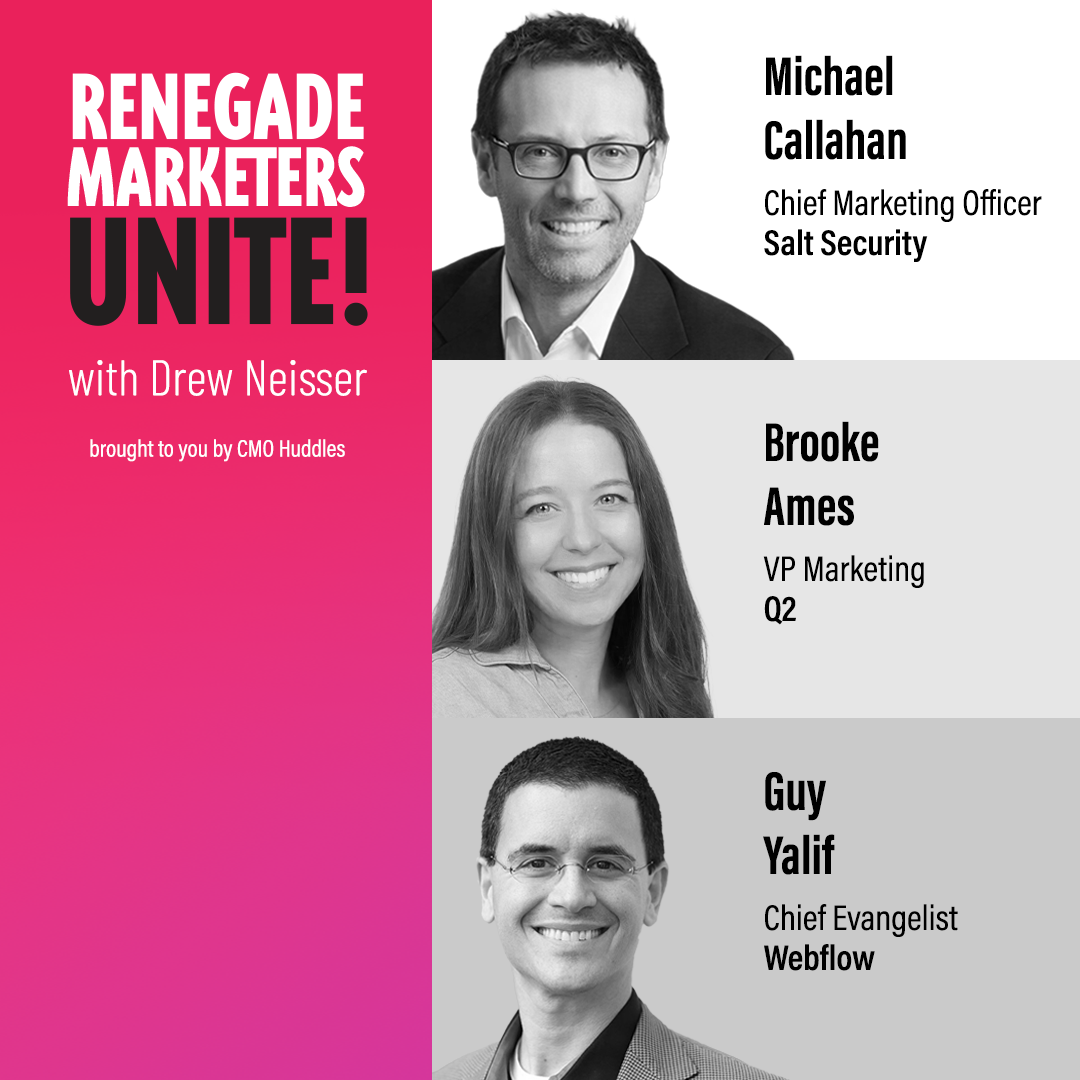
Joining Drew are Michael Callahan (Salt Security), Brooke Ames (Q2), and Guy Yalif (Webflow). In this episode, they follow a B2B deal past the hand raise and into the part where momentum gets fragile. They get into where buying groups get complicated, what happens when interest starts to cool, and how much coordination it takes on the seller side to keep things moving. In enterprise, there’s a fine line between staying in step and stepping on each other.
In This Episode
- Michael breaks down how to build depth of contact across a buying group and give each stakeholder the proof they need to keep moving
- Brooke walks through the operating model she built to turn strong starts into strong finishes, with five initiatives, clearer ownership, and scorecards tied to what teams can influence
- Guy digs into what enterprise buyers need to feel safe saying yes, plus how LLMs are reshaping shortlists, reputation, and the story buyers hear before sales gets in the room
Plus
- How to map a buying group without creating a thousand threads
- Where marketing should stay involved after the handoff
- What keeps a stalled deal warm without another hard sell
- Why the reps and sales engineers closest to the deal often have the best insight
Long enterprise deals rarely stall all at once. Tune in to spot where momentum starts slipping and where marketing can step in to keep the deal moving.
Renegade Marketers Unite, Episode 543 on YouTube
Resources Mentioned
- CMO Huddles
- Virtual Super Huddle
- Tools mentioned
- Past episodes mentioned
- Michael Callahan
- Guy Yalif
Highlights
- [3:01] Michael Callahan: Getting the whole buying committee onboard
- [7:15] Marketing’s one-two revenue punch
- [8:32]The messy math of pipeline growth
- [10:48] Brooke Ames: Giving enterprise marketing an operating upgrade
- [14:19] The five-initiative marketing playbook
- [15:50] Let product data drive marketing priorities
- [18:16] Guy Yalif: Enterprise marketing must sell safety and success
- [20:54] How LLMs influence B2B buying decisions
- [22:57] Is AI replacing word of mouth?
- [30:35] CMO Huddles: The inside track to success
- [33:05] How to map and influence buying committees
- [37:43] Who drives enterprise deal progression?
- [41:45] The B2B battle for AI visibility
- [44:24] Revive stalled deals with helpful content
- [46:20] Words of wisdom for enterprise CMOs
Highlighted Quotes
"Don't talk to the VPs, talk to the reps. It's too abstracted at the VP level. They're sometimes just repeating stories or legends, and it's old tapes. Go directly to the rep and say, "What's going on in your accounts? What's going on in your territory?" And you get much better feedback and insight."— Michael Callahan, Salt Security
"We now have what we define as initiatives. There are no more than five initiatives in a 12-month period. What we've created is initiative charters, which is all the context of why this initiative is important and what we hope it achieves."— Brooke Ames, Q2
"69% of B2B buyers chose different vendors than they originally planned based on what AI told them. So we need to arm our sales team and go direct to customers, and we need to speak to them indirectly, not just through word of mouth and happy customers, but also when the LLMs are talking to them."— Guy Yalif, Webflow
Full Transcript: Drew Neisser in conversation with Michael Callahan, Brooke Ames, & Guy Yalif
Michael: If you're a VP of sales and you're listening to this, this is a good time to log off. Okay, good. Now that they're gone, don’t talk to the VPs, talk to the reps, and say, "What's going on in your accounts? What's going on in your territory?" And you get much better feedback and insight.
Brooke: There are no more than five initiatives in a 12-month period. What we've created is initiative charters, which is all the context of why this initiative is important and what we hope it achieves.
Guy: Give your buyer the "nobody ever got fired for buying IBM" security. People so often are like, "Yeah, I like these two, but that one's defensible. No one's going to get mad at me for buying that one."
Drew: Hello, Renegade Marketers! If this is your first time listening, welcome. If you're a regular listener, welcome back. You're about to listen to a recording from CMO Huddles Studio, our live show featuring the freaking awesome B2B marketing leaders of CMO Huddles. In this episode, Michael Callahan, Brooke Ames, and Guy Yalif talk about why enterprise marketing is a different game altogether. They get into how marketing can build confidence, create consensus, and keep momentum going through long, complex deals, and with AI now shaping how buyers research and shortlist vendors, they look at what it takes to stay visible and trusted along the way. And this just in: We're hosting our first virtual Super Huddle on November 6 from 12 to 5 p.m. Eastern time, and it's open to marketers of all levels. And it's brought to you in part by our friends at Demand Science, who can guide you to get more pipeline now. Visit CMOHuddles.com for more details. Look for the Super Huddle and the Virtual Super Huddle, and you'll find what you're looking for. All right, let's dive into the episode.
Narrator: Welcome to Renegade Marketers Unite, possibly the best weekly podcast for CMOs and everyone else looking for innovative ways to transform their brand, drive demand, and just plain cut through, proving that B2B does not mean boring to business. Here's your host and chief marketing renegade, Drew Neisser.
Drew: I'm your host, Drew Neisser, live from my home studio in New York City. Enterprise marketing isn't just B2B marketing with a lot more zeros attached. It's really a different game entirely. Bigger buying committees, longer sales cycles, more hurdles, higher stakes, and marketing has to do a lot more than generate leads. It has to build confidence, create consensus, and sustain momentum long before a contract is signed. Today, we're joined by three leaders who live this reality every day and who will share how enterprise marketing is evolving in the age of AI. So, with that, let's dive in and let's bring on Michael Callahan, CMO of Salt Security and a returning guest who has previously appeared on this show to discuss many topics, including marketing metrics, cybersecurity, and product-led growth. Hello, Michael. How are you, and where are you this fine day?
Michael: Hello, Drew. I'm doing great. I'm in Dallas, Texas, today, where we have 10 straight days coming up of 100-plus temperatures. So,
Drew: So, oh man, this is time to get those eggs out to put them on the sidewalk.
Michael: Totally do that.
Drew: Just cook them. All right, let's talk about enterprise cybersecurity. And I'm curious. There's a big question, but how does marketing help a buying committee understand the risk, align around urgency, and, like, keep the deal moving? So talk a little bit about that.
Michael: Yeah, well, you're, you're 100% right that it is definitely more committee now than ever before, and it seems like anybody on that committee, any, anyone on that committee, can stop things. Right? Where before maybe it wasn't like that, but any, any one person can say, "Oh, you know, maybe we don't want this," or "We don't have the data," or whatever, and then the whole thing slows down or dies. How we can influence that is, you think, what do the different people need, and you provide them, you know, content that is interesting to them. But one of the things we do on this for this committee is we, as we're working with the sales teams, we say we have this depth of contact idea where we need at least 10 contacts in an account. Oftentimes, it's more than that, but we say at least 10 will give us the, the exposure to everybody that's in the committee, and then we can, we can market or talk to them in things that are relevant to them.
Drew: Let's talk about that depth of contact. I mean, I know there are a lot of tools out there that will help you sort of figure out who those individuals are. This merges into the ABM land. Can you talk a little bit about the assembling? I mean, how you actually create that depth of contact?
Michael: The creating is probably the harder part, right? The creating that, that depth, because you, you do need to go out and find, find everyone. And different, and people have different titles, so there's a lot of, I'll say it's a combination of automated and manual work that you do, right? So we have BDRs that are, that are tasked with building out that account team. What does that, what does that team look like, or the committee on, on the, on the customer side? And some of it you can automate. You can use, there's different tools where you can go out and search and say, "You know, I'd like to see everybody in purchasing," or "I'd like to see everybody in the technical side," or "everybody in a SOC," if it turns out this, you know, for cybersecurity. So there's tools that can help you build that. And then we run analysis and say, "Where are we light?" So if we, if our goal is we want to have a minimum of 10, where, where do we have gaps or not? And then we work together to try to fill that. And we may go to partners too, but it's, it is a combination of some, you know, automation and manual, manual work to build out that team.
Drew: So we've identified them. We figure out who they are, whether they're on LinkedIn or get their email, or, or someone's a friend of a friend. Then how do you sort of, because, again, they may or may not even know that they're part of this process, and you've got, in theory, this lead came through, or opportunity came through, some prospect who actually raised their hand and said, "I'm interested." So the surrounding group, how do you communicate with those, those others?
Michael: We try to work real close with the sales team, right? Because they should have a handle on the account. What we may end up doing, oftentimes, is we'll bring them more insight. Like, it looks like in accounts like this, you're going to have these type of people based on history, so we need to either build this out, or here's what they're going to be asking, or make sure you communicate with this person, and here's some content that maybe we developed, or maybe the rep just, just knows, to bring them along, so that everybody understands... Well, how did it even get to this point? Because you could imagine, like you said, Drew, it may come in from a lead or an event, and someone's like, "Oh, I really need that," or "That's, that's going to be really important to us," and then you end up communicating with someone else at that company. They're like, "I don't even know what you're talking about. Well, what do you mean?" So it's, it's on, it's a sort of combination of the AEs, in our case, we call them account executives, or marketing to get everybody there on the same page and current with why they're doing it, and, you know, why did this even, why are we even having this conversation, but get everybody so kind of communicated with at the same time.
Drew: Interesting. So you're actually having to create alignment at the customer side in order to... Sure, yeah, right. Which is another fascinating part of this. People
Michael: People don't have time to. They're doing so many things that they're not going to go out of their way to align themselves. So if we can help, though, then that helps all of us, you know, get to rest with good conclusion.
Drew: Make buying easier, right? I don't know. Yeah. So let's talk about this. I mean, I, I, you know, like to oversimplify sometimes, but I think about it. Once an opportunity is created, marketing can, in theory, have impact. Whether it's closing, helping close faster, helping close bigger, or just helping close at a higher percentage rate. Where do you see marketing having its biggest impact? That's sort of part A of this question. Again, a nice easy one. And then part B of this is, when you know you're helping to drive revenue versus simply supporting sales. Yeah,
Michael: Yeah, yeah. I think, I think marketing can help in general up and down the funnel, but there's two points where I think marketing has the biggest impact, and one is obviously at the top of the funnel, getting the interest, getting someone to say, "Oh, hey, I'd like, you know, I'm raising my hand and I'd like you to talk to me." Clearly, at the top of the funnel, creating that awareness, and then getting people to say, "Yeah, I'd like you to talk to me." And then, not that marketing isn't involved, but there's a little bit of a lull, I think, in the process. Till you get toward the end of the process, you get a little bit further down the funnel, and that's when, if someone is, the sales team has done their job and communicated the value, and someone wants to buy. Usually, what happens is the customer then starts looking for ways to justify their purchase because they've already decided, kind of mid-funnel. Then they're getting toward the end, and they're like, "Okay, now I need to be able to build this business case and take it back to the rest of our team." That's where I think marketing comes back in. It can say, "Here's some, there's some analysis," or "Here's an ROI," or "Here's other people like you that have gone through this and what the business outcome was for them," and on and on. And
Drew: And interestingly, it sort of connects the first answer with the second answer. I'm imagining that you're anticipating the need by every person on the buying group. So you mentioned, like, ROI. That would obviously be really important to the CFO. Not that it wouldn't be important to the others, but there may be technical things that the IT people want to do. And so, can you anticipate these and then serve them up in a way that feels, feels right? So interesting how those two come together. And have you seen any particular success in any one of those areas?
Michael: When we're creating the awareness and we're creating, we're doing that outbound marketing, we see success there. In fact, in our company, we've seen pipeline growing year over year, over 50% year over year, but quarter to quarter, every quarter it's increasing. So that's a good, you know, metric for us to say, "Is it overall, is it growing?" That's a great metric, and like most people, we can also dissect that into say, "Well, where is it? Where is it originating? Is it, is it from partners, reps, or marketing?" But you know, and you said this a bunch of times, Drew, is like we're in low-channel environments. There is no one channel. Everything is influencing everything else. But you can do some, you know, influence and estimation to see where it's coming from. But I think it's a top piece for sure.
Drew: Well, that's obviously a reassuring notion. So all right. Well, with that, you know, you're actually driving sales, and sales are up. And so, all right. Well, let's bring on Brooke Ames. Brooke is the VP of Marketing at Q2, who is joining this show for the very first time. Hello, Brooke, and welcome.
Brooke: Hi, thank you for having me. I'm glad to be here.
Drew: So, how are you, and where are you this fine day?
Brooke: So, I am also in Texas. I am in Austin, and yes, it is very hot. We're getting into triple-digit days, but it's, you know, 65 degrees in the office, so don't really know how to dress. But there you go. Oh,
Drew: Oh, that, that is hilarious. There was a big article in the, in The Times about why your office feels so cold. It's a big challenge to actually keep an office cool at the same temperature. So they just overcool, but, and also, we were in Dallas and then Austin, and we had a Buc-ee's moment, our first Buc-ee's moment, several of us, which then became a whole meme during World Cup. So anyway, excited that you are here, and thank you for joining us. So you recently rolled out a new operating model for your enterprise marketing team. Curious, what sort of drove you to do that? What problems are you trying to solve, and how's it working?
Brooke: Yeah, so we meet as a marketing leadership team, and I had everyone review: What are your challenges? What are you hearing from your teams? I had AI kind of bring all that together and pull together some themes, and they all centered around how we operate as a team. So when we think about that, it's, how do we prioritize? It seems like this is a challenge everywhere, right? You say yes to everything and no to nothing. Clear ownership. How do we drive ownership on our team and accountability? How do we get from strategy to execution? There's been times before in the past of strong start, weak finish. How do we get strong start, strong finish? And then just building some consistency in how we operate and what are the labels. What everyone says, "campaign." What does that mean to you? What is "program"? What's "initiative"? So really getting tight on those definitions as well. And so we support multiple product lines. So I'm sure many others experience this challenge, but not all of those product lines are created equal, require the same amount of work all at the same time. So that's kind of what has led to us rethinking this and rebuilding it.
Drew: I just want to go through those. It's such a great... So, obviously, if, if you don't have priorities, then you have an absence of strategy, because, right, the definition of strategy is, is knowing what you won't do as much as it is. So that's so important. Ownership and accountability is, sort of, seems like it's a basic thing, but it's hard to create in marketing because, particularly, let's say you have someone who's working in brand. Well, what's brand accountability mean? Have you solved that issue?
Brooke: Well, we just rolled out a new framework for scorecards. So we do what we call level one through level four reporting. Level one is the executive leadership level. That's what I report back up to, my, you know, my leadership team. Level two is what do we look at from an entire marketing organization. Level three is what are the teams looking at. So if you are the content, comms, brand team, if you're the design team, if you're the programs team, what are you looking at? And then level four is the actual individual scorecard level. And the individual scorecard level, I really like what we rolled out because it's more around what are the metrics you influence, what are the projects you own and drive. There's so much we measure that can't, you know, we as individuals can't always influence that number, right? We can only do so much to influence pipeline and bookings. Like, it's a team effort, and so we were, what we were doing when we were measuring before was holding people accountable to webinar registrations or email open rates, and it's like, you can only do so much about that. So it's, I, we rolled that out last week, and I'm super excited. Everyone seems to really like the framework, and I think it'll also give us a kind of a gut check. Our, you know, how are we trending, trending up, trending down, and then the context around that, because that's really what matters.
Drew: I'm curious for this model. Did, is, are you following a path of preexisting, or did you create it for yourself?
Brooke: Created for ourselves. So, you know, obviously, with the help of AI, you can, you can really create anything you want. There's definitely some things that are, you know, within our business, the way we think about marketing influence and how we calculate that, we didn't change those things. Those have kind of stuck with us. But AI gives us access to so much data we didn't have before, and we can see trends. We can do more predictions. I do think that the looking at historical data is going to be very difficult because things have changed so much. So that predictive modeling, I think, is going to be really important for us and having more insight there, and less on, "Okay, if it was 10%, then we're just going to add 5%, do 15%." You know, so it's, it's a little different.
Drew: So you mentioned that you were hoping to go from great strategy to great execution. What do you think is going to sort of be the things that will help you put that and ensure that? I mean, one of the things that I've noticed in a lot of marketing departments is just so much to do that it's like everybody is peanut butter thin, spread across a wide range of things. Have you tried to narrow things or, or, or just, you know, how do you, how do you get better execution?
Brooke: So the one thing that I think has been very critical for us is we, we now have what we define as initiatives. So there are no more than five initiatives in a 12-month period. And what we've created is initiative charters, which is all the context of why this initiative is important and what we hope it achieves. The people that review and provide input to that are the product team. It's our leadership team. It's marketing leadership. It's sales and success. So we actually bring them all in to say, "Hey, does this feel right? Because this is our marching order for what we're going to go build." And then the integrated marketing teams take that and go build the integrated marketing plans that then feed all the projects and our campaigns and activities. And then we go through and review and prioritize even from that. So that has been a game changer. But again, because of this world of AI, we're able to pull all this context that has been built across all these different teams together to make sure that we have all the relevant information we need on what's the most important thing marketing should be doing.
Drew: Interesting. And so those five charters, you have some data to back up why those are the ones where you can have the sort of the greatest leverage.
Brooke: Yeah, exactly. So, especially data from the product leaders, right? They're kind of like our managing directors of our product lines. They, they have all that information. They can tell us, you know, what's happening in the market. What do we need to be focusing on? So that has been really, really helpful for us, and it creates alignment across the organizations. We're not doing things that aren't important for everyone else too,
Drew: Right? I wonder. It's funny. I think about, yeah, you're obviously a well-established company with a lot of existing customers. I just imagine a CMO at a smaller company trying to say, "Yeah, we've got five initiatives this, this year." It's not a list. Good luck. We'll see you in 2027.
Brooke: Yeah,
Drew: Yeah. So you needed a lot of alignment to support it, and I'm imagining that those initiatives are pretty kind of big, right? Yes,
Brooke: Yes, they're very big, very hairy. I mean, it's pipeline and bookings for XYZ product line. That's a really big thing, but within that, you have segments identified, right? You have priority segments. You have priority, you know, sometimes it's not always as much bookings as it might be pipeline. Like, things can change. So these charters aren't meant to be forever and ever. It's, right, should evaluate them on a quarterly basis. Make sure it still aligns.
Drew: Got it. Well, the last thing I just wanted to sort of note was the definition thing seems obvious. I'm so glad you brought it up, but if you don't get this right, particularly with sales, and you're using one word and they're using another word to say the same thing, you've got a problem from the beginning. So thank you for reminding us of that. All right. Well, with that, now we're going to welcome Guy Yalif, Chief Evangelist at Webflow, who has previously joined this show to shed light on the intricacies of AI adoption and product launches. Hello, Guy. Welcome back.
Guy: Great to be with you again, Drew. How are you?
Drew: I am fantastic. Thank you. Where are you joining us from?
Guy: I am normally based in SF, but I am here in New York. Actually, right now was supposed to be in SF, and all of the excitement and logistical mayhem that came associated with the World Cup resulted in me not being able to make it back home. So I'm here for an extra day.
Drew: I got it. All right. Well, I could have invited you. You could have been live in the CMO Huddles World Headquarters, but anyway, great to see you as always. So my understanding is that Webflow, you know, started working with smaller, medium-sized businesses, but as you and I have talked over the last couple years, you've been moving upmarket. What specifically has to change in the marketing story to prove sort of enterprise readiness?
Guy: I am sorry not to be at the intergalactic headquarters as well. My bad on not sharing it earlier. Webflow has been serving enterprises for seven out of our 13-plus years, but a couple of things besides, sort of, you know, in SMB land, marketing can own revenue. In enterprise land, marketing tends to own pipeline. So the first part is, you know, shifting a bunch of the storyline itself, as we're talking about, where you need to give your buyer the "nobody ever got fired for buying IBM" security, because people so often are like, "Yeah, I like these two, but that one's defensible. No one's going to get mad at me for buying that one." How do you do that? Well, some of it is telling the stories about how it is safe, how you've got roles and permissions, and all the security certifications and collaboration, and that part. And then the other part is telling people the glorious vision of what happens when they're using your product, how they're going to get promoted. In SMB land, those stories tend to be a bit different than they do in enterprise land. I think that's one part. The other part is ensuring you are everywhere they are, which, especially for enterprises, you're not in the room for a lot of it. We happen to have just published a bunch of new research on AEO, and G2 is finding, "Hey, 69% of B2B buyers chose different vendors than they originally planned based on what AI told them." And so we need to arm our sales team and go direct to customers to be in the room with them, and we need to speak to them indirectly when we're not in the room at all, not just through word of mouth and happy customers, which I'm a huge believer in, but also in the LLMs you're talking about.
Drew: There was a lot to break down there, so let me go back to a couple of things that you said. It's funny. A lot of times, a lot of the work that marketing and sales does in enterprise is sort of this peace of mind, the assurance, because there is so much buyer remorse in enterprise, and, you know, Brent Adamson talks about this a lot, and others do too. That buyers are actually very bad at buying, and in your case, this is a big decision. Moving, you know, moving a website from one platform to another is not a simple, "Oh, let's just, well, we'll just move it." It's a little different than some other software decisions. So, you know, there is not only the peace of mind. There's got to be the reassurance of that. So that was one. I want to dig in a little bit because you and I've talked a lot about AEO. You mentioned LLMs. It's so interesting. Not only are you being discovered on a large language model, but you may be being discovered late in the sales cycle as a surprise entry, so talk a little bit about how that impacts sort of buying decisions and, and so forth in ways that really didn't exist pre-2023.
Guy: Happy to. And on the, just on the first thing you said, gosh, with us as CMOs or former CMOs having average tenure of 18 months, you get, like, one or two really big decisions. And if your website sucks or breaks in some way, you're getting fired. Like, that's going to be your decision. And so, to your point, it is a very big choice for someone to make, even though, you know, many enterprise CMOs have no idea of what their website is built on, but they know if it doesn't work, they're in deep trouble. On the LLM impacting buying decisions, you and I both believe, based on our many interactions, that, you know, enterprise CMOs talking to each other is the single most effective way, and has been for several years, and will be for a long time to come. How people learn about other, what's working, especially in a rapidly changing world, and often compare notes about short lists. The LLMs are impacting that part of the process tremendously, saving people time, often because they are so useful, without as much verification. Where, you know, with Google, you had to go, quote unquote, "verify" because you would click on a link and learn from the site itself. Here, it is routine to take the synthesis from an LLM and use that directly. Full stop. However, all of our work building brand, it's not for naught. There is data, especially in e-commerce land, but you see it some in B2B land too, that if a brand is already well known to you, the LLM can say what it wants. You are going to consider that brand. And so that partly answered the question, but it is, it's, it's really impacting the buyer journey tremendously.
Drew: Well, I wonder, as you were talking, I thought, have LLMs replaced word of mouth?
Guy: In my humble opinion, the less considered the purchase, perhaps, you know, I drink a lot of soda every day. If an LLM gave me advice on where to buy that more efficiently, I'd go do it in a heartbeat. I'd have an agent go do it fully end to end. Versus a CMS, I would go save myself, or, or a car or some other heavily considered purchase. I would absolutely go use an LLM a bunch, and I hear anecdotally other people saying that. But then you do have to go verify. You do have to get the "nobody got fired for buying IBM" facts verified because your livelihood depends on it. And so I think they are a big augmentation and carry, in my humble opinion, and I think the data supports it, more weight than straight search did because they are synthesizing so much and so personalized. Is that your read too?
Drew: So the data certainly shows. I mean, we said both of us, I think we were there when we saw G2 present and how that certainly is, and that is a form of sort of verified word of mouth. I was just sort of more imagining, you know, a group of CMOs in a huddle in person, and someone asks about, if they raise the question and they get that right, then that's word of mouth is alive and well. But if you think about, am I going to pick up the phone and call someone to ask that kind of word of mouth only if they happen to be out? Right. It's just sort of more cir, and so the LLM may replace the act of calling, phoning a friend.
Guy: I had genuine curiosity about whether it will be generational or not, because I do not. I think for really considered purchases, we all still do this as execs. We all still, for the important ones, we will go talk to someone, or we will hold on to that thought because it's a considered purchase. It's not done overnight. So the next dinner, the next event, the next something, we are going to go talk to other people because you want the color and the nuance, and you want the stuff that nobody's going to write down, so an LLM will not say. And I do wonder, with intellectual curiosity, will that generationally change a long time from now? But by then, LLMs will do. It'll be whatever's after LLMs, and so who knows?
Drew: Yeah, well, and I was just thinking about this. In our Slack channel at CMO Huddles, you would see probably more questions related to big software purchases than almost any other topic. So they're still asking the question and doing their homework as fast as they can. I did want to make the point: anybody who's listening to this show, if you want to endear yourself to Guy Yalif, be sure to send him a case of Diet Coke. That is his soda of choice. That would certainly endear you to him. Just wanted to get that out there. All right, we have a couple of questions. Do you have recommendations for marketing leaders as it relates to justifying brand-related investments that impact AEO performance but might be harder to attribute to direct revenue and pipeline contribution?
Guy: Heather, I think this is an absolutely fantastic question. I think it's an age-old one. I think the age-oldness has not changed at all and won't change. I think, you know, for many of us, '23 and even '24 were brutal years for brand, where that was basically zero, and even performance was coming down some, and the pendulum is absolutely swinging back some, as it does. Okay, in this case, I think actually AEO helps us tell better stories about the impact of brand, because LLMs are looking for consensus. They want to hear the same thing said over and over again about your brand. One, two, they are telling your brand story, and our data shows that they are doing a very poor job of it, as far as our self-interest is concerned, as they are stripping out most of our value prop and so on. And so, you've got this new medium that's retelling your story, is talking to your buyers, or they're talking to it extensively, getting further down the funnel before they talk to you, and it wants to see consistency. What does brand do? Brand causes you to speak consistently and hopefully get the message pulled through the LLMs when your prospects are talking to them. And so I feel like we've always needed to go deliver pipeline to have the right to talk about brand, as it is measured less directly. That's why it's such a challenge. But the throughline of how brand causes you to show up in LLMs more often and causes them to tell our stories more effectively, which then directly leads to revenue, is a tighter one than it was before. Does that solve the problem of "Well, I spent brand dollars and that didn't tie directly to revenue"? Absolutely not. I think it just gives us more talking points in the discussion. Right?
Drew: And ironically, the real answer to this is anecdata. Chances are your CEO is going to be somewhere. Someone's going to tell him, "Hey, I saw your something," or a salesperson will be talking to a prospect, and they'll say, "You know, I was reading up on your website about this and that." But I also say that it is quite likely, and this must be happening, although it'd be really hard to measure, that let's say you do this: "Hey, best websites for enterprise," and up comes two competitors plus Webflow. If you've heard of Webflow, you'll keep them on the list. If you haven't heard of them, they're going to have to do more work, and that's where brand matters, right? And again, I wouldn't use the word brand. I would use the word reputation, and everybody understands the notion that a bad reputation is bad and a good reputation is good. And so, in investing in reputation and how you build it, then it becomes: well, it's about product. It's about marketing, and that's the thing. The conversation is not about marketing. This is about the company and so forth. So, off soapbox, I'm done. Anything to add on that, Guy?
Guy: Two. One, anecdata is a new term. I'm going to go use it extensively. I love that, because so much of what we do as marketers is based on it. However much we wish for hard data, it is sometimes just not there. And two, could not agree with you more. I love the framing of it as reputation, reputation in the form of what people say about you when you're not in the room, and how that influences trust, and how the premium for that is higher in a world where one, LLMs are retelling your story, but two, anybody can create any content anywhere, any time. Like, it's even more important than it was before.
Drew: Right? And again, when I talk about reputation, I'm not talking about measuring simply awareness. We're talking about a deeper understanding of your brand, which means your customers really like your product and service, and they will say so. Your partners really like the company and will say so. Your employees really like the company and say so. And just in case you were wondering, CMO Huddles created something called Repute Tracker for a leader program, which attempts to track reputation on behalf of the community members because it is that important. But if you can afford to get a brand tracking study of some kind, all right. With that, it is now time for us to talk about CMO Huddles. Even though I just talked about CMO Huddles, we were launched in 2020. CMO Huddles is the only community of flocking awesome B2B marketing leaders, and that has a logo featuring penguins. Wait, what? Well, first thing you need to know: a group of these curious, adaptable, and problem-solving birds is called a huddle. CMO Huddles, huddle penguins. Okay, and the leaders in CMO Huddles are all that and more, huddling together to conquer the coldest job in the C-suite. Michael, Brooke, guys, since you're all incredibly busy marketing leaders, I'm wondering if you could share maybe a specific example of how CMO Huddles has helped you.
Michael: I'll go. Yeah. Okay, Michael. I like how you said, too, the coldest, the coldest position in the C-suite. I hadn't heard that before, but that also... So between anecdata and the coldest position, one of the things that we use it for, I use it for, we're all always looking for talent, right? At finding new people, either if you're growing or you're trying to up-level or what have you, and it's a great resource that I found. I can go out and ask people because, like other things, if someone's going to recommend them, like we were just talking about with AI, you're going to want to talk to someone. It's your credibility on the line, and you feel more confident in it, so I found a big benefit out of using it to find talent.
Drew: I love that. Well, thank you for sharing that. Let's see, Brooke, anything?
Brooke: I think you just don't know what you don't know, so you learn something every day. You should always continue learning, and I think there are so many smart people, and it really gives you, talking to other people, the courage to try out something different, change things up. It's a little scary when you're alone. You don't want to do that. You kind of want to stick with what you know. So, I've loved being a part of the group.
Drew: Thank you for that. And yeah, one of the services that we do provide is we set up one-on-ones for y'all. So, thank you, Brooke. Guy, any thoughts?
Guy: I was going to add on to the one-on-ones, and then the sort of culture and people you bring together, Drew, because it's such a shortcut, in the positive sense of the word, to be able to talk to other thoughtful, caring people who give a hoot about you and your success, who will share the stuff you're not going to write somewhere else, but that really helps you avoid some pitfalls and landmines that may be relevant for you, and that happens so freely and so openly in this community. The very first super huddle you hosted in Palo Alto in November of '24, I believe it was, I sat down next to the CMO of one of our direct competitors. We had a phenomenal conversation, a great time. In other environments, that would have been a very icy conversation, and so I really appreciate that about CMO Huddles.
Drew: I love that, and I'm gonna bet that that CMO, who's no longer at that company, is gonna be back at the super huddle in '26. So thank you all, all three of you. If you're a B2B marketing leader who wants to build a stronger peer network, gain recognition as a thought leader, perhaps recruit your next best talent, and get your very own stress penguin, please join us at CMOHuddles.com. Okay, so we sort of got into this a little bit, but I'm curious: how do you map and influence, like, I mean, I keep hearing numbers in the buying committee. I find it impossible to believe that it's growing beyond 14, but maybe it is. But how do you map and influence this large buying group? And Guy, you were last, so I'm going to pick on you first on this one.
Guy: I think with great intention and also recognition about not creating 1,000 threads. And so by that I mean absolutely recognize the different roles people are going to play. Recognize that some folks are going to, as we all know, hold the purse strings. Some are going to be the champions. Some are going to be the users. Some are going to have various forms of evaluation and can really only say no. They can't say yes. And think about what gets them promoted, how do they get fired? What's important to them, and map that out. So on the one hand, be explicit about it. Recognize you've got different people playing different roles and speak to them differently. Do create the different storylines. Do create the "I'm speaking to you about the thing that matters to you," like you would in empathetic listening overall, but do it systematically. That's on the "get more granular" version. On the "don't get more granular" version, you could do that times geography times industry times size of company times individual, and create this level of granularity that feels overwhelming and that a seller will never really activate or a marketing team won't really be able to put to use. It's, in some sense, it may or may not be false precision, but it's false precision in the sense that it will never get activated. And so find that right balance for your org. Now, if you've never done any of this, you may be like, "We have technical, we have economic, and we have champion," and that's it. And if you've been doing this for a while, add the next level of refinement that you think your team can activate. That's where my head goes in this discussion.
Drew: Right. Brooke, Michael, do you want to weigh in on this? I know we talked a little bit about this already. Michael, Brooke?
Brooke: I feel like Guy said everything I would have said, but I think we forget about the people who are not the C-suite. You know, when you talk to sales, they always say, "I want to talk to the C-suite. I need the executive in the room." And the next level, the next executives, are the people below them. The people below them. So I think that's one of the things we lose sight of, is kind of going deep in the organization, and especially in our space, people stick around for a while, and we don't spend enough time really nurturing some of those director, VP, and so on titles and doing the research up front. I always tell our team, I know it's called account-based marketing, but it's really people-based marketing, because they're the ones that make a pick.
Drew: All right, we're going to change the name right now. PBM. I'm in. We need...
Brooke: Another acronym in this industry. Yes, exactly. Another TLA.
Drew: Yeah. No. Okay. Fine. Scrub that. No PBMs. Okay, Michael, anything on that one? Otherwise, I'm going to move to the next. You know,
Michael: Let me just add one. Just one thing on it is that I think we... I agree with what Guy and Brooke said for sure. One thing I do think that people we just kind of blow by is we say, "Oh, we want this. We want this whole buying committee. We want everybody involved. We want a message to them. We want to give them content that's relevant to them." And, but you miss that first step of you actually have to go get these groups of people. Like when we look at our reps and what they have, especially in their target accounts, they may have one or two contacts, right? And we can help, but it's not like we can build it all. And a lot of times, if you know what marketing would bring in doesn't have that personal touch, right? So you may find, you go to ZoomInfo, right, and you pull something in, and he's like, "Well, that person isn't there anymore," or "That's the wrong title." So this idea of spending some time on it to get the right people in there will pay back in dividends in the future. And it's important not to just blow by it and just go, "Okay, well, now let's get to the message. Okay, what is it? What does a purchasing person want? What is..." And spend some time on building that buying group.
Drew: Yeah, it's so funny. There's a parallel to one of our Huddles recently where someone was monitoring Gong calls and found out that their salespeople were talking 80% of the time, which is like, oh yeah, that should be fingernails on a chalkboard for most of you. But it is that, but that happens, and if there isn't enough listening, then you are not going to be building those relationships. As Brooke, you talked about that lower level. I mean, you're right. There are going to be plenty of times where, if the CFO is fine and the CSO is fine, and all the people are, the CEO's not going to care about that decision. There's a budget. There's a need. Knock yourselves out. And so that's really interesting, is trying to understand when you actually need CEO buy-in and when you don't. But I would imagine you could look at your past deals and figure that out. And so that's an interesting part of this. So I'm curious, in these long deals, and I don't know what your sales cycles are, but I'm going to guess, let's just say nine to 18 months. Maybe they're faster in this AI-induced world. But where should marketing own progression, and where should sales sort of take it? And, you know, I'm curious how you approach that, Guy. How do you approach it?
Guy: We today approach it as: get the intro with a qualified level of interest to an SDR or AE, depending on the account and the level of seniority, and technically stop there. Practically, there continues to be ongoing support, but not the driver, with content and exec sponsorship throughout the funnel. One, and two, a lot of looking at the funnel itself, so that nobody kids themselves on vanity metrics. I think the whole "MQLs are dead" is really all about that, and to ensure that that's there, and to really look ourselves in the mirror on a regular basis to be like, "Well, this place where we hand off, it wasn't the right level of interest or the right moment in time or the right ICP," and to be really self-critical about that. And so I think we have a relatively traditional one. I've been in other places where, like, marketing is actively accountable for shortening the funnel throughout, with, you know, lifecycle email and content and so on, and we don't run it quite that way today.
Drew: Interesting. I mean, I am a fan when marketing can own it, mainly because there is no question about whether it's quality or not. Because if you get it all the way to an opportunity where you know a deal is made, that feels like a great place for marketing to say, "Okay, sales, close this," and then there's no question about it. But I'm curious, Michael or Brooke, if you have thoughts on, or how you handle, progression.
Brooke: I can go. The way I look at it is I'm actually working on marketing owning a piece of all of it. Right, like a lot of times marketing is just the demand, and we're actually just starting to build out a go-to-market operations team. We're bringing in RFP writers in marketing, so it'll bring us closer to the full life cycle of a deal. And so I see sales owning the relationships. That's what you should be good at. We can help with all the channels, right? We will help you with the event. We will help you get an introduction. We will help you with a direct mail you want to do. We'll own the channels along the entire life cycle while you're nurturing the personal relationship, and so I think that's the future of marketing. I think someone actually on one of your podcasts was talking about, you know, marketing really needs to be playing a part across the whole life cycle, and so that's what we're working on here and building that up more.
Drew: I certainly think there's that opportunity. You have to be very well coordinated with sales and in lockstep with them, so yeah. If marketing can, I don't know why they wouldn't. Michael, anything to add on that?
Michael: Yeah, I would say so. I agree as well. I think probably earlier in my career, I was more of a "I can go do it. I can break down any wall and make it happen myself." And then what happens is you end up realizing that we have an enterprise Salesforce for a reason that has the relationship, and you have to be working together. You can't blindside each other, which ends up being a disaster. I do think that there are some cases where, obviously, marketing will take the lead. I don't know, maybe, Guy, in your group, in your company, works this way. If there is no salesperson involved, if it's a direct buy, right? Like that, of course, marketing should be doing that, and that's typically more on the B2C side. But you do have it in B2B. In fact, I think that, Guy, we use your platform, and it works well for us. So thank you. I don't know that we talked to any of you. I think we just did it on our own, and so in that case, you would be responsible for that experience, kind of beginning to end, and taking the lead. 100%.
Guy: And to your point about consumers, sorry to jump in, Drew, I was going to, if it's okay, echo that and say B2C and SMB, you know, just have so many similarities. Not that you're an SMB, but that experience is built for folks that are going to go end to end. To your point.
Drew: Well, Guy, while you're up, I know that you've been developing some new products. You and I have had a lot of conversations about AEO, GEO, and how, you know, they're really changing the way enterprise buyers qualify, build short lists, move through the process. So it's funny, because we could have had some of this conversation three years ago, but LLMs are changing things really, really quickly. So one, maybe you want to highlight. I think you have some new research or new products that you're bringing out to help folks with this. So talk a little bit about that.
Guy: Happy to share. Forrester last year surveyed B2B buyers. 95% of them said, "I am going to use an LLM in my buying process in the next year." And then G2, we already talked about the fact that 69% of buyers said, "I chose someone different because of what the LLM said." 51% said, "I'm just going to start my short list on the LLMs." And so it really is a meaningful factor in the end-to-end that Michael was talking about. We observe folks are so much further down the funnel that when they show up at our website from an LLM, they convert six times more, not 6% more. Six times more than unbranded organic search, which I think is the fair comparison, because they have been through a good chunk of the journey on the LLMs. And to your point, Drew, we are seeing, all of us as brands, research we put out last week said, "Hey, we're probably showing up a lot less than we want to." When we ran a few 100,000 lines of code, 5,000 lines of prompt, which is our free assessment, on a couple of 1,000 sites, 16% was the average mention rate. 6% was the average citation rate. I don't know anybody that would be happy with that. The message pull-through rate was effectively zero. There was basically no... All the hard work we do on our brands, it was effectively none. Sentiment was completely neutral. Like, we want more than that as marketers in this medium that's having such an impact. And so, in my humble opinion, we all need, like we do in paid search, in conversion rate optimization, in media mix modeling, the ability to go through hypothesis, next experiment to run, implement it, measure, and repeat that closed loop in a thoughtful way, faster and faster.
Drew: By the way, it's webflow.com/aeolma for AEO...
Guy: Maturity assessment.
Drew: Right. And by the way, if you haven't done that for your website, it is by far the best free tool out there, because I've tested many of them. And so yes, check that out. Thank you for developing that, Guy. Okay, so let's talk about deals and where they get stuck and how marketing, and maybe you haven't, specific example you can sort of share where a deal appeared to be stuck and marketing was able to unstick it.
Michael: What we see is you get the initial lead, come in, that initial interest. You have a demo. You made a POB, and then because everyone is doing so many things, they just get distracted. And even though it came in a certain way, like there was all of this value, and then, well, that was on a Monday, but on Wednesday there was some other thing that they had to go look at, and so they forget about you, right? And so unless you're in front of people giving them some sort of value and making it easy, they're not going to take their time to go figure out what you do and make sure that you're, you know, you're relevant. What we try to do, and it seems to be effective, is get our sales teams content that's not confrontational, and it's not meant to be like, "Here, I'll send you this. Okay, send me the PO." It's just like, "Hey, by the way, there was this breach yesterday. It's something that you guys have talked about. Thought you might be interested in it. Oh, hey, here's a research report. Oh, hey, here's this." But it's not meant to be like, the outcome isn't to have a response in an order. It's just to keep in front of them and continue to show that value. Sometimes it works better than other times, but I think you have to do that. You have to keep having that, you know, "Here's something." And it goes to the rep's credibility on their own if they can say, "Hey, you just thought you were interested in this. You might be interested in it," but not with a give and take or a quid pro quo. It's just like you're trying to give something. I don't want to say for free, but it's like without an expectation of something in return. Seems to work.
Drew: Yeah, I mean, it's funny, the old social media formula is give, give, give, ask.
Michael: Yeah.
Drew: So it's like, in order to... So you've got to put three times the energy into giving value before you can ask for something in return, which is an interesting and simplistic way of thinking about it. Okay, well, gee, we're getting to that point where now it's time to get your final takeaways for CMOs trying to help marketing play a bigger role in complex enterprise deals, and we'll go last to first. So, Guy, you're up first...
Guy: For CMOs trying to play bigger roles in enterprise deals, two suggestions: one, have your sales leadership be your best friends. Understand what they are struggling with, understand how, you know, how they're getting promoted. It's making their numbers, but really be aligned so that there is a high-trust environment. And two, intimately understand the day in the life of your customer. You need to be that voice of the customer. Hopefully sales is, CS is, product marketing is, but you need to deeply, intuitively understand a day in the life. And if you don't, literally go take time out in the field. Go take time talking to them. Go understand what frustrates them. You can have so many other problems that then are overcome and become less impactful if you really understand what makes your customer tick.
Drew: Yeah, I've been there. It's a line I've said on the show many, many times, which is if you want to get the attention of your board or the executive team, there is nothing like saying, "I was talking to a customer the other day." If you want heads to turn, that's the way to do it. And today you can listen to Gong calls. You can create an executive sponsor program. There is kind of no excuse to not have that. Okay, next up will be Brooke.
Brooke: So I would say, we've talked about it a lot, but building that trust with our sales and success counterparts, and one of the ways that we've done that is holding a go-to-market council where we actually talk about these things, and so that is representative of product, our direct sales team, our cross-sell team, our customer success team, marketing, product marketing, and having real conversations and allowing you to actually move quickly because you're all aligned. The other thing is a lot of times sales will just do things on their own, and you don't get to play a role because you just don't move fast enough. So having that alignment early and often, especially with those go-to-market councils, has been really, really helpful for us.
Drew: Yeah, I love it. I love that idea. Go-to-market council. Okay, Michael, bring us home.
Michael: I would say, and I'm gonna say, if you're a VP of sales and you're listening to this, it's a good time to log off. Now that they're gone, don't talk to the VPs. Talk to the reps. So go to the individual reps. I think what happens is at some level, it's too abstracted at the VP level or the senior level, and sometimes they're just repeating stories or legends, and it's old tapes. And I think what has been more successful is go directly to the rep and say, "What's going on in your accounts? What's going on in your territory?" and you get much better feedback and insight. Drew, did I add one thing?
Drew: Sure.
Guy: I couldn't agree more with Michael. Not on that. I actually think you should totally talk to the VPs. But your point about them telling legends with the best of intentions, totally agree. The sales engineer, the person, and/or the solution architect, the person who needs to speak customer and technical, and can't leave when something doesn't deliver. That person really, really gets it, in my humble opinion.
Drew: Okay, so we can summarize this part of it. One, obviously, you have to make sales your best friend. Two, being the voice of the customer, which means talking to and listening to. Conversations. Three, I love this idea of a go-to-market council to create alignment, and I also think that's going to make a big difference with your AI implementations moving forward. And then go deeper. Don't just talk to your direct counterpart. I love all of that. Okay, with that, thank you, Michael, Brooke, Guy. You're all amazing sports, and thank you to our audience for staying with us.
To hear more conversations like this one and submit your questions while we're live, join us on the next CMO Huddle Studio. We stream to my LinkedIn profile. That's Drew Neisser, every other week.
Show Credits
Renegade Marketers Unite is written and directed by Drew Neisser. Hey, that's me! This show is produced by Melissa Caffrey, Laura Parkyn, and Ishar Cuevas. The music is by the amazing Burns Twins and the intro Voice Over is Linda Cornelius. To find the transcripts of all episodes, suggest future guests, or learn more about B2B branding, CMO Huddles, or my CMO coaching service, check out renegade.com. I'm your host, Drew Neisser. And until next time, keep those Renegade thinking caps on and strong!