Marketing Inside the Sales Rhythm
Sales has one clean tell for whether it trusts marketing. Timing.
Bring marketing in late, and partnership turns into a very polite scramble. The field has moved, the campaign needs context, and sales is working leads without the story that made them worth chasing in the first place. Trust grows when marketing stays close enough to hear the objections, spot the stalls, and change the work while there’s still time to help.
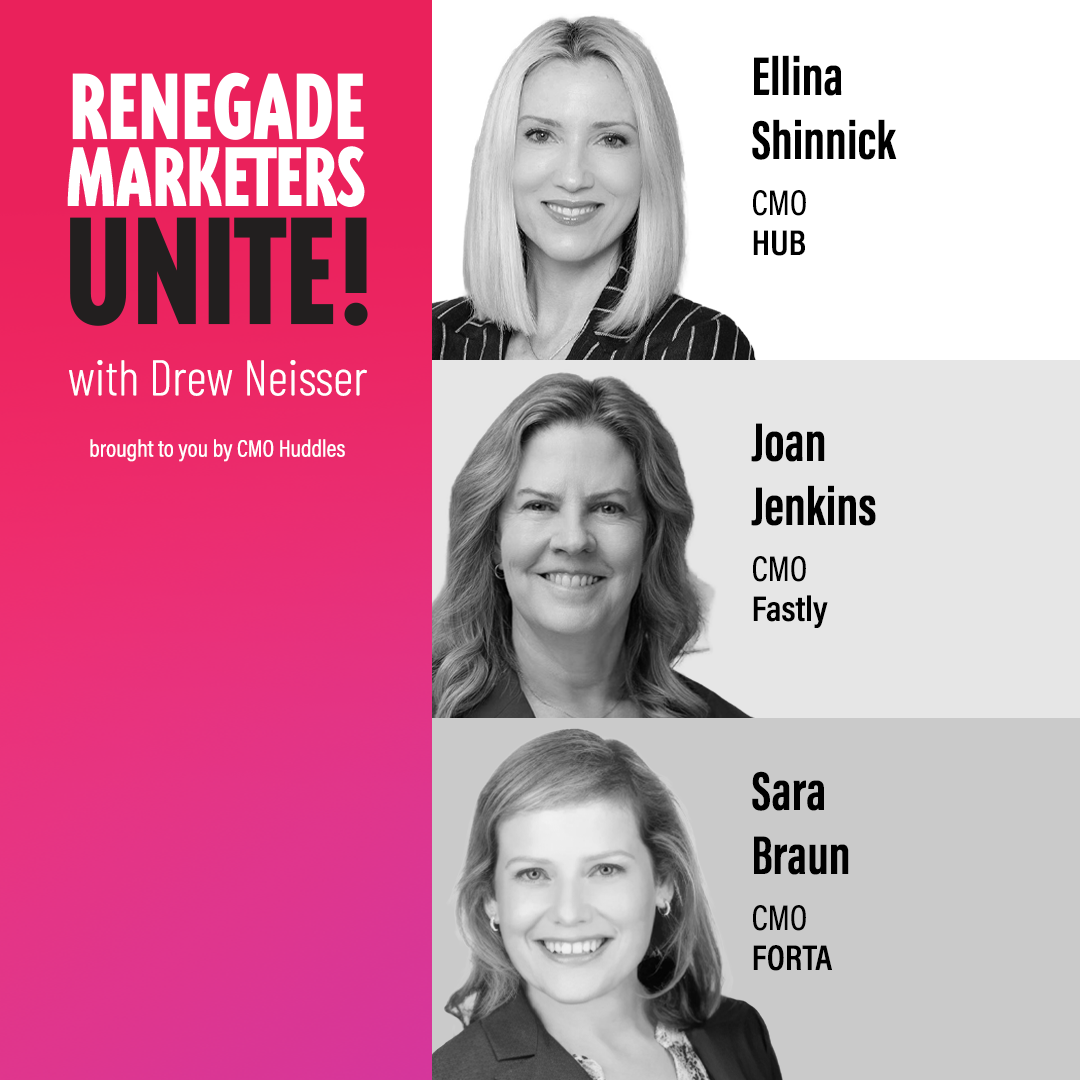
In this episode, Drew is joined by Ellina Shinnick (HUB), Joan Jenkins (Fastly), and Sara Braun (FORTA) to look at where marketing belongs inside the sales rhythm. Their examples ground partnership in the weekly decisions, shared numbers, and field-ready enablement that turn marketing from a separate function into a stronger growth partner.
In this episode:
- Ellina shows how HUB embedded marketing in weekly sales leadership meetings, creating faster pivots, clearer lead ownership, and a 3x lift in conversion
- Joan explains why Fastly keeps marketing accountable through pipeline creation, progression, and revenue instead of stopping at the lead handoff
- Sara shares how field visits, customer input, and rep feedback helped FORTA build sales playbooks around the accounts and moments that mattered most
Plus:
- How CMO-CRO behavior sets the tone for sales-marketing alignment
- How AEO, AI content, and recorded calls surface new customer signals
- What marketing needs from sales, from honest feedback to field activation
- Why speed and flexibility matter more than rigid annual plans
Listen in for how B2B CMOs can build stronger sales partnerships, improve pipeline accountability, and make marketing more useful from first signal to final outcome.
Renegade Marketers Unite, Episode 528 on YouTube
Resources Mentioned
- CMO Huddles
- CMO Huddles Strategy Labs
- Tools mentioned
- Past episodes mentioned
Highlights
- [2:06] Ellina Shinnick: Embed marketing with sales
- [6:57] Agile marketing wins sales trust
- [9:40] Joan Jenkins: Sales and marketing own pipeline
- [13:56] One team needs a system
- [16:01] Major in marketing, minor in sales
- [18:49] Sara Braun: Turn field insights into playbooks
- [21:18] Building a sales support engine
- [24:57] When engagement doesn’t convert
- [27:09] CMO Huddles: Peer wisdom on tap
- [30:37] Impact of LLMs on driving leads
- [32:59] Closing the enablement loop
- [37:30] Keep sales on ICP
- [40:58] Make marketing speak revenue
- [44:35] Using sales calls to refine messaging
- [46:33] CMO advice for partnering with sales
Highlighted Quotes
"In order for this to work, we need to create an actual partnership, not some sort of flyby relationship that happens once a quarter. That isn't sticky."— Ellina Shinnick, HUB
"There's no world in which, if sales isn't hitting their target, marketing looks good. That world doesn't exist. You don't want to be the marketer that shows up to the board meeting with everything in green."— Joan Jenkins, Fastly
"We regularly meet with sales and bring back the data to show them what's getting engagement, what's falling flat, where we should double down. It's made marketing feel, to them, a lot more valuable. Now they're bringing us in earlier and coming to us instead of us going to them."— Sara Braun, FORTA
Full Transcript: Drew Neisser in conversation with Ellina Shinnick, Joan Jenkins, & Sara Braun
Drew: Hello, Renegade Marketers! If this is your first time listening, welcome. If you're a regular listener, welcome back. You're about to listen to a recording from CMO Huddles Studio, our live show featuring the flocking awesome B2B marketing leaders of CMO Huddles.
In this episode, Ellina Shinnick, Joan Jenkins, and Sara Braun get into what it really takes to build a true partnership with sales. They talk about why trust is the starting point, why alignment has to be modeled at the top, and why marketing works best when it stays close to the deal instead of simply handing things off.
If you like what you hear, please subscribe to the podcast and leave a review. You'll be supporting our quest to be the number one B2B marketing podcast. All right, let's dive in.
Narrator: Welcome to Renegade Marketers Unite, possibly the best weekly podcast for CMOs and everyone else looking for innovative ways to transform their brand, drive demand, and just plain cut through, proving that B2B does not mean boring to business. Here's your host and chief marketing renegade, Drew Neisser.
Drew: Welcome to CMO Huddles Studio, the live streaming show dedicated to inspiring B2B awesomeness. I'm your host, Drew Neisser, live from my home studio in New York City, and today we're digging into one of the most talked about and maybe most misunderstood relationships in the business: marketing and sales. And it sounds simple enough, but as every CMO knows, turning alignment into a true partnership is anything but easy. And when it goes wrong, you feel it fast.
In this episode, we're going to unpack what great really looks like and the subtle shifts CMOs need to make to turn friction into forward momentum. With that, let's bring on Ellina Shinnick, CMO of Hub International, or just Hub, and a returning guest who previously appeared on this show to discuss many topics, including event strategy, leadership in a hybrid world, and content strategy. Hello, Ellina. How are you, and where are you on this fine day?
Ellina: Hi, Drew. It's so great to be with you again. Love your shirt, by the way. And I am in Chicago.
Drew: Awesome. Well, yes, we are wearing the brand a little bit here today. So let's just talk about marketing, partner, sales, all that, and what's it look like for you at Hub?
Ellina: Well, every day is all about marketing and sales partnership. It's the name of the game. Without that, we can't really show ROI or make an impact in a way that is as meaningful as it can be. So I can give you a couple of examples of how we work with the sales organization. Is that where you'd like me to start?
Drew: Yeah. Why don't you do that? Just give me one, and then we can interact, and then we can talk about another one.
Ellina: Sure. So the first example is on our B2B retail side. So in typical ways, we have a field marketing organization, and each of the marketers is assigned to a region and they work closely together. And in traditional processes, the team would go through an annual marketing plan, and then maybe they would meet once a quarter and show what marketing did. And you've heard and seen this story many times. Marketing thinks they're putting together emails or sponsorships or social media, and sales is sort of not clear on what's going on and where the leads are coming from. They're not motivated to act on the leads because they're losing trust.
So we found that this was happening, and we switched up the model in one of our regions. We really came to our sales partners and we said, in order for this to work, we need to create an actual partnership, not some sort of flyby relationship that happens once a quarter that isn't sticky. So what we did was we embedded our marketers into this regional sales leadership team. She now has a seat at the table. Rather than being a guest visitor once a quarter or once a year, she's meeting with the sales leadership team every single week virtually. We have a quarterly offsite, two days, she's with the sales leadership team, and then again on an annual basis planning.
And how that completely changed the relationship is the following: she's able to activate plans much more quickly because she's in these weekly meetings. She understands the priorities and is able to provide opportunistic and fast suggestions to drive campaigns. If we see a segment popping or a regulatory issue popping, she can activate that really quickly with an asset to support business outcomes to reach out to clients. So now sales understands what she's presenting and why her plans are much more tightly aligned to where they see the opportunities to drive new business, cross-sell or retention. So then there's a clear connection point between what's in the market in any given month, quarter, or year, and how that maps back to their ongoing conversations.
And the final piece is not only do they have clarity into what the team is doing, they have more trust in it because they have a say in it every single week. So there's a memory there, right, and a recency bias and a clarity of understanding.
We also started to put the marketing leads into their sales pipeline dashboard. So marketing leads don't live on some kind of a dashboard on an island that people have to remember to look at. Their pipeline manager presents the marketing leads as part of the overall leads. So the sales leadership team, with our regional leader, looks at that data on a monthly basis and says, how is the lead conversion going? What channels are driving that effectively? And we've seen a 3x improvement in the conversion.
We've seen an improvement in where we're investing our dollars as opposed to being more rigid on the planning. We're able to pivot and say, okay, originally we thought you wanted to go after this particular segment, but it turns out from a more recent conversation, you actually see that there's an opportunity to double down on cross-sell.
So we're going to take our resources and create opportunities and campaigns and assets for you to deploy more effective cross-sell campaigns, and so that improves our conversion, our revenue impact, and the trust with the sales organization.
Drew: So that was a lot. I'm going to put some pins in some things. One, you started with one region and then expanded it to others. Is that sort of...
Ellina: We're taking that model now to other regions now that it's worked out.
Drew: Okay, so that's one, and I think that's great. If you have this challenge and you think there's a new approach, if you can test it and prove that it works, often folks will say take up an individual salesperson or something when they want to do that. Okay, that was one.
Number two, you mentioned that a marketer has a seat at the table. That seems to be just a critical part of it because then you are a team, because you're meeting with it. I love the notion that the input-output exchange is faster because I think that's such a... you mentioned that early on, the problem being you do an annual plan and off you go, and then the rubber meets the road with the leads. Do they follow up on them? Are they of value? Right. And so you sort of close the loop there because they are, in fact, converting at a higher rate. So all of that sounds really, really good. Were there any things that, as you were doing that program, adjustments that you had to make, or sort of things that you picked up that you will do differently as you roll this out to other regions?
Ellina: We're going to roll out this process, so this was the learning, and the learning is all about speed and agility. And so we moved away, more or less, from traditional marketing plans, where we have a general framework of what we know our priorities are, and that lives more, frankly, at the center and in the brand work and the portfolio. But on a regional basis, in our world, things change so quickly, and we react so much to what's happening in world events. For us to support sales in the most effective way is to be able to spin things up quickly, and the only way that works is when we have a seat at the table and we're looking at pipeline and opportunities with them together.
And it's sort of this virtuous cycle, Drew, and I'll kind of close my point on this. Is it that the leads originally weren't good, or is it now that they actually trust why the leads are coming based on the input they had and are more willing to work on them? Right. So again, that trust in the relationship begets more positive prioritization, and that begets more work of the leads, and then that begets better wins, and then that just kind of multiplies, and you do that over and over again. And they also see and feel that we hear them. It's not like, oh, marketing said this was their plan at the beginning of the year, and that's it, they're stuck to it because they have to achieve it. No, that's not it at all. This was what we thought to be true in December for planning, but in February the world changed, and now this is a better opportunity. So we're going to shift where we're spending our time, and that hearing creates a lot of goodwill as well.
And so it all, to me, comes down to trust and understanding of what we're delivering, and then they feel more connected to the work and are actually going to share it with their sales organization. Because a lot of times, what happens is the marketing assets don't even get into the field's hands, and there's no trust because the sales leaders are like, 'Why did you create this email campaign? It has nothing to do with the life I live today and the conversations I'm having with my prospects.'
Drew: Right. Yeah. No, it's amazing. Well, this is a great kickoff. We will be back to you because I know we didn't cover it all. But right now, it's time to bring on Joan Jenkins, CMO of Fastly, who is joining the show for the very first time. Hello, Joan, and welcome.
Joan: Hello, Drew. Good to see you.
Drew: Nice to see you as well. So, how are you, and where are you on this fine day?
Joan: Yeah, so I'm at my home office today in Palo Alto. So happy to be here after weeks of traveling.
Drew: You heard some of the things that Ellina said. I wonder, were there some things that resonated with you as you were listening?
Joan: Yeah, I mean, one of the things that I was thinking about recently, especially since you started a new role at Fastly, one of the key things I think really drives success is that shared accountability. So, in my mind, what that means is shared outcomes. I've seen marketing, I've seen sales have different goals, different outcomes, and it just doesn't really work. So I think that shared, joint responsibility for pipeline, for pipeline quality, progression, ultimately revenue... No longer can you have marketing just kind of handing off leads and hoping for the best. We really need to be in it for the whole deal cycle, and that's really the shift we made at Fastly since joining. I've been there now, well, been there a bit over three months. Really having those shared goals around pipeline creation, conversion, revenue, it really keeps the conversation focused. So it's not activities, but it's really what are those outcomes that we're trying to drive. And to me, that really changes the dynamic. It's not, okay, marketing versus sales. It's, okay, we're one team and we're accountable for growth. And what does that look like?
Drew: Yeah, and it's so interesting. In theory, that's a wonderful thing because you're presenting the same dashboards, and presumably you and the CRO, when you're presenting to the executive committee, are essentially presenting from the same deck.
Joan: Yeah.
Drew: I've wondered about this for a while, and I'm sort of springing this on you, because pipeline is often the result of a lot of other things that happen beforehand. Everything from AEO search to positioning to whatever marketing and air cover that allowed you to get that lead and qualify it in the first place, and those don't show up in the pipeline progression dashboard. So I'm just curious, as a CMO, how do you think about that? Because you know they're important, but you're just looking at these sort of, almost call them, lagging indicators, although certainly close rate and win rate are probably good leading indicators. So talk a little bit about that. Yeah, that... because I know the show was focused on this balance, but I also feel like if we just talk about sales and marketing and the alignment, we miss the other part of marketing.
Joan: Yeah, I do think it's getting that buy-in at the front end, if we are in agreement that to move the deal along the pipeline, it does take input from marketing. We need to still stay in that conversation, and some things might not show up as easily. Our data is not perfect. Everywhere I've been, the data hasn't been perfect. But it's understanding that we are touching that account jointly, so we don't have a first-touch, last-touch model here. It's taking a look by account. We are looking at the touch points, but it's not that attribution model that you would typically find.
So I would say getting agreement at the front end and then staying consistent throughout the cycle. It really is that day-to-day partnership that we have with sales and marketing, and those consistent touch points, and making sure we're staying with it throughout the process. So it really is that agreement at the front end, and then looking at the data throughout. And it is trust. I know Ellina touched on this a little earlier. It's building that trust and understanding where we show up in an account, and you have to build that. You have to show sales that you are in it. You're not just throwing things over the fence. You are in it for the whole cycle, and improving that a bit for sure. How are you showing up per account? What does that look like? What are some of the activities you're doing, and what are some of those outcomes?
Drew: So let's talk about this trust-building process, because we're only three months in, but how much of it is you as the CMO meeting with the CRO versus your team, and where do they align with the various sales activities?
Joan: Yeah, so it's important to do both. I always like to say, I've talked to several CMOs as well, and when you think about it, sometimes what you say is, oh, everyone needs to be one team, but if you don't have the actions to back it up... It does start from the CMO. What you're modeling as the one team really trickles down into your team, and it is about consistent touch points. So you need to hear from sales, both from the top all the way through, what's working, what's not working, and the faster you get that from sales through regular touch points...
We have not only weekly, we just started kind of quick video snippets that we send to each other, and that's throughout the whole team. We have Slack, we have regular touch points weekly, monthly touch points. So we really set up a system where we're getting that feedback from sales. We can look at the data, but there's nuance there with what you're hearing from sales, what is happening in the field, what's resonating, what's not, where deals are getting stuck. You need to have that conversation. It's not all just about the data, it's the nuance, and they need to hear from you from a marketing standpoint, and that's from the top all the way through.
And it sounds simple, those regular touch points, but what I find is sometimes people start that motion, and then you don't keep it up, and you're not consistent. And that consistency is what really drives that difference, and that's really what instills that trust that we're talking about.
Drew: Boy, that word just keeps on coming up, doesn't it? Yeah. So one last question before we move on. One of the things that I have seen, and I'm not saying this is you, is a dynamic where you have a CRO, you have a great relationship, they understand the importance of marketing, they get recognized air cover and why that helps to be recognized in the marketplace and what it means when you're not. And then another CMO comes in and a CRO comes in and they're like, 'Yeah, we're hunters, go away,' and they just don't have any understanding or appreciation for the role that marketing plays. And I'm curious, I'm not going to ask you if you run into that here, but in other situations, have you run into that, and how have you tried to deal with that?
Joan: Yeah, I mean, I have run into it in the past. I would say the way that I've dealt with it, a couple of different ways. One, show up, either you show up personally, or your team shows up in deals. Show that you are in it to help them win. I regularly show up to customer conversations, obviously when I'm invited, I don't surprise them, 'Here I am,' but regularly show up to deals that you're there to help them win, and you're in it with them.
You have to prove... I mean, in some ways, if you have a CRO that comes in like that, you have to prove marketing's worth. It's education on what marketing can do, because we can do a lot. But I regularly show up to deals. I had a sales leader tell me the other day, 'Oh, wow, a marketing leader that's a sales leader,' and that was the best compliment I think I could have ever received. So as marketers, we need to show up as, yeah, marketing leaders, marketing people, but we also need to show up with, you know, major in marketing, minor in sales. Show them that we are part of the team. So it's proof.
Drew: Yeah, and I love that, because there is no world in which, if sales isn't hitting their target, marketing looks good. That world does not exist.
Joan: You don't want to be the marketer that shows up to the board meeting with everything in green.
Drew: Yes.
Joan: And sales shows up with no, no, yellows and reds. No.
Drew: It's funny, a CMO that I respect a lot, in his first job, did that in his first executive meeting, actually with the board, and got called out on it. Whoop. Okay, that's a life lesson. I love it all. Right, well, now we're going to bring on Sara Braun. Sara is the CMO of Forta, who is joining the show for the very first time. Hello, Sara. You've been so patient. How are you, and where are you?
Sara: I'm great. I'm actually timely. I just came out of a sales leadership team meeting, so I'm here today at the Forta offices in Grove City, PA, about 50 miles north of my home in Pittsburgh.
Drew: I love it. All right, well, you're fresh now. You heard both Ellina and Joan talk about what they were doing. What'd you hear that resonated?
Sara: It was great. A lot of the same themes about how to build that trust and focus on where you have the shared accountability. And I was listening to Joan talk about how it's so important to not have a handoff, but be along for the whole journey of the deal creation, and I think that's what I've really been trying to do on my side, just really have a seat at the table and not just say, 'Here's your materials,' or 'Here's a bunch of materials and a bunch of activity,' but really be involved and understand their goals, and communicate that their goals are the same as your goals.
Drew: Yeah, I feel like every marketer needs one of those signs with a circle and a handoff on it with a line going through it, because that day... It's sort of, I feel the same way about MQLs, but that's a different conversation. So, as you think about some of the things that you've done at Forta, besides the fact that you were just coming from a sales meeting, talk a little bit about your approach to building that productive relationship.
Sara: Yeah, so I'm coming up on a year almost of being here, and I think it was really important coming in, spending time with those sales leaders, the leaders, but also the top reps, the new reps, to understand their struggles. I got out into the field, and I went to a job site. We sell fibers in the building material space, so I was seeing them put down an asphalt road. I talked directly to customers in the verticals that we were trying to grow, to really understand their struggles as well and what they cared about. And it became clear to me that I needed to get that alignment with sales, and rather than jump into the campaigns, really understand more about who we were targeting. So the specific companies, the specific job titles, which verticals were the most priority, and then how we could best support our reps in the field who are dealing with municipalities and departments of transportation across all the states and different nuances in each state. So that gave me a clear foundation and helped me figure it out. Okay, for one, for the reps, how can we build a playbook that they can use in their day-to-day efforts?
Drew: So, it's funny, because notoriously a big complaint among CMOs was sales wants a special piece of information for a special... This one's big, you got to help us out and do it. And those requests can come all the time, or they can be managed and turned away. And I'm wondering how you've done that and managed through that, because otherwise, marketing gets to be this order-taker, right?
Sara: Yeah, I think it is a balancing act. I think, on the one hand, I have a stakeholder that's a national account, and we're selling products that support the construction of data centers. So you have some really, really big opportunities and really big customers, and need to develop the right content and materials to go after those customers. And then we have all these reps across the country, where what somebody's facing in Texas is completely different from what somebody's facing in South Carolina or Arizona. And we actually did a quick survey to the reps and said, what are your biggest challenges? Give an example of five customers that you're trying to go after. Worked with the sales leader to then prioritize, okay, who are we going to help first? Was it the person that was new and struggling in Texas? Yes, it is, and let's have them be, you know, kind of the test case for this playbook. But it's definitely, from any type of marketing leader standpoint, just a constant reprioritization and managing those stakeholders and understanding what's going to really drive ROI and that positive outcome.
Drew: So, have you put a process or something in place that's improved this over the last year?
Sara: I think... Well, as I mentioned, we're trying to survey and constantly prioritize, but then we become more disciplined about what we test and what we learn and how we act against that. So we have targeted efforts in specific verticals and have been trying to have more of a rhythm of, okay, we're doing this for data centers, can we replicate it for industrial outdoor storage? Can we replicate it for courts and transportation and rail? And then on the regional rep side, the same thing, of really just kind of honing in on that playbook and suite of materials, figuring out what is going to be most helpful to all those reps, and then where do we need to surgically go in and support some of the more challenging areas.
I think it's also been important that we regularly meet with sales and bring back the data to show them what's getting engagement, what's falling flat, where we should double down. And from that effort, it's just made marketing feel, I hope, to them, a lot more practical and valuable. And we know that's the case because now they're bringing us in earlier and coming to us instead of us going to them.
Drew: Right. So that's great. You have a growing and healthy relationship when sales is bringing you in early. I love that as a sort of moment, and if you're listening to this or watching this, just think about when sales bring you in. And if it's like at the ninth, tenth hour, five minutes before they want to close, you've got a problem.
Sara: Yeah.
Drew: If they're bringing you in at the beginning, they are recognizing you as an important partner in this question, and I think there's a lot of tricky things in this process, because you're talking about government deals and RFPs and long-term, and there's a lot of things that can influence it, including just how the RFP is written to get to the final close. So this brings up some of the things that Joan was talking about. Attribution is hard.
Sara: Yeah.
Drew: So when you say what's working or not working relative to sales, or a salesperson says this is working, you're kind of dealing with anecdotal information more than you are actual data, aren't you?
Sara: It's hard. You're dealing with the metrics of open rates, click-through rates, engagement on LinkedIn, but there is such a long sales process. In one case, for example, we were feeling really good about, oh, we're going after industrial outdoor storage as a new vertical, and we're getting all these great results. People went to a one-day summit, had really great discussions, had this tight list of hot prospects, and haven't closed a deal. And so I had to go back and talk to my sales lead and say, I know we were feeling good, why do you think, what was it off in our messaging, how can we recalibrate for this next effort so that we can start closing some deals in this space?
Drew: Yeah, and it's funny, because it may be messaging, it may be a competitor just decided to undercut you on price, and that was that. And you may not even know that answer unless you can do some win-loss analysis. So, anyway, lots of variables in this thing, but clearly building trust is essential. Consistent communication over time, listening to what they all have to say, are really important.
All right, well, it's now time for me to talk about CMO Huddles, which I love to do. CMO Huddles launched in 2020. It's the only community of flocking awesome B2B marketing leaders, and it has a logo featuring penguins. Wait, what? Yes. Well, a group of these curious, adaptable, and problem-solving birds is called a huddle, and the leaders in CMO Huddles are all that and more, huddling together to conquer the toughest, if not the coldest, job in the C-suite. So, Ellina, Joan, Sara, you're all incredibly busy marketing leaders. I'm wondering if you could share a specific example of how CMO Huddles has helped you. And Ellina, you've been with us the longest, feel free.
Ellina: I've made so many wonderful relationships as a result of CMO Huddles. Anytime I have a specific question, and perhaps I don't know someone or don't have a name at the top of my head, Drew, you are so responsive when I email you and ask you to connect me to someone in your incredibly vast network. So for me, it's the relationships, it's access to Drew, his responsiveness, and the continuous learning. Anytime I join one of these huddles as a listener or one of your workshops, I walk away with at least three things I can implement the next day to test and learn.
Drew: I love it. Well, thank you, and thank you for being a longtime member. And by the way, there's a crew at CMO Huddles that is also helping out, I just... Thank you for giving me the credit, even though these folks are doing a lot of the heavy lifting. Joan, you're relatively new to CMO Huddles. I'm just curious where, if any, the value has come for you.
Joan: Yeah, definitely. So, for sure, meeting, connecting with peers, as Ellina said, but also the sharing and hearing of ideas is extremely important to me. Last week, I went to the Strategy Lab and walked away with very practical ideas and tips on positioning and AEO, which are both top of mind for me, and I'm sure top of mind for a lot of us. So I even followed up with a couple of the speakers to see how we could work together. But the quality of the people presenting and sharing ideas, and just really learning some practical tips... So it's really that mix of peer insights and key learnings that makes CMO Huddles so useful.
Drew: Well, thank you. I'm so glad you could join that. That was our... You were in Palo Alto, our...
Ellina: Sixth.
Drew: Super Strategy Lab, and they've all been really well received. Love it. Okay, Sara, anything working for you?
Sara: I think for me, it's kind of like a phone-a-friend network and a big content engine. So when I'm facing a challenge, something that I haven't done before or want a different perspective, I've reached out. Melissa has been great about sending me, oh, here's the notes from three different sessions we did, here's a few podcasts to listen to. So this happened with a complex rebrand that I was leading. I'm actually fractional here at Forta, on my other 50% of my time I spent with another company that was renaming and bringing five companies together who had been competitors. So I got connected to another CMO who had gone through something similar, and it was just really helpful to pressure-test how to handle the internal communications given all of these sensitivities. So that's just one example. I mean, I feel like, although I call myself a Swiss Army knife of marketers, there's still certain things that, hey, I haven't done that, who can share about account-based marketing? And the nice thing I find is how honest everyone is, that you hear not just the highlight reel but what didn't work, which is so helpful.
Drew: I love it. Well, we're very grateful that the three of you spend time with us in CMO Huddles land. And if you're a B2B marketer who wants to build a stronger peer network, gain recognition as a thought leader, and get your very own stress penguin (it's over here somewhere), please join us at cmohuddles.com.
Okay, so it's been 33 minutes and we haven't mentioned the word AI yet. Unbelievable, a marketing conversation of that... I am wondering, however, and this wasn't in the plan, but I'm wondering how generative AI is infusing and helping you in the context of this sales and marketing relationship, if you have a thought on that, because I know a number of things are happening that have come up in Huddles. People are doing competitive battle cards in real time as a result, using AI. Just curious, anybody want to jump in on that one?
Sara: This actually just came up because, again, I'm hot out of this sales meeting where one of our sales leaders had said, 'Oh, we got a lead, and he came in and said he found us through Claude,' and so he was asking me, what are we doing? And I had a great answer for him, that we're using a new tool that's going to help us, on the SEO, through my web company, but also all of these other things that we're doing to help put more content out there, to help build our Q&A on our website, to make sure that we're featured in these large language models. And I've been trying to educate that team, and I've been telling them, search for the product, see what comes up. And that same person said, 'Hey, I think we should hire a technical writer so that we can get more articles.' And I said, 'I've already hired her, we have an AI agent that does that,' and let me sit down with you and work through the questions, and we'll get, you know, three articles ready to print with the data that you want to feature on our product.
Drew: Love it, love it. Joan, Ellina, on this one?
Joan: Top of mind for me is AEO, similar to what Sara had said, and everything that we're doing around that. I do see the impact, looking at some of the numbers recently, it's like a 1,000% increase, sort of thing. So my mind is definitely on that and how we can continue to make a difference in that. We've definitely moved the needle and need to continue moving the needle. So that's top of mind for me, and where we've made a difference from a marketing standpoint.
Drew: I love it. All right, well, let's keep going. We've talked a lot so far about what marketing needs to do in order to build this relationship, but what do you need back from sales in order for this to actually work as a partnership? What do you find, when they're sort of embracing this partnership, what does that look like?
Ellina: For me, they are ambassadors of the work, and they activate it, and they communicate how to use the resources in the region. So number one, taking it to the very top, the accountability, completely, setting a number, setting a target, whatever the objective is, whether it's for the year or for a campaign or a particular moment in time or sponsorship, but also working with us and really providing meaningful feedback as well. It has to be a continuous conversation when we ask, how are you positioning this in person, how can we be even more effective in providing the sales enablement material, so it's not a cold lead handoff, but we really work closely with them to say this particular lead magnet, whatever it may be, a webinar X generated the leads, and now we're passing them on to you. It's not like our job is done, we're passing them on to you, enabled with a portfolio of assets.
And when they show up as our partners and look at the resources, look at the PowerPoint deck, look at the script, and say, yeah, this is what I would use, legitimately, this is something that I would legitimately say... the more they can be honest and transparent and engaged in the process, the more effective our content is. And then, of course, bringing us into those sales conversations and really taking the time to communicate, but to communicate with impact, and to communicate so that the deliverable makes all of us better. To me, that's a really strong sales and marketing partnership, not just, I need X and I'll see you on date Y.
Drew: It's interesting that you mentioned sales enablement, because that always feels to me like the black hole. The classic story is, oh, I didn't know, from the salesperson, oh, I didn't know we had that material, and there it is, you did the training, you put it on Iterable or whatever you use for sales enablement. So there's this sort of, it feels like this black hole, because they aren't, they don't even know the assets that you have, they haven't even bothered to learn them. So I'm just curious on that front, of getting the sales people to actually use the materials that you develop. And it's not just that they need to use them, it's really about having them tell a consistent story. So, I'm just wondering, how are you making sure that they are telling a consistent story that lines back to the overall positioning of the company? Joan, you want to jump in on that one?
Joan: Yeah. Well, one is you can look at the data and see what materials they're using, but I also think it comes down to, you need to create that consistent messaging as well, because sometimes the messages are all over the place. So I'm in the middle of that right now, making sure you have that consistent messaging and there's a shared agreement with the customer. I think, as a foundation, make sure that's in place. Then it's communicating, engaging, I go back to that constant engagement with the sales team on the right message, the right customer. And, like you said, sales enablement, making sure that the training is there, certification on the messages is key as well. Having the sellers get certified on delivering the deck, the first call deck, making sure that message is consistent, looking at the data, also getting feedback on the materials that flow from that. There needs to be a way to, not only in the discussions with sales, but through technology, get that feedback, look at the data, are they using it, why are they not using it, that sort of thing.
Drew: Yeah, I'm so glad you mentioned the certification, because that is something you do when you create a new go-to-market. The other thing I just wanted to highlight is it feels like if you have agreement on ICP, and the more narrow that is, sometimes the harder it is for sales to comply, but the more important it is. So, how have you... maybe Sara, you can jump in there, how have you gotten agreement that this ICP, these verticals, these titles, whatever, however you want to define it, so that they're not going off chasing something way over here, because they're hunters and they want to do that?
Sara: Yeah, I think that can be tough. I think it's aligning during a strategic planning process, and then making sure that you're going back to it, reminder, these are our targets. And believe me, it constantly comes up, oh, I want to go to this show, and I want to pull this list. Like, no, that's not one of these three things that we discussed. Do we need to add it? Do we need to resource that? Is that... are we really set up for success there? So I think that's a challenge. And, frankly, one other thing that can be a challenge from where I sit is that we deal with a lot of distributors. So when you talk about closing that loop and keeping people on message, on strategy, that can be tough, because it's out of our hands when it goes to them, and I'm really still trying to improve that, when our leads flow through the distributors, how can we have a relationship with them where they're using the same playbooks?
Drew: Well, it's funny, because we know that when you get the right ICP, you typically have a higher win rate, you win faster, and you can conceivably win bigger. But if we look at compensation for most sales, it's just, did you hit your quota? It didn't say, did you hit your quota in the ICP, and that's a... you know, an incentive, what you incent is a factor. So I'm just curious, is there a world where, if they get a customer that's outside the ICP, do they not get as much commission for it? I'm looking at those shaking heads, no.
Joan: No, not at all. The way I've handled that is, look at the closed-won, and say, okay, which ICPs are actually making it to the closed-won, and that's proof that that's kind of where they should be focusing.
Drew: Right. I guess the other thing, the reason why the ICP and the focus on it, in theory, if you built this right, these are the people that also have the longest lifetime value. And so this is an issue with sales and the way they're compensated too, if it's about just, get the business, I don't care where you get it, and that business is bad business and it churns, everybody loses. So, again, I do think there's some opportunity for compensation discussions in this. If you can prove, and again, this is not blind, but if you do have a group of customers that win faster, win bigger, and stay longer, the incentive should be to get those customers. How far can marketing go in this territory?
Sara: True. I mean, I'm thinking about it, from how we're structured, we do have somebody going after more national accounts or maintenance business, and then we have kind of almost a separate sales force going after more of the regional quick-turn, more competitive, more pricing-based business at the municipality and department of transportation level.
Drew: Okay, so what do you think, and we've talked about a lot, but what's one habit or behavior that you think, and it's not just for you as the CMO, but also with your team, that earns marketing more credibility with sales?
Ellina: Know the business, know the numbers, and be able to articulate everything back to the business strategy. So when a plan is presented, it's presented using their language and their goals. If you're targeting customers in this segment, or you want to do cross-sell or round out, if those are your goals for the quarter or the year, that's how the marketing team should present the plan. These are your three goals, and these are the strategies that are going to help you accelerate those goals or improve them or create the pipeline for them. It's continuously tying it back to the things that they wake up thinking about every single day, and not getting into sausage-making. As soon as you start to ramble off 50 KPIs about visits, click-through rates, open rates, I see the body language on those Zoom calls, literally, I see the eyes going down, and they're checking their text messages about what they're going to order for lunch. Get out of the minutiae, people are too busy, they don't have time for the minutiae that you may care about, because they're indicators that are important to you. These are your goals, this is what we did, we feel confident in it, and here's what it means to your bottom line, or here's where we can improve. Simple, direct, and the final thing I would say is move fast. In today's day and age, you have to deliver quickly, and speed is a superpower.
Drew: I love it. There were so many little nuggets in there, but one, and I know a number of CMOs who, when they were coming up, had the greatest advice they ever got, was from another CMO or a CFO: know the numbers. Every single person on your team should know the numbers, and every person on your team should know how the company makes money. And that understanding doesn't always go deep in the marketing department. Sales guys, and this is the difference between marketing and sales, I mean, you could have someone in marketing who's just focused on brand, and thinking about building that, and PR impressions, and does not understand how the business works. Whereas sales, they all know, because they live or die, at least, on closing deals. And so that's where this problem starts. So thank you for that one. Agree with the move fast, it feels like that's the rallying cry, because of AI, everybody's talking about how much speed you can pull into this. So, other thoughts, Sara?
Sara: Yeah, if I could just build on what Ellina said, about having that honest discussion, here's what's working, not throwing a bunch of numbers at them, here's what's not working, here's what we're changing because of it, and that we're going to make these changes quickly. That's what drives some of that trust.
Drew: Yeah, and that's hard, I mean, it is hard to tell your team, hey, by the way, that program that we were doing, it didn't work, so we're going to pull that one out, and we have to replace it, and you got two days, go.
Sara: Yeah.
Drew: Right, that's hard, but that feels like reality. One thing we haven't talked about at all is this sort of new emerging asset of Gong or another service, where you're recording the calls and all that data comes back, which is taking a lot of the guesswork out of what sales is saying, how the customer is talking about it. I'm wondering if any of the three of you are using a tool like that, where sales calls are being recorded.
Joan: I've used it quite a bit in my last role, and one of the interesting ways that I used it is to come up with messaging. So, in my previous company, we had a tool like that, and I listened, so through AI, basically came up with what's resonating in the conversations with sales and with SDRs, what's not resonating, and we completely changed our messaging based on that. So it really had a big impact. Now, it's going through a lot of data, but we used AI for that, and then, of course, you need the human, you need marketing to go back in and say, okay, what does this mean, and all of that. But we created our whole messaging from that, and it had an impact.
Drew: Interesting. Yeah, I have been talking to a lot of CMOs about this, and I'm really excited about the massive amount of data that, in theory, you can collect and then mine. And imagine this for a moment, you're listening to the last 10 sales calls, and a new competitor is coming up that wasn't even on your radar, but because you had those calls, and you had maybe an agent that is looking at these recordings for you, hey, there's a new competitor in here, and then you've got your new competitive battle cards and are ready to go. These are the kinds of speed that's going to be required in the next few months, that some companies who do have this installed are going to have an advantage of, because it takes the guesswork out of whether sales is on message or not. It gives an opportunity to help sales get better at what they do.
So, anyway, it's an exciting world, and I think it will really help marketers too, as you said, Joan, refining message, hearing message. Also, by the way, win-loss, when you lose, it's really great to look at the losing conversations and figure out what happened. All right, enough of that. Let's get some final words of wisdom for other CMOs when it comes to partnering with sales, or you could also do it as just a key takeaway for you from this conversation that we've had today. And we'll do it in reverse order from the beginning. So we'll start with Sara.
Sara: Sure. I would say just don't overcomplicate it, be practical, be honest, and when it's working, you'll know, because you'll start getting brought in earlier as a partner.
Drew: I love it. Okay, Joan.
Joan: Yeah, so this is something that's been on my mind recently. It really starts with the CMO and the CRO. So if you want one team, you want to drive a certain behavior, you need to think through how you're operating at the top. So it's not just something you say, it's how you lead, what you expect from the team. So that one-team mindset at that level is really what helps drive results.
Drew: Yeah, you're just reminding me of a conversation that we had with Chris Degnan, who's the CRO of Snowflake, and Denise Persson, and I felt like these guys were talking all the time, and they were messaging each other, and they really were. And this team lasted seven years through four CEOs, so it is possible for that kind of alignment to exist. Okay, Ellina, bring us home. Final words of wisdom.
Ellina: Sure. So, two quick ones. The first one is to invite yourself to the table if you feel like you're last in the program. Don't wait, just be in there, make those relationships, and, frankly, be relentless about joining from the beginning of those conversations to make an impact. Second is what we talked about: message to your team every single month, or whenever your all-hands are, the entire marketing plan and how it aligns to overall company objectives, so that a designer, a copywriter, or a brand strategist can all parrot back the same exact goals and objectives of the marketing plan, whether you're in the room or you're not.
Drew: I love it, and it's so important that it comes back down to, are you all marching in the same direction, which is one thing that marketing is particularly good at. Well, thank you, Ellina, Joan, Sara. You're all amazing sports. Thank you, audience, for staying with us
To hear more conversations like this one and submit your questions while we're live, join us on the next CMO Huddle Studio. We stream to my LinkedIn profile. That's Drew Neisser, every other week.
Show Credits
Renegade Marketers Unite is written and directed by Drew Neisser. Hey, that's me! This show is produced by Melissa Caffrey, Laura Parkyn, and Ishar Cuevas. The music is by the amazing Burns Twins and the intro Voice Over is Linda Cornelius. To find the transcripts of all episodes, suggest future guests, or learn more about B2B branding, CMO Huddles, or my CMO coaching service, check out renegade.com. I'm your host, Drew Neisser. And until next time, keep those Renegade thinking caps on and strong!